
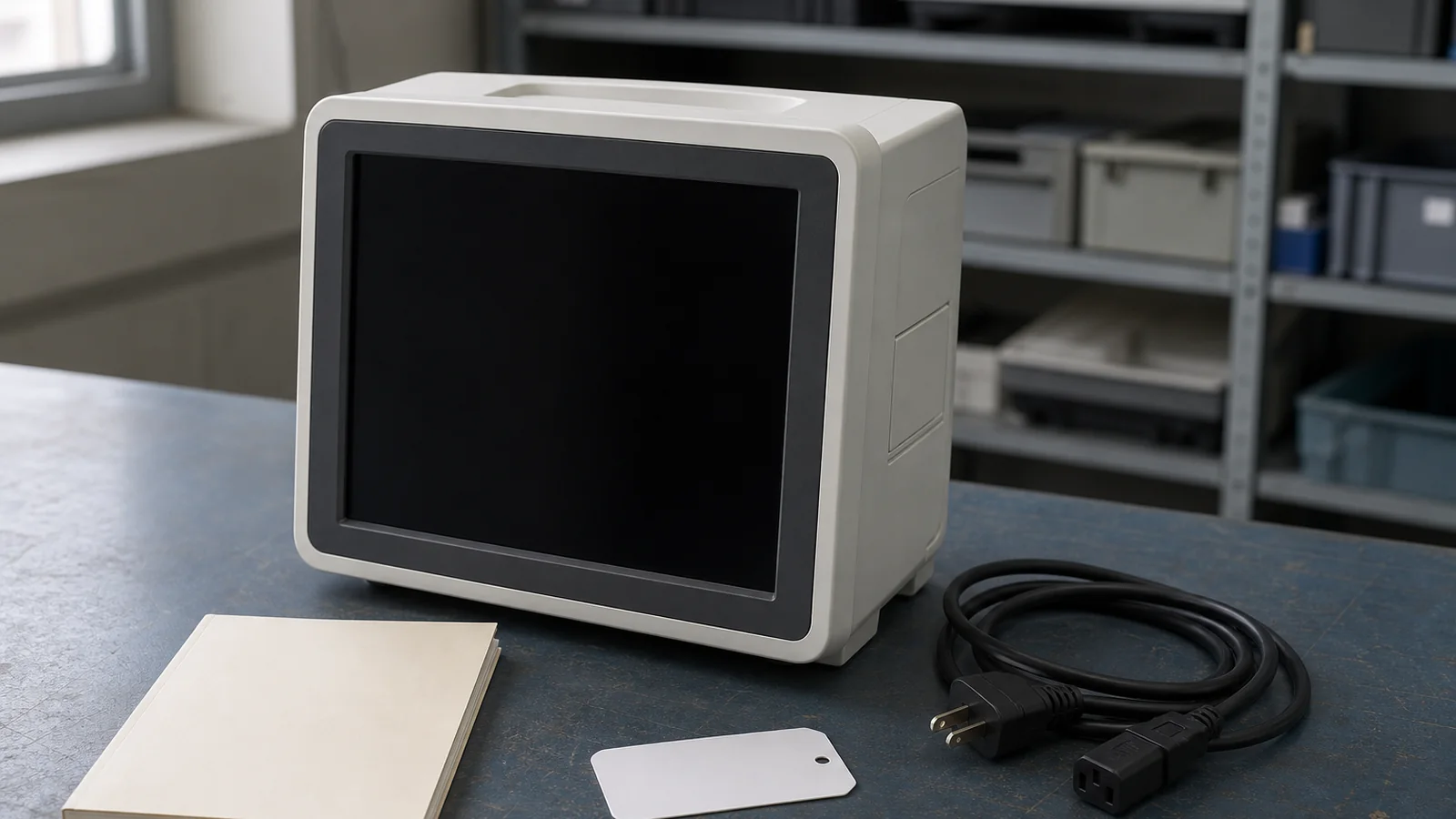
First-use acceptance is a clinical-use gate, not a dock receipt
When a shipment of medical equipment arrives at a healthcare facility, the receiving department verifies that the external cartons match the bill of lading, logs the purchase order number, and moves the boxes to clinical engineering. For logistics and procurement, delivery is complete. For healthcare technology management (HTM) and clinical engineering departments, however, the formal regulatory and safety evaluation has not yet begun. First clinical use is an acceptance gate—a documented technical barrier that prevents unverified, damaged, misconfigured, or counterfeit devices from making contact with a patient.
A common operational failure in expanding health systems is confusing physical possession with clinical release. OEM factory calibration certificates, European CE marks, and FDA 510(k) premarket clearances demonstrate that a manufacturer design met regulatory standards at production. They do not prove that a specific physical unit survived warehouse handling, pallet transit vibration, electromagnetic exposure, or shipping drop shocks intact. Nor do factory documents verify that the device software revision matches facility clinical networks, that local voltage parameters are set correctly, or that incoming accessories match the intended clinical configuration.
Under the Centers for Medicare & Medicaid Services (CMS) Conditions of Participation (CoP) set forth in 42 CFR 482.41(d)(2), hospital facilities, supplies, and equipment must be maintained to ensure an acceptable level of safety and quality. CMS interpretive guidance in State Operations Manual (SOM) Appendix A, Tag A-0724 (Rev. 238, issued 20 March 2026) interprets that CoP. Live A-0724 text says all equipment should be inspected and tested for performance and safety before initial use and after major repairs or upgrades, while ongoing inspect, test, and maintain duties remain must. Survey procedures still ask whether there is a complete inventory of equipment required to meet patient needs, regardless of ownership.
The same first-use inspection and testing expectation applies across intake channels that put a device into patient care:
Newly purchased capital equipment: Direct acquisitions that still need identity capture, inventory membership, and named first-use checks before clinical release.
Leased and evaluation systems: Third-party systems placed on trial or long-term lease, which carry identical clinical risk to owned assets.
Loaner and consignment devices: Temporary surgical or diagnostic units supplied during OEM repairs or volume surges.
Inter-facility transferred units: Existing assets moved between regional hospitals or ambulatory surgical centers within the same health system.
graph TD
    A["Equipment Arrival at Facility"] --> B["Gate 1: Asset Identity Verification"]
    B --> B1{"Identity Verified?"}
    B1 -->|"No: Identity mismatch or unresolved exception"| B2["Quarantine and supplier resolution"]
    B1 -->|"Yes"| C["Gate 2: Inventory and risk class"]
    C --> C1{"Inventory Decision"}
    C1 -->|"Deemed Hospital"| C2["Written inventory of all medical equipment"]
    C1 -->|"Non-Deemed Hospital"| C3["Risk evaluation and inclusion decision"]
    C2 --> D["Gate 3: Safety and performance testing"]
    C3 --> D
    D --> D1{"Named electrical method and IFU functional tests"}
    D1 -->|"Fail any named criterion"| D2["Quarantine and defect reporting"]
    D1 -->|"Pass named criteria"| E["Manufacturer-recommended maintenance until history exists"]
    E --> F["CMMS asset-master record"]
F --> G["Asset tagging and clinical release"]Identify the unit before it can be accepted
The initial phase of incoming inspection is the rigorous capture of physical and regulatory identity data. Before test leads touch a power supply or functional scripts are initiated, clinical engineering must establish an unambiguous, traceable identity record in the Computerized Maintenance Management System (CMMS).
CMS SOM Appendix A Tag A-0724 describes a well-designed equipment inventory as including the fields below. Hospitals may demonstrate equally effective alternatives. Capture these identity elements at intake unless the hospital's documented alternative clearly covers the same management need:
Manufacturer Legal Name: The equipment manufacturer as labeled on the unit.
Model Name and Commercial Number: The specific hardware designation and catalog configuration.
Serial Number: The unique factory-assigned physical hardware identifier.
Facility Unique Asset ID: The hospital unique identification number CMS lists for a well-designed inventory, usually applied as a durable asset tag.
Equipment Description and Modality: Standardized clinical nomenclature describing the device function.
Physical Location and Owning Department: Initial primary deployment site, cost center, and responsible clinical unit.
Designated Service Provider: Identification of in-house HTM, OEM contract, or qualified ISO support.
Official Acceptance Date: The exact calendar date on which all intake gates are completed and passed.
Two inventory limits matter at incoming inspection. First, CMS presents the unique-identification field list as a well-designed inventory, not as the only lawful format. Second, low-cost, low-risk facility equipment such as housekeeping vacuums may be grouped on the inventory rather than uniquely serialized; that grouping does not extend to patient-care medical equipment required to meet patient needs. Leased as well as owned equipment required to meet patient needs belongs on the inventory, which is why a loaned-in-as-new or transferred unit still needs first-use acceptance even though loaner custody and return-condition controls are a different workflow.
Unique Device Identification (UDI) integration
Under FDA regulations codified in 21 CFR 801.40, device labelers generally must present a Unique Device Identifier on labels and packages. Exceptions and alternatives exist under 21 CFR 801.30, 801.40(d), 801.45(d), and 801.55. A UDI generally consists of a device identifier and, when those production data appear on the label, a production identifier:
Device Identifier (DI): A mandatory, fixed numeric or alphanumeric code that identifies the labeler and the specific model or version of the device. This identifier is publicly searchable in the FDA AccessGUDID database.
Production Identifier (PI): A conditional segment that identifies dynamic manufacturing data whenever present on the device label, including the serial number, lot or batch number, date of manufacture, expiration date, and distinct identification code for human cell and tissue products.
Per 21 CFR 801.40, the UDI must be presented in two formats: easily readable plain text (human-readable interpretation) and Automatic Identification and Data Capture (AIDC) technology, such as linear 1D barcodes or 2D Data Matrix symbols. During incoming inspection, technicians should scan the AIDC carrier directly into the CMMS intake module to eliminate manual transcription errors.
| Identity Attribute | Primary Source | Regulatory Basis | HTM Verification Requirement |
|---|---|---|---|
| Device Identifier (DI) | FDA UDI Label / AIDC Barcode | 21 CFR 801.40 | Scan into CMMS; validate against AccessGUDID model registry. |
| Production Identifier (PI) | Label / Serial Nameplate | 21 CFR 801.40 / SOM A-0724 | Capture production identifiers that appear on the label, including serial number when present. AccessGUDID will not store the PI. |
| Facility Asset Number | Hospital HTM Barcode Tag | CMS SOM Appendix A A-0724 | Apply the hospital unique identification number as a durable asset tag. |
| Acceptance Date | Intake Inspection Record | CMS S&C Letter 14-07 | Record the acceptance date only after identity, inventory, and named first-use checks are complete. |
Decide inventory membership and risk class before first use
Once asset identity is validated, the second gate is whether the item enters the medical-equipment inventory and how it is risk-classed.
Under The Joint Commission 2025 Environment of Care (EC) survey tool, inventory structure depends on the deemed versus non-deemed pathway. Some hospital manuals now label the chapter Physical Environment (PE); the 2025 public survey tool still uses EC.02.04 numbering:
Deemed Status Hospitals (EC.02.04.01 EP 2 Deemed): For deemed hospitals, the 2025 survey tool requires a written inventory of all medical equipment. CMS survey procedures separately ask whether there is a complete inventory of equipment required to meet patient needs, regardless of ownership.
Non-Deemed Hospitals (EC.02.04.01 EP 2 Non-Deemed): Facilities operating outside Medicare deemed status may maintain a risk-selected inventory. However, these facilities are explicitly required to evaluate new types of equipment before initial use to determine whether they must be included on the inventory, and must include all life-support equipment.
High-risk and life-support classification
Under Joint Commission EC.02.04.01 EP 3, high-risk medical equipment must be identified on the inventory. EC.02.04.03 notes that high-risk includes life-support. Classify from the facility inventory policy and the survey definitions, not from an invented universal device list.
Per EC.02.04.01 EP 4, the inventory record must specify the exact maintenance, inspection, and testing activities to be performed, along with their associated recurrence frequencies. For high-risk equipment, Joint Commission compliance requires a strict 100% completion rate for scheduled preventive maintenance cycles.
Consensus guidance in ANSI/AAMI EQ56:2024 publicly describes inventory management as including evaluation, inspection, and record-keeping. EQ56 is a voluntary consensus program standard. It is not a CMS Condition of Participation and it is not a Joint Commission regulation.
Safety and performance checks: name the IFU and the facility standard
Gate 3 represents the core technical verification of the incoming device. Technical personnel must never rely on subjective visual intuition or general familiarity. Every measured parameter, safety test, and operational trial must be executed against two authoritative source documents:
The Manufacturer Instructions for Use (IFU): The definitive source for operational, calibration, and functional performance procedures.
The Facility In-Service Electrical Safety Standard: The formally adopted facility testing protocol governing electrical leakage and grounding integrity.
Electrical safety verification: NFPA 99 vs IEC 62353
The legal foundation for healthcare facility electrical safety in the United States is established by 42 CFR 482.41, which explicitly incorporates NFPA 99, 2012 edition (Health Care Facilities Code). In its official Standards Interpretation FAQ titled Medical Equipment - Initial Check (first published 11 April 2016, last updated 30 December 2025), The Joint Commission states that prior to initial use, and after major repair or upgrade, an electrical safety test is performed in accordance with NFPA 99-2012 Section 10.3 Testing Requirements.
In international environments and certain specialized biomedical shops, IEC 62353:2014 (Medical electrical equipment — Recurrent test and test after repair) is utilized as a named in-service testing standard. The public scope of IEC 62353 explicitly includes testing 'before putting into service' as well as post-repair and recurrent maintenance. However, clinical engineers must recognize that IEC 62353 is an in-service consensus standard, not incorporated federal statute. For a comprehensive technical analysis of post-repair standard selection and measurement methodologies, refer to our detailed analysis of electrical safety testing after repair.
Operational and functional verification to manufacturer IFU
The Joint Commission Initial Check FAQ states that an operational or functional test is performed to manufacturer specifications using the procedures in the manufacturer IFU. Those procedures are device-specific. The following are evidence classes, not a universal incoming script:
Self-Test and Initialization Diagnostics: Completing the power-on, self-test, and initialization checks the IFU names.
Alarm System Validation: Testing visual, audible, and remote alarm annunciation across physiological threshold and technical failure states.
Output Energy and Flow Delivery: Measuring only those output or delivery parameters the IFU requires, with the test equipment that procedure names and with current calibration evidence when that procedure requires it.
Battery Runtime and Power Failover: Confirming automatic switchover to internal battery backup upon mains power interruption and validating battery charge capacity.
Physical Integrity and Accessory Compatibility: Inspecting power cords, strain reliefs, chassis enclosures, fluid ingress seals, and patient application leads.
These classes identify the kind of evidence the IFU may require. They are not a universal incoming script, and they are not a license to invent numeric limits or analyzer operating steps. If the IFU does not call for a given measurement on that model, do not add it from memory.
New equipment stays on manufacturer recommendations until history exists
Incoming inspection is the wrong moment to adopt an Alternate Equipment Management (AEM) strategy. AEM is CMS interpretive guidance under S&C 14-07 and SOM Tag A-0724, not a term that appears in 42 CFR 482.41(d)(2) itself. Current CMS guidance is direct: new equipment should not be placed immediately into an AEM program.
S&C 14-07 used must for the new-equipment bar. Live SOM Tag A-0724 says new equipment for which sufficient maintenance history is not available should not be immediately included in an AEM program, and should be maintained in accordance with manufacturer recommendations until that history exists. History may come from the hospital, its contractor, or nationally recognized public sources. Record manufacturer-recommended inspect, test, and maintain activities and frequencies on the new asset; do not convert this incoming decision into a full AEM-eligibility analysis.
CMS also lists categorical AEM exclusions that should be recognized at intake, before anyone later argues for an alternate regimen:
Diagnostic Imaging and Radiologic Equipment: CMS interpretive guidance states that imaging/radiologic equipment, whether diagnostic or therapeutic, is governed by 42 CFR 482.26(b)(2) and must be maintained per manufacturer recommendations. The regulation text itself requires periodic inspection and prompt hazard correction; it does not contain a verbatim manufacturer-schedule sentence.
Medical Lasers: S&C 14-07 and SOM Tag A-0724 treat medical laser devices as ineligible for AEM. FDA requires manufacturers to provide a maintenance schedule and service instructions to purchasers.
Equipment with Insufficient Service History: Any asset lacking documented organizational service data supporting alternate maintenance intervals.
To understand how clinical engineering departments compile evidence to support future AEM transitions after sufficient operating history is acquired, review our comprehensive framework on AEM vs manufacturer maintenance.
Acceptance evidence, quarantine, and what the record must show
Incoming inspection is complete only when the dual layers of clinical engineering documentation are generated and committed to the institutional asset database. The HTM record architecture separates this evidence into two distinct structures: the Master Asset Record and the Initial Acceptance Work Order.
| Data Layer | Core Documentation Fields | Operational & Audit Function |
|---|---|---|
| Master Asset Record (CMMS Asset Master) | Unique Asset ID, Manufacturer, Model, Serial Number, UDI (DI/PI), Equipment Category, Risk Class, Life-Support Flag, Owning Department, Location, Official Acceptance Date, Service Provider. | Establishes the permanent regulatory identity, depreciation tracking, and scheduled maintenance baseline for the life of the asset. |
| Initial Acceptance Work Order (First-Use Service Event) | Date completed, who performed the check, named IFU results, the named electrical-safety method and any readings it requires, pass/fail disposition, and test-equipment identity when measurements were taken. | Records that named first-use safety and performance checks occurred before clinical release. It is not a substitute for the later service-event work-order standard. |
For the later service-event work-order contents that apply after first use, see medical equipment service record requirements. When third-party service organizations or independent service organizations (ISOs) perform incoming acceptance checks, the hospital must also ensure that service personnel are qualified and verified according to our service provider qualification checklist.
Quarantine protocol: handling non-compliant arrivals
If a device fails any component of incoming inspection—whether due to transit damage, missing safety labels, firmware bugs, unverified electrical leakage, or missing accessories—clinical engineering must execute an immediate quarantine protocol:
Physical Segregation: The unit must be immediately removed from the clinical intake pathway and placed in a secure, designated bioengineering quarantine zone.
Defective Status Tagging: Apply a conspicuous out-of-service tag so the unit cannot be mistaken for a released device.
CMMS Status Lock: The asset record must be placed in a non-deployable 'Quarantined / Rejected' status that prevents work order closure or clinical delivery.
Vendor & Supply Chain Escalation: Formal non-conformance documentation is issued to the vendor, manufacturer, and hospital procurement department for Return Merchandise Authorization (RMA) or warranty correction.
Do not release a device for even temporary clinical use on a conditional pass or with unverified safety readings. If first-use checks fail, or identity cannot be established, quarantine the unit and keep it out of service until the named IFU and facility-standard criteria are met. SOM Tag A-0724 also expects a process for removing equipment determined unsafe or no longer suitable for its intended application.
Limits: what this gate does not decide
To maintain operational precision, clinical engineering leaders must recognize what the first-use acceptance gate does not encompass:
Does not define custom electrical test limits: Numeric pass/fail thresholds are governed strictly by the manufacturer IFU and formally adopted standards (NFPA 99-2012 Section 10.3 or IEC 62353). The acceptance gate executes the tests; it does not author the limits.
Does not establish long-term AEM eligibility: The incoming gate establishes the baseline manufacturer maintenance schedule. Future AEM transitions require empirical failure data gathered over operational lifecycle periods.
Does not manage loaner return logistics: While incoming inspection verifies safety for loaned and consigned devices prior to patient contact, post-procedure decontamination, custody chain tracking, and vendor return logistics represent separate operational workflows.
Does not substitute for manufacturer quality system compliance: Hospital incoming inspection verifies physical integrity and in-service performance. It does not replace the premarket design verification, 510(k) clearance, or ISO 13485 quality manufacturing obligations of the device labeler.