
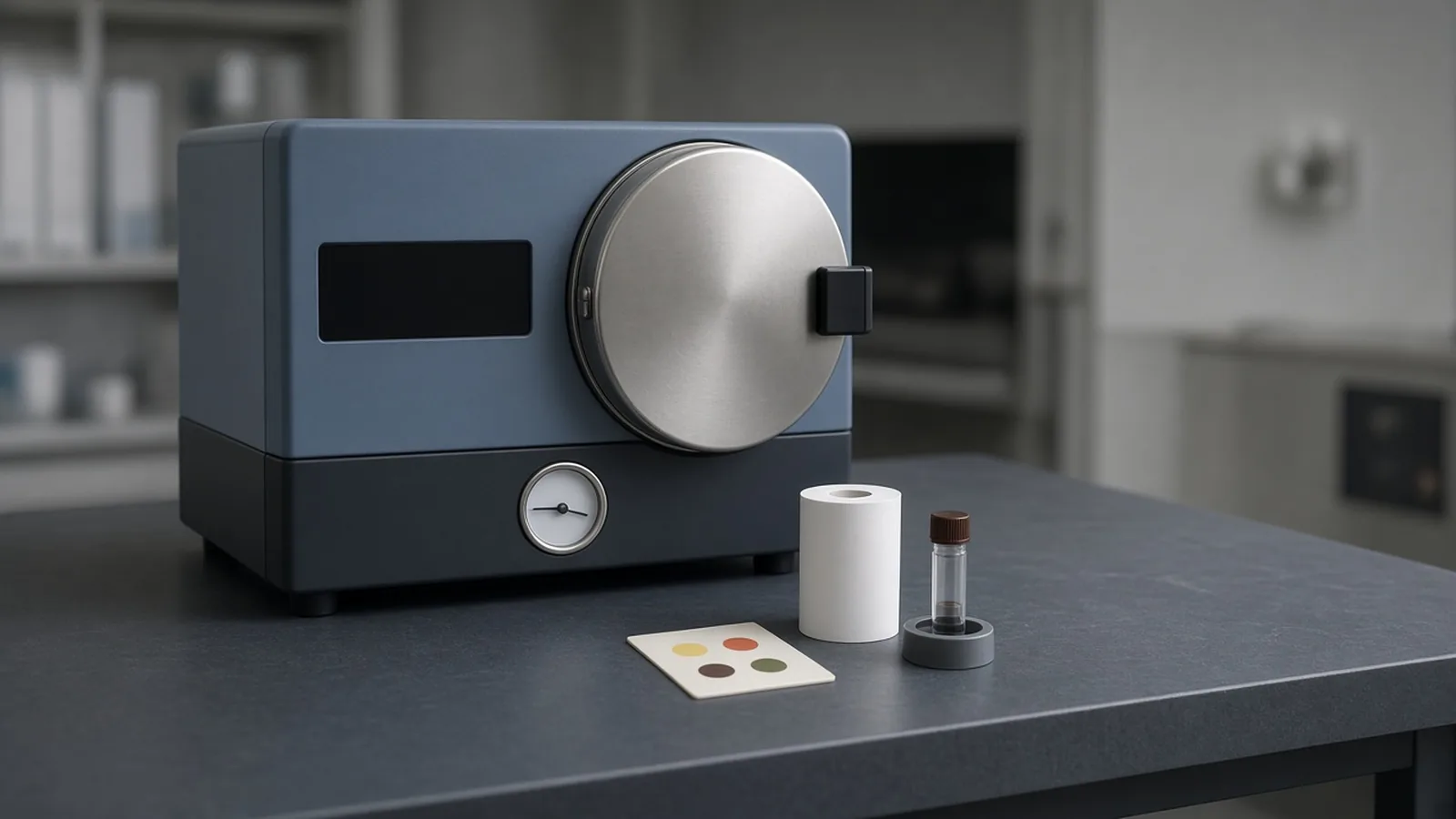
Three monitors and a maintenance record, not one spore test
When a hospital steam sterilizer undergoes scheduled servicing, relocation, or corrective repair, clinical engineering and sterile processing leaders face an immediate operational decision: What objective evidence must be recorded before releasing the autoclave back to clinical processing?
A common operational vulnerability is treating return to service as a single-department task. A biomedical technician may complete the work order, run the hospital's written electrical-safety method, and close the record in the computerized maintenance management system (CMMS). Concurrently, sterile processing personnel may run a routine spore test, log a passing biological result, and resume packaging. Neither action in isolation closes the other evidence layer.
Under the federal Conditions of Participation (CoP) for hospitals, infection prevention programs governed by 42 CFR 482.42 must demonstrate active adherence to nationally recognized infection prevention and control guidelines, notably the Centers for Disease Control and Prevention (CDC) Guideline for Disinfection and Sterilization in Healthcare Facilities and ANSI/AAMI ST79. In parallel, physical environment mandates under 42 CFR 482.41(d)(2) and accreditation standards enforced by The Joint Commission require complete, verifiable maintenance and performance testing records for all medical equipment.
Federal surveyors and accreditation reviewers assess steam sterilizers across two interdependent evidentiary dimensions: the continuous infection control monitoring record (comprising physical, chemical, and biological verification) and the physical equipment maintenance file (comprising preventive maintenance, corrective work orders, and after-major-repair requalification). Sourcing these criteria requires strict alignment with manufacturer documentation and federal guidelines rather than reliance on informal shop heuristics.
Identify the device: 21 CFR 880.6880 steam sterilizer, not an AER
Auditable quality systems begin with precise medical device identification. Under 21 CFR 880.6880, the Food and Drug Administration (FDA) identifies a steam sterilizer (autoclave) as a device intended for use by a health care provider to sterilize medical products by means of pressurized steam. FDA product code FLE, on the classification page last updated 7 September 2026, is Class II, requires 510(k), is not GMP-exempt, and is not a life-sustain/support device. That classification fact does not automatically make every sterilizer Joint Commission high-risk life-support inventory; use the hospital's written inventory risk class while still applying documented performance testing and maintenance to all sterilizers.
Process verification tools are similarly regulated as Class II medical devices rather than generic laboratory consumables. Clinical engineers and sterile processing teams must recognize their independent regulatory status:
Biological Process Indicators: Classified under 21 CFR 880.2800(a) (product code FRC), a biological sterilization process indicator consists of a known number of microorganisms of known resistance on a carrier. For steam, CDC names Geobacillus stearothermophilus as the organism used to monitor lethality. Growth or failure to grow indicates the adequacy of sterilization. FDA's 4 October 2007 BI 510(k) guidance, which is nonbinding, restates that healthcare-facility BIs (FRC) are Class II devices requiring 510(k). Incubation, readout, and resistance details belong in the cleared indicator IFU; this article does not invent spore-count or D-value limits.
Physical and Chemical Process Indicators: Classified under 21 CFR 880.2800(b) (product code JOJ), chemical indicators monitor one or more physical parameters of the sterilization process through a characteristic visible chemical or physical change, verifying exposure to steam at specified temperatures and durations.
Equipment construction and design specifications are partitioned by chamber volume under recognized consensus standards:
Large Hospital Steam Sterilizers: Chamber volumes exceeding 56.63 liters (2 cubic feet) fall under ANSI/AAMI ST8:2013/(R)2018, fully recognized by FDA as Rec# 14-406. While AAMI published the seventh edition, ANSI/AAMI ST8:2026, introducing revised manufacturer testing for moisture tension, exclusion of drying time from biological performance tests, and updated terminology for immediate-use steam sterilization (IUSS), the FDA consensus standards database for product code FLE continues to recognize ST8:2013/(R)2018. ST8 establishes manufacturer manufacturing and labeling benchmarks, not hospital routine operational workflows.
Small Tabletop Steam Sterilizers: Chamber volumes of 56.63 liters (2 cubic feet) or less fall under AAMI/ANSI ST55:2016/(R)2023, recognized by FDA as Rec# 14-518. Although common in ambulatory clinics, outpatient surgery centers, and dental suites, tabletop autoclaves are still monitored by mechanical, chemical, and biological indicators. Chamber-volume identity (ST8 versus ST55) does not drop those layers.
Moist Heat Process Validation: ISO 17665:2024, recognized by FDA as Rec# 14-601 on 29 May 2024, governs development, validation, and routine control of moist heat sterilization processes. FDA will accept premarket declarations of conformity to ISO 17665-1:2006 (Rec# 14-333) and ISO/TS 17665-2:2009 (Rec# 14-277) until 4 July 2027. That transition is a premarket-declaration fact, not an SPD form. ISO 17665 is not an in-service hospital survey checklist.
Physical, chemical, and biological evidence at the CDC/CMS floor
The core of daily sterility assurance is the three-layer monitoring model established in the CDC Guideline for Disinfection and Sterilization in Healthcare Facilities. This operational model is reinforced by surveyors assessing hospital compliance with 42 CFR 482.42 via the CMS Hospital Infection Control Worksheet (issued under S&C 15-12, Attachment 1). The worksheet is surveyor guidance used to assess 42 CFR 482.42; it is not itself a regulation. Items 3.B.9 through 3.B.13 are the last fully public CMS hospital sterilizer-monitoring objects.
Layer 1: Physical / Mechanical Monitoring (CMS Item 3.B.13)
Physical monitoring evaluates the thermodynamic conditions inside the chamber. Every sterilization cycle must be recorded using real-time instrumentation, such as an integrated digital printer, electronic chart recorder, or mechanical strip graph. The operator and clinical engineer must verify three essential physical parameters for each cycle:
Chamber Temperature: Verification that the exposure temperature named in the sterilizer IFU and the programmed recipe was achieved and maintained throughout the timed exposure phase. CDC's 2008 steam page states common steam-sterilizing temperatures and Table 7 minimum exposure examples; those figures are not sterilizer-IFU substitutes and are not in-service numeric limits for this article.
Exposure Time: Confirmation that the dwell time at or above the validated sterilizing temperature complied exactly with the programmed recipe.
Operating Pressure: Verification via chamber pressure transducers and mechanical gauges that pressure corresponded accurately to saturated steam conditions at the recorded temperature.
Per CMS Worksheet item 3.B.13, sterilizer logs must remain current and record the operational data of each run. An automated printout indicating cycle completion is not merely an informational receipt; it represents a primary release record. If a temperature dip, pressure variation, or cycle abort occurs, the load cannot be released, regardless of external package appearance.
Layer 2: Chemical Process Indicators (CMS Item 3.B.9)
Chemical indicators (CIs) monitor one or more physical parameters through a visible change. CMS Worksheet item 3.B.9 asks whether a chemical indicator (process indicator) is placed correctly in the instrument packs in every load. CDC typically affixes chemical indicators to the outside of packs and preferably also places a chemical indicator inside each pack to verify sterilant penetration:
External Indicators: Affixed to the exterior of every pouch, wrapped tray, or rigid container (such as indicator autoclave tape or external indicator labels). External CIs serve primarily as process discriminators to differentiate units that have undergone steam processing from unsterilized inventory.
Internal Indicators: Preferably placed inside each pack to verify sterilant penetration, as CDC currently posts. Indicator IFUs name interpretation. This article does not invent Type 4 versus Type 5 pass criteria.
Clinical and technical staff must uphold a strict distinction: Chemical indicators do not prove sterility. They confirm exposure to one or more process parameters. If the internal and/or external indicator suggests inadequate processing, CDC states that the item should not be used.
Layer 3: Biological Lethality Monitoring (CMS Item 3.B.10)
Biological indicators (BIs) represent the only monitoring modality that directly measures microbial lethality. Because Geobacillus stearothermophilus bacterial endospores are the steam organism CDC names, a negative BI is the process indicator that directly monitors lethality. It is not a sterility certificate for every item in the load.
CDC guidelines and CMS Worksheet item 3.B.10 establish the baseline inspection floor: A biological indicator must be used at least weekly for each sterilizer and with every load containing implantable items. CDC states that each load containing implantable objects should be monitored and that, if feasible, implantable items should not be used until spore-test results are known to be negative. That is CDC's public implant-hold language, not a CMS numeric shortcut.
CDC notes that when an autoclave is subjected to heavy utilization (multiple cycles processed daily), daily biological indicator testing provides enhanced risk mitigation. Daily testing enables earlier detection of mechanical drift or procedural failures, thereby drastically limiting the volume of clinical packs subject to mandatory recall. However, this risk-reduction practice remains an institutional quality decision rather than an excuse to alter weekly baseline compliance.
CDC states that a control biological indicator from the lot used for testing should be left unexposed to the sterilant and then incubated to verify presterilization viability of the test spores and proper incubation. The most conservative approach is a control for each run; CDC notes that less frequent use may be adequate (for example weekly). Indicator IFUs name incubation temperature and readout interval.
Dynamic Air Removal: The Bowie-Dick Gate (CMS Item 3.B.11)
Prevacuum and dynamic-air-removal steam sterilizers depend upon active mechanical evacuation of ambient air to enable rapid, deep penetration of saturated steam into porous goods and narrow lumens. Residual air pockets form thermal insulating barriers that prevent steam contact and defeat sterilization.
Under CDC guidelines and CMS Worksheet item 3.B.11, a Bowie-Dick air-removal test must be performed daily in an empty chamber before processing the first clinical load. CDC describes the historical folded-towel pack as placed horizontally in the front, bottom section of the sterilizer rack, near the door and over the drain, in an otherwise empty chamber, and notes that smaller disposable test packs (process challenge devices) have been devised as equivalent challenges. The sterilizer IFU and the Bowie-Dick indicator IFU name the cycle and interpretation. CDC's historical Bowie-Dick cycle example is not used here as a universal in-service limit.
CDC states that vacuum performance is acceptable if the sheet inside the test pack shows a uniform color change, and that entrapped air causes a spot because steam cannot reach the chemical indicator. If the sterilizer fails the Bowie-Dick test, the sterilizer is not used until it is inspected by sterilizer maintenance personnel and passes the Bowie-Dick test.
CMS worksheet item 3.B.12 asks whether sterile packs are labeled with the sterilizer used, the cycle or load number, and the date of sterilization, and if applicable the expiration date. Item 3.B.13 requires that logs for each sterilizer cycle are current and include results from each load. Item 3.B.14 asks whether routine maintenance for sterilization equipment is performed regularly and whether maintenance records are available. Those worksheet items are surveyor observations for 42 CFR 482.42, not a license to invent BI intervals beyond the public at-least-weekly and every-implant-load floor.
CDC also distinguishes empty-chamber qualification from product testing. When major changes are made in packaging, wraps, or load configuration, biological and chemical indicators are placed in products processed in a full load. That full-load product test is a different activity from the three consecutive empty cycles used after installation, relocation, redesign, major repair, or sterilization failure. Items from those evaluation cycles are quarantined until results are negative. If immediate-use steam sterilization is used, the CMS worksheet requires mechanical, chemical, and biologic monitors approved for the cycle being used; this article does not expand into an IUSS-policy recap.
What Joint Commission still expects to be documented
Accreditation surveys evaluate sterilizer operations under equipment inspection, testing, and maintenance and under infection control. In the 2025 Hospital Life Safety and Environment of Care Document List and Review Tool, EC.02.04.03 EP 4 states: “Conducts performance testing of and maintains all sterilizers.” The same tool states that required inspection, testing, and maintenance activities and associated frequencies must have a 100% completion rate.
The public Joint Commission Tracers with AMP sterilization tracer is an ambulatory form. Use it for the public EP 4 sentence and surveyor questions, not as hospital-only law. It states that the organization conducts performance testing of and maintains all sterilizers and that these activities are documented (see also IC.02.02.01, EP 2). It prompts review of 12-month preventive-maintenance records for sterilizers against manufacturer recommendations and the equipment-management plan or schedule.
The tracer explicitly instructs surveyors to examine corrective service records. Surveyors must determine: When maintenance records indicate repairs were necessary, does documentation indicate a biological-indicator test was performed and documented at the time the sterilizer was placed back into service?
After major repair: CMS inspect-and-test plus CDC three consecutive empty cycles
Neither S&C 14-07 nor QSO-25-24 defines major repair by a parts list, dollar figure, or gasket event. Under CMS hospital physical environment rules (42 CFR 482.41(d)(2)), healthcare equipment must be maintained to ensure an acceptable level of safety and quality.
The regulatory expectation for post-repair verification is rooted in CMS equipment-maintenance policy. CMS Survey & Certification Letter S&C 14-07 (20 December 2013) stated that “All equipment must be inspected and tested for performance and safety before initial use and after major repairs or upgrades.” Current QSO-25-24 A-0724 (5 September 2025) restates that sentence as “All equipment should be inspected and tested for performance and safety before initial use and after major repairs or upgrades,” while retaining “All equipment must be inspected, tested, and maintained to ensure its safety, availability, and reliability.” Quote both memos. Do not silently restore the 2013 must onto the 2025 after-repair sentence. A steam sterilizer used to process patient-care items is medical equipment under S&C 14-07's definition, not a facility boiler. Alternate Equipment Management eligibility is a different published article and is not retold here.
The Three-Consecutive-Empty-Cycle Requalification Standard
A routine weekly spore test is not a substitute for CDC qualification after installation, relocation, redesign, major repair, or sterilization failure. CDC's currently posted sterilizing-practices page is the public empty-chamber protocol:
All steam sterilizers are tested with biological and chemical indicators upon installation, when the sterilizer is relocated, redesigned, after major repair, and after a sterilization failure has occurred, before they are placed into routine use. Three consecutive empty steam cycles are run with a biological and chemical indicator in an appropriate test package or tray. Each type of steam cycle used for sterilization (for example, vacuum-assisted, gravity) is tested separately. In a prevacuum steam sterilizer, three consecutive empty cycles are also run with a Bowie-Dick test. The sterilizer is not put back into use until all biological indicators are negative and chemical indicators show a correct end-point response.
Whether a given work order is a CDC major-repair trigger is a hospital documentation decision. When that trigger applies, the public empty-chamber sequence is:
Mechanical Requalification: Execute three consecutive empty cycles for every cycle recipe utilized clinically (e.g., three separate gravity cycles, three dynamic-air-removal cycles). Physical printouts must verify proper time, temperature, and pressure stabilization across all three runs.
Chemical Requalification: Each of the three test cycles must include chemical process indicators placed within a recognized process challenge device (PCD). All chemical indicators must demonstrate complete, uniform endpoint transition.
Biological Requalification: Each of the three test cycles must contain a biological indicator (Geobacillus stearothermophilus) in an appropriate test package or tray. The sterilizer is not put back into use until all biological indicators are negative and chemical indicators show a correct end-point response, with a control BI handled per CDC and the indicator IFU.
Prevacuum Vacuum Integrity: For dynamic-air-removal sterilizers, run three consecutive empty Bowie-Dick test cycles. All three test sheets must exhibit completely uniform color transition without spots or air entrapment.
Sterilization Failure Response and CDC Table 12
When a biological indicator is positive, follow documented facility policy. CDC Table 12 remains the named suggested protocol for a positive biological indicator in a steam sterilizer. The current CDC HTML page is truncated after a February 2017 format change and currently displays the last step: if the problem is not resolved, close the sterilizer down until the manufacturer can assure that it is operating properly, then retest with biological indicators in three consecutive sterilizer cycles. Do not reconstruct omitted Table 12 steps from memory.
CDC also states a more conservative approach in which any positive spore test is assumed to represent sterilizer malfunction and requires recall of materials from the last negative biologic indicator. Facility policy, not invented recall-rate benchmarks, chooses how conservative the recall is.
Parallel HTM Electrical Safety Testing
When the work is a CMS major repair or upgrade, or otherwise triggers the hospital's written after-repair electrical-safety procedure, electrical testing is a parallel HTM gate. As detailed in electrical safety testing after repair, method selection among IEC 62353, NFPA 99, and IEC 60601-1 type tests is a prior hospital program choice. IEC 62353 is a public after-repair electrical-safety standard, not the only lawful method and not a substitute for steam-process monitors.
ST79's public maintenance and record objects, without paywalled numbers
ANSI/AAMI ST79:2017 & 2020 Amendments A1–A4 (consolidated text) is the current FDA-recognized U.S. recommended practice for steam sterilization and sterility assurance in health care facilities. FDA lists complete recognition as Rec# 14-562, FR Recognition List 056, date of entry 7 June 2021. Recognition supports premarket declarations of conformity; it is not a CMS in-service testing regulation.
The FDA-reprinted public scope of Rec# 14-562 includes:
Functional and physical design criteria for sterilization processing areas.
Staff qualifications, training, and ongoing competency considerations.
Processing procedures, wrapping, pack assembly, and loading configurations.
Installation, routine care, and preventive maintenance of steam sterilizers.
Sterility quality control, documentation, and continuous process improvement.
The same federal recognition sheet formally identifies the four 2020 amendments:
Amendment 1 (A1): Environmental services, fans, food, and drink in processing areas.
Amendment 2 (A2): Visual inspection of insulated electrosurgical instruments.
Amendment 3 (A3): Modification of content pertaining to the frequency of cleaning for routine care of sterilizers.
Amendment 4 (A4): Content addressing the recording of biological indicator lot numbers in sterilizer records.
AAMI's public page states that ST79 provides guidance regardless of sterilizer size or facility type, including hospitals, ambulatory surgery facilities, physician offices, cardiac catheterization laboratories, endoscopy suites, radiology departments, and dental offices, and that it remains a go-to document for The Joint Commission. That last sentence is AAMI's public characterization, not a Joint Commission adoption notice.
Sourcing Operating Limits Without Inventing Numbers
The operational rule for clinical engineering is: Never fabricate cycle parameters, vacuum leak rates, or cleaning chemical specifications. FDA recognition sheets and public standard abstracts do not publish proprietary cycle timing, vacuum leak tolerances, or temperature thresholds. Sourcing these technical parameters must follow a legitimate evidentiary path:
Sterilizer Manufacturer IFU: In its final guidance, Remanufacturing of Medical Devices (May 10, 2024), FDA encourages OEMs of reusable devices, as a best practice, to provide servicing instructions that facilitate routine maintenance and repair. Recommended labeling includes key performance and safety specifications; recommended maintenance activities and schedule; and recommended troubleshooting steps, routine testing, and acceptance criteria to confirm the device remains within OEM performance and safety specifications. Those recommendations are the public source of sterilizer PM tasks, leak-test methods, and cycle-print interpretation limits. Do not invent leak-rate, dryness-fraction, or cleaning-chemistry numbers.
Process Indicator IFU: Indicator IFUs name incubation, readout, and color-change interpretation. This article does not invent spore-count, D-value, or chemical color-change numeric limits.
Remanufacturing Boundary: FDA generally believes changes to the device's sterilization methods significantly change performance or safety specifications and are likely remanufacturing. That boundary is not a license to classify every gasket, printer, or door-seal repair as remanufacturing, and this article does not retell the published six-principle servicing-versus-remanufacturing decision tree.
This article does not retell AEM versus manufacturer maintenance eligibility, the IEC 62353 versus NFPA 99 versus IEC 60601-1 method-selection job, what a work order must contain, servicing versus remanufacturing classification, CMMS unique identification, or service-contract scope and SLA evidence. Do not apply CLIA 42 CFR 493.1255 laboratory-analyzer calibration verification to a steam sterilizer. Supplier qualification remains a separate published checklist.
An evidence matrix, not invented intervals
To ensure audit readiness across CMS Conditions of Participation, Joint Commission physical environment surveys, and infection control inspections, clinical engineering and sterile processing leaders must maintain a coordinated, four-layer evidence matrix:
| Evidence Layer | Primary Regulatory Source | Public performance gate | Audit Documentation Record |
|---|---|---|---|
| 1. Device & Baseline Identity | 21 CFR 880.6880; FDA Product Code FLE; ST8 / ST55 | Confirm device classification, chamber volume (> or <= 56.63 L), and OEM servicing manual availability. | CMMS asset master record with unique equipment identifier, serial number, and risk classification. |
| 2. Routine Process Verification | CDC 2008 Guideline; CMS Hospital Worksheet 3.B.9–3.B.13 | Physical printout or chart every cycle; CI placed correctly in packs every load (CMS 3.B.9); CDC preferably also inside; BI at least weekly and every implant load; daily empty Bowie-Dick for dynamic air removal. | Daily sterilizer load log with physical charts, CI verification, BI lot numbers (ST79 A4), and pack traceability labels. |
| 3. HTM Preventive Maintenance | 42 CFR 482.41(d)(2); Joint Commission EC.02.04.03 EP 4 | Written inspect-test-maintain activities and frequencies; CMS worksheet 3.B.14 routine maintenance records; ST79 A3 names frequency of cleaning for routine care as a public amendment title only; leak-test methods from the OEM IFU. | Documented PM work orders. Required ITM activities and frequencies must have a 100% completion rate on the 2025 Joint Commission tool; the public tracer reviews 12-month sterilizer PM against manufacturer recommendations and the equipment-management plan. |
| 4. Post-Major-Repair Requalification | CMS S&C 14-07 / QSO-25-24 Tag A-0724; CDC Requalification | Three consecutive empty BI/CI cycles per cycle type used; three consecutive Bowie-Dick tests if prevacuum; hospital written electrical-safety method as a parallel gate, not a substitute. | Completed corrective work order with attached requalification logs, negative BI incubation reports, and signed return-to-service sign-off. |
The workflow for returning a serviced sterilizer to active inventory follows a sequential gate model:
graph TD
    A["Service, install, relocate, or failure event"] --> B["HTM service against the OEM IFU"]
    B --> C["Hospital written electrical-safety method if after-repair EST is triggered"]
    C --> D{"CDC qualification trigger: install, relocate, redesign, major repair, or sterilization failure?"}
    D -- "No: routine service" --> E["SPD physical, chemical, biological floor"]
    D -- "Yes" --> F["CDC empty-chamber qualification"]
    F --> G["Three consecutive empty BI plus CI cycles per cycle type used"]
    F --> H["Three consecutive empty Bowie-Dick tests if prevacuum"]
    G --> I{"All BIs negative and CIs at labeled endpoint?"}
    H --> J{"Bowie-Dick uniform per indicator IFU?"}
    I -- "No" --> K["Keep out of use; follow facility policy and remaining public Table 12 step"]
    J -- "No" --> K
    I -- "Yes" --> L["Document control BI, lot numbers, printouts, work order"]
    J -- "Yes" --> L
    E --> M["Current cycle logs, pack identity, BI lot numbers"]
    L --> M
M --> N["First clinical load only after HTM and SPD layers close"]When surveyors ask for sterilizer performance evidence, the file that can be shown is an integrated record: device identity, current cycle logs, chemical-indicator and biological-indicator results including lot numbers, pack identity, documented PM completion, and—after a CDC qualification trigger—empty-chamber BI/CI (and Bowie-Dick if prevacuum) results plus the hospital's written electrical-safety method if that gate applied. A passing electrical-safety test or a single weekly spore test does not close the other layers. This article does not guarantee compliance.