
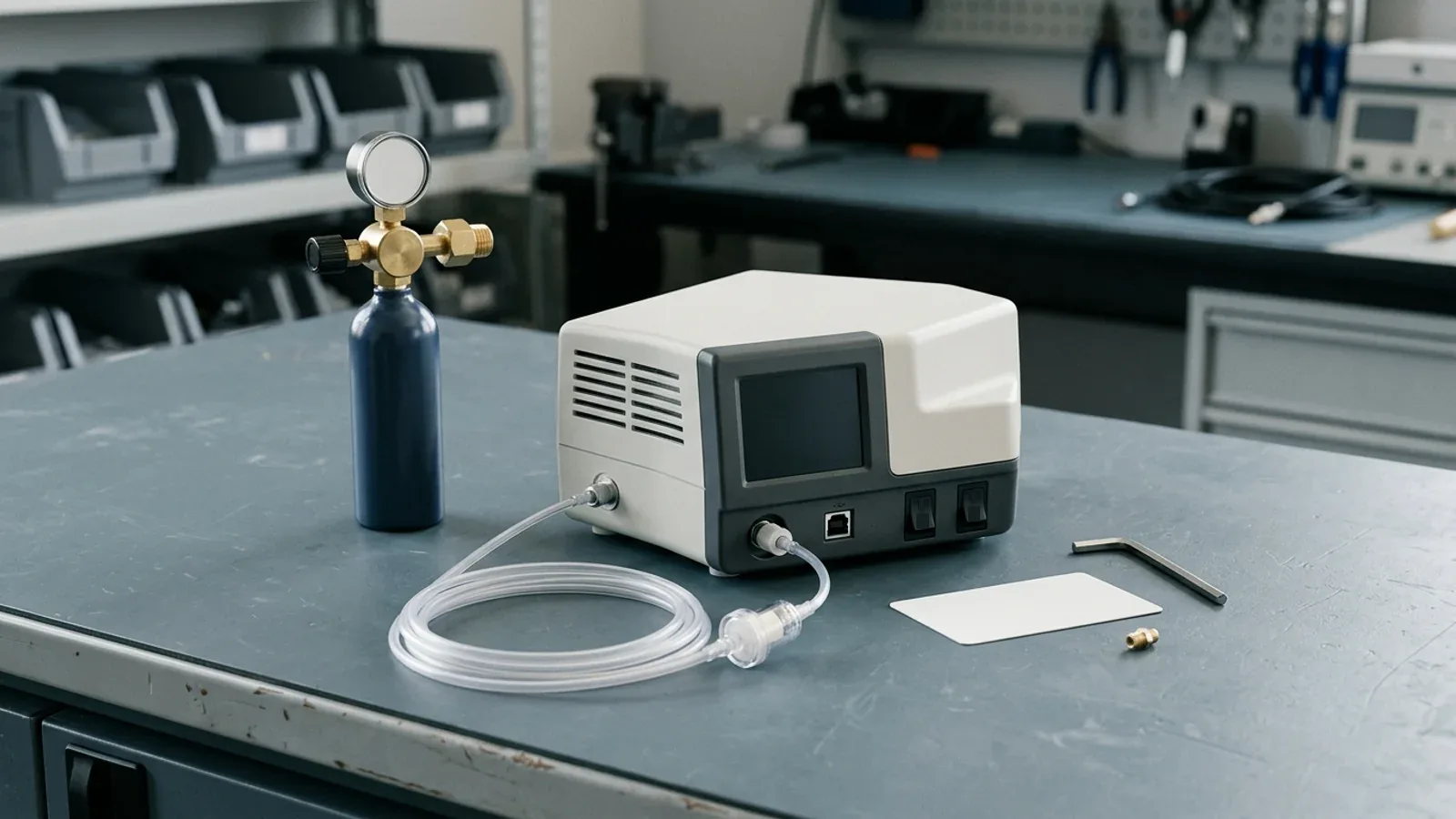
Where Capnography Verification Sits in Return-to-Service
Returning a capnography monitor or multi-parameter respiratory gas module to clinical operation after corrective repair or scheduled inspection demands rigorous physical and analytical verification. Whether servicing a standalone capnograph, an integrated telemetry monitor, an anesthesia workstation delivery module, or an exhaled gas module on a critical-care mechanical ventilator, clinical engineering professionals cannot treat end-tidal carbon dioxide (PetCO2) measurement as an uncalibrated secondary parameter. A simple power-on self-test or an unverified electrical check provides zero evidence that the optical bench or pneumatic sampling system is delivering clinically truthful measurements.
The clinical stakes governing respiratory gas accuracy have steadily intensified across surgical, critical care, and procedural environments. In the Standards for Basic Anesthetic Monitoring, last amended October 15, 2025, the American Society of Anesthesiologists says that during moderate or deep sedation the adequacy of ventilation shall be evaluated by continual observation of qualitative clinical signs and that every effort should be made to achieve continual monitoring for the presence of exhaled carbon dioxide. That is a clinical monitoring standard, not a maintenance interval. It is the reason an unchecked CO2 reading is a weak return-to-service decision wherever sedation and anesthesia care depend on exhaled carbon dioxide.
From a regulatory perspective, capnographs operate under particular design and safety standards. The international consensus benchmark, ISO 80601-2-55:2018 (including Amendment 1:2023), is the particular standard for the basic safety and essential performance of respiratory gas monitors intended for continuous operation, whether standalone or integrated into other equipment. FDA recognition number 1-184, for the 2018 edition including Amendment 1:2023, was entered on December 23, 2024. Declarations of conformity to the prior recognition 1-140 remain acceptable for premarket submissions through December 20, 2026. The recognition entry is a design-stage consensus standard. It does not set a hospital verification interval or a universal field tolerance for service gas checks.
ISO 80601-2-55 is the manufacturer’s design standard for basic safety and essential performance of a respiratory gas monitor. It is not the hospital work instruction, and this article does not treat its paywalled test clauses as field limits. Return-to-service still needs three records that match the model in hand: whether that model is factory-calibrated, gas-checked, or user-calibrated; whether the sampling path is the one that model specifies; and a maintenance entry that shows the gas, the window, and the number that was displayed.
Measurement Accuracy and Calibration State: Confirming whether the specific device architecture requires optical zeroing, automated room-air baseline compensation, or span verification against a certified reference gas mixture.
Pneumatic and Sampling-Path Integrity: Verifying nominal aspiration flow rates, moisture separation efficiency, occlusion detection circuitry, and leak-tight pneumatic connections across the entire sampling train.
Audit-Ready Maintenance Documentation: Recording traceability metrics including certified calibration gas lot numbers, expiration dates, observed numeric tolerances, and qualified technician credentials in the computerized maintenance management system (CMMS) in alignment with medical equipment service record requirements.
Conflating these distinct evidence streams—or applying a sidestream reference gas procedure to a mainstream optical sensor—leads to unverified equipment, false component condemnations, and non-compliant survey records.
Calibration by Architecture: Mainstream Zero vs. Sidestream Verification
A persistent misconception in biomedical servicing is that all capnography systems require periodic physical adjustment of an internal span potentiometer or digital calibration table. In modern clinical instrumentation, the appropriate service protocol is strictly determined by whether the device utilizes a mainstream or sidestream measurement architecture, and whether the optical bench incorporates automated baseline compensation.
Mainstream Sensors: Optical Zeroing Without Calibration
Mainstream sensors, exemplified by the Philips Respironics CAPNOSTAT 5, position the infrared sensor head directly on an airway adapter inserted into the patient’s breathing circuit. The CAPNOSTAT 5 is a solid-state sensor with no moving parts. The manufacturer’s technical documentation explicitly designates this architecture with “No calibration required”. The Philips biomedical FAQ says the CAPNOSTAT 5 and the LoFlo sensor are calibrated at the factory, store that calibration, and continually validate the stored information. If the sensor recognizes an error, it sends an error message. The retrieved FAQ does not describe a field adjustment of an internal calibration constant.
Instead of a span calibration, the technician or clinician performs an airway adapter zero. The same FAQ says a zero takes 15 to 20 seconds. Asked whether a zero is a calibration, it answers “Not really.” The zero identifies light transmission through the adapter windows. Reusable windows are sapphire. Single-patient-use windows are plastic. Zero a CAPNOSTAT 5 when it is first connected, when the adapter style changes, such as reusable to single-patient use, or when the monitor requests a zero. A size change within the same style does not require another zero. Never zero without an adapter installed, and keep every CO2 source, including the technician’s breath, away from the sensor while the zero runs.
No required field calibration is not the same thing as skipping a gas check. The Philips biomedical FAQ for these sensors, copyright 2010, recommends a yearly mainstream CO2 accuracy check, a yearly sidestream CO2 accuracy check, and a flow check, using certified calibration gas. The parts it lists are M2506A calibration gas and the M2505A regulator. For the LoFlo sensor, the FAQ says a flow check can be performed with a calibrated flowmeter as desired. The FAQ does not state the cylinder concentration or the numeric pass window. Do not borrow the Masimo 4.5% to 5.5% window or the Nonin 33–43 mmHg window for this check. Use the limit in the current procedure for the monitor being serviced. The copy is dated 2010 and was retrieved from a distributor host, so confirm the interval and the gas specification against current Philips documentation before writing them into a procedure. A LoFlo zero still takes 15 to 20 seconds, still requires the sampling kit to be installed, and is not required merely because one sampling accessory was exchanged for another.
Sidestream Analyzers: Calibration-Free Spectrometry vs. User Span Calibration
Sidestream capnographs continuously aspirate respiratory gas from the breathing circuit through a narrow capillary tube into an internal measurement chamber. Within sidestream systems, two fundamentally different maintenance philosophies exist:
Automated Calibration-Free Analyzers (e.g., Masimo NomoLine ISA): The Masimo NomoLine ISA CO2 analyzer is a sidestream module. Operator manual lab-10345c says no span calibration is required. The spectrometer is described as highly stable and does not need regular zeroing. A room-air reference measurement runs when the NomoLine sampling line is disconnected from the LEGI connector, provided CO2 measurements are stable, and the LEGI indicator blinks green during that zero. The specifications list automatic compensation for pressure and temperature, and manual compensation for broadening effects on CO2. Masimo recommends maintenance once a year with the NomoLine ISA Maintenance Kit, which is also the troubleshooting path. That yearly task challenges the module with calibration gas. It does not adjust a span coefficient.
Monitors with User-Performed Calibration Routines (e.g., Nonin RespSense II): The Nonin RespSense II is a different sidestream design. Its operator manual gives the monitor a built-in zero-point calibration for CO2, performed at least every 6 months or if the baseline of the CO2 graph is elevated. Calibration uses Nonin’s CO2-absorbent apparatus. The manual says the pellets are spent when they turn purple and that calibration takes 15 minutes. That step is not the 5% gas check. After calibration, verify the monitor with 5 vol% CO2, the Nonin gas valve, and its T-connector. Nonin also recommends a yearly inspection and functional check, separate from the 6-month calibration. The calibration apparatus, gas valve, and 5% CO2 verification gas are available from Nonin.
Table 1 details the architectural differences, zeroing mechanisms, and service scopes across leading clinical capnography platforms.
| Measurement Architecture | Representative Device | OEM Calibration Policy | Zeroing Mechanism & Frequency | Cylinder Gas Challenge | Primary Service Focus |
|---|---|---|---|---|---|
| Mainstream NDIR Sensor | Respironics CAPNOSTAT 5 | Factory calibrated; no required field calibration. The sensor stores and checks that calibration. | 15–20 second adapter zero on first connection, adapter-style change, or monitor request. Not required for a size change in the same style. | Separate yearly accuracy check with certified gas (FAQ parts M2506A and M2505A). Numeric window is not in that FAQ. | Clean, dry windows. Never zero without an adapter, and keep breath and other CO2 away. |
| Sidestream infrared sensor | Respironics LoFlo | Factory calibrated; no required field calibration, same FAQ statement as CAPNOSTAT 5. | 15–20 second zero on first use or when the monitor requests it. Not required when only the sampling accessory changes. | Yearly sidestream CO2 accuracy check with certified gas. Optional flow check with a calibrated flowmeter. Window not stated in the retrieved FAQ. | Specified sampling kit and water handling. FAQ sample rate is 50 mL/min. |
| Sidestream Micro-Spectrometer | Masimo NomoLine ISA CO2 Module | Calibration-free; no span adjustment in routine maintenance | Automatic room-air zero reference on sampling line disconnect | Annual maintenance-kit span check. Displayed CO2 within 4.5% to 5.5% on the specified 5% gases. | Specified NomoLine, occlusion alarm, and compensation settings. Published sample flow is 50 ± 10 sml/min. |
| Standalone Portable Sidestream | Nonin RespSense II Monitor | User zero-point calibration at least every 6 months, or if the CO2 baseline is elevated. Yearly inspection is separate. | About 15 minutes with the CO2-absorbent calibration apparatus. This is the calibration, not the 5% gas check. | After calibration, verify with 5 vol% CO2. The gas-valve needle must be in the green zone. Red means the cylinder is empty. | Replace the moisture trap and repeat calibration if the reading is outside 33–43 mmHg, then contact Nonin Technical Service. |
The Reference-Gas Check: Gas Composition and Acceptance Windows
When a capnograph’s maintenance schedule, corrective repair validation, or hospital policy calls for a reference gas check, the biomedical technician must apply the exact gas mixture, delivery apparatus, and pass/fail window mandated by the original equipment manufacturer (OEM). Generalized approximations—such as blowing ambient air into the port or using uncertified industrial gas cylinders—introduce massive measurement uncertainty and invalidate service records.
Masimo NomoLine ISA Reference Gas Specifications
For the Masimo NomoLine ISA CO2 analyzer, the service manual for the NomoLine ISA Maintenance Kit specifies an annual verification procedure utilizing calibrated test gas. The analyzer accepts reference cylinders containing between 4.0% and 11.0% CO2. Approved reference gases and manufacturer part numbers include:
GE Healthcare REF 755580: 5.0% CO2, balance Air.
GE Healthcare REF 755583: Multi-gas blend comprising 5.0% CO2, 2.0% Desflurane, 33.0% N2O, and 55.0% O2.
Philips M1662A: Multi-gas blend comprising 5.0% CO2, 2.0% Desflurane, 43.0% N2O, and 50.0% O2.
Masimo Calibration Gas: Masimo calibration gas is an accepted cylinder in the maintenance-kit manual. Regulator kit REF 900910 is specified for the GE and Philips cylinders, not as a substitute for recording which cylinder was actually used.
For a 5% CO2 reference, the maintenance-kit manual says the NomoLine ISA meets its accuracy specification when displayed CO2 is within 4.5% to 5.5%. That window is stated as a percent. It is not published there as a kPa or mmHg band, so a unit conversion is not the OEM limit. Acceptable cylinder CO2 for the ISA CO2 analyzer is 4.0% to 11.0%. The named cylinders are Masimo calibration gas, GE Healthcare REF 755580 (5% CO2, balance air), GE Healthcare REF 755583 (5% CO2, 2% desflurane, 33% N2O, 55% O2, balance N2), and Philips M1662A (5% CO2, 2% desflurane, 43% N2O, 50% O2). Regulator kit REF 900910 fits the GE and Philips cylinders. Set the host compensation for the cylinder before reading the display: for REF 755580, oxygen Low or 21% and N2O compensation OFF; for REF 755583 and M1662A, oxygen Medium or 50% and N2O compensation ON. The delivery checks in the manual are that the pressure indicator is not in the red mark and that the rotameter float stays above the first line for at least 30 seconds. If the span check fails, confirm those compensation settings, the rotameter, the red mark, and the cylinder’s expiration and storage, then repeat. The manual does not publish a universal mmHg penalty for a missed compensation setting. Compensation has to be entered again if the module is restarted.
Nonin RespSense II Gas Verification and Delivery Mechanics
For the Nonin RespSense II, the operator’s manual establishes a rigorous verification protocol using a 5% CO2 verification bottle, gas delivery valve, and specialized T-connector assembly. During verification, gas delivery pressure and plumbing integrity are critical:
Regulator Pressure Needle Check: The gas delivery valve incorporates an integrated pressure indicator. Before sampling, the technician must verify that the pressure needle rests securely in the green zone. A needle resting in the red zone indicates a depleted cylinder. The manual says a needle in the red zone means the CO2 tank is empty and should be replaced. Do not treat a reading taken from an empty cylinder as a failed monitor.
Pass/Fail Acceptance Window: With 5.0 vol% verification gas actively delivered, the displayed EtCO2 reading must stabilize within the normal verification window of 4.4 to 5.7 vol% (or kPa), corresponding to approximately 33 to 43 mmHg.
Leak Differentiation: If the measured value falls outside that range, the manual says an internal air leak is possible. Replace the single-use disposable moisture trap and perform the calibration procedure again. If the problem persists, contact Nonin Technical Service. The caution does not authorize opening the monitor.
Table 2 summarizes the reference gas configurations, part numbers, and acceptance windows across these standard clinical systems.
| Device Family | Approved Reference Gas Blend | OEM Part Numbers | Gas Delivery Apparatus | Acceptance Tolerance Window |
|---|---|---|---|---|
| Masimo NomoLine ISA CO2 | 5.0% CO2, bal Air (or multi-gas: 5% CO2, 2% DES, 33% N2O, 55% O2) | GE REF 755580 / 755583, Philips M1662A, Masimo Gas | Regulator REF 900910 with the maintenance kit. Pressure indicator not in the red mark; rotameter float above the first line. | 4.5% to 5.5% CO2 displayed (on 5.0% nominal gas) |
| Nonin RespSense II | 5 vol% CO2 verification gas, used after zero-point calibration | Nonin calibration apparatus, gas valve, and 5% CO2 verification gas | Nonin Gas Valve with needle gauge & sampling T-connector | 33–43 mmHg (4.4–5.7 kPa), also stated as 4.4–5.7 vol%/kPa. Outside this range, a leak is possible. |
| Respironics CAPNOSTAT 5 and LoFlo | Certified calibration gas. Concentration is not stated in the retrieved FAQ. | M2506A calibration gas; M2505A regulator | Philips regulator for the accuracy check. LoFlo flow check, if performed, uses a calibrated flowmeter. | Numeric window not stated in the 2010 FAQ. Do not copy another model’s window. |
Sampling-Line Faults That Imitate Calibration Failure
In sidestream capnography, clinical engineering service calls frequently originate from reported “calibration failure” or “inaccurate EtCO2 readings” that have nothing to do with optical bench deterioration. Because sidestream analyzers operate by continuously drawing patient gas through narrow-bore tubing at precise aspiration rates—typically 50 ml/min in modern micro-flow systems like the NomoLine ISA—the integrity of the pneumatic circuit is an inseparable component of the measurement chain.
Low Flow Dynamics, Moisture Traps, and Pneumatic Leaks
Sample flow is part of the measurement, and the number is model-specific. Masimo specifies NomoLine ISA sampling flow at 50 ± 10 sml/min under standardized conditions. The maintenance kit treats the flow check as passed only when the mean is inside that range; the kit’s related pressure acceptance is 16 to 24 hPa. The Philips FAQ states that LoFlo samples at 50 mL/min and notes that a sidestream sensor removes a portion of the patient’s breath. Those figures are not a RespSense II limit, and they are not a pass/fail tolerance for a substitute cannula. On NomoLine ISA, occlusion is water or secretions that stop the analyzer from holding its normal 50 mL/min flow. The indication is a flashing red LEGI indicator and an alarm. The remedy written in the manual is to replace the sampling line, not to recalibrate.
Occlusion Alarms vs. Optical Faults: Exhaled gas is humid, and liquid in a narrow line can block sample flow. NomoLine sampling lines use the proprietary water-removal tubing described in the Masimo manual. Separately, the Philips FAQ says some LoFlo sampling kits include Nafion and some do not. When secretions or condensation block the lumen, the correct service response on these systems is to replace the disposable sampling line or moisture trap. Recalibrating the sensor does not clear an occlusion.
Micro-Leaks Dilute End-Tidal Peaks: If an external fitting or moisture-trap seal leaks, the sample pump can entrain room air. Room air dilutes expired gas, so the displayed peak falls and the capnogram can look rounded. On RespSense II, a verification reading outside 33–43 mmHg is the manual’s cue that an internal air leak is possible, and the first replacement is the moisture trap. On NomoLine ISA, the questionable-reading sequence is the correct sampling line, a reconnect and leak inspection, the operational check, maintenance, and then the return procedure. Do not open the housing to chase an internal hose.
The Clinical Risk of Non-Validated Sampling Cannulas
A 2025 bench study in the Journal of Clinical Monitoring and Computing compared oral-nasal sampling lines on one Microstream-enabled capnograph. The study was funded by Medtronic, the manufacturer of Microstream capnographs and sampling lines. It is not an independent comparison, and its millimeter-of-mercury errors do not transfer to every monitor.
In a rigorous 2025 bench study published in the Journal of Clinical Monitoring and Computing, the oral-nasal cannula comparison measured PetCO2 against an expected 36 mmHg at simulated rates from 10 to 80 breaths per minute. The reported differences were:
Tight Acceptability Window: Only two lines stayed inside the capnograph’s stated ±2 mmHg acceptability window through 80 breaths per minute: the matched Microstream Advance FilterLine and the cross-paired Masimo NomoLine-O LH. Staying inside that accuracy window did not mean the cross-paired NomoLine passed every specification in the study.
Severe High-Frequency Error: Four lines — Comfort Soft-Plus, VentFLO, MicroFilter, and Flexicare Dual Cannula — reached errors of 5 mmHg or greater. Errors were generally higher above 30 breaths per minute. The paper reports that the Flexicare Dual Cannula exceeded a ±6 mmHg ISO error range cited in the study, at every rate above 30 breaths per minute, with estimates as high as 10 mmHg. This article did not re-check that ISO clause. The standard’s test methods were not reviewed, and the ±6 mmHg figure is the paper’s citation, not a field limit to copy onto other models.
Premature Filter Occlusion: The Microstream system in the study treated a sampling line as clogged above a 100 mBar pressure threshold. Clog capacity was tested up to 160 μL by adding water drops at 1 mL/min, not as a clinical aerosol. Four cross-paired filters — MicroFilter, VentFLO, Salter Labs, and Comfort Soft-Plus — clogged at less than half of that 160 μL expectation. The matched Microstream Advance FilterLine and two cross-paired lines, Flexicare Dual Cannula and NomoLine-O LH, passed the clog test. Flexicare therefore missed the accuracy comparison and passed the clog test. All cross-paired cannulas, including the NomoLine that stayed inside ±2 mmHg, fell outside the capnograph’s rise-time specification. One bench result is not a single pass or fail for every substitute line.
Table 3 provides a structured troubleshooting and fault isolation guide to distinguish between sampling train physical failures and true optical bench drift.
| Observed Service Symptom | Likely Physical Root Cause | Immediate Bench Inspection | Corrective Action & Return-to-Service Step |
|---|---|---|---|
| Displayed CO2 outside the model’s own gas window during a cylinder challenge | Possible leak, wrong O2 or N2O compensation, a low cylinder, or a sampling line the monitor was not checked with | RespSense II: confirm the needle is in the green zone. NomoLine ISA: confirm compensation, the red mark, the rotameter, and cylinder expiry | Repeat that model’s check. If the reading stays outside the window, use the manufacturer’s service path. Do not open the bench. |
| Sampling-line or occlusion alarm | Water or secretions blocking sample flow. On NomoLine ISA, occlusion means the analyzer cannot hold normal 50 mL/min flow | Confirm the line is specified for that module and look for fluid in the disposable section | Replace the single-use line or moisture trap. Do not recalibrate to clear a clog. |
| Slow rise or a rounded capnogram on a sidestream monitor | Partial obstruction, or a line outside the family the monitor was characterized with. In the Microstream bench study, every cross-paired cannula missed that capnograph’s rise-time specification | Compare the line identity with the line specified for the monitor | Restore a specified line and repeat the operational check. A rounded wave is not, by itself, spectrometer drift. |
| Mainstream zero rejected, or the baseline shifts after a zero | Zero attempted without an adapter, wet or dirty windows, or CO2 near the sensor, including the technician’s breath | Adapter or sampling kit installed; sapphire or plastic windows clean and dry; breath kept away | Repeat the 15–20 second zero. If the sensor reports an error, follow the monitor message. Do not open the sensor. |
| Steady red LEGI indicator on a NomoLine ISA | Operator manual lab-10345c labels a steady red light as a sensor error | Reconnect the module and power-cycle the host, the manual’s first step when a sensor error requires service | If the steady red indication remains, stop and use Masimo’s return procedure. Do not open the module. |
Figure 1 separates the return-to-service check by architecture. It does not apply one gas window, one sample-flow number, or one interval to every module. Pump and spectrometer disassembly are not branches on the diagram. Those stops go to the manufacturer or its authorized service path.
flowchart TD
    A["Capnograph ready for return to service"] --> B{"Which architecture?"}
    B -->|"CAPNOSTAT 5 or LoFlo"| C["Adapter or sampling kit on, windows clean and dry"]
    C --> D["15 to 20 second zero, away from breath and other CO2"]
    D --> E{"Zero accepted?"}
    E -->|No| F["Clean or replace the adapter and repeat the zero"]
    F --> E
    E -->|Yes| G["If the yearly accuracy check is due, use the current certified-gas procedure"]
    B -->|"NomoLine ISA"| H["Specified NomoLine connected"]
    H --> I["Capnogram check, then occlude the line for 10 seconds"]
    I --> J{"Occlusion alarm and flashing red indicator?"}
    J -->|No| K["Replace the sampling line and repeat. If it still fails, use the return procedure"]
    J -->|Yes| L["When the annual span check is due, use an allowed cylinder and its O2 and N2O settings"]
    L --> M{"Displayed CO2 within 4.5 to 5.5 percent?"}
    M -->|Yes| N["Record gas identity, lot, expiry, settings, and the reading"]
    M -->|No| O["Check compensation, the red mark, the rotameter, and cylinder expiry"]
    O --> P{"Now within 4.5 to 5.5 percent?"}
    P -->|Yes| N
    P -->|No| Q["Stop. Masimo or an authorized service department"]
    B -->|"RespSense II"| R["If due, run zero-point calibration with the absorbent apparatus"]
    R --> S["Verify with 5 percent CO2 and the needle in the green zone"]
    S --> T{"Reading 33 to 43 mmHg?"}
    T -->|Yes| N
    T -->|No| U["Replace the moisture trap and repeat the calibration"]
    U --> V{"Now in range?"}
    V -->|Yes| N
    V -->|No| W["Contact Nonin Technical Service"]
G --> NRecords, Intervals, and the Escalation Boundary
The final phase of capnography servicing is establishing an audit-ready maintenance record and recognizing when an instrument has crossed the line separating hospital servicing from factory-level remanufacturing.
CMMS Record Requirements under CMS and Accreditation Standards
Under 42 CFR 482.41(c), a hospital must maintain facilities, supplies, and equipment so they remain at an acceptable level of safety and quality. S&C 14-07 tells surveyors to look for documentation of the manufacturer’s recommendations and of the maintenance the hospital actually performs, including any risk-based Alternate Equipment Management departure. Joint Commission EC.02.04.01 expects the hospital to inspect, test, and maintain medical equipment and to document that work. Those sources do not publish a capnography-only form. They do expect the record to show which check was done and what result was observed.
A capnography work order that says only “PM completed—tested OK” does not show which architecture was checked, which gas and lot were used, or what number the display showed. For a return-to-service record, capture the elements that match the model’s own procedure:
Traceable Gas Standards: The manufacturer, part number, cylinder lot number, certified chemical concentration, and formal expiration date of all reference gases utilized.
Delivery Pressure Verification: Confirmation that regulator delivery pressure was verified in the operational green zone during sampling.
Quantitative Results: The observed numeric EtCO2 reading recorded against the manufacturer’s model-specific acceptance window (e.g., “Observed: 4.9% CO2; Pass Window: 4.5%–5.5% CO2”).
Consumable and Hardware Traceability: Part numbers and lot numbers of new moisture traps, airway adapters, or sampling lines installed during service.
Technician Authorization and Next Interval: Identity of the qualified servicing technician, date of completion, and the next scheduled maintenance due date.
Maintenance Intervals and the Alternate Equipment Management (AEM) Framework
The intervals in the manuals reviewed here are not the same activity and are not interchangeable. Masimo recommends NomoLine ISA maintenance once a year, using the maintenance kit. Nonin says to calibrate the RespSense II at least every 6 months, or if the CO2 baseline is elevated, and separately recommends a yearly inspection and functional check. The Philips biomedical FAQ, copyright 2010, says the CAPNOSTAT 5 and LoFlo have no required routine maintenance or field calibration, and recommends a yearly CO2 accuracy check plus a flow check. Confirm that 2010 FAQ against current Philips documentation before adopting its interval.
As established in CMS S&C 14-07, a hospital may adjust maintenance, inspection, and testing frequencies from manufacturer recommendations only through a formal, documented risk assessment under an Alternate Equipment Management (AEM) program. Qualified personnel have to perform that assessment. Another federal or state requirement, or a Condition of Participation that requires the manufacturer’s recommendations, blocks the adjustment. Equipment without enough maintenance history to support a risk-based decision stays on the manufacturer recommendation until that history exists. Capnographs are not named as a special exemption or a special prohibition in S&C 14-07. An informal decision to stretch a gas check is not an AEM program. The assessment and the maintenance that follows it have to be documented.
The OEM Escalation Boundary: Prohibited Service Actions
Clinical engineering departments must maintain an uncompromising boundary regarding optical bench and spectrometer disassembly. Manufacturer technical documentation—including Masimo’s NomoLine ISA manuals—establishes a strict escalation path for unresolved gas measurement faults:
Step 1: Sampling Consumables: Confirm that an authentic, compatible sampling line is securely attached without kinks or condensation.
Step 2: Pneumatic Integrity: Reconnect the sampling line and inspect external fittings and the moisture trap for leaks. Do not open the housing to reach an internal manifold.
Step 3: Operational Check: Execute the standard capnogram breathing check and a 10-second occlusion challenge to verify pressure sensor responsiveness.
Step 4: Certified Gas Challenge: Challenge the module using certified reference gas and the appropriate OEM regulator kit.
Step 5: Manufacturer Return: If measurement errors persist, or if the unit exhibits a steady red status LED that survives a power reboot, the device requires factory-level depot service via the manufacturer’s return procedure.
Table 4 is an illustrative record for one NomoLine ISA gas span check. The lot, serial number, reading, and technician are examples of what to capture. They are not a real cylinder or a universal form, and the 4.5% to 5.5% window applies to this Masimo check, not to RespSense II or to a CAPNOSTAT accuracy check.
| Service Record Element | Regulatory / Accreditation Driver | Compliant Documentation Example |
|---|---|---|
| Device Identification | 42 CFR 482.41(c); Joint Commission EC.02.04.01 | Example only: NomoLine ISA CO2 module; record the actual serial number and asset ID. |
| Operational Architecture | Manufacturer Service Manual; HTM Device Classification | Micro-spectrometer sidestream analyzer (50 ml/min aspiration rate) |
| Reference Gas Lot & Expiry | OEM gas-span procedure and the hospital maintenance record under 42 CFR 482.41(c) | Example only: GE REF 755580, 5% CO2 balance air; record the actual lot and expiration. |
| Delivery Apparatus Check | Manufacturer Verification Procedure | Example only: REF 900910; oxygen Low or 21%; N2O compensation OFF; pressure indicator not in the red mark; rotameter float above the first line. |
| Quantitative Test Results | The model’s published acceptance window | Example only: 5% CO2 balance air applied; display 4.9% CO2; NomoLine ISA window 4.5% to 5.5%. |
| Pneumatic & Occlusion Checks | NomoLine ISA operational check in the operator manual | Example only: line occluded for 10 seconds; occlusion alarm and flashing red LEGI indicator occurred. |
| Consumables Replaced | HTM Quality System & Inventory Traceability | Example only: record the actual sampling-line identity installed for this module. |
| Technician Authorization | Person who performed the check, date, and next due date | Example only: technician identity and work-order number as stored in the CMMS. |