
After a major repair, energy testing is not a ventilator template
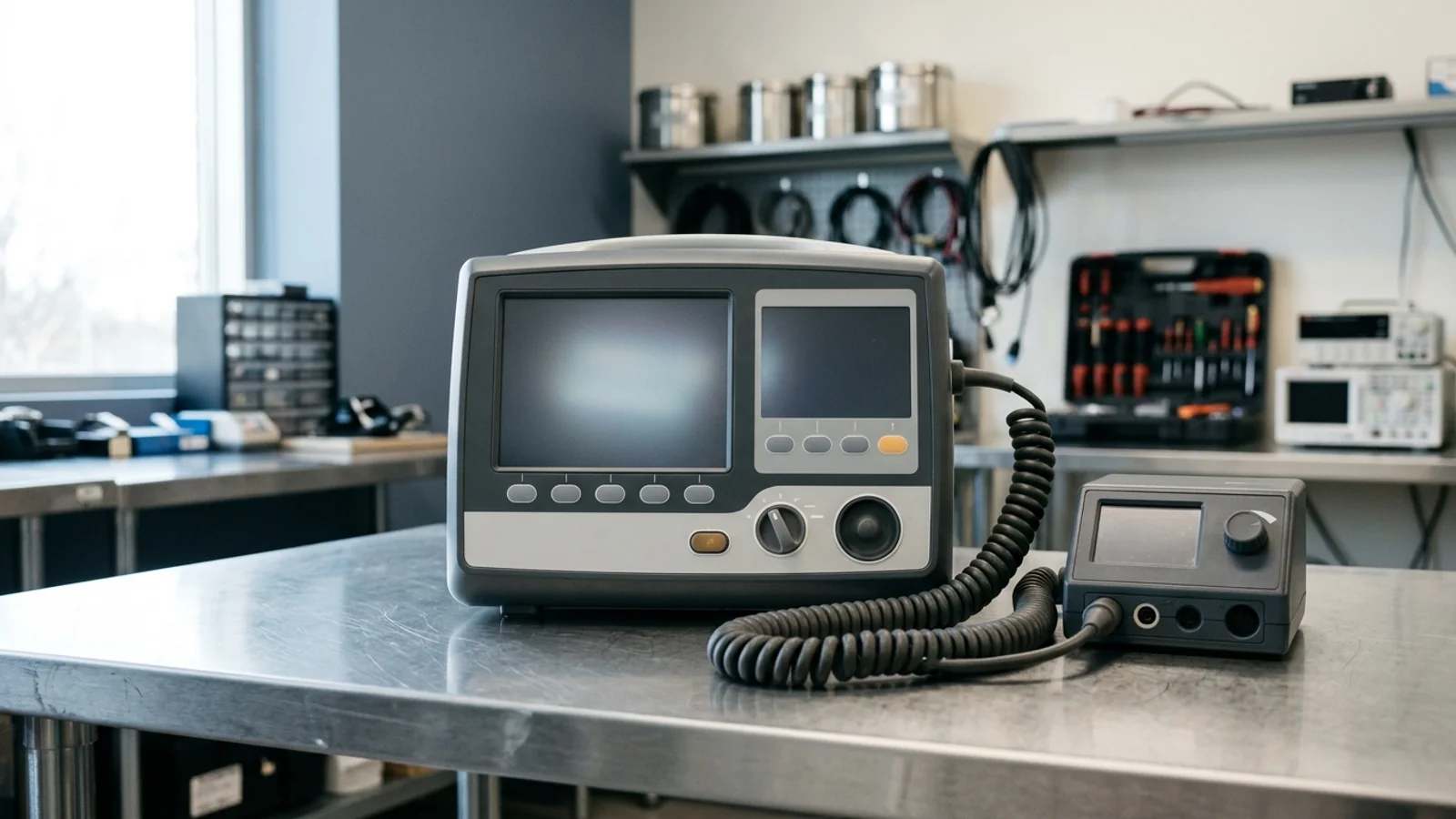
When a hospital external defibrillator comes off the bench after a major repair or upgrade, a clean boot and a power-on self-test do not answer the return-to-service question. The device is going back onto a crash cart or into a code-response inventory. The hospital still has to show that it inspected and tested the equipment for performance and safety before that return. That is an essential-performance problem for this device class—delivered energy, charge, and synchronized cardioversion, plus any labeled AED analyze/advise functions—not a copy of the published critical-care ventilator essential performance after service article and not a replay of infusion pump return-to-service verification.
The hospital inspect-and-test-after-major-repair expectation originates in CMS equipment-maintenance guidance. Survey & Certification memo S&C 14-07-Hospital (20 December 2013) stated that all equipment “must be inspected and tested for performance and safety before initial use and after major repairs or upgrades.” Current interpretive guidance in QSO-25-24-Hospitals (5 September 2025), revising State Operations Manual Appendix A Tag A-0724 under 42 CFR 482.41(d)(2), restates that equipment “should be inspected and tested for performance and safety before initial use and after major repairs or upgrades,” while retaining that all equipment “must be inspected, tested, and maintained to ensure its safety, availability, and reliability.” Keep those sentences distinct. Do not quote the 2013 “must” as if it were the displayed 2025 A-0724 after-repair sentence. The Condition of Participation at 42 CFR 482.41(d)(2) requires facilities, supplies, and equipment to be maintained to an acceptable level of safety and quality. That CoP sentence is not a defibrillator joule table, and it does not classify crash-cart defibrillators as high-risk life-support equipment or impose a 100% completion rate—those accreditation statements live on the 2025 Joint Commission review tool discussed later.
Neither S&C 14-07 nor QSO-25-24 defines “major repair” by a universal numeric threshold or by a defibrillator parts list. Whether the device sits on manufacturer-recommended maintenance or an already-documented AEM versus manufacturer-maintenance strategy is a prior program decision. If an independent service organization performs the work, the service-contract scope and SLA still has to produce inspect-and-test evidence the hospital can show. For an external defibrillator, the after-major-repair gate is whether the labeled energy and synchronization functions still meet the OEM specification, not an electrical-safety-standard-selection question and not a swapped ventilator or infusion-pump checklist.
To answer the scenario question directly: after a major repair, confirm the device is in IEC 60601-2-4 cardiac-defibrillator scope rather than an ICD, remote-control defibrillator, wearable-only AED, or stand-alone cardiac monitor. Treat CMS inspect-and-test for performance and safety as the hospital trigger. Execute the OEM IFU’s routine testing and acceptance criteria for delivered energy into the tester’s standard resistive load, for synchronized operation when the labeled system can sync, and for any AED analyze/advise/deliver functions on this software version. Measure energy with a 21 CFR 870.5325 defibrillator tester the IFU names—never by live high-energy discharge into open air, people, crash-cart metal, or improvised loads. Record identity, software version, accessories, instruments, results versus OEM criteria, and who authorized return to service. Do not invent joule, waveform, charge-time, synchronizer-delay, or AED-algorithm numeric limits.
Confirm the device is in IEC 60601-2-4 cardiac-defibrillator scope
Before connecting a tester, confirm the governing particular-standard boundary. The current particular standard for basic safety and essential performance of cardiac defibrillators is IEC 60601-2-4 Edition 3.1 2018-02 CONSOLIDATED VERSION. FDA entered it on Recognition List 055 as Rec# 3-169 on 21 December 2020, with identical national adoption ANSI/AAMI/IEC 60601-2-4:2010/A1:2018 (consolidated text). The IEC webstore listing for IEC 60601-2-4:2010+AMD1:2018 CSV identifies Edition 3.1, publication date 28 February 2018, 327 pages, and a 2026 stability date. That metadata is a freshness trigger, not a hospital testing mandate.
Rec# 3-169’s reprinted abstract applies to cardiac defibrillators as medical electrical (ME) equipment and, where relevant, ME systems. The legal identification of a DC-defibrillator, including paddles, is 21 CFR 870.5300. A low-energy DC-defibrillator is a device that delivers into a 50 ohm test load an electrical shock of a maximum of 360 joules, used for defibrillating the atria or ventricles or terminating other cardiac arrhythmias; it includes lower-output devices used in pediatric defibrillation or in cardiac surgery; it may synchronize the shock with the proper phase of the electrocardiogram or operate asynchronously; and it delivers the shock through paddles placed either directly across the heart or on the surface of the body. That generic type is Class II. Rec# 3-169 maps it to product code LDD. A high-energy DC-defibrillator that delivers greater than 360 joules into a 50 ohm test load is a different generic type and is Class III. The 50 ohm test load and the 360 joule ceiling are classification identity. They are not an in-service plus-or-minus accuracy window, and 360 J is not a universal selected-energy setpoint. This article addresses external, body-surface crash-cart and code-cart use. It does not write open-chest internal-paddle procedures.
Automated external defibrillator systems are a separate identification at 21 CFR 870.5310: an AED plus the accessories necessary to detect and interpret an electrocardiogram and deliver an electrical shock, with battery, pad electrode, adapter, and hardware key for pediatric use given as examples. The system analyzes the ECG, interprets the cardiac rhythm, and either automatically delivers a shock or advises the user to deliver the shock to treat ventricular fibrillation or pulseless ventricular tachycardia. AEDs are Class III and require PMA. Rec# 3-169 maps 870.5310 to product codes MKJ (non-wearable AED) and NSA (over-the-counter AED), and also lists wearable AED product code MVK with no regulation number. Hospital crash-cart and code-cart readers are in the LDD and MKJ lane. Do not treat a wearable AED or a public-access OTC unit as the same after-service plan without checking intended use, and do not invent pediatric-key or pad-shelf-life numeric rules. Accessories named in 870.5310 are system-identity examples, not invented shelf-life numbers.
Equally important is what Rec# 3-169’s public scope does not cover. The reprinted abstract states that the particular standard does not apply to:
Implantable defibrillators — surgically implanted cardioverter-defibrillators sit outside IEC 60601-2-4. Do not apply this after-service energy plan to an ICD.
Remote-control defibrillators — shock delivery managed through a remote-control architecture is outside this particular-standard job.
Separate stand-alone cardiac monitors — those devices are standardized by IEC 60601-2-27:2011 (FDA Rec# 3-126, date of entry 18 December 2023, identical adoption ANSI/AAMI/IEC 60601-2-27:2011(R)2016). Cardiac monitors that use separate ECG monitoring electrodes are outside 2-4 scope unless they are the sole basis for AED rhythm-recognition detection or beat detection for synchronized cardioversion. Defibrillator electrodes may also be used for ECG monitoring; IEC 60601-2-27 is not applicable to those larger defibrillator electrodes.
Choice of a particular waveform — including waveshape, delivered energy, efficacy, and safety. After-service verification therefore cannot invent biphasic waveform parameters or a universal joule-accuracy table from 2-4.
Wearable AED product code MVK appears on the Rec# 3-169 sheet with no regulation number. That listing is not the same thing as the abstract’s exclusion list. Treat MVK as a different intended-use lane, not as if the 2-4 public exclusions had named wearable garments. Confirm intended use before borrowing this crash-cart energy plan.
FDA recognition is partial, and it is not a hospital type-test script
A frequent mistake is treating FDA consensus recognition of IEC 60601-2-4 as a mandate to run the 327-page particular standard as a hospital in-service checklist. FDA’s September 2018 guidance “Appropriate Use of Voluntary Consensus Standards in Premarket Submissions for Medical Devices” addresses the use of recognized standards in the preparation and evaluation of premarket submissions. Recognition is a premarket declaration-of-conformity fact. It does not convert paywalled type tests into a hospital procedure, and it does not authorize inventing joule, waveform, charge-time, or AED-algorithm numeric limits from memory.
Rec# 3-169 is partial. FDA does not recognize two parts of the standard:
Subclause 201.107, Requirements for Rhythm Recognition Detector. FDA does not recognize this subclause because it is not consistent with published literature. The recognition sheet points to Kerber et al., Circulation 1997;95:1677–1682, on specifying and reporting AED arrhythmia-analysis algorithm performance. That 1997 scientific statement is literature FDA cites for the non-recognition. It is not a hospital in-service test method. Do not write AED algorithm sensitivity, specificity, or shockable-rhythm pass criteria from 201.107 or from Kerber 1997 as if they were bench tolerances.
Clause 202, Electromagnetic compatibility — Requirements and tests. FDA does not recognize Clause 202 because it is not aligned with the recognized IEC 60601-1-2 collateral: clause 202 was updated to refer to IEC 60601-1-2:2014, but relevant text within clause 202 was not updated to align with that edition. Do not turn EMC type tests into a post-repair energy checklist, and do not send a crash-cart defibrillator to an anechoic chamber as if that were return-to-service evidence.
Where, then, do authoritative pass/fail limits come from? FDA’s 10 May 2024 final guidance “Remanufacturing of Medical Devices: Guidance for Industry, Entities That Perform Servicing or Remanufacturing, and FDA Staff” is nonbinding. This article does not retell the published six-principle servicing-versus-remanufacturing decision tree. In Section IX, FDA encourages OEMs, as an industry best practice, to provide servicing instructions that facilitate routine maintenance and repair of reusable devices, without requiring disclosure of trade secrets. The OEM labeling of reusable devices should include, as applicable:
A description of the key performance and safety specifications, and device-specific performance specifications;
The recommended maintenance activities and schedule;
Recommended troubleshooting steps, routine testing, and acceptance criteria to confirm that the device remains within its performance and safety specifications;
A description of error codes, alerts, and alarm features on the device; and
Version number and release date of software.
After-service pass/fail limits for selected energy, charge behavior, synchronized operation, and any shock-advisory checks therefore come from that OEM labeling and the service IFU for the specific model and software version—not from Rec# 3-169’s paywalled type-test tables, not from Kerber 1997, and not from a vendor PM menu.
What to verify: 50 ohm energy, sync, and labeled AED functions
A manufacturer-neutral after-service plan evaluates the public function families in 21 CFR 870.5300 and, when labeled, 21 CFR 870.5310. It does not publish a joule cookbook.
Delivered energy into a standard resistive load
Under 21 CFR 870.5300, defibrillator output is identified as delivery into a 50 ohm test load. The 360 joule maximum identifies the low-energy Class II generic type against the high-energy Class III identification. It is not an in-service accuracy tolerance. During post-repair testing, measure delivered energy at the selected-energy settings the OEM IFU names across the labeled range, into the tester’s standard resistive load. Record the selected setting, the measured delivered energy, and the OEM acceptance criterion used. Do not invent a universal low/mid/high joule ladder, and do not treat patient thoracic impedance as a substitute for the identification test load.
Charge behavior
Charge is a public function family in the CMS performance-and-safety gate for this device class, and test-equipment vendors list charge time among typical analyzer families. Verify the charge functions the OEM IFU requires for the power sources that will be used clinically—line, battery, or both as labeled. Battery condition is an OEM IFU input to energy delivery; this article does not expand into a separate battery-maintenance protocol. Do not invent a universal charge-time limit or a six-month interval from vendor marketing.
Synchronized cardioversion when the device can sync
21 CFR 870.5300 identifies that the device may synchronize the shock with the proper phase of the electrocardiogram or operate asynchronously. When the labeled system includes synchronized cardioversion, verify synchronized operation as the OEM IFU names it: the synchronizer functions, the ECG source the IFU uses for beat detection, and the acceptance criteria for that check. The identification is “the proper phase of the electrocardiogram,” not a shop-invented millisecond delay window. Do not write a live discharge procedure. Energy measurement belongs on a 21 CFR 870.5325 tester connected to the output, using the accessories and simulator or analyzer setup the OEM and tester IFUs name.
Abort, disarm, and internal energy dissipation if the IFU requires them
If the OEM IFU requires verification of charge abort, disarm, or internal energy dissipation after this repair, perform those checks as written in that IFU and record the result against the OEM criterion. Do not invent a universal hold-timer or dump-timeout number, and do not attribute an unpublished timeout to IEC 60601-2-4 as if it were an in-service rule.
Labeled AED analyze/advise/deliver functions
If the serviced configuration is an AED system under 21 CFR 870.5310, the public functions are analyze the ECG, interpret the cardiac rhythm, and automatically deliver or advise a shock to treat ventricular fibrillation or pulseless ventricular tachycardia. Verify those labeled functions only as the OEM IFU names them for this software version, including the accessories—battery, pads, adapter, pediatric key—that the IFU includes in the check. Because FDA did not recognize Subclause 201.107, do not invent algorithm pass criteria, shockable-rate thresholds, or universal “shock advised” prompt language.
Test-equipment vendors publicly describe typical analyzer function families—charge time, discharge energy, synchronized-mode operation, ECG monitoring, and AED functionality—and still tell readers that the testing procedure is specified in the service manual for the particular model. That is SERP context, not a CMS or IEC checklist. The same vendor pages tell readers that more generic procedures may be followed when the manufacturer manual is not available. That is not an acceptable method for a life-support energy test. It conflicts with FDA’s reusable-device labeling recommendation that acceptance criteria come from OEM labeling. Missing-manual generic procedures are not a substitute for the IFU.
Alarms and pacing as companion functions, not this energy test
Crash-cart defibrillator/monitors often integrate companion therapy and monitoring functions in one chassis. Those companions have their own public identifications. They are not substitutes for the 21 CFR 870.5300 energy measurement, and this energy article is not a model-specific error-code library.
Clinical alarm systems are covered by IEC 60601-1-8 Edition 2.2 2020-07 CONSOLIDATED VERSION, recognized completely by FDA as Rec# 5-131 on 21 December 2020 (included in ASCA), with identical national adoption ANSI/AAMI/IEC 60601-1-8:2006 and A1:2012 including AMD 2:2021. The public scope is requirements for alarm systems and alarm signals in medical electrical equipment and systems. For a defibrillator, charge-ready, shock-advisory, and related alerts are a collateral-standard function family. Verify the alarm and alert features the OEM IFU requires for the modes that will be used clinically, and record that those checks were done. Do not invent sound-pressure, delay, or priority numeric limits from the paywalled collateral text, and do not write a universal list of lead-off, battery, or CPR-voice prompts as if every model required the same set.
Noninvasive transcutaneous pacing, when present on a defibrillator/monitor, is a companion device function under 21 CFR 870.5550, not an IEC 60601-2-4 delivered-energy test. 870.5550 identifies an external transcutaneous cardiac pacemaker as a device used to supply a periodic electrical pulse intended to pace the heart, usually applied through electrodes such as defibrillator paddles, and classifies it as Class II. The special-control text includes historic ANSI/AAMI DF-21 1996 and numeric pulse-amplitude and pulse-duration figures. Those figures are classification special controls, not after-service pass/fail windows, and they are not a substitute for the current OEM IFU.
Do not map that transcutaneous function onto IEC 60601-2-31. FDA currently recognizes IEC 60601-2-31 Edition 3.0 2020-01 completely as Rec# 3-201 (date of entry 22 December 2025, included in ASCA) for external cardiac pacemakers with internal power source. Rec# 3-201 maps to 21 CFR 870.3600 product codes, not to 870.5550, and the public abstract states that the document does not apply to transthoracic and oesophageal pacing ME equipment. Declarations of conformity to the prior Rec# 3-102 remain acceptable for premarket submissions until 19 December 2027; that sunset is a premarket declaration fact, not a hospital cutover. If the serviced configuration includes transcutaneous pacing, verify the pacing functions the OEM IFU names, using the pacing setup that IFU specifies. Do not invent milliamperes, pulse-width, or rate limits, and do not use a 50 ohm defibrillation load as if it were a pacing test.
Stand-alone ECG diagnostic monitoring using separate patient electrodes remains IEC 60601-2-27 (Rec# 3-126, partial recognition) unless those electrodes are the sole basis for AED rhythm recognition or synchronized-cardioversion beat detection. Rec# 3-126’s non-recognition is an EMC patient-cable exemption, not an invitation to invent ECG amplitude or heart-rate accuracy windows. Verify monitoring functions the OEM IFU still requires after this repair; do not recast a patient-monitor alarm-verification article here.
Electrical safety is required and not sufficient
A successful electrical safety test does not qualify a repaired defibrillator for return to a crash cart. Electrical safety and essential-performance energy verification address different failure modes.
IEC 62353:2014’s public scope covers recurrent testing and testing after repair of medical electrical equipment to assess safety, as well as tests before putting into service. The IEC webstore abstract states that the standard “is not suitable to assess whether ME equipment or ME systems or any other equipment comply with the relevant standards for their design” and that it “does not define requirements for repair, exchange of components and modification of ME equipment or ME systems.” Electrical-safety testing after repair is therefore necessary under the hospital’s already-named in-service electrical-safety method, and it is not a substitute for IEC 60601-2-4-scope energy and synchronization verification. Do not recast the published IEC 62353 versus NFPA 99 versus IEC 60601-1 standard-selection article here. NFPA 99 (2012 edition) is incorporated as the Health Care Facilities Code at 42 CFR 482.41(c); that is a facility-code hook, not an IEC 60601-2-4 in-service script. A power-on self-test or a low-energy daily self-test is likewise not, by itself, CMS performance-and-safety evidence after a major repair.
Passing the hospital’s EST method shows the chassis was tested under that method. It does not show that selected energy was delivered into the tester’s standard resistive load within the OEM criterion, that synchronized operation met the OEM check, or that labeled AED analyze/advise functions still behave as the IFU requires. Electrical safety is a parallel gate. It is not the energy gate.
Life-support ITM evidence on the work order
The Joint Commission’s public 2025 Hospital Life Safety & Environment of Care Document List and Review Tool still treats life-support equipment as high-risk under EC.02.04.03, requires documented inspection, testing, and maintenance of high-risk equipment, and states that required inspect/test/maintain activities and frequencies must have a 100% completion rate. That is a hospital accreditation completion duty for required ITM activities and frequencies, not a joule table. Accreditation 360 relocated Environment of Care medical-equipment standards beginning January 2026. Use the 2025 review tool as public evidence that life-support ITM is documented and 100% complete; do not invent 2026 Physical Environment element-of-performance numbers. CMS A-0724 remains the durable CoP hook.
To make that evidence usable, every post-repair work order needs an immutable record before the defibrillator is released to clinical custody. The published medical equipment service record requirements article is the work-order object. This article supplies the defibrillator function list that object should store. The work order should contain:
Equipment identity. Inventory asset identifier, make, model, serial number, and the software version number and release date FDA’s reusable-device labeling recommendation names.
Accessory identity. Pads, paddles, therapy cables, battery, adapter, and pediatric key actually used during verification—the accessory classes 21 CFR 870.5310 uses as system-identity examples, not invented shelf-life numbers.
Test-instrument lineage. Make, model, serial number, and calibration status of the 21 CFR 870.5325 defibrillator tester, plus any electrical-safety analyzer or rhythm/ECG tool the OEM IFU required for this job.
Quantitative energy and charge results. Selected-energy settings the OEM IFU named, measured delivered energy into the tester’s standard resistive load, charge checks the IFU named, each paired with the OEM acceptance criterion—not a generic joule cookbook.
Synchronized and AED function results. Synchronized operation if the labeled system can sync, and AED analyze/advise/deliver checks if present, recorded as the OEM protocol specifies.
Companion-function results. Alarm/alert features and transcutaneous pacing functions only when present and only as the OEM IFU names them.
Electrical-safety prerequisite. The hospital’s adopted after-repair EST method, with the results that method produces. EST remains necessary and not sufficient.
Return-to-service authorization. Who performed the tests, the date, and explicit authorization that the device met the OEM performance and safety specifications used for this work order.
A scope-and-evidence matrix, not a joule cookbook
Returning an external defibrillator to clinical service after a major repair is a structured evidence problem. Device classification, consensus-standard scope, the CMS trigger, the measuring instrument, and OEM acceptance limits are different layers. Mixing them produces either invented tolerances or an unsafe live-discharge method.
| Verification domain | Public hook | Criteria source | Work-order evidence |
|---|---|---|---|
| Scope and identity | IEC 60601-2-4 Rec# 3-169; 21 CFR 870.5300 / 870.5310 | Public scope and exclusions; labeled intended use | In-scope confirmation; model, serial, software version; LDD vs MKJ vs out-of-scope ICD/wearable/monitor |
| Hospital trigger | S&C 14-07; QSO-25-24 A-0724; 42 CFR 482.41(d)(2) | Inspect and test for performance and safety after major repair; ongoing inspect/test/maintain | Nature of the work; no invented major-repair parts list |
| Delivered energy | 21 CFR 870.5300 (50 ohm identification); 21 CFR 870.5325 tester | OEM IFU selected-energy settings and acceptance criteria | Measured energy into the named tester’s standard resistive load versus OEM limits; never open-air discharge |
| Charge | CMS performance-and-safety gate; OEM charge functions | OEM IFU for the power sources that will be used clinically | Charge checks the IFU names; no invented charge-time window |
| Synchronized cardioversion | 21 CFR 870.5300 (proper ECG phase or asynchronous) | OEM IFU when the labeled system can sync | Sync functions and OEM criterion; no invented millisecond delay |
| AED analyze/advise/deliver | 21 CFR 870.5310; Rec# 3-169 does not recognize 201.107 | OEM challenge protocol for this software version | Labeled AED functions if present; no invented algorithm numbers |
| Alarms | IEC 60601-1-8 Rec# 5-131 | OEM-named alerts for clinically used modes | Record that required alarm/alert checks were done |
| Transcutaneous pacing if present | 21 CFR 870.5550; not IEC 60601-2-4 energy; not 2-31 transthoracic | Current OEM IFU; not 870.5550 special-control figures | Pacing functions the IFU names; separate from the 50 ohm energy test |
| Electrical safety | IEC 62353:2014 public after-repair scope; hospital EST method | Hospital EST policy; not a design-conformity assessment | EST results under the adopted method; EST is not joule evidence |
| Authorization | CMS A-0724; 2025 Joint Commission life-support ITM / 100% completion | Hospital medical-equipment program and OEM specifications used | Technician, date, instruments, results versus OEM criteria, sign-off |
The operational sequence is a set of gates, not a recipe of invented setpoints:
graph TD
  A["Confirm IEC 60601-2-4 cardiac-defibrillator scope"] --> B{"ICD, remote-control, wearable-only, or stand-alone monitor?"}
  B -->|"Yes"| C["Use the applicable particular standard and OEM IFU instead"]
  B -->|"No"| D["Record identity, software version, and accessories"]
  D --> E["Electrical safety per hospital IEC 62353 / NFPA 99 method"]
  E --> F{"EST complete under hospital method?"}
  F -->|"No"| G["Do not return to service; close the electrical-safety finding"]
  F -->|"Yes"| H["Connect a 21 CFR 870.5325 defibrillator tester the IFU names"]
  H --> I["Verify delivered energy, charge, and sync per OEM IFU"]
  I --> J["Verify labeled AED analyze/advise functions if present"]
  J --> K["Verify OEM-named alarm and pacing companions if present"]
  K --> L{"Results versus OEM acceptance criteria?"}
  L -->|"No"| M["Do not return to service; document the failed function"]
  L -->|"Yes"| N["Complete work-order evidence and authorize return to service"]
N --> O["Release to crash-cart or code-response inventory"]Refuse generic PM shortcuts, missing-manual procedures, and live high-energy methods. Keep electrical safety and essential-performance energy verification as parallel gates. Anchor every numeric pass/fail threshold in authorized manufacturer documentation for this model and software version. That is the manufacturer-neutral plan a work order can defend: IEC 60601-2-4’s public scope names the device class and the exclusions, CMS names the after-major-repair inspect-and-test trigger, a 21 CFR 870.5325 tester is the public measuring instrument, and the OEM IFU names the limits.