
What Closes a Conductivity Repair: The Release Evidence
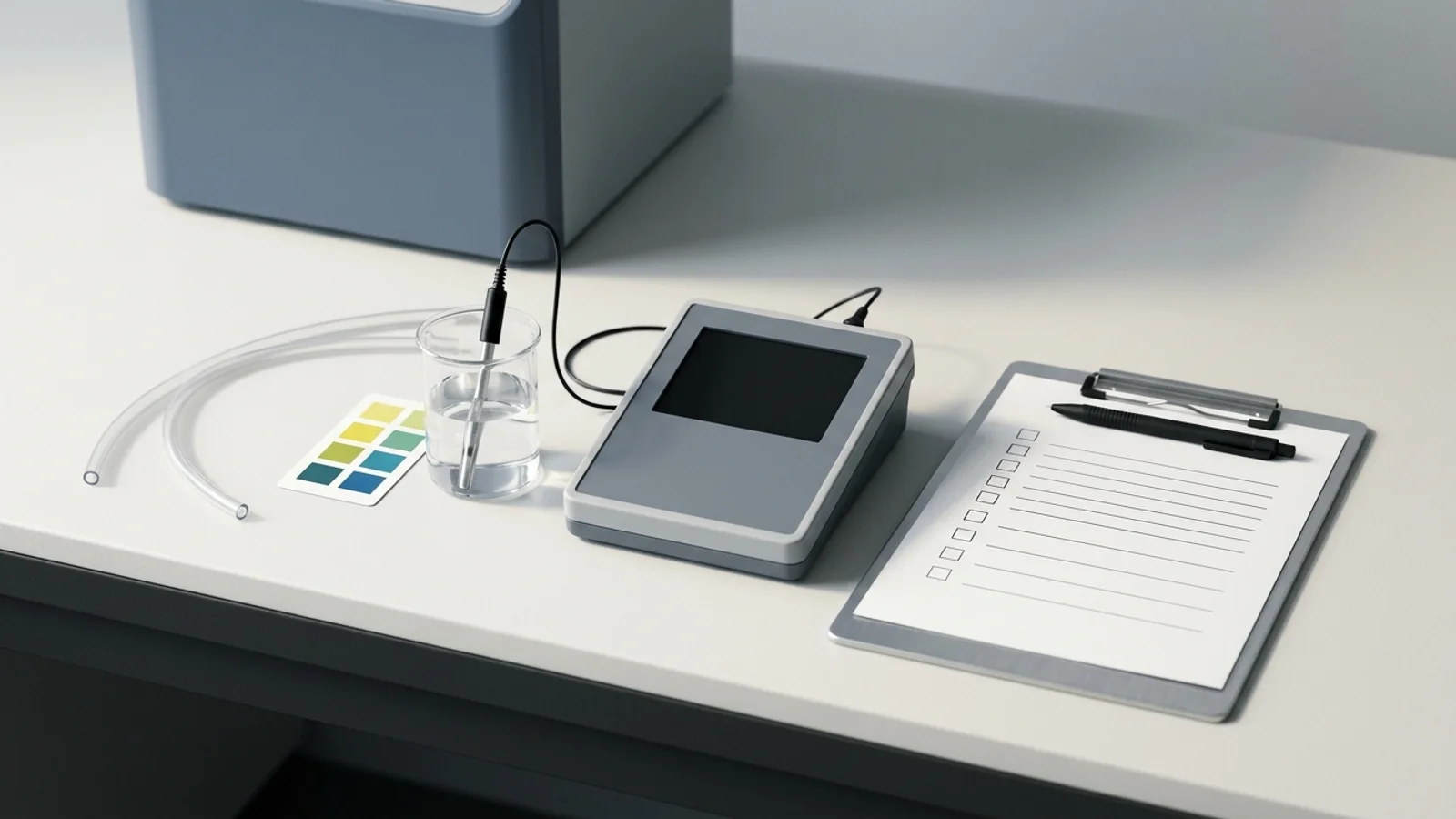
After conductivity-related repair on a Fresenius 2008K, 2008K2, 2008K@home, or 2008T, use the Dialysate Composition Verification Procedure, P/N 490287 Rev B. The OEM also permits a conductivity procedure that captures the same data points. It calls for independent measurements, concentrate-pump checks, both self-tests, and facility disinfection. Document and correct failed verification before release. The machine display alone cannot close this work order.
This guide helps biomedical teams review the evidence and assemble a service record. The OEM procedure is written for Fresenius Medical Care-trained customers. Perform the work under the applicable manufacturer instructions and your facility’s authorization process. The numerical limits below belong to the four named models and the cited revision; check the controlled procedure before use. For another platform, retain the record structure and obtain its own acceptance criteria.
Why Conductivity Is the Proportioning Evidence
Conductivity belongs to the machine’s fluid-delivery evidence. 21 CFR 876.5820 describes a Class II hemodialysis system whose dialysate delivery mechanisms monitor and control conductivity, temperature, flow, and pressure, with alarms for abnormal conditions. This device description explains why those measurements matter; it does not prescribe the post-repair tolerances in this article.
The 2020 Indian Journal of Nephrology guidance recommends an independent, properly calibrated reference meter for final-dialysate conductivity checks and keeping equipment repair histories. Its discussion of periodic laboratory electrolyte measurement when a reference meter is unavailable concerns routine monitoring. It does not authorize replacing the external meter required by this OEM post-repair procedure. Arrange the required equipment before scheduling release verification.
The reference instrument deserves the same scrutiny as the repaired machine. Obialo and colleagues’ case report describes two patients with symptomatic hypernatremia associated with erroneous online conductivity readings and a faulty handheld conductivity meter. Reported symptoms included thirst, weight gain, and worsening hypertension. This is case-level evidence, not an incidence estimate or proof that every conductivity fault has the same cause. Its practical lesson for service review is to verify the reference meter’s status as well as the machine’s result.
Repairs That Trigger Verification on a 2008-Series Machine
The OEM scope covers conductivity-related repairs and explicitly includes acid/bicarbonate concentrate-line extensions. Describe the actual intervention on the ticket. Avoid reducing a line modification to an undocumented accessory change, and avoid assuming that every unrelated repair has the same verification scope.
For an unclear ticket, ask the responsible service lead to identify the work performed, the controlled procedure used, and the resulting verification requirements. A useful trigger entry states the reported problem, affected assembly or line, completed action, and why composition verification applies. This is a documentation recommendation, not an expanded manufacturer list of mandatory triggers. Do not classify a repair from its billing code alone.
The CMS survey completed February 7, 2025, at Fresenius Kidney Care Richmond County illustrates the danger of treating a stable display as a complete check. Under tag V0250 and 42 CFR 494.40(a), surveyors identified missing independent pH verification after concentrate changes. One observation recorded conductivity stabilizing after an alarm, yet the pH check was omitted. These were treatment-preparation observations at one facility, not a post-repair trial or a new national directive. They support checking that each required evidence item is actually present.
Data Points and Tolerances: The Verification Table
The following limits are from P/N 490287 Rev B, pages 2–3. They are OEM values, not numerical limits printed in 42 CFR 494.40.
| Check | Acceptance or completion criterion | Record |
|---|---|---|
| Composition entry | Correct acid/bicarbonate compositions | Confirmation |
| Displayed conductivity versus external meter | Within ±0.1 mS/cm | Both readings |
| Nominal theoretical conductivity (TCD) versus external meter | Within ±0.4 mS/cm | Both readings |
| Displayed temperature versus external meter | Within ±0.3 °C; 37 °C check at 500 mL/min | Both readings |
| Dialysate pH | 6.9–7.6 | Measured result |
| Concentrate pumps | Model PM procedure | AMIN, AMAX, BMIN, BMAX; outcomes |
| Both self-tests | All pass | Outcomes |
| Facility disinfection | Completed before return | Completion |
Round external conductivity reported to thousandths to tenths for documentation. The procedure specifically requires NEO-1 meters to be grounded. Use the instrument instructions for its setup; this note does not establish a universal grounding connection for every meter.
For review, keep acceptance and completeness as separate questions. A value can be within its limit while the record is incomplete because the comparison reading is missing. Equally, a complete pair of readings can show a failure. Require a documented outcome for each row rather than allowing one passing conductivity comparison to stand in for the whole verification. Preserve the actual observations so a later reviewer can understand the decision without contacting the original technician.
The Repair-Trigger and Tester-Identification Worksheet
Use the linked OEM fillable PDF for the controlled verification. The blank companion worksheet below is an original record-design aid for your CMMS or service packet. It links the repair trigger and reference instruments to the measurement record; it is not a completed test, a replacement service procedure, or a certification of fitness for use. Complete a separate entry for each machine and test event.
| Record group | Blank field or entry prompt | Reviewer’s check |
|---|---|---|
| Machine and event | Model: ____; serial: ____; asset ID: ____; hours: ____; work order: ____; date: ____ | Same identity throughout packet |
| Repair trigger | Reported fault: ____; work performed: ____; line modification: ____ | Explain why this verification applies |
| Controlled documents | Verification revision: ____; model procedures: ____ | Identify versions actually used |
| Reference instruments | Conductivity/temperature meter model and serial: ____; calibration record and due date: ____ | Match instrument to evidence |
| pH method | Strip identification/status or pH meter identity/calibration: ____ | Make method traceable |
| Measurement results | Attach completed OEM fields for composition, display, TCD, temperature, pH, and pumps: ____ | Keep readings, outcomes, initials, dates |
| Remaining requirements | Self-test record: ____; disinfection record: ____; other applicable release records: ____ | Link completion evidence |
| Failure and correction | Failed item: ____; action reference: ____; repeat results: ____ | Retain original failure and closure |
| Disposition | Hold/release decision: ____; authorized person: ____; date: ____ | Resolve open items before closure |
For the measurement portion, copy this blank matrix into the same service packet and carry over its work-order and tester identifiers. Use the acceptance table above and the controlled procedure; enter observations only after performing the required verification.
| Data point | Machine/display or pump entry | Independent result or criterion reference | Outcome; initials/date |
|---|---|---|---|
| Composition entry | Acid/bicarbonate entries: ____ | Composition verification: ____ | ____ |
| Conductivity display | ____ mS/cm | Meter: ____ mS/cm | ____ |
| Nominal TCD | ____ mS/cm | Meter: ____ mS/cm | ____ |
| Temperature | ____ °C | Meter: ____ °C; flow: ____ mL/min | ____ |
| pH | Not a display comparison | Measured: ____; method: ____ | ____ |
| Acid pump | AMIN: ____; AMAX: ____ | PM criteria/page: ____ | ____ |
| Bicarbonate pump | BMIN: ____; BMAX: ____ | PM criteria/page: ____ | ____ |
Add rows when more than one reference instrument or repeat event is involved. Distinguish an unavailable calibration record from an out-of-date calibration and from a measured failure; each needs a clear disposition. Do not fill blank measurement fields from the machine’s expected settings. A preset tells the reviewer what was requested, while an observation records what was found.
Keep initial failures and subsequent results together. When a result is repeated after corrective work, identify the intervening action rather than overwriting the first entry. This makes it possible to distinguish an initial failure that was resolved from an unexplained change in numbers. If you attach a scan, check that the machine identity, units, initials, and dates remain readable.
For broader record organization, see Medical Equipment Service Records: What a Work Order Must Contain. A practical local review is to ask someone who did not perform the work to locate the repair trigger, measurement comparisons, tester identity, and final disposition in the packet. If those cannot be located, improve the record before closing the work order.
When a Step Fails: Escalation and Model Manuals
Keep the machine on hold while a failed verification remains unresolved. Send the actual results and repair history to personnel qualified and authorized for the model. The OEM form routes composition-entry errors to correction, conductivity and temperature failures to their respective calibrations, pH failures to hydraulic volume/pressure calibration checks, and pump failures to corrective work and retesting. This is a referral map; use the model procedure for execution.
For TCD, retain the distinction in the form: ±0.4 mS/cm is the acceptance comparison; its corrective-action row is labeled ±0.5 mS/cm. Do not treat the latter as permission to relax acceptance. That row directs qualified service to inlet-pressure verification and balance-chamber/concentrate-pump calibration. Its inlet-pressure ceilings differ with bibag configuration: ≤2 psi without bibag and ≤10 psi with it. The form also has a line-extension priming prerequisite before calibration; consult it rather than improvising a priming sequence.
| Model | Calibration procedure P/N | Preventive maintenance procedure P/N |
|---|---|---|
| 2008T | 508032 | 508033 |
| 2008K | 507296 | 507297 |
| 2008K2 | 508137 | 508138 |
| 2008K@home | 507664 | 507665 |
These document identifiers are references listed in Rev B, not evidence that a particular manual revision is current for your machine. Obtain the applicable controlled documents and record what was used. The maintenance procedure supplies pump-test criteria; do not infer those limits from the calibration document’s title or from another model.
An escalation packet should answer three questions: what failed, what evidence supports the finding, and what work has already been done. Include the meter identity and status because disagreement does not by itself identify the faulty device. Avoid adding speculative component diagnoses to the release record. Capture the confirmed corrective action, repeat the required verification under the applicable instructions, and retain its results with the original failure.
Machine-Side Evidence Is Not Water-System Qualification
42 CFR 494.40(a) incorporates ANSI/AAMI RD52:2004 for water and dialysate quality and equipment requirements. Paragraph (b) addresses chlorine/chloramine controls; (c) addresses corrective-action planning; and (d) addresses adverse-event investigation. Identify these water-program obligations separately from the manufacturer’s machine-specific verification requirements. Preserve the document and edition behind each acceptance decision in the service record.
The standards catalogs also separate equipment and fluid scopes. IEC 60601-2-16:2025 covers basic safety and essential performance of hemodialysis equipment and excludes dialysis-water supply systems and fluid concentrates, referring to ISO 23500-2 and ISO 23500-4 respectively. This scope information comes from the public catalog abstract, not a review of paywalled clauses.
Publication and recognition are separate facts. IEC lists Edition 6.0 with a January 6, 2025 publication date; FDA recognition record 9-121 lists Edition 5.0 (2018). The ISO 23500-1:2019 catalog record is marked withdrawn and points to the 2024 replacement. Do not label that older URL as the current edition or assume that a newer consensus publication automatically changes the edition incorporated by CMS.
For the service packet, identify the machine-side record and refer separately to the facility’s relevant water-program records. Assign follow-up to the appropriate owner when either is missing. This keeps a machine repair from being closed solely because a water report is satisfactory, and prevents a passing machine comparison from being used to dismiss an unresolved water-quality issue. It also keeps this article’s release decision focused on the repaired machine rather than expanding into a water-treatment qualification procedure.
Records, Surveyors, and the Reference Meter’s Own Calibration
Before relying on a reference reading, confirm that the instrument in the packet matches the calibration evidence you reviewed. Record its model, serial number, status, and the record location. Where your program assigns a due date, include it. A certificate for another meter does not support this measurement. Apply the meter manufacturer’s instructions and your controlled equipment program to its use and maintenance.
Mesa Labs’ calibration page gives a vendor example: daily verification of key machine parameters, monthly checks with an external factory-calibrated meter, and annual factory calibration of the meters themselves. This is supplier guidance with a commercial context, not a universal regulatory schedule or a requirement for daily zero/span adjustment of every reference meter. For certificate review, use How to Read and Audit a Medical Equipment Calibration Certificate.
Likewise, the University of Toledo nursing guideline, effective June 2024 covers sampling after a dialysis-bath change at that institution. It illustrates independent conductivity, pH, and temperature checks in a clinical workflow. Its local absolute ranges do not replace the displayed-versus-reference acceptance comparisons for post-repair verification. Keep routine treatment checks and the service event identifiable in the equipment history.
Use the repair log to connect repeat complaints and prior corrective work, without assigning a component diagnosis solely from a trend. Keep records under the facility’s applicable retention policy; the sources here do not establish a universal device-lifetime retention period. A concise work-order summary can point to the detailed verification packet, but should not replace it with an unexplained “tested OK.”
Confirm that the machine identity, repair scope, and controlled procedure agree across the packet.
Check each required result and comparison against the applicable acceptance criterion; investigate missing entries separately from failures.
Confirm reference-instrument evidence, corrective-action closure, and required repeat verification.
Locate both self-test outcomes, facility disinfection completion, and any additional applicable release evidence.
Record the authorized disposition and handover so the machine’s service status is clear.
Coordinate any wider repair obligations through When a Repair Is Major: Return-to-Service Testing After Corrective Work and, where applicable, Electrical Safety Testing After Repair. Those broader reviews accompany the composition evidence; completion of this worksheet alone does not establish that every duty for the repair has been met.