
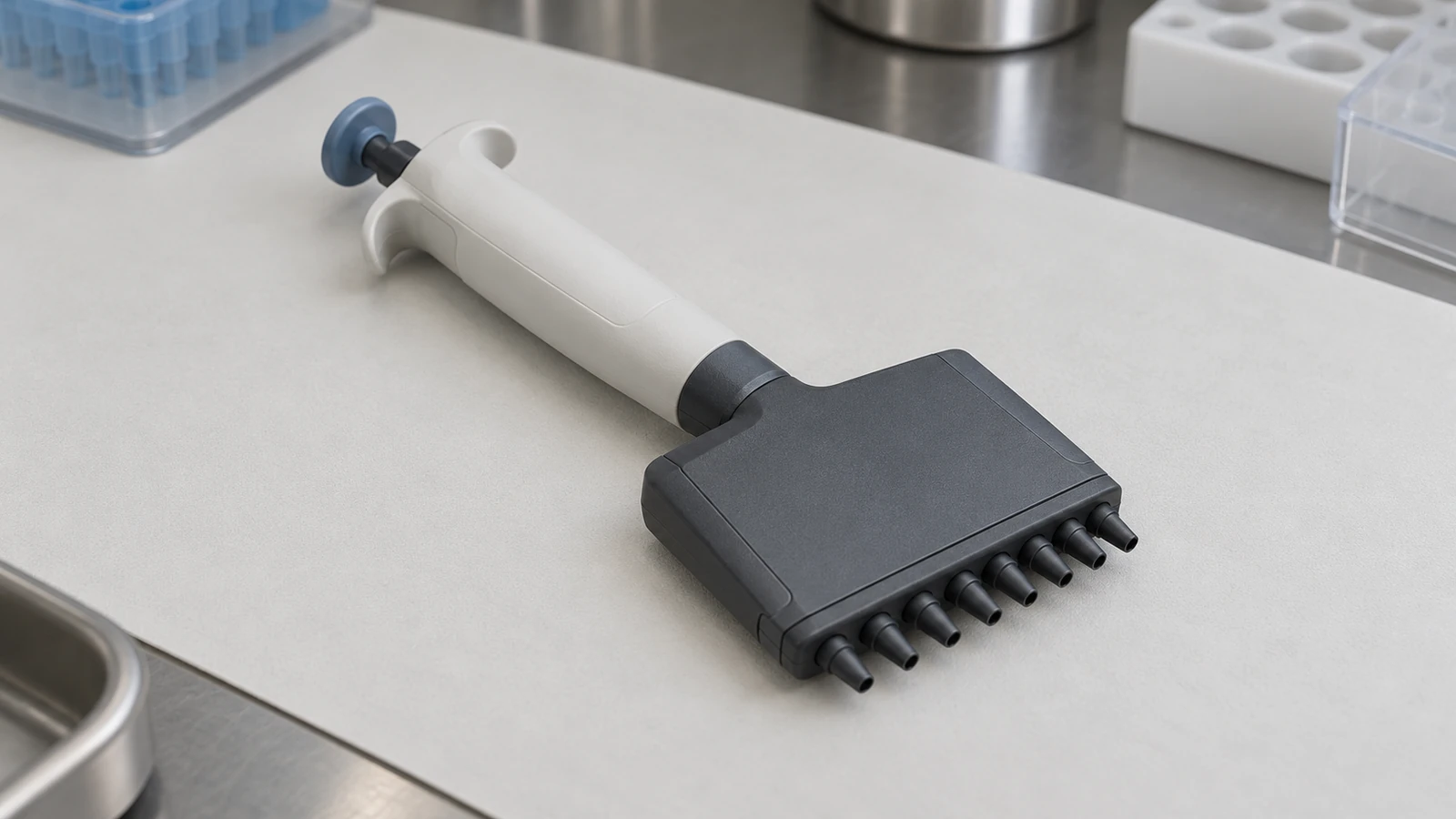
A certificate listing three volumes and one overall pass does not establish that every channel was tested at every required volume. Request the channel-level results, identify the method and repeat count, and map them to the physical pipette. Compare that evidence with the service order and your laboratory’s acceptance requirements before making a release decision. Missing information is a documentation question first; it does not establish either a mechanical failure or acceptable performance.
For ISO 8655-6:2022 testing, Sartorius explains the per-channel principle: channels are evaluated separately, even when the equipment measures them in parallel. This review checks that coverage. It does not prescribe a repair procedure or replace the laboratory’s authorized release process.
Define the required volumes and limits first
Begin with the pipette model, nominal volume, usable range, channel count, manufacturer instructions, and agreed service scope. Record which method and edition apply. Do not impose a three-volume variable-volume example on every fixed-volume model or another service method. If the order only says “calibration,” ask the provider to confirm the channels, actual test volumes, repeat counts, and reporting phases included.
The ISO 8655-2:2022 catalogue identifies pipettes together with their selected tips and essential consumables as the system covered by its metrological requirements and maximum permissible errors. Its public abstract establishes scope; it does not reproduce all test clauses. Record the tips used so the laboratory can compare the tested configuration with its intended use.
Eppendorf’s notice on the 2022 changes describes explicit error limits at 10%, 50%, and 100% of nominal volume and a separate table for multichannel pipettes. It also distinguishes ISO, manufacturer, and user-defined limits. Identify the exact applicable limits before interpreting a pass. Do not assume the selected limit set is suitable for every application, or that a supplier’s use of ISO limits automatically establishes the laboratory’s acceptance.
| Record field | Question to resolve |
|---|---|
| Volume settings | Which actual volumes, in µL, does this model and ordered method require? |
| Method and edition | What method was performed, and what repeat count applies at each volume? |
| Limit set | Were ISO, manufacturer, or laboratory-defined limits used, and which version? |
| Reporting phases | Was as-found, as-left, or both ordered, and what work occurred between them? |
| Tested system | Which pipette, channel count, and tip type do the results describe? |
How channel results and orientation connect
Parallel measurement is compatible with separate channel results. A short run or compact report is not evidence of incomplete testing: the useful question is whether its output preserves each channel’s identity and results. Conversely, an average across channels cannot demonstrate how each channel performed.
The Mettler-Toledo MCP operating instructions provide a concrete equipment example. Section 5.3.3 specifies starting at marked container 1 and maintaining orientation during a measuring cycle. Section 8.7 contrasts a ten-measurement method at each of three volumes with a four-measurement method. These are descriptions in a 2013 manual, not universal names or a substitute for the applicable current method.
Ask the provider which physical end is channel 1 and how numbering proceeds. Retain an unambiguous orientation description or linked annotated record in the service file. Do not infer numbering from the volume window or assume all providers use the same convention. If a report flags channel 4, the mapping must let the service team locate that channel without guessing.
Build a channel-by-volume coverage grid
Use one row per physical channel and one column per required volume. The worksheet below is an unfilled template for an eight-channel, 10–100 µL variable-volume pipette whose agreed scope covers 10, 50, and 100 µL. It contains no measured results or acceptance thresholds. Replace the example volumes with the settings required for your instrument and service order.
| Physical channel | 10 µL | 50 µL | 100 µL |
|---|---|---|---|
| 1 | AF: ___; AL: ___ | AF: ___; AL: ___ | AF: ___; AL: ___ |
| 2 | AF: ___; AL: ___ | AF: ___; AL: ___ | AF: ___; AL: ___ |
| 3 | AF: ___; AL: ___ | AF: ___; AL: ___ | AF: ___; AL: ___ |
| 4 | AF: ___; AL: ___ | AF: ___; AL: ___ | AF: ___; AL: ___ |
| 5 | AF: ___; AL: ___ | AF: ___; AL: ___ | AF: ___; AL: ___ |
| 6 | AF: ___; AL: ___ | AF: ___; AL: ___ | AF: ___; AL: ___ |
| 7 | AF: ___; AL: ___ | AF: ___; AL: ___ | AF: ___; AL: ___ |
| 8 | AF: ___; AL: ___ | AF: ___; AL: ___ | AF: ___; AL: ___ |
AF means as-found; AL means as-left. In each applicable entry, record or reference the number of measurements, systematic error, random error, applied limit set, conformity outcome, and report page or dataset identifier. A linked result sheet is preferable to squeezing unreadable numbers into a work order. Where a phase was not ordered, say so explicitly rather than leaving an unexplained blank.
This example has 8 × 3 = 24 channel-volume combinations per phase. If the agreed method calls for ten measurements in each combination, expect 240 channel-level measurements per phase, or 480 when both phases each use that scope. These are calculated coverage counts, not separate pipetting actions: parallel systems can collect multiple channel results from one dispensing operation. The numbers do not establish that both phases are universally required.
Mark absent report entries as “not supplied” until the provider confirms what happened. Use “not tested” only for a confirmed omission, and record “not required” with the reason when the agreed method excludes a setting or phase. A summary page may omit data that exists in an attached or separately retrievable dataset. Never reconstruct missing measurements from neighboring channels or an overall average.
Separate missing evidence from measured failure
| What the record shows | What it establishes | Next action |
|---|---|---|
| Overall pass; no channel breakdown | Individual channel coverage is not established by the supplied report. | Request the underlying channel results and confirm the ordered scope. |
| Provider confirms a required channel or volume was not tested | The performed scope did not cover that required combination. | Arrange the missing testing; document the release decision under laboratory policy. |
| One measurement for a channel at a volume | A single result cannot establish that channel’s repeatability at that setting. | Compare the repeat count with the method and request the required repeated results. |
| Repeated results exceed the applicable limits | Performance failed the stated criteria under the recorded conditions. | Hold or restrict use under laboratory policy and obtain qualified evaluation. |
| As-left results only | The supplied evidence describes the reported post-service condition. | If prior performance matters, request as-found evidence or document that it is unavailable. |
A channel outside the applicable systematic or random error limit warrants evaluation even if its neighbors pass. That pattern does not identify a worn seal, cracked tip cone, or another root cause by itself. Ask qualified service personnel to evaluate the recorded failure conditions. Missing coverage can also coexist with a real failure; resolving the paperwork does not resolve an out-of-tolerance result.
Likewise, a reduced repeat count should be compared with the declared method rather than automatically called a device defect. A single observation cannot provide a within-channel sample standard deviation. Four observations provide different coverage from ten, but the appropriate judgment depends on what was required, performed, and claimed.
Service tier names do not define the evidence
Published commercial examples show why the purchase order matters. The TTE Laboratories service form, R200-2/B Rev 03 from 2019 separates the calibration level from the multichannel option: MC Standard includes measurements from one random channel; MC Plus adds one measurement from every channel at selected volumes; MC Premium applies the selected calibration to each channel. Levels also differ in as-found and as-left data, and the form excludes some option combinations. These historical terms illustrate scope differences, not a current provider ranking or menu.
A 2017 Pipette.com article describes a channel-averaged offering and separately recommends individual-channel service. Treat that as a vendor’s description, not a normative definition of ISO 8655 compliance. Such an average does not supply individual results; whether a reduced scope meets a laboratory’s own policy is a separate decision. Confirm the provider’s current scope in writing.
Before another order, specify the channel count, required volumes, method and edition, repetitions, limit set, tip configuration, requested reporting phases, physical channel mapping, and access to results. Request separate channel outcomes instead of relying on a tier label or the phrase “multichannel calibration.” For general certificate fields, use the medical equipment calibration certificate guide; this worksheet adds the channel and volume checks.
Keep orientation and measurement provenance together
The following is a recommended intake record, not a claim that every field is mandated on every certificate. Keep the report, worksheet, and any provider clarification linked to the same device and service event:
Device identity: manufacturer, model, serial number, asset identifier, and channel count; identify any separately numbered module relevant to the results.
Physical mapping: the provider’s channel-1 reference, numbering direction, and orientation record, with enough detail to locate a flagged channel.
Tested configuration: tip identification and the method, volume settings, and repeat counts actually used.
Measurement evidence: results for each applicable phase and channel-volume combination, with error measures, limits, conformity decisions, and dataset references.
Test-system provenance: the calibration-system identity and a reference to its applicable calibration or verification evidence. Follow that system’s procedure rather than importing another instrument’s adjustment tolerances.
Disposition: the person authorized to review the evidence, unresolved questions, any restriction or hold, required follow-up, and the laboratory’s next review or service date.
If channel numbering or instrument identity is unclear, request a corrected or linked record. Do not alter the provider’s certificate yourself. Preserve the original and the clarification so a later reviewer can see what changed and why. A complete-looking grid is useful only when it remains traceable to the supplied measurements.
Resolve short coverage within the laboratory’s release process
For US clinical laboratories, 42 CFR 493.1252(a)–(b) requires testing to follow manufacturer instructions within the laboratory’s stated performance specifications, and requires defined essential conditions to be monitored and documented. This section does not specify a pipette channel count, repeat count, or fixed calibration interval. Do not infer a particular CAP or CMS citation from a thin certificate alone. Analyzer-specific calibration verification is a separate question, discussed in the laboratory analyzer guide.
Check the order and request missing evidence. State the exact channel, volume, phase, or method question, and ask whether data exists but was not supplied or whether testing was omitted.
Have the authorized laboratory reviewer decide disposition. Where required evidence is absent, keep release pending or restrict use according to laboratory policy until resolved. Record the reason as unverified coverage unless a measured failure is also established. If potentially affected work was already performed, route that concern to laboratory quality staff for assessment.
Close the gap with clarified records or additional qualified testing. If the purchased scope was too narrow, amend the next service order. For a measured failure, retain the failed results and service findings, then obtain the required post-service evidence before release.
Set the next service date from manufacturer instructions and the laboratory’s documented program. The historical TTE form offers 3-, 4-, 6-, and 12-month choices; those options do not establish a regulatory interval. Before external shipment, follow the receiving provider’s current return and decontamination requirements using methods compatible with the pipette. The TTE form requires a signed decontamination statement, but its form is not a universal cleaning procedure.
Sources and evidence limits
ISO 8655-2:2022 Piston-operated volumetric apparatus — Part 2: Pipettes — Official catalogue scope; full test clauses are not reproduced.
ISO 8655 — Sartorius application page on pipette calibration and multichannel volumetric performance — Manufacturer explanation of separate channel evaluation and parallel measurement.
Multichannel Pipette Calibration System MCP — Operating Instructions (11780744C) — 2013 equipment manual; sections 5.3.3 and 8.7 illustrate orientation and method scope.
Customer information: Change of measurement values according to ISO 8655:2022 — Manufacturer notice on error limits and the 2022 changeover.
42 CFR 493.1252 — Standard: Test systems, equipment, instruments, reagents, materials, and supplies — US laboratory requirements; no pipette-specific interval or channel rule.
Are you familiar with the industry calibration standard for multichannel pipettes? — 2017 vendor description of service offerings, not a standard.
Pipette Calibration Service Form (R200-2B Rev 03) — 2019 provider form illustrating coverage tiers and return requirements.