
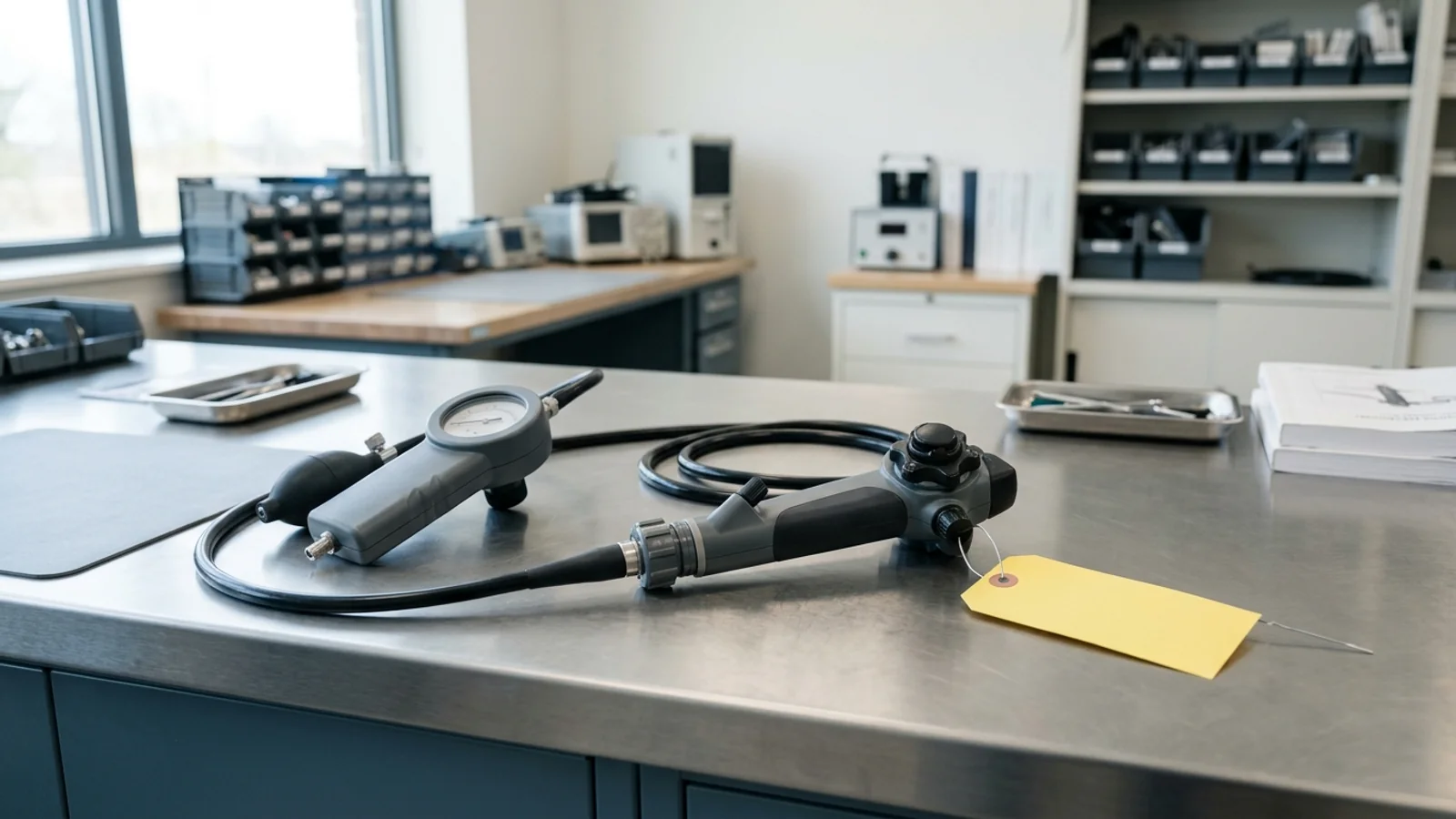
What to Record When This Endoscope Fails Its Leak Test
When a flexible endoscope fails a routine leak test, the clinical engineering and sterile processing workflow must halt immediately. Watertight integrity is the fundamental physical barrier separating delicate internal optoelectronic components from corrosive reprocessing liquids, while simultaneously preventing patient bioburden from entering inaccessible internal dead spaces. A failure—whether identified by a continuous stream of bubbles from a single anatomical point during a wet immersion test, a rapid pressure drop on a calibrated dry manometer, or an automated test cycle abort—indicates that fluid can penetrate internal channels and void spaces that standard manual brushing and liquid chemical disinfection cannot clean.
For biomedical equipment technicians (BMETs) and sterile processing department (SPD) specialists, the primary duty upon discovering a leak is not troubleshooting how to rebuild internal channels, reseat bending rubbers, or re-align fiberoptic bundles. Instead, the immediate mandate is to execute a structured tag-and-hold protocol and compile a comprehensive, defensible out-of-service record packet before the instrument leaves the decontamination suite. That documentation packet substantiates the failure for external repair facilities, protects the healthcare organization during accreditation surveys, and provides indispensable evidence should hospital infection prevention leadership initiate an epidemiological lookback.
This article defines the evidence to record, the model-scoped failure indicators, and the return-to-service gates that apply when a flexible endoscope fails its leak test. It keeps these boundaries:
Regulated Scope: Reusable Class II flexible gastrointestinal, pulmonary, and urological endoscopes whose manufacturer instructions for use (IFU) require routine post-procedure pneumatic leak testing.
Explicit Exclusions: Single-use bronchoscopes and cystoscopes (which must never be reprocessed or leak-tested), rigid optical telescopes whose labeling does not specify pneumatic testing, and unvalidated third-party workshop rebuilds.
Action Boundaries: This article provides evidence capture, safe transport preparation, and the regulatory gates that apply after a leak-test fail. It does not teach DIY channel relining, bending rubber vulcanization, or electrical tape field repairs.
Which Device This Is, and Why a Leak Is a Classified-Function Failure
To handle leak-test failures properly, clinical engineering personnel must understand the statutory and regulatory classification of the device under test. Under Title 21 of the Code of Federal Regulations, 21 CFR 876.1500 classifies an endoscope and accessories as medical devices intended to provide access, illumination, and observation or manipulation of body cavities, hollow organs, and canals. Within this generic classification, reusable flexible endoscopes are regulated as Class II devices subject to premarket notification [510(k)] clearance. Key product-code families governed by this regulation include:
Colonoscopes and accessories (Product Code: FDF, Class II)
Gastroscopes and accessories (Product Code: FDS, Class II)
Duodenoscopes and accessories (Product Code: FDT, Class II)
Cystoscopes and accessories (Product Code: FAJ, Class II)
Flexible bronchoscopes represent a distinct generic device type classified under 21 CFR 874.4680 (Product Code: EOQ, Class II). Across all these product classifications, reusable models require comprehensive reprocessing validation data and validated instructions for use within their 510(k) submissions.
In the FDA final guidance document Reprocessing Medical Devices in Health Care Settings: Validation Methods and Labeling (issued June 2017), the agency specifically designated bronchoscopes, elevator-channel gastrointestinal endoscopes, and complex lumened devices as equipment posing a greater likelihood of microbial transmission if not adequately reprocessed (Appendix E). The guidance establishes that device labeling must provide practical methods allowing end users to detect physical deterioration, material fatigue, and loss of watertight seals in difficult-to-inspect internal lumened architectures. Leak testing is explicitly identified by the FDA as the foundational engineering control to evaluate structural deterioration.
A breach in watertight integrity is therefore a failure of a classified safety function. Flexible endoscopes contain internal voids housing mechanical steering cables, electrical image-sensor wiring, optical light guides, and fluid channels. When the outer covering, distal bending rubber, or internal channel lining is punctured or torn, fluids can enter these void spaces. Because these spaces are not accessible to cleaning brushes or chemical disinfectant flow, retained bioburden, blood, and moisture form a protected matrix for biofilm formation. Subsequent patient use presents severe cross-contamination risks. Simultaneously, fluid ingress into the electrical video connectors or distal optical block causes rapid corrosion, sensor short-circuits, and total image degradation.
What a Failed Leak Test Means in ST91, CDC, and ISO 15883-4
The professional benchmark for endoscope processing in United States healthcare facilities is ANSI/AAMI ST91:2021 (Flexible and semi-rigid endoscope processing in health care facilities). The FDA formally recognized ANSI/AAMI ST91:2021 in part as Consensus Recognition Number 14-572 (Federal Register List 058, effective May 30, 2022). While specific sections concerning drying verification (clause 8.2.5 and Annex K) and user cleaning verification tests (clause 13.5.3 and Annex F) were excluded from FDA recognition, leak-testing provisions are not among the unrecognized parts. ST91 is a recommended practice, not a CMS condition of participation.
According to AAMI's published consensus summary (A Closer Look at ST91:2021 for Endoscope Processing), leak testing must be performed for every endoscope whose IFU requires it immediately following point-of-use pre-cleaning and prior to manual chemical immersion cleaning. AAMI's public summary of those leak-test-failure actions is:
Label as Defective: Label the endoscope as defective equipment.
Remove from Clinical Service: Remove it from service so it does not proceed to routine manual cleaning or automated washing.
Execute Facility Repair Guidelines: Follow facility repair guidelines rather than returning the endoscope to clinical use.
Document Product Traceability: Report the failure according to organizational policy, including endoscope product identification and traceability information.
AAMI's public summary of ST91 also addresses leak-tester quality. Automated leak testers should be placed on a calibration schedule. Manual handheld leak testers and tubing should be inspected for damage, leakage, and pressure output. Pressure verification should be performed for each type of leak tester in the facility each day endoscopes are used, and leak-test results should be documented. AAMI also states this operational limit: an automated endoscope reprocessor (AER) mechanical leak test cannot substitute for the endoscope manufacturer's IFU leak test. Document an AER mechanical leak-test result when that cycle is used, but do not treat it as a substitute for the endoscope IFU leak test. Named IFUs still govern whether the bending section and, for TJF-type elevators, the forceps elevator must be articulated during the IFU test.
Those tester and failure-handling recommendations sit alongside CDC and Healthcare Infection Control Practices Advisory Committee (HICPAC) recommendations in Essential Elements of a Reprocessing Program for Flexible Endoscopes. CDC/HICPAC recommends leak testing, for endoscopes that require it, using the manufacturer IFU after each use and before manual cleaning, because leak testing detects damage to external surfaces and internal channels that can lead to inadequate disinfection and further endoscope damage. Those recommendations also include records of preventive maintenance and repair of endoscopes and leak testers, documentation of investigations of critical equipment failures, and visual inspection plus leak testing of loaner endoscopes before use. The CDC/HICPAC document is consensus recommendations, not a regulation or a model IFU.
From an international standards perspective, ISO 15883-4:2018 (Washer-disinfectors — Part 4) publicly defines an endoscope leak test as a set of actions designed to identify a loss of integrity, intended to establish that the covering surface and channel linings are intact enough to maintain a slightly positive internal air pressure. Biomedical technicians should note that ISO 15883-4 is an industrial standard governing washer-disinfector manufacturing and type-testing; it does not set clinical hospital pass/fail pressure bands or bubble tolerances.
Model-Scoped Fail Evidence: Olympus, Pentax, Bronchoscopes, and Urological Catalogs
Clinical engineering leaders must instruct technicians never to treat leak testing as a generic, cross-model procedure. Different manufacturers, catalog generations, and clinical specialties utilize distinct test fixtures, pressurization thresholds, venting cap designs, and failure criteria. Applying generic assumptions risks either missing subtle internal leaks or falsely condemning functional equipment.
Federal safety communications reinforce these model-specific and specialty-specific requirements. In the FDA Safety Communication Flexible Bronchoscopes and Updated Recommendations for Reprocessing (issued June 25, 2021, supplementing the September 2015 advisory reported by the American Hospital Association), the agency warned healthcare facilities not to use damaged bronchoscopes or those that failed a leak test, identifying them as serious potential vectors of microbial contamination. Documented physical damage requiring immediate quarantine includes loose distal components, cracked channel walls, kinks, sharp bends, and distal end imperfections.
Similarly, in the May 2022 FDA MedSun Newsletter (reprinting the April 2021 Letter to Health Care Providers, as documented in Healthcare Purchasing News), the FDA addressed persistent infections associated with reprocessed urological endoscopes (cystoscopes and ureteroscopes). The FDA reviewed more than 450 Medical Device Reports (MDRs) of patient infection and device contamination, noting that multiple reports cited inadequate maintenance and failed leak testing; one reported fatality involved a flexible cystoscope that did not pass its leak test. Clinical engineers must emphasize that MDRs represent reported adverse events rather than statistical incidence rates, and the FDA stated it is unknown whether or to what degree the reported infections contributed to those deaths. MedSun also detailed the April 2022 Karl Storz field safety notice: following reprocessing validation failures, Karl Storz recalled affected urological catalogs to discontinue liquid chemical high-level disinfection in favor of validated sterilization. While that action represented a reprocessing-method recall rather than a leak-test specification change, it reaffirmed the core safety rule: immediately quarantine any device failing leak testing.
The following model-scoped matrix maps explicit failure criteria, required mechanical articulations, and immediate handling rules across major manufacturer lines:
| Endoscope Family / Reference | Test Phase & Fixture | Observed Failure Criteria | Mandated Immediate Handling Rule |
|---|---|---|---|
| Olympus EVIS EXERA II TJF-Q180V Duodenoscope (Reprocessing Manual & Operation Manual) | Wet immersion test using MB-155 leakage tester and MH-553 water-resistant venting cap. | Continuous series of air bubbles from any external surface, or channel bubbles exiting distal end, suction connector, cylinder, or instrument port. Bending section expansion during pressurization is normal. Forceps elevator must be actively raised and lowered during immersion test. | Remove from water with MB-155 and MH-553 attached. Never turn off air source while immersed. Contact Olympus for leaking-scope reprocessing instructions prior to repair shipment. |
| Olympus GIF/CF/PCF-190 Series (Operation Manual) | Wet leakage test using the 190-series venting connection specified in that series' operation manual. | Air bubbles emerge continuously during the leakage test. | Do not use the endoscope. Water entry may cause a short circuit and image-sensor damage. Never use the endoscope on a patient if an irregularity is observed. |
| Olympus Flexible Endoscopes (Preventable Repairs Advisory) | Wet test observation and pressurized removal sequence. | Any localized continuous stream of air bubbles. | Note the leak location while still immersed and pressurized. Keep the air source on and the tester connected while lifting the endoscope out of water; turning the air source off while immersed can allow water invasion. Contact Olympus for that model's leaking-endoscope reprocessing instructions. Do not treat tape covering or ethylene oxide as a field repair or a cross-OEM method. |
| PENTAX Medical Flexible Endoscopes (SHA-P5 Instructions ZN-C229) | Stage I (Dry Test) & Stage II (Wet Immersion Test) with SHA-P5 tester. | Stage I: Gauge indicator drops rapidly from GREEN zone; never immerse if gauge fails to hold in GREEN. Stage II: Continuous stream of bubbles from single location (initial recessed surface bubbles are normal). | Immediately remove from water, do not use, dry thoroughly, and contact PENTAX Service Center. Never connect or disconnect tester under water. |
| Reusable Flexible Bronchoscopes (FDA Safety Communications 2015 & 2021) | IFU leak test required in reusable-bronchoscope reprocessing (product code EOQ). | Failed leak test, or visible damage such as loose parts, damaged channel walls, kinks or bends in tubing, holes, cracks, or imperfections in the distal end, or other wear. | Do not use damaged bronchoscopes or those that failed a leak test; they can be a potential source of contamination. Do not reprocess or reuse single-use bronchoscopes. |
| Flexible Urological Endoscopes (FDA MedSun May 2022 Advisory) | IFU leak test named in FDA urological-endoscope reprocessing options (cystoscopes, ureteroscopes, and related devices; product code FAJ for cystoscopes). | The device failed its leak test, or is damaged. FDA does not publish a numeric leak-pressure limit for this family. | Do not use damaged urological endoscopes or those that have failed a leak test; they can be a potential source of contamination. Document identity and the fail for organizational reporting. |
| Karl Storz Flexible Urological Endoscopes (April 2022 Recall Notice) | Use the named Karl Storz IFU leak test. The April 2022 action is a reprocessing-method recall, not a leak-test specification. | Failed leak test or visible damage. Do not invent a millimetre-of-mercury or bubble-count limit from unofficial field notes. | Do not use if the leak test fails. For affected catalogs, discontinue high-level disinfection (and most liquid chemical sterilization) and sterilize per the updated IFU. Match the open recall before return to service. |
| Fujifilm Flexible Endoscopes (General Reprocessing Standards) | Use only the named Fujifilm IFU for that catalog. No public model leak-fail sentence was available for this article. | Do not invent a Fujifilm bubble-stream or gauge-drop sentence. Record the exact fail language from the IFU on the work order. | Require the named Fujifilm IFU on the work order before tagging for service. Do not copy Olympus or Pentax fail sentences onto a Fujifilm catalog. |
The Record Packet: Identity, Tester QA, Location, and Lookback Fields
When a leak test fails, generating a vague service work order that states merely 'scope leaks' undermines the entire clinical engineering and quality framework. An incomplete record prevents service vendors from performing accurate root-cause failure analysis, impedes infection control risk assessments, and exposes the hospital to regulatory citations under CMS Conditions of Participation and hospital accreditation survey of equipment maintenance records.
To establish full regulatory and operational defensibility, biomedical technicians and sterile processing specialists must capture evidence across five critical domains:
| Evidence Domain | Required Technical Elements | Verification Method & Source | Operational & Clinical Rationale |
|---|---|---|---|
| 1. Device Identification & Asset Metadata | OEM, catalog model number, serial number, Unique Device Identifier (UDI), hospital asset tag, venting cap model (e.g., Olympus MH-553 cap vs 190-series direct vent; Pentax electrical soaking cap). | Direct chassis laser marking inspection and CMMS asset register cross-check. | Ensures precise catalog configuration tracking and eliminates mix-ups between model lines with differing venting cap protocols. |
| 2. Leak Tester Quality Assurance | Tester OEM, model (Olympus MB-155 / MU-1 / ALT-Pro; Pentax SHA-P5), serial number, calibration status, daily pressure check timestamp. | Tester calibration sticker and SPD daily equipment verification log. | Proves tester accuracy; satisfies ST91 requirements for daily pressure verification and prevents false-failure quarantines caused by out-of-spec manometers. |
| 3. Dynamic Articulation & Mechanical Stress | Documentation that bending section was angulated through maximum range in all planes (up/down, right/left); for duodenoscopes (e.g., TJF-Q180V), explicit notation of forceps elevator articulation during pressurization. | Technician physical manipulation log during dry or wet test. | Detects micro-fissures in bending rubbers and elevator control channels that remain sealed in neutral position and open only under mechanical deflection. |
| 4. Defect Characterization & Geometry | Specific anatomical failure location (distal tip, bending rubber sleeve, insertion tube sheath, light guide cable, electrical connector, suction cylinder, biopsy port); failure mode (rapid dry gauge drop from GREEN zone vs continuous bubble stream). | Visual inspection under magnification and pressurized bubble tracking. | Distinguishes catastrophic tube rupture from localized port wear, directing external repair scope and preventing diagnostic confusion. |
| 5. False-Failure Diagnostic Checks | Verification that connector contacts were bone dry before attachment; check for tester O-ring degradation; confirmation that tester housing was not submerged; tester integrity check named in the IFU (Pentax SHA-P5: a needle that stays in GREEN when tubing is pinched then released may mean a damaged tester). | Pre-test procedural checklist per OEM IFU. | Excludes operator error and leaking tester hoses, preventing unnecessary third-party service dispatches for functional endoscopes. |
| 6. Point-of-Use Traceability & Lookback | Patient identifier, procedure date, time point-of-use treatment was completed, and employee contact, plus the quarantine tag reference. Do not add a physician-notification mandate beyond organizational infection-prevention policy. | Point-of-use reprocessing handoff document per ST91 recommendations. | Provides necessary epidemiological trace if infection prevention initiates a lookback; establishes exact timeline prior to chemical wash. |
Clinical engineering teams must maintain a clear boundary regarding infection risk and mandatory regulatory reporting. A failed leak test confirms a loss of mechanical barrier integrity; it does not constitute proof of patient infection. Instead, it serves as an objective clinical trigger for the hospital Infection Prevention and Control (IPC) department to perform a formal risk assessment under institutional lookback policy.
Similarly, mandatory user facility reporting under 21 CFR 803.30 (Medical Device Reporting) is triggered only when a healthcare facility becomes aware of information suggesting that a medical device has caused or contributed to a patient death or serious injury. A routine leak-test failure detected during decontamination without an associated adverse clinical event is an internal maintenance quarantine action, not an automatic Form FDA 3500A submission. For comprehensive specifications on building audit-ready work orders that satisfy hospital accreditation standards, see Medical Equipment Service Records: What a Work Order Must Contain.
Escalate, Ship, and Return Without Repairing from This Page
Once an endoscope is tagged and documented, it must transition through a rigorous, closed-loop service lifecycle. Biomedical technicians must never attempt in-house structural rebuilds. Disassembling fluid channels, vulcanizing replacement bending rubbers, or applying adhesive patches in a hospital shop creates uncontrolled patient safety hazards and directly violates manufacturer specifications.
The following escalation flowchart depicts the required lifecycle from failure identification through specialized decontamination, qualified repair, and post-service verification:
flowchart TD
    A["Leak Detected During IFU Test"] --> B["Halt Washing; Keep Pressurized While Lifting From Bath"]
    B --> C["Apply Quarantine Hold Tag & Log Evidence Packet"]
    C --> D["Execute OEM Leaking-Endoscope Decontamination Protocol"]
    D --> E["Ship to Qualified OEM or Audited Service Facility"]
    E --> F["Post-Repair Return: Conduct Incoming Leak & Functional Testing"]
    F --> G["If the work is a major repair, inspect and test before return (CMS A-0724)"]
G --> H["Close CMMS Work Order & Return to Clinical Suite"]1. Specialized Leaking-Scope Decontamination and Transport: Never ship a contaminated endoscope without executing the manufacturer's dedicated leaking-endoscope handling instructions. Routine high-level disinfection of a compromised scope drives chemical germicides into internal lumen channels, permanently damaging electronic sensors and corroding steering mechanisms. Olympus and Pentax publish model-specific leaking-endoscope reprocessing instructions because routine wet processing of a leaking endoscope can cause further damage. Follow that named IFU so the device is safe to handle; that path is not a repair and is not permission to return the endoscope to clinical use. Do not copy electrical-tape covering or ethylene oxide steps from an Olympus education guide as a hospital-shop or cross-OEM method.
2. Qualified Service Provider Selection and Remanufacturing Boundaries: Route leaking instruments to qualified repair providers rather than attempting a hospital-shop rebuild. Do not rank vendors from this page. Audit providers against objective quality evidence; see How to Qualify a Medical Equipment Service Provider: An Evidence Checklist. Evaluate contracted repair work against the FDA final guidance Remanufacturing of Medical Devices (issued May 10, 2024; nonbinding except where a statute or regulation is cited). That guidance defines servicing as returning a finished device to OEM safety and performance specifications and original intended use, and remanufacture as a significant change to those specifications or intended use. Appendix B illustrates a flexible-endoscope repair in which lens, irrigation-channel, and shaft-exterior work were assessed, individually and together, against OEM leak, optics, and field-of-view specifications. Use that hook only to ask whether restored watertight integrity still matches OEM specifications; do not treat the example as a hospital-shop substitution protocol. See Replacement Parts After Repair: Compatibility Evidence and Remanufacturing Risk and Medical Device Servicing vs Remanufacturing: How to Draw and Document the Boundary.
3. CMS Return-to-Service Verification Gate: Under the Centers for Medicare & Medicaid Services (CMS) Conditions of Participation, 42 CFR 482.41(d)(2) (recodified under QSO-25-24 Tag A-0724 and CMS Survey & Certification Letter S&C 14-07), hospital facilities, supplies, and equipment must be maintained to ensure an acceptable level of safety and quality. S&C 14-07 used must for inspect-and-test of equipment for performance and safety after major repairs or upgrades. Current QSO-25-24 Tag A-0724 restates that inspect-and-test-after-major-repair sentence as should, while keeping must for ongoing inspect, test, and maintain. Neither memo defines major repair.
Channel, covering, or connector restoration on a leak-failed endoscope is a candidate for that CMS gate when the work is a major repair. Incoming leak testing of the repaired or loaner endoscope is the device-specific acceptance check and is not a substitute for CMS inspect-and-test language. If the major-repair call is uncertain, the conservative move is still to inspect and test before return and document why. For the must-versus-should split and the major-repair trigger, see When a Repair Is Major: Return-to-Service Testing After Corrective Work.
4. Recall Cross-Check and Final Close-Out: Prior to closing the work order and returning the instrument to the endoscopy suite, the verifying clinical engineer must search the FDA Recall Enterprise System (RES) to verify that no outstanding recalls, field corrections, or safety alerts affect the specific catalog (such as the Karl Storz urological sterilization transition). The CMMS record must record the external service report number, incoming test parameters, authorizing technician identity, and return-to-service date; see Medical Device Recall Response for HTM: Corrections, Removals, and Close-Out.
Sources and Regulatory References
Centers for Disease Control and Prevention (CDC) / HICPAC — Essential Elements of a Reprocessing Program for Flexible Endoscopes: Recommendations of the HICPAC.
U.S. Food and Drug Administration — Recognized Consensus Standards: ANSI/AAMI ST91:2021 (Consensus Recognition Number 14-572).
Association for the Advancement of Medical Instrumentation (AAMI) — A Closer Look at ST91:2021 for Endoscope Processing.
ANSI/AAMI ST91:2021 — Flexible and semi-rigid endoscope processing in health care facilities.
International Organization for Standardization (ISO) — ISO 15883-4:2018 Washer-disinfectors: Requirements and tests for washer-disinfectors employing chemical disinfection for thermolabile endoscopes.
U.S. Food and Drug Administration — Flexible Bronchoscopes and Updated Recommendations for Reprocessing: FDA Safety Communication (25 June 2021).
American Hospital Association (AHA) — FDA issues safety recommendations for bronchoscope reprocessing (17 September 2015).
U.S. Food and Drug Administration — May 2022 MedSun Newsletter: Urological Endoscope Reprocessing and Karl Storz Letters to Health Care Providers.
Healthcare Purchasing News (HPN) — FDA issues warning on infections associated with reprocessed urological endoscopes.
Olympus America — EVIS EXERA II TJF TYPE Q180V Reprocessing Manual.
Olympus — GIF/CF/PCF-190 Series Operation Manual (Leakage-test warnings).
Olympus America — Identifying and Reducing Preventable Flexible Endoscope Repairs.
HOYA Corporation PENTAX Medical — Leakage Tester (SHA-P5) Instructions (ZN-C229).
U.S. Government Publishing Office — 21 CFR 876.1500 Endoscope and accessories.
U.S. Food and Drug Administration — Product Classification: Colonoscope and accessories, flexible/rigid (FDF).
U.S. Food and Drug Administration — Product Classification: Duodenoscope and accessories, flexible/rigid (FDT).
U.S. Food and Drug Administration — Product Classification: Cystoscope and accessories, flexible/rigid (FAJ).
U.S. Food and Drug Administration — Product Classification: Bronchoscope (flexible or rigid) (EOQ).
U.S. Food and Drug Administration — Reprocessing Medical Devices in Health Care Settings: Validation Methods and Labeling (June 2017).
U.S. Food and Drug Administration — Infections Associated with Reprocessed Duodenoscopes.
U.S. Food and Drug Administration — Remanufacturing of Medical Devices: Guidance for Industry and Food and Drug Administration Staff (May 2024).
Centers for Medicare & Medicaid Services (CMS) — 42 CFR 482.41 Condition of participation: Physical environment.
Centers for Medicare & Medicaid Services (CMS) — S&C 14-07-Hospital: Hospital Equipment Maintenance Requirements.
Centers for Medicare & Medicaid Services (CMS) — QSO-25-24-Hospitals: Revised Hospital Interpretive Guidelines (Tag A-0724).
U.S. Food and Drug Administration — 21 CFR 803.30 Medical Device Reporting: User facility reporting requirements.