
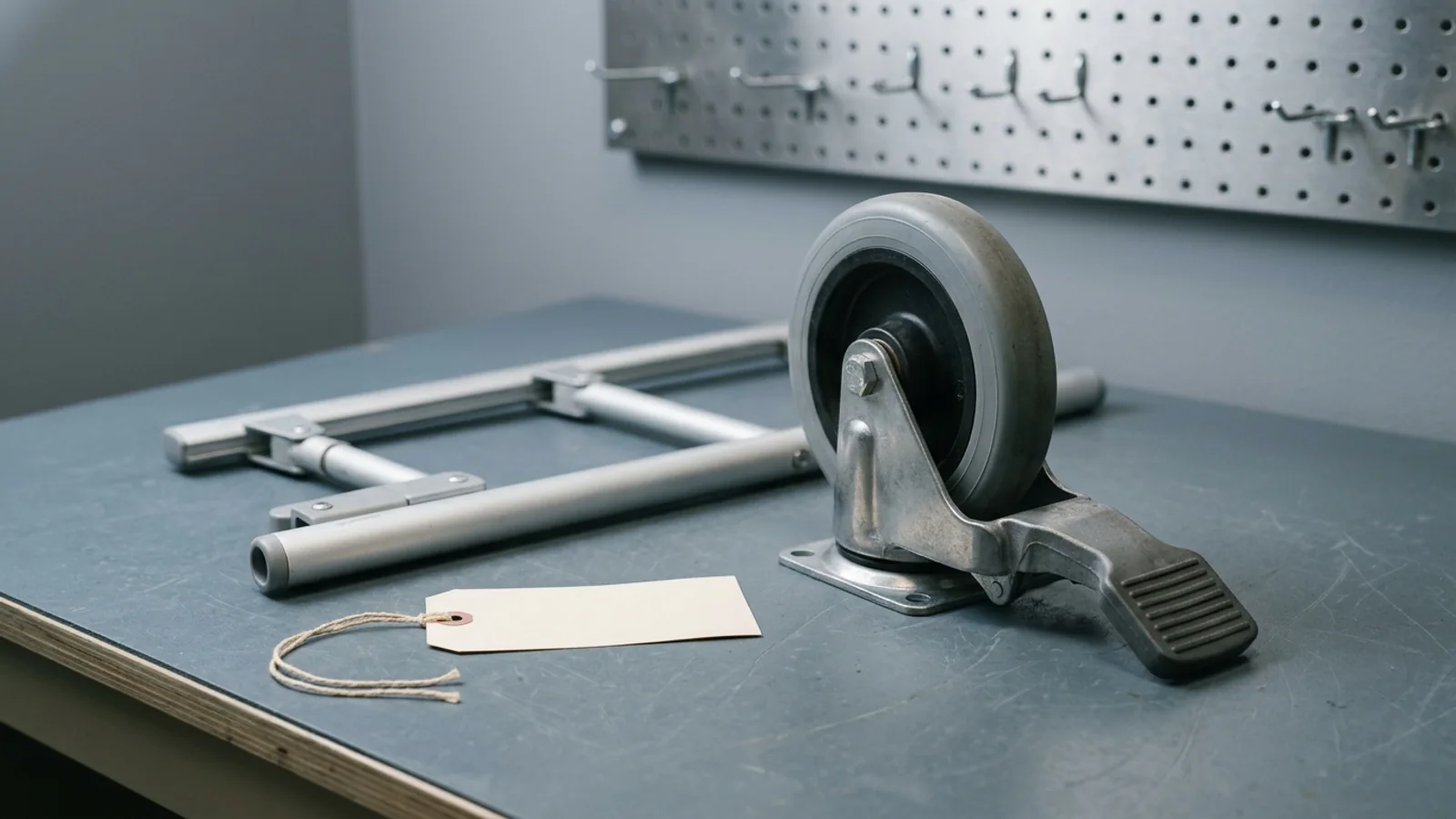
Decide whether this bed stays in service after a brake, rail, or movement complaint
When clinical staff report that a hospital bed drifts during a patient transfer, that a side rail requires repeated slamming to stay upright, or that an articulation motor creeps after releasing the control pendant, biomedical equipment technicians (BMETs) and healthcare technology management (HTM) leaders face an immediate operational decision: does this bed remain in clinical service, or must it be immediately removed from the patient room?
The decision is whether this named bed stays in service after the manufacturer’s prescribed checks, not whether a technician can rebuild the caster or latch at the bedside. Run the model IFU set-and-push, click-and-pull (or equivalent latch confirmation), and commanded-versus-unintended motion checks. Take the bed out of service when those checks fail, or when an open recall already requires removal. Brakes that do not hold after the IFU set procedure, a steer caster that will not trail, a siderail that will not latch or that drops when gently pulled or shaken, or motion that continues after a control is released or locked out are classified-function failures on an FDA hospital bed, not comfort complaints. Do not leave an occupied bed in service once those checks fail while waiting for a scheduled maintenance window.
Clinical engineering teams must avoid two widespread service pitfalls when responding to bed complaints. First, never attempt unapproved field repairs or latch disassembly using generic shop hardware. Latch, caster, and actuator work belongs to qualified service against the named IFU, not a bedside rebuild. Second, never fabricate a universal brake-holding force or latch-force specification. No published manufacturer IFU provides a benchtop newton or pound-force threshold for routine clinical checks. Instead, manufacturers specify repeatable, functional procedures—such as the set-and-push check for brakes and the click-and-pull check for siderails—supplemented by open recall correction notices.
Defensible return-to-service decisions depend on a rigorous, three-stage evaluation: verifying physical performance against model-specific IFU criteria, assessing entrapment risk across FDA Zones 1–4 following any component change, and closing out documented inspect-and-test gates under CMS hospital maintenance requirements and HTM recall management workflows.
What counts as a hospital bed, and which functions are classified
To establish proper service boundaries, clinical engineering departments must identify the exact regulatory classification of the equipment. Under the Food, Drug, and Cosmetic Act, the Food and Drug Administration (FDA) classifies medical beds into three distinct product categories based on actuation power:
21 CFR 880.5100 (AC-Powered Adjustable Hospital Bed): An AC-powered device intended for medical purposes that consists of a built-in electric motor and remote controls to adjust the height and surface contour of the bed. The device includes movable and latchable side rails. Regulated as Class II (special controls), 510(k) exempt subject to the limitations of 21 CFR 880.9; assigned product code
FNL.21 CFR 880.5110 (Hydraulic Adjustable Hospital Bed): A hydraulic device intended for medical purposes that consists of a hydraulic mechanism operated by an attendant to adjust the height and surface contour of the bed. The device includes movable and latchable side rails. Regulated as Class I; assigned product code
FNK.21 CFR 880.5120 (Manual Adjustable Hospital Bed): A manual device intended for medical purposes that consists of a manual mechanism operated by an attendant to adjust the height and surface contour of the bed. The device includes movable and latchable side rails. Regulated as Class I (general controls); assigned product code
FNJ.
A critical legal and engineering fact unites all three regulations: the FDA classification identification in 21 CFR 880.5100, 880.5110, and 880.5120 explicitly includes movable and latchable side rails as part of the classified medical device. Consequently, a malfunctioning side-rail latch is not an accessory annoyance—it is a functional failure of a regulated medical device. Furthermore, FDA's 2006 Hospital Bed System Dimensional and Assessment Guidance to Reduce Entrapment defines the hospital bed system as the integrated assembly of the bed frame, the mattress, the bed side rails, head and foot boards, and any attached clinical accessories. Stretchers used for extended patient stays in emergency or observation units are treated as hospital beds for entrapment assessment.
This medical device definition strictly excludes three categories of equipment:
Transport stretchers and examination tables intended primarily for short-term patient transit or procedural examination.
Pediatric cribs, youth beds, and infant incubators, which are governed by specialized anthropometric standards including IEC 80601-2-89 and distinct FDA classifications.
Consumer adult portable bed rails regulated by the Consumer Product Safety Commission (CPSC) under 16 CFR Part 1270. CPSC recalls of consumer bed attachments must not be conflated with hospital bed systems.
The clinical consequence of mechanical failure on a regulated bed system is severe. FDA's Hospital Beds public records (updated through August 2018) document that between January 1, 1985, and January 1, 2013, the agency received 901 reports of patient entrapment incidents in hospital beds, resulting in 531 deaths, 151 nonfatal injuries, and 220 staff interventions to free trapped patients. FDA's 2006 guidance analyzed an earlier cohort of 691 reports (413 deaths, 120 injuries, and 158 near misses). In both analyses, the overwhelming majority of victims were frail, elderly, or cognitively impaired patients. Clinical engineering teams must recognize that these published figures reflect adverse events voluntarily or mandatorily reported to FDA databases (MAUDE/MDR), rather than controlled epidemiological incidence rates.
From a standards perspective, the current FDA Recognized Consensus Standard for adult medical beds is IEC 60601-2-52 Edition 1.1 2015-03 (Recognition Number 6-489), covering basic safety and essential performance for product codes FNL, LLI, FNK, and FNJ. On May 5, 2026, the International Electrotechnical Commission published IEC 80601-2-52:2026, which cancels and replaces IEC 60601-2-52 internationally. However, as of September 2026, IEC 80601-2-52:2026 is not yet listed in the FDA Recognized Consensus Standards database. More importantly, manufacturer type-test standards and informative annexes (such as Annex DD periodic inspection) are design and laboratory standards—they do not replace facility-level preventive maintenance or the clinical engineering inspection procedures established by hospital policy.
Siderail evidence: latch first, then FDA Zones 1–4 as a bed system
Evaluating a side rail requires a two-step evidence process: first, confirming positive mechanical latch stability; second, measuring dimensional gaps across the bed system. A side rail that cannot reliably latch must never be assessed for dimensional gaps—it must be removed from service immediately.
Manufacturer instructions provide the authoritative baseline for latch verification. For example, the Hill-Rom Centrella Smart+ Bed Instructions for Use (193587 REV 15) instructs operators to raise the side rail until an audible click is heard, followed immediately by a gentle pull to ensure positive engagement:
Raise procedure: Pull the siderail up and push it in until it latches; you will hear a click.
Confirmation check: After the click, gently pull on the siderail to make sure it is latched correctly.
Operational warning: Siderails are designed to serve as a reminder of the bed's perimeter, not as a patient-restraining device. Never use siderails to pull or transport the bed.
The IFU click-and-pull check is the field method. FDA Class 2 Recall Z-2738-2020 (Centrella Smart+ catalog P7900; serials V133PF2502 through V142PF3819, manufactured 12–21 May 2020; terminated 20 October 2022) was a nonconforming-screw correction limited to listed units. Until those beds were updated, the firm's action required: "Follow the Instructions for Use each time when raising a siderail to the latched position. If the siderails are not latching properly, take the bed immediately out of service until updated." Similarly, the Hospital Bed Safety Workgroup (HBSW) Clinical Guidance posted by FDA establishes that "latches securing bed rails should be stable so that the bed rails will not fall when shaken." Health Canada's Adult Hospital Beds guidance reinforces this requirement by warning against false-latch conditions—scenarios where a rail appears locked in an elevated position but drops upon minor lateral force. Note that Health Canada's cited 30,000-cycle latch durability test is a factory design protocol, not a clinical engineering field test.
Once latch integrity is verified, technicians must assess FDA Entrapment Zones 1 through 4 whenever a rail is replaced, a frame pivot is repaired, or an alternative mattress is installed. FDA's 2006 dimensional guidance established numeric recommendations for Zones 1–4 because historical surveillance demonstrated that these four zones accounted for the overwhelming majority of fatal entrapments:
Zone 1 (Within the rail): Any open space within the perimeter of the side rail itself must be less than 120 mm (4 3/4 inches). This dimension prevents passage of a patient's head.
Zone 2 (Under the rail, between supports or adjacent to a single support): The opening between the bottom edge of the side rail and the top surface of the mattress, measured between support legs, must be less than 120 mm (4 3/4 inches). This prevents head passage under the rail.
Zone 3 (Between the rail and mattress): The space between the inside surface of the side rail and the side of the mattress must be less than 120 mm (4 3/4 inches). This prevents head entrapment between the mattress side and the rail.
Zone 4 (Under the rail at the ends): The space between the lower corner of the rail and the mattress deck at the articulated ends must be less than 60 mm (2 3/8 inches), AND any V-shaped angle formed by the rail and mattress deck must be greater than 60 degrees. This critical limit prevents neck entrapment and airway compression.
FDA identified Zones 5, 6, and 7 (between split side rails, between the rail and head/foot boards, and between the headboard and mattress), but explicitly declined to issue numeric dimensional recommendations for Zones 5–7 due to insufficient adverse incident data. Clinical engineering departments must not invent arbitrary millimeter thresholds for Zones 5–7.
Furthermore, the 2006 guidance emphasizes that every hospital bed becomes a legacy bed once installed. Wear, play from loosened rails, and substitution of mattresses or rails not contemplated in the original system can change Zones 2–4. After any mattress, rail, or latch substitution, reassess Zones 1–4 as a bed system. FDA recommends the HBSW dimensional test methods in Appendix F as an acceptable approach for healthcare facilities; IEC type-test methods are not readily applicable for facility use. Do not invent numeric limits for Zones 5–7. Do not apply the Zone 1–4 millimetre figures to pediatric, bariatric, or infant products, air-fluidized therapy beds, or most compressible therapeutic mattress replacements except Zone 1.
| Inspection Parameter | Evaluation Standard & Zone | Dimensional / Physical Limit | Immediate Out-of-Service Trigger |
|---|---|---|---|
| Latch Engagement | OEM IFU / HBSW Guidance | Audible click; stable under gentle pull/shake | Rail fails to lock, drops under shake, or shows false latch |
| Zone 1 Opening | FDA 2006 Guidance Table 3 | < 120 mm (4 3/4 in) | Opening >= 120 mm under cone tool probe |
| Zone 2 Opening | FDA 2006 Guidance Table 3 | < 120 mm (4 3/4 in) | Under-rail gap >= 120 mm between rail supports |
| Zone 3 Opening | FDA 2006 Guidance Table 3 | < 120 mm (4 3/4 in) | Mattress-to-rail gap >= 120 mm with cylinder probe |
| Zone 4 Opening | FDA 2006 Guidance Table 3 | < 60 mm (2 3/8 in) AND angle > 60° | End gap >= 60 mm or acute angle <= 60° (neck trap) |
| Mattress Fit | Bed System Compatibility | OEM-specified dimensions & firmness | Excessive lateral shift or compression exposing gaps |
Brake and steer evidence: set, push, trail, then recall match
Hospital bed mobility systems are safety mechanisms designed to prevent patient falls during unassisted egress or caregiver transfers. When testing caster braking and steering, technicians must rely on functional set-and-push procedures rather than uncalibrated force measurements.
Each major hospital bed platform features specific brake actuation geometry and published recall triggers that dictate return-to-service decisions:
Hillrom Centrella Smart+ (Catalog P7900): Features a three-position pedal assembly: Brake (orange pedal, pressed fully downward), Steer (green pedal, pressed fully downward), and Neutral (pedal level for sideways movement). The Centrella IFU (193587 REV 15) requires that foot-end casters be in a trailing position before steer. Failure to trail can produce erratic movement. The same Z-2738-2020 action, limited to the listed serials, also required: "Follow the Instructions for Use each time when setting the brakes. If the brakes do not hold after following the instructions, take the bed out of service until updated. After placing the bed in steer and beginning transport, if there is difficulty aligning a caster in the trailing position and maintaining control, take the bed out of service until updated."
Hill-Rom Progressa Bed (Catalog P7500): FDA Class 2 Recall Z-1319-2018 (beds manufactured 8 June 2017–1 November 2017; serials S159AW9192 through S305AW2321; terminated 26 June 2020) identified a braking-system component that may break so one or more pedals stay in brake or are not engaged, which could result in unwanted bed movement. That unwanted travel is a brake-system failure, not a pendant software bug. Until listed units were updated, the firm required staff to: "Always set the brakes when the bed is occupied, except during patient transport. After setting the brakes, push and pull the bed to check stability. If brakes do not hold, take the bed out of service until updated."
Stryker Secure II (Model 3002) & S3 Signature Series (Model 3002/3005): The Stryker S3 Operations Manual (3006-009-201 REV C) establishes standard operating rules: always apply caster brakes when a patient gets on or off the bed; push the bed sideways to ensure the brakes are securely locked; and keep brakes engaged unless actively transporting. FDA Class 2 Recall Z-1685-2008 (posted 19 September 2008; terminated 5 November 2010; Model 3002 serials 040915077 through 071116347) documented that brakes may not have adequate holding power to lock the bed in place. A separate FDA Class 2 recall record for Medical Surgical Bed Model 3002S3EX (RES id 114351) states that affected beds may have been built with brake rings that do not meet specifications, negatively impacting brake holding force. Neither record publishes a numeric holding-force limit, and neither is a shop rebuild procedure. Use the IFU sideways-push check on current units, and match open RES records by catalog and serial before treating a terminated action as a live correction.
Stryker ProCuity Series: Modern ProCuity models can set electric brakes from the footboard touchscreen or siderail controls, according to Stryker's product page; that page does not publish a holding-force specification or a visual-icon field procedure. An October 2024 MAUDE report on model 300900000002 described inadvertent brake release from an unlocked outside siderail control or footboard touchscreen during transfer; MAUDE is a reported event, not incidence and not an OEM specification. ProCuity Class 2 Recall Z-0424-2024 concerned missing IEC 62353 electrical-safety test values in service documentation—not a mechanical brake or rail defect. Route electrical testing questions to post-repair electrical safety protocols.
| Bed Platform | Brake / Steer Architecture | Standard Field Verification Check | Mandated Out-of-Service Trigger |
|---|---|---|---|
| Hillrom Centrella (P7900) | Three-position pedal (Orange Brake / Green Steer / Neutral) | Depress orange pedal fully; push bed longitudinal & lateral; trail foot casters before steer | Brakes slip after IFU set; caster fails to trail; binding or frame deformation (Z-2738-2020 listed serials; terminated) |
| Hillrom Progressa (P7500) | Central brake pedals; braking-system component may break (Z-1319-2018) | Engage brake pedal; execute bidirectional push-and-pull stability check | Pedal in brake or not engaged; bed moves after push-and-pull (Z-1319-2018, listed serials; terminated) |
| Stryker Secure II & S3 (3002) | Caster brakes set from side pedals; confirm with the IFU sideways push | Depress brake pedal; apply lateral (sideways) push force against frame | Bed moves sideways after IFU sideways-push; Z-1685-2008 was listed serials, now terminated |
| Stryker ProCuity Series | Electric motorized caster brakes with touchscreen / rail control | Follow that model's IFU for electric-brake set locations (touchscreen or siderails); do not invent a holding-force number | Do not treat MAUDE events or the missing IEC 62353-value recall (Z-0424-2024) as this brake decision |
Movement evidence: lockout, pendant, and unintended motion
Unintended bed movement falls into two distinct failure categories: involuntary frame rolling due to brake failure (as detailed above), and uncommanded electrical articulation of the head, foot, or height deck actuators.
Standard definitions in IEC 60601-2-52 distinguish two key user interfaces that clinical engineering teams must evaluate:
Pendant Control: A handheld or rail-mounted device provided with operating controls intended to command articulations, bed elevation, or contour adjustments.
Motion Lockout Control: An auxiliary subsystem operated by clinical staff that deactivates specific motion controls to prevent unwanted or medically contraindicated patient articulation.
FDA Class 2 Recall Z-0738-2012 (terminated 20 July 2012) covered remote handsets for Linet Multicare, Eleganza 3, and Eleganza Smart beds (product code FNL). The manufacturer reason was premature failure of remote-handset buttons that may result in unintended movement of the bed; the field correction was handset replacement by the firm, not a hospital rebuild.
When testing bed movement during preventive maintenance or following a work order, technicians must execute three sequential checks:
Commanded Motion Verification: Confirm commanded motions run only when selected on attendant, pendant, and siderail controls, and that motion stops when the control is released. If motion continues after release, occurs when lockout is engaged, or occurs without a command, take the bed out of service. Accept only against the named model's IFU; do not treat grinding noise as a numeric specification.
Lockout Integrity Check: Activate the model's motion lockout (for Centrella, lock out FlexAfoot after length adjustment; lock out other articulations as that IFU directs). Attempt to command the locked functions from pendants and siderail controls. Locked functions must remain inactive.
Transport Integrity Verification: Do not use siderails to move the bed; Centrella IFU requires push or pull from the headboard or footboard. If a transport complaint remains after brakes, steer, and lockout checks, take the bed out of service rather than diagnosing handles or hinge pins from this page.
Technicians must also maintain clear boundaries between physical bed movement and connected electronic alerts. Two prominent FDA recalls illustrate this distinction:
Baxter/Hillrom WatchCare Class I Recall: Involved radiofrequency (RF) interference between incontinence sensor pads and hospital telemetry systems. This was an RF coexistence issue, not a mechanical bed-motion defect.
Centrella Class 2 Recall Z-0228-2025: Affected Centrella software version 1.27.000 used with Rauland Responder 5, where the bed-exit system may alert at the bed but fail to send a remote alert through the nurse-call system. That is an interface defect, not a brake, rail, or movement failure.
Escalate, then record return-to-service without repairing from this page
When a hospital bed fails any brake, steering, latch, or movement verification check, clinical engineering teams must follow a strict, documented escalation pathway:
Tag and Quarantine: Tag the bed out of service, keep it unoccupied, and record the hold in the CMMS. Follow the facility's equipment-hold procedure. Do not transport an unbraked occupied bed, and do not treat disconnect-and-roll steps on this page as a repair method.
FDA Recall Database Cross-Check: Check the FDA Recall Enterprise System (RES) using the exact catalog, model, and serial. Historical OOS sentences in terminated recalls still describe the public user checks; they do not by themselves prove the unit is under an open correction. Follow HTM recall response guidelines to execute manufacturer-mandated correction kits.
Qualified Service vs Remanufacturing: Perform repairs using only OEM-authorized replacement parts and factory service manuals. Under FDA's May 2024 guidance Remanufacturing of Medical Devices, routine servicing returns a finished device to its original performance and safety specifications. However, installing non-OEM mattresses, modified side rails, or third-party actuators that alter entrapment gap dimensions, structural load ratings, or braking friction crosses the legal threshold into medical device remanufacturing. Review servicing versus remanufacturing boundaries before substituting non-OEM parts.
CMS Inspect-and-Test Verification Gate: Under 42 CFR 482.41(d)(2), facilities, supplies, and equipment must be maintained to ensure an acceptable level of safety and quality. That sentence does not define a hospital-bed brake or rail method. S&C 14-07 used must for inspect-and-test after major repairs or upgrades; current QSO-25-24 Tag A-0724 uses should for that inspect-and-test sentence and keeps must for ongoing inspect, test, and maintain. CMS does not define major repair. Brake-system, siderail/latch, caster/brake-ring, and actuator or control work are candidates for that gate when the OEM IFU or a named recall treats the function as safety-critical; if the major/upgrade call is uncertain, the conservative CMS-aligned move is still to inspect and test before return. Route the trigger decision through the published major-repair article, and keep IEC 62353 method selection on the electrical-safety article as a parallel gate.
Document Work Order Close-Out: A defensible CMMS work order record must be generated before releasing the bed. In accordance with HTM service documentation standards, the record should reconstruct device identity, the clinical symptom, the IFU/recall checks performed, Zone 1–4 results when mattress or rail work occurred, whether the work was treated as a CMS major repair or upgrade, who authorized return, and the date. Do not invent a numeric brake-holding result the IFU does not publish.
flowchart TD
    A["Bed complaint: brake, rail, or motion"] --> B{"IFU check\nSet-and-push / click-and-pull / commanded motion"}
    B -->|Check fails| C["Tag out of service\nHold in CMMS"]
    B -->|Check passes| D["Record the checks\nReturn only if no other hold"]
    C --> E{"Open FDA RES match?\nExact catalog / serial"}
    E -->|Open correction| F["Follow the recall action\nDo not DIY the correction"]
    E -->|No open match| G["Qualified service\nOEM-specified parts and IFU"]
    F --> H{"Mattress, rail, or latch substituted?"}
    G --> H
    H -->|Yes| I["Reassess FDA Zones 1-4 as a bed system\nHBSW methods are acceptable"]
    H -->|No| J{"Could the work be a CMS major repair or upgrade?"}
    I -->|Zones meet 2006 limits| J
    I -->|Zones fail| K["Do not return\nParts/remanufacturing review"]
    J -->|Treat as major/upgrade or uncertain| L["Inspect-and-test performance and safety\nS&C 14-07 must / QSO-25-24 should; 62353 is parallel"]
    J -->|Clearly not major| M["Document IFU functional checks"]
    L --> N["CMMS record and authorized return"]
    M --> N