
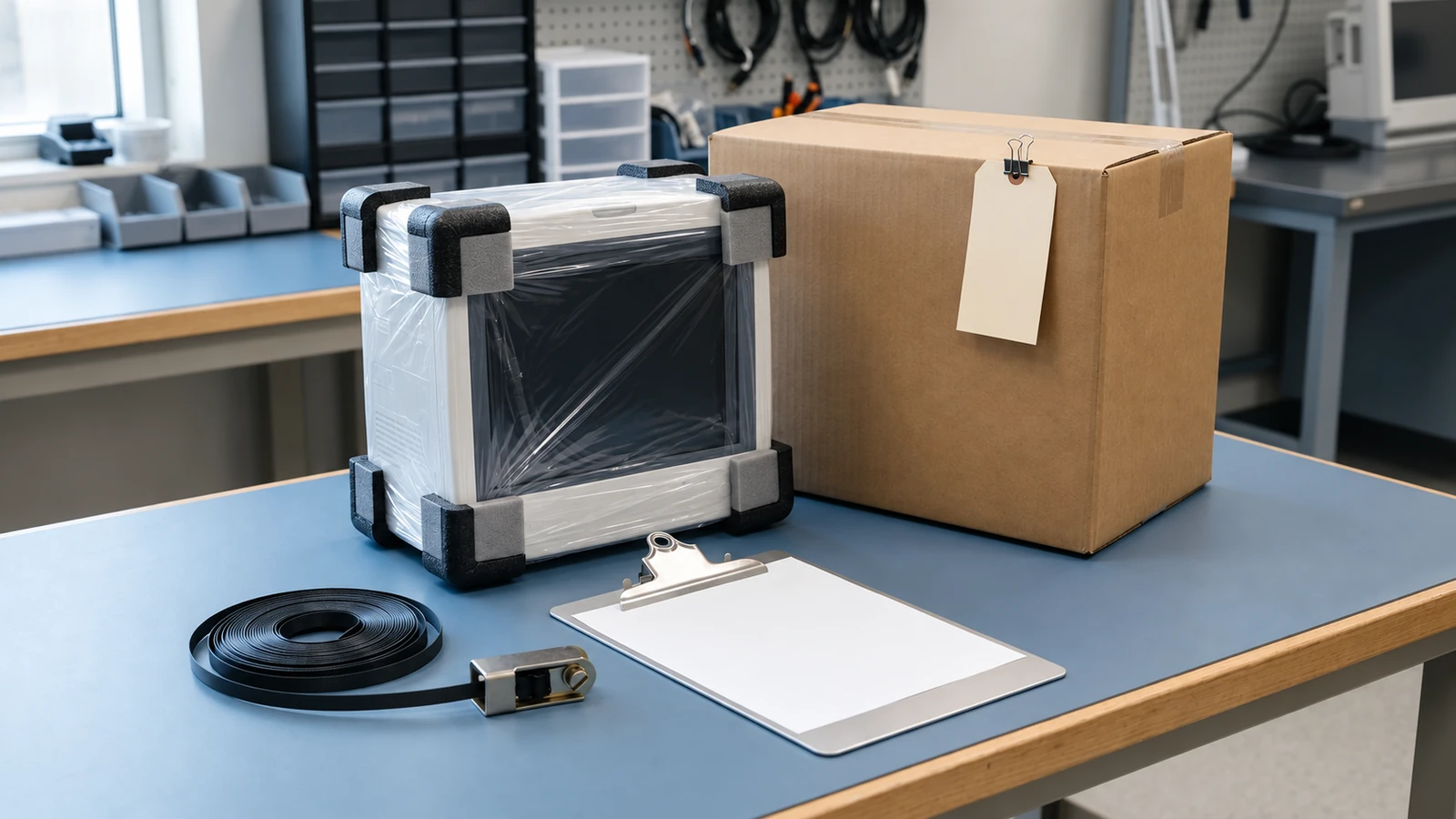
Before sending medical equipment for off-site repair, establish its handling status, complete the receiving provider’s required paperwork, and connect the shipment to the service work order. A certificate records the decontamination performed; its signature cannot make an unknown or contaminated device safe. The practical decision is whether the available evidence supports dispatch through the intended receiving route.
For biomedical equipment technicians and independent service teams, the outbound packet should answer three questions: which device is moving, what handling hazards remain, and who has agreed to receive it? This guide separates the U.S. worker-protection rule from sampled vendor terms and recommended record controls. It addresses the shipping stage of the service record, without replacing the device’s instructions for use or the facility’s reprocessing procedure.
What OSHA actually requires before equipment leaves
The OSHA Bloodborne Pathogens standard applies to occupational exposure to blood or other potentially infectious materials (OPIM). Paragraph 1910.1030(d)(2)(xiv) requires potentially contaminated equipment to be examined before servicing or shipping and decontaminated as necessary, unless the employer can demonstrate that decontamination of the equipment or a portion is infeasible.
Subparagraph (A) requires an observable equipment label identifying the portions that remain contaminated, consistent with (g)(1)(i)(H). Subparagraph (B) requires that information to reach affected employees, the servicing representative and/or manufacturer, as appropriate, before handling, servicing or shipping. A certificate cannot replace that label or communication.
OSHA’s September 6, 2019 interpretation addresses outer, tertiary shipping packages: when DOT labels are not required but contents present potential blood or OPIM exposure, OSHA biohazard labeling applies. Where the label duties overlap, the letter accepts a DOT label outside if OSHA labels appear on internal containers that are present. This interpretation explains labeling; it does not itself authorize a shipment or determine its transport classification. Have the facility’s responsible shipping personnel resolve applicable carrier and transport requirements before release.
What a decontamination certificate should record
Start with the receiver’s current form. The Stirling Ultracold freezer certificate, revision 0 dated June 25, 2020 is a concrete example: it collects contact information, model and serial number, exposure history, measures taken, and a dated signature. It also asks about inaccessible surfaces or compartments. This laboratory-freezer form is useful evidence of certificate practice, rather than a universal template for monitors, pumps or endoscopes.
The table below is a recommended review checklist. Some entries support the local work order rather than being fields required by every vendor. Keep the certificate’s wording and supporting records consistent; if the receiver’s form cannot represent a partial or unknown status, resolve that mismatch before signing.
| Review item | Evidence to check | Reason for the check |
|---|---|---|
| Device identity | Match model and serial number to the device and return authorization; use an asset ID locally. | Prevent a certificate for one unit being attached to another. |
| Exposure history | Record known hazards and the basis for the answer; distinguish unknown history from confirmed no exposure. | Give the receiver a meaningful account of the handling risk. |
| Work completed | Describe the applicable procedure and date; link the device to its reprocessing or cleaning record. | Allow the signer to substantiate what was performed. |
| Residual or inaccessible areas | Identify unresolved portions and the disposition agreed with the responsible safety staff and receiver. | Prevent a surface-cleaning record being treated as complete clearance. |
| Signer and contact | Check the required signature, date, printed name and reachable facility contact. | Allow a receiving technician to resolve a discrepancy. |
| Return authorization | Reconcile the authorization number, recipient and shipment contents with the vendor’s instructions. | Connect the safety declaration to the intended return. |
Route the physical document as the receiving provider specifies. Olympus’s June 1, 2020 return policy calls for a signed certificate in the return package. Stirling’s form calls for the completed certificate outside the shipping container. These examples do not establish a universal rule requiring both locations. A duplicate may be useful if the receiver agrees, but it should reproduce the same status and signature rather than introduce conflicting declarations.
As a local control, retain a legible electronic copy with the work order and note where the traveling copy was placed. Verify that any required exterior declaration will be accessible at receiving. A decontamination-status document, the hazard label and the carrier label serve different purposes; completing one does not resolve the others.
Three handling states before dispatch
Use the following operational decision aid to organize the review. These are workflow states, not three legal shipping classifications. Receiver agreement is an additional coordination step; it cannot waive the employer’s decontamination, labeling or communication duties.
| Handling state | Evidence needed | Dispatch decision |
|---|---|---|
| Decontamination completed | A device-linked record supports completion of the applicable procedure and the certificate’s wording. | Proceed when the vendor paperwork, packaging and shipping review are complete. |
| Contamination remains and decontamination is infeasible | Document the affected portions, the basis for infeasibility, required labels and advance hazard communication. | Hold until responsible safety and shipping staff and the receiver have resolved handling and acceptance. |
| Damage prevents the normal process, or status is unknown | Identify the limitation and obtain instructions for the specific device and condition. | Hold for resolution; a return authorization alone is insufficient evidence of safe handling. |
Choose reprocessing through the device instructions and the applicable facility procedure. CDC’s recommendations distinguish sterilization, high-level disinfection and low-level disinfection by intended patient contact; they recommend low-level disinfection for noncritical equipment touching intact skin. They also recommend disinfecting noncritical devices when visibly soiled and regularly, and following product instructions for compatibility and safe use. There is no blanket CDC requirement for intermediate-level disinfection of every monitor or pump before repair.
A leaking endoscope illustrates why damage needs a separate review. The Olympus TJF-Q190V reprocessing manual, page 96, directs users who identify a leak to contact Olympus for instructions on reprocessing the leaking endoscope before returning it for repair. This instruction is specific to that model. Olympus’s OER-Elite product page describes a capability to decontaminate a leaking scope before service. That capability statement does not provide operating instructions, establish compatibility for every scope, or authorize an ordinary cycle. Obtain the relevant manufacturer instructions and qualified reprocessing support rather than choosing a method from this article. Keep the device out of clinical use while the return is resolved; see the endoscope leak-test failure guide for the separate failure-evidence task.
Getting the return authorization right
An authorization number identifies an accepted return request, while the contamination record describes handling status. Verify both. The examples below are published policy snapshots, not a survey of all repair vendors. Confirm the terms applying to the specific service order before dispatch, particularly for damaged equipment or residual hazards.
| Source and scope | Verified published terms | Question for the dispatch review |
|---|---|---|
| Olympus Medical Systems Group, June 1, 2020 | Prior RMA; number on carton and shipping documents; 30-day validity; customer-prepaid returns, with an Olympus-error exception. Used devices must be decontaminated or sterilized; returns lacking a signed certificate are refused. | Is this authorization still valid, and is the signed certificate included as instructed? |
| GE HealthCare On Demand Quotation service terms, page labeled March 2026 | Return-for-repair clause 1.3 requires backup and removal of stored data; the customer is responsible for shipment damage. GE may remove data before return. | Who is authorized to manage the data, and what backup and removal evidence is available? |
| Stirling Ultracold freezer form, June 25, 2020 | Certificate submission precedes RA processing; signed certificate goes outside the container. The form requires an RA number and warns of denied returns and shipper expense when documentation is absent. | Does the declared condition meet this receiver’s acceptance wording? |
GE’s return-for-repair clause does not specify a decontamination certificate. Follow the applicable receiving instructions rather than inferring a universal certificate rule. Likewise, backup and removal of stored data is not an instruction to delete operating software or perform an improvised reset. Assign that work to authorized personnel using the device and facility procedures, and retain the resulting record separately from the decontamination declaration.
What the shipping record should retain in the CMMS
The computerized maintenance management system (CMMS) can connect the physical shipment with its supporting evidence. The following packet is a recommended operational control assembled for this handoff, rather than a regulator-prescribed field list or a permanent-retention rule. Apply the facility’s records policy to retention and access. The goal is to reconstruct what left, its declared status, and who received the information.
Certificate and supporting evidence. Retain the exact signed version that traveled with the device, its date and the device identity. Link the applicable cleaning or reprocessing record rather than relying on a generic department log. If the declaration describes a limitation, keep the same limitation visible in the work order.
Authorization and receiving instructions. Keep the return confirmation, authorized address, validity period if applicable, and the instructions used to prepare the packet. Record the named contact and any handling discussion. Review the service provider’s qualification through the facility’s separate supplier process.
Hazard communication and disposition. For a residual hazard, retain the identified portions, recipients informed, timing, and agreed next action. Record who resolved the shipping and acceptance questions. A telephone discussion can be summarized in the work order so subsequent staff can follow the decision.
Shipment identity and movement. Record carrier, tracking or waybill number, dispatch date, shipment contents and delivery confirmation. Distinguish courier pickup from receipt at the repair provider. For contract turnaround tracking, use the start event defined in the agreement.
Condition and packaging evidence. Retain suitable photographs or receiving notes showing device condition and protective packaging. Choose views that answer the likely dispute; there is no universal minimum of four photographs. Pictures support a condition record, but do not prove decontamination or guarantee recovery for transit damage.
Fault handoff and data status. Preserve the fault description sent to the service provider and the record of any required data backup or removal. Keep patient information out of routine shipping paperwork and public-facing labels; use the facility’s approved handling process for sensitive records.
For example, a monitor may have a completed external-cleaning record but an unresolved report that fluid entered its enclosure. Do not collapse those two facts into a general “decontaminated” checkbox. Record the completed work, flag the unresolved area, and ask the responsible safety staff and receiver what evidence or instructions are needed. Until that review is resolved, keep the dispatch task open rather than treating the courier booking as approval.
Use a second check at packing to reconcile the unit, certificate and authorization. If the serial numbers differ, the form is unsigned, or the shipping instructions conflict with the declared condition, stop the handoff and assign an owner to correct the gap. If the device returns after a receiving rejection, record the reason and reassess the packet before sending it again. These local controls make missing evidence visible without creating invented regulatory test limits.
Loaners, trade-ins, and the return leg
Apply the same review questions to a used loaner or transfer: what was exposed, what work was completed, and what does the recipient require? The UK MHRA’s Managing Medical Devices, January 2021, section 9 recommends decontamination before inspection, maintenance or repair, including returned loaned items, with a contamination-status declaration accessible to the recipient. Sections 10.3 and 10.4 address certificates for applicable transfers, resale or donation. This is UK guidance, rather than a U.S. certificate mandate.
The Northern Ireland Infection Prevention and Control Manual specifies a decontamination-status certificate for equipment sent to a third party for inspection, servicing or repair. It also directs staff to follow COSHH risk assessments and manufacturer guidance. These are useful examples of regional policy structure; U.S. facilities should identify their own applicable requirements.
The TJF-Q190V manual’s section 1.5 (page 17) states that new and repaired endoscopes and new accessories are not reprocessed before shipping from Olympus, including demo and loaner equipment. It instructs users to reprocess the received endoscope and accessories before storage or a patient procedure. On the return leg, verify the received unit and accessories against the manifest, record the provider’s stated reprocessing condition, and route the device through its applicable reprocessing and return-to-service review. A service-completion report is evidence about repair work; release for patient use should also resolve the receiving facility’s handling and use requirements. Assign ownership for those checks before the device leaves the receiving area.
Who signs, and where responsibility stops
Have the person authorized by the facility and receiving form sign only the declaration that the records support. Stirling’s form, for example, specifies a laboratory safety officer or another authorized certifier. It does not establish that every biomedical technician may sign every vendor’s certificate. Confirm the role and the meaning of the attestation before using a prefilled form.
The signer should be able to identify the device-linked evidence for the work performed and explain any limitation. Firsthand participation or a traceable reprocessing record can support review; the signature should not be based solely on appearance, an unsigned note or the courier’s deadline. If the form certifies a condition the available evidence cannot support, resolve the condition or obtain an acceptable declaration from the receiver.