
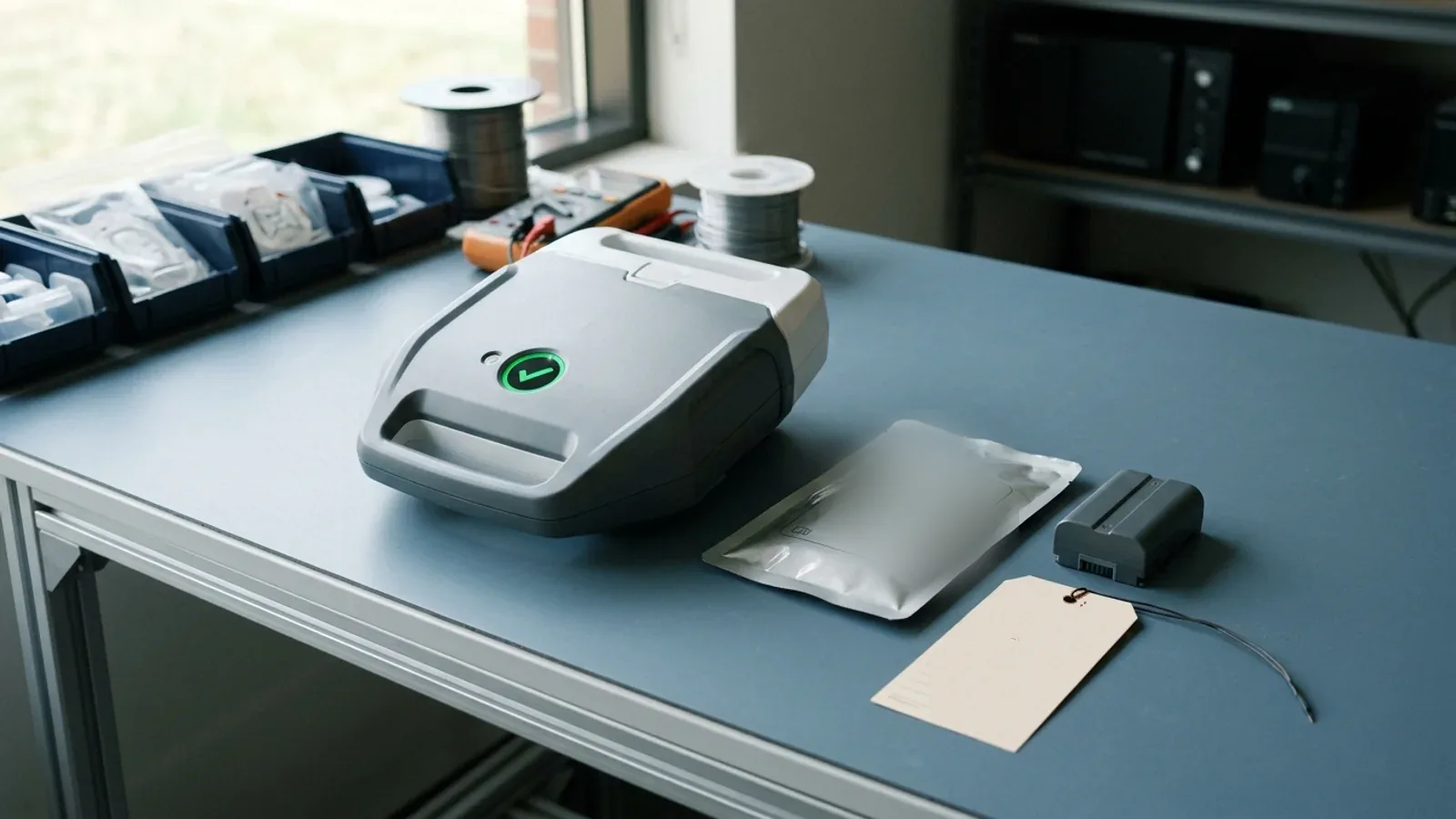
What Makes an AED Ready: Pads, Battery, and Self-Test Status
An automated external defibrillator (AED) is rescue-ready only when three conditions are satisfied simultaneously: its labeled consumables (electrode pads and primary battery pack, or a unified cartridge) are strictly within their printed expiration dates, its visual readiness indicator displays the manufacturer's active pass state, and sealed, uncompromised electrodes are properly connected to the pulse generator. In healthcare technology management (HTM) and facility safety programs, assuming that a green flashing light guarantees rescue capability is one of the most dangerous operational errors a service team can make.
Under 21 CFR 870.5310 and the Food and Drug Administration's (FDA) 2015 Premarket Approval (PMA) Final Order (80 FR 4787), an AED is regulated as a Class III life-supporting medical device system. Critically, this regulatory classification covers not merely the physical pulse-generator housing, but the entire functional ecosystem required to acquire an electrocardiogram (ECG), analyze the cardiac rhythm, and deliver a biphasic defibrillation shock. The regulated system explicitly encompasses the primary battery pack, defibrillation pad electrodes, pediatric attenuator keys, and external cable adapters. Every element of this chain must remain validated and in date.
flowchart TD
    Start["AED Inspection at Station"] --> CheckIndicator{"Visual Readiness Indicator"}
    CheckIndicator -- "Pass (Flashing Green / Green Check)" --> InspectConsumables["Directly Inspect Consumable Dates"]
    CheckIndicator -- "Fault / Dark / Chirping" --> AlertTriage["Execute Model-Specific First Checks"]

    InspectConsumables --> DateCheck{"Pads or Battery Expired?"}
    DateCheck -- "Yes" --> ReplaceOnSpot["Replace Expired Consumable On the Spot"]
    DateCheck -- "No" --> VerifyIntegrity["Confirm Foil Pouch Seal & Pre-Connection"]

    VerifyIntegrity -- "Sealed & Connected" --> LogPass["Log Passing Check to CMMS Work Order"]
    VerifyIntegrity -- "Pouch Compromised" --> ReplacePad["Install Sealed Replacement Electrode"]

    AlertTriage --> CheckSeating{"Consumable Seated & Key Removed?"}
    CheckSeating -- "Resolved by Reseating" --> VerifyPass["Verify Normal Indicator Pass State"]
    CheckSeating -- "Persistent Error" --> AssessRecall{"Active Safety Alert or Phased Recall?"}

    AssessRecall -- "Yes (e.g. FDA Recall Advice)" --> MaintainInPlace["Keep Unit Available Until Replacement Arrives"]
    AssessRecall -- "No (Hardware Fault / Damaged)" --> TagOut["Tag Out of Service & Route to Qualified Repair"]

    ReplaceOnSpot --> LogAction["Log Replacement Part UDI & Lot in CMMS"]
    MaintainInPlace --> StageSpare["Order Immediate Replacement Unit"]
TagOut --> InstallLoaner["Deploy Reserve AED to Maintain Response Coverage"]When a biomedical technician or designated clinical lead inspects a cart or wall-mounted AED, the inspection requires physical verification of the consumables rather than a passing glance at the front bezel. If an electrode pad's conducting gel dries out due to seal degradation or chronological age, or if a lithium battery experiences cell depletion during standby, an emergency resuscitation will fail even if the device completed its internal self-check hours earlier. Establishing model-specific inspection routines is the only defensible method to maintain AED readiness across hospital departments, ambulatory clinics, and public access locations.
Why a Green Light Is Not Enough: Readiness Failure Evidence
The clinical engineering rationale for mandating physical date checks alongside status indicator observation is rooted in substantial peer-reviewed failure evidence. Relying solely on internal automated diagnostics creates a false sense of security because automated self-tests cannot evaluate the physical properties of the conductive gel or the hermetic integrity of the electrode foil pouch.
In a landmark retrospective study published in the Annals of Emergency Medicine, DeLuca and colleagues analyzed 40,787 adverse event reports submitted to the FDA MAUDE database between 1993 and 2008. The reports included 1,150 fatality events. Pads and connectors were cited in 23.7% of failures, and battery and power problems in 23.2%. The authors noted that, regardless of cause, these errors went unrecognized during the AED self-test sequence. Only 4.7% of malfunctioning AEDs gave a battery-low indication, and 9.6% powered off unexpectedly. The same paper cautions that this reporting database cannot support incidence rates.
Field registry studies demonstrate that consumable neglect is widespread in active deployments:
Danish Public AED Registry: In an evaluation of registered, publicly available AEDs published in Resuscitation (Jespersen et al., 2022), researchers found that almost one-fifth of the registered units were not functional, primarily because of expired electrodes, failed self-tests, or obstacles to retrieval. The study is a Danish public-access registry, so it describes that fleet rather than a U.S. hospital rate, and it does not support a single national battery-failure percentage.
Seoul Metropolitan Five-Year Inspection: A 5-year on-site audit of 23,619 public AEDs published in Scientific Reports (Kim et al., 2022) found that 3,646 of 23,619 units (15.4%) were not ready for use. Among those non-ready devices the recorded causes overlap: invalid electrodes in 83.7%, AED malfunction in 22.1%, and bad battery status in 17.2%. Those shares can exceed 100% because one unit can have more than one defect. The inspection is a Seoul public-access fleet, not a measure of U.S. hospital readiness.
These empirical findings are why a passing indicator is not a pad inspection. Expired or invalid electrodes were the dominant recorded reason public units were not ready, and the MAUDE analysis found pad, connector, and battery failures that the self-test sequence had not flagged. Read the printed date and confirm the pouch is sealed. Do not treat a green indicator as proof the gel will still conduct a shock.
The Readiness Map: Indicators and Consumables Across Five AED Platforms
Because major manufacturers utilize distinct indicator mechanisms, consumable form factors, and self-diagnostic cadences, clinical engineering teams must establish model-specific checklists. The table below maps the readiness indicators, consumable architectures, test cadences, and fault signals across five common FDA-approved platforms.
| AED Platform | Consumable Architecture & Expiry | Self-Test Cadence & Coverage | Rescue Ready State | Fault Indication & Audio Alerts | Approved Consumables & FDA PMA Scope |
|---|---|---|---|---|---|
| ZOLL AED Plus | Separate consumables. CPR-D-padz (one-piece with real-time CPR feedback sensor, up to 5-year shelf life) or Stat-padz II / Pedi-padz II. Primary power: sleeve of 10 commercially available Type 123 lithium manganese dioxide batteries with 5-year standby life. | Battery-installation, power-on, manual, and automatic self-tests, plus an automatic monthly test on software version 5.32 or higher. The monthly test is software-dependent; do not assume every installed AED Plus runs it. | Status indicator window displays a clear green checkmark (✔). | Status indicator shows a red X. The Administrator's Guide directs removing the unit from service. A warning sound may be present; the service decision follows the red X and the guide, not a single chirp interval. | PMA-approved system under 21 CFR 870.5310. FDA's accessory list for the AED Plus includes Stat-padz II, CPR-D-padz, and Pedi-padz II. Power is a set of ten Type 123 lithium cells as specified in the labeling; match the listed cell instead of treating one retail brand as the approval. |
| Philips HeartStart FRx | Separate consumables. SMART Pads II (Model 989803139261) packaged in a protective case with visible use-by date. Primary power: disposable M5070A 4-year lithium manganese dioxide battery pack with printed install-by date. Reusable Infant/Child Key. | Automatic daily self-tests plus a self-test when the battery is inserted. The Owner's Manual treats a blinking green Ready light as the sign that the defibrillator passed its most recent self-test. | Green Ready indicator blinks. | Green Ready light turns off. Single chirp every minute with flashing blue Information ('i') button indicates depleted battery, damaged pads, or key left inserted. Triple chirp signals a severe internal component failure. | PMA-approved system. Consumables: SMART Pads II (989803139261), M5070A battery pack, and Infant/Child Key (989803139311). |
| HeartSine samaritan PAD (350P / 360P / 450P) | Integrated cartridge. Pad-Pak-01 (Adult, gray) or Pediatric-Pak (pink) merges the lithium battery and defibrillation electrodes into a single cartridge with one synchronized expiration date (~4 years from manufacture). | Automatic weekly self-test verifying internal circuitry, battery power delivery, and electrode continuity. No user-initiated calibration or energy discharge required during routine PM. | Status indicator LED flashes green once every 5 to 10 seconds. | Status indicator flashes red or is unlit, or the unit emits a beep that does not stop. The manual's first check is the Pad-Pak expiration date. A red flash during the short weekly self-test can return to green if the test passes; a red indicator that continues is a fault. | PMA-approved system. Consumables: Pad-Pak-01 (adult battery/pad combo) and Pediatric-Pak (under 8 years / 55 lbs). |
| Stryker LIFEPAK CR2 | Separate consumables. QUIK-STEP electrodes with a 4-year shelf life, and a dedicated LIFEPAK CR2 non-rechargeable lithium battery pack. Stryker states a 4-year standby life if the battery is installed within one year of manufacture, about 800 minutes of ON time or 166 discharges at 200 joules. Those figures are labeling claims under the stated install condition, not measured fleet life. | Automatic daily, weekly, monthly, and power-on diagnostic routines (default test time 3:00 AM EST). Wi-Fi and cellular models transmit automated readiness status, self-test results, and consumable alerts to LIFELINKcentral. | Readiness indicator (bright green LED) flashes once every 6 seconds. | Readiness indicator LED turns off (dark) and a loud audible alert sounds every 15 minutes. Indicates expired electrodes, low battery reserve, or hardware malfunction. | PMA-approved system. Consumables for this row are QUIK-STEP electrodes and the CR2 lithium battery pack, catalog 11141-000165. Confirm the electrode catalog number on the pouch and on FDA's approved-accessory list; seller listings do not agree on one electrode number. This battery is not the older CR Plus Charge-Pak. |
| Defibtech Lifeline (DDU-100 Series) | Dual-battery architecture. Main therapy battery pack: DBP-1400 (5-year installed standby, 125 shocks or 8 hours) or DBP-2800 (7-year installed standby, 300 shocks or 16 hours). A separate 9V lithium cell (DAC-410, about one year installed) inside the pack powers the Active Status Indicator. Pre-connected pads: adult DDP-100 and child/infant DDP-200P on the current product page. Replace pads after each use or when the printed expiration date has passed. | Automatic daily, weekly, monthly, and quarterly electronic circuitry self-tests; battery-pack insertion integrity test; and daily pad-presence test verifying connector continuity. | Active Status Indicator shows green when the unit is rescue-ready. | A red or dark indicator means the unit needs service. The status indicator is powered by the separate DAC-410 9V cell, so a failed indicator can be that cell rather than an exhausted therapy pack. Replace the 9V only as the labeling directs, then confirm the indicator returns to green. If it does not, the unit is not ready. | PMA-approved Lifeline family. Packs for this row are DBP-1400 and DBP-2800, the DAC-410 9V cell, and DDP-100 and DDP-200P electrodes. The Lifeline VIEW uses a different pack (DBP-2003); do not order it from this row. |
Notice that a single rule such as 'all AED pads expire in two years' does not match the labeling. The HeartSine Pad-Pak and the LIFEPAK CR2 electrodes and battery are described as about four years under the manufacturer's storage and install conditions. Other pads, including pediatric sets, carry their own printed dates. Read the date on the package in front of you. Do not substitute a fleet-wide interval for that date.
Reading a Self-Test Alert: First Checks Before You Call the Unit Broken
When an AED begins chirping or drops its green pass indicator, clinical engineering and nursing personnel should not immediately declare the pulse generator defective and ship it off site. In many cases, the self-test alert is triggered by an unseated consumable, an expired accessory, or an operator error that can be diagnosed and corrected on the spot in seconds.
Follow this standardized model-specific first-check triage protocol:
Check Consumable Expiry and Cable Seating: Examine the pad connector. On Philips HeartStart FRx units, ensure the SMART Pads II plug is firmly seated in the top receptacle; the device runs a daily pad-presence check and will chirp if the connector has backed out. On HeartSine devices, verify the Pad-Pak is pushed completely into the housing until both side latches click. On ZOLL AED Plus units, confirm the CPR-D-padz cable is fully inserted and the cable has not suffered pinch damage inside the lid.
Examine the Battery Pack and Seating: On Defibtech Lifeline units, separate the therapy pack from the 9V cell that powers the Active Status Indicator. If the labeling shows that 9V cell is due and the therapy pack is still in its standby window, replace the 9V cell and confirm the indicator returns to green. If the indicator stays red or dark, do not call the pack good. On ZOLL AED Plus units, replace all ten Type 123 lithium cells together. The labeling does not support mixing new and partially used cells in the same sleeve.
Inspect Pediatric Attenuator Keys: On Philips HeartStart FRx devices, check whether the Infant/Child Key is physically plugged into the key slot. If an Infant/Child Key is left inserted during routine storage, the device will chirp once per minute and flash the blue 'i' button because it is configured in pediatric energy-reduction mode rather than standard adult standby.
Depress the Information Button: On platforms equipped with spoken diagnostic assistance (such as the Philips 'i' button), pressing the button causes the device to verbally announce the exact cause of the alert (e.g., 'Replace pads', 'Low battery', or an error code), immediately isolating consumable issues from internal electronics faults.
Persistent Hardware Failure Escalation: If consumables are verified fresh and properly seated, but the ZOLL displays a red X, the HeartSine flashes red, or the LIFEPAK CR2 remains unlit with periodic tones, the device has experienced an internal diagnostic failure. Tag the device out of service immediately, record the serial number, and initiate an HTM work order for depot repair or manufacturer RMA.
How Often to Check: Manufacturer Schedules, State Law, and the Hospital ITM Duty
A frequent question among healthcare safety committees and clinical engineering managers is how often an AED must be inspected to remain compliant. The answer requires harmonizing manufacturer instructions for use (IFU), state public access defibrillation statutes, and federal hospital accreditation requirements.
Manufacturer maintenance documentation establishes the baseline technical cadence:
HeartSine samaritan PAD: The user manual directs establishing a weekly visual check to confirm the status indicator blinks green every 5 to 10 seconds, combined with a monthly inspection covering physical enclosure integrity and verification of the Pad-Pak expiration date.
ZOLL AED Plus: ZOLL's Administrator Guide mandates a monthly visual inspection checklist covering enclosure cracks, electrode package seals, cable condition, battery expiration dates, and adequate rescue supplies (shears, razor, CPR mask).
Philips & Stryker: Philips and Stryker labeling also expect a visual check of the green indicator and of intact, pre-connected pad packaging. They do not share one cadence. Use the interval in the manual for that model, then the hospital's written program if it is stricter.
Beyond manufacturer guidelines, statutory and hospital regulatory mandates govern clinical environments:
State Public Access Defibrillation (PAD) Laws: In a nationwide review of PAD legislation published by the Centers for Disease Control and Prevention (CDC), investigators found that only approximately 60% of US jurisdictions maintained statutory requirements mandating AED maintenance or readiness inspections. The CDC study highlighted an Iowa investigation where not a single public AED site complied with all recommended operational elements over a 2-year tracking period—frequently suffering unreplenished batteries, expired pads, and absent check logs. However, because state statutes vary drastically and represent dated legislative baselines, hospitals and clinical facilities cannot rely on state law to define their maintenance schedules.
The Hospital CoP and Joint Commission ITM Duty: In licensed healthcare institutions, AED maintenance is not voluntary. Under the Centers for Medicare & Medicaid Services (CMS) Hospital Conditions of Participation (42 CFR 482.41(d)(2)), facilities, supplies, and equipment must be maintained to ensure an acceptable level of safety and quality. CMS interpretive guidance for that condition, including QSO-25-24 on Tag A-0724, and The Joint Commission Environment of Care Standard EC.02.04.01, hospitals must maintain an auditable inspection, testing, and maintenance (ITM) program for all medical equipment on their inventory.
Joint Commission medical-equipment standards require the hospital to define inspection, testing, and maintenance activities and to document them. Where those scheduled activities follow manufacturer recommendations, the standard's note calls for a 100% completion rate, and high-risk equipment includes life-support devices. That note is not a rule that every informal glance is a scored activity. Put the AED indicator check and the consumable-date check on the written schedule, at the interval the manual and hospital policy require, and log completion in the Computerized Maintenance Management System (CMMS). For how a hospital chooses manufacturer intervals versus an alternate equipment maintenance strategy, see AEM vs Manufacturer Maintenance: How to Decide, Document, and Defend the Choice.
Out-of-Service Boundaries: What to Pull and What to Keep Available
When a routine inspection uncovers an expired accessory, an active fault indication, or a manufacturer recall notification, clinical engineers face an operational dilemma: should the device be removed immediately from the wall cabinet, or should it remain in place? The decision depends strictly on the nature of the issue and regulatory guidance.
Establish clear operational boundaries across three failure categories:
Category 1: Expired Consumable with Passing Indicator: If an AED's readiness indicator is green but the electrode pads or battery have reached their expiration date, replace the expired item immediately on the spot. Keep spare, sealed electrode sets where the station can reach them. Bring the replacement to the AED. Do not take the pulse generator off the wall while a sealed spare is on the way to that spot. If no spare pad is on hand, do not leave the location with an empty cabinet and no coverage plan. An expired pad is not a ready pad, and it is not evidence that a shock will be delivered. Escalate procurement the same day and record the gap.
Category 2: Active Internal Diagnostic Failure or Physical Damage: If the unit displays a red X, an unlit indicator, persistent chirping, a cracked casing exposing internal electronics, or fluid ingress, remove the AED from service immediately. Tag the unit out of service with a physical lock-out tag. Crucially, HTM must deploy a reserve loaner AED to the location so that patient care areas and public zones are never left without defibrillation coverage.
Category 3: Active Device Recall or Phased Regulatory Transition: When a manufacturer issues a field safety notice or recall, clinical engineering must consult FDA-specific advice before reflexively pulling equipment.
For hospital clinical engineering teams executing large-scale manufacturer corrections or device removals, refer to our comprehensive workflow on Medical Device Recall Response for HTM: Corrections, Removals, and Close-Out.
Documenting the Check and Sourcing Approved Consumables
Closing the loop on AED maintenance requires a work-order record and disciplined accessory sourcing. In an accreditation survey, a check that was not recorded cannot be shown as completed work. That is a documentation gap. It is not a statute that renames the missing record as a crime or that invents a completion rate the file does not contain.
Every recurring AED check entered into the CMMS work-order record must capture seven essential data fields:
Unique Equipment Identifier: Asset control number, manufacturer, model, and serial number matching the hospital CMMS inventory. For unique identification requirements, see CMMS Medical Equipment Inventory: Unique Identification and Survey Requirements.
Physical Location: Building, floor, department, and specific cabinet or room number where the unit is stationed.
Observed Indicator Status: Exact visual indicator state recorded at the time of inspection (e.g., 'ZOLL green check verified', 'FRx blinking green Ready LED verified', 'LIFEPAK CR2 flashing green LED verified').
Electrode Pad Data: Electrode lot number, printed expiration date, and confirmation that the sterile foil package seal is intact and pre-connected where applicable.
Primary Battery Data: Battery serial/lot number, installed date, and manufacturer install-by or expiration date.
Rescue Ancillary Supplies: Confirmation of ancillary kit presence (trauma shears, medical prep razor, dry wipe, nitrile gloves, and CPR barrier mask).
Corrective Action & Inspector Identity: Specific description of any action taken (e.g., 'Replaced expired SMART Pads II Lot #24A12 with Lot #26F18; re-verified blinking green Ready status'), inspector name/technician badge ID, and exact timestamp.
For full compliance details on maintaining audit-ready clinical engineering records, consult Medical Equipment Service Records: What a Work Order Must Contain.
When an AED has had major corrective work, such as a power-supply replacement or a high-voltage repair, the readiness check in this article is not the return-to-service test. Use the facility's defibrillator energy-verification procedure before the unit goes back into service. See Defibrillator Energy Verification After Service: Delivered Energy, Sync, and Evidence, When a Repair Is Major: Return-to-Service Testing After Corrective Work, and How to Qualify a Medical Equipment Service Provider: An Evidence Checklist.