
Why an In-Range Display Proves Nothing About the Alarm
The morning temperature log can be perfect and the alarm can still be dead. A reagent refrigerator that reads in range only shows that its control sensor is reporting a temperature inside the current operating band and that the cooling circuit is holding the cabinet there right now. The supervisory alarm is a separate function. It has its own thresholds, delay, sounder, visual indicator, arming switch, backup battery, and, on many units, remote contacts. Any one of those can fail while the display continues to read a normal temperature.
That split is why a surveyor or a laboratory director should not accept "the chart says 4 °C" as evidence that someone would be called at 2 a.m. The useful question is narrower: which alarm paths does this unit actually have, which of them did someone force, and which result was written down?
The paths that stay silent during normal operation are the ones worth naming before any test:
Alarm left disarmed. Revco laboratory refrigerators activate the alarm only when the key switch is in the Alarm On position. Cooling continues if the key is left in the non-alarm position. A temperature log will not show that.
Sounder or indicator dead. The controller can register an alarm condition while the horn or the lamp does not. A local test is the only way to see that split.
Remote path open. Contacts that sit unused oxidize, and a dialer or building system can be reprogrammed without anyone opening the refrigerator. The local horn can work in an empty laboratory and still reach nobody.
Power-failure battery missing or depleted. On the PHCbi MPR-715F, the power-failure alarm does not operate unless the optional MPR-48B1 battery kit is installed. The same instructions say a flat battery will not blink the alarm indicator or sound the buzzer during a power failure. Mains-powered cooling tells you nothing about that battery.
Delay or mute left in a state the laboratory did not approve. A long delay, or a buzzer-recovery setting of "no recovery," can suppress the audible warning the laboratory thinks it has. The setting lives in the controller, not on the temperature chart.
Verification means forcing the path the manual actually provides, then recording what happened. It does not mean copying a setpoint, a decibel level, or a battery interval from a different model.
What CLIA, CMS Surveyors, and Accreditors Actually Expect
Cold-storage rules are layered. A duty that applies to histocompatibility storage, or to blood for transfusion, is not a duty that applies to every reagent refrigerator. The map below uses the current eCFR text and the CMS State Operations Manual Appendix C file retrieved on 30 September 2026.
General CLIA Monitoring, Without an Alarm Mandate
42 CFR 493.1252(b) requires the laboratory to define criteria for conditions essential to proper storage of reagents and specimens, consistent with the manufacturer's instructions when those instructions are provided. Those conditions must be monitored and documented. Temperature is one of the listed conditions. The section does not require an audible alarm, a remote dialer, or a calendar interval for alarm tests.
Appendix C's interpretive guideline for §493.1252(b)(2) adds the evidence surveyors look for, and it still is not an alarm rule. Corrective action is needed when the laboratory's acceptable temperature range is exceeded. Continuous monitoring by a recording thermograph or computer is acceptable when the data and the time of use are annotated or electronically recorded. Those charts are to be retained for at least two years unless another requirement specifies longer. If an instrument monitors temperature internally, the laboratory still has to be able to show the readings, or record them manually, for that retention period.
A waived laboratory following only a test system's instructions is outside this nonwaived Subpart K duty. An alarm test is not the compliance floor for every refrigerator in every laboratory.
Histocompatibility Alert Systems
The explicit CLIA alert-system duty is 42 CFR 493.1278(a)(1). A histocompatibility laboratory must use a continuous monitoring system and an alert system to monitor storage temperature of donor and recipient specimens and reagents, and must notify laboratory personnel when temperature limits are exceeded. The regulation does not say "immediately," and it sets no numeric threshold and no test interval.
Appendix C, tag D5729, is the surveyor guideline for that paragraph. The tag itself is stamped Revision 233, issued 12 September 2025. The Appendix C file that contains it has a later table-of-contents revision, Rev. 236, issued 23 January 2026. D5729 tells surveyors to verify a continuous monitoring and alert system for the freezers and refrigerators where those specimens and reagents are stored, and says the laboratory should establish the temperature at which the system activates. It does not say that factory default setpoints are automatically a deficiency.
The same guideline gives examples of continuous monitoring that include an electronic notification system, which may sit off site, or a manual process that detects when limits are exceeded. It also says laboratories should have a backup method. Emergency power for the alarm is one way to cover an electrical failure. If emergency power is not available, the laboratory should have a procedure for an alternate method and a prompt response at all hours, including holidays. For a laboratory that is not staffed around the clock, a notification system is described as an acceptable practice. Surveyors are also told to look for an emergency plan for alternate storage, and for evidence of a process that notifies someone when limits are exceeded.
Read that as a histocompatibility requirement. Do not paste it onto every chemistry or hematology refrigerator as if Appendix C had created a universal alarm statute.
Blood Storage Is a Separate Alarm Duty
Immunohematology storage is different again. 42 CFR 493.1271(c) requires blood and blood products to be stored under appropriate conditions that include an adequate temperature alarm system that is regularly inspected. Paragraph (c)(1) requires an audible alarm to monitor proper storage temperature over a 24-hour period. Paragraph (c)(2) requires inspections of the alarm system to be documented. In the Appendix C guideline at D5555, also stamped Rev. 233, surveyors are told to confirm that the laboratory inspects the alarm on the schedule in its own policy, and that the temperature at which the alarm sounds is compared with the recording chart.
That is a federal alarm duty for blood and blood-product storage. It is not the duty for a general reagent refrigerator, and a reagent-refrigerator test record is not blood-bank evidence.
21 CFR 606.65, which covers supplies and reagents used in blood collection and processing, does not impose an alarm or an alarm-test method. 21 CFR 606.60 does require blood establishments to compare a temperature recorder against a thermometer daily, among other equipment checks. That daily comparison is not an alarm-chain test. Accreditation expectations sit on top of these rules. A Helmer Scientific summary published on 25 November 2025 describes AABB Standard 5.1.8.1 as calling for continuous temperature monitoring and recording at least every 4 hours, and describes Standards 5.1.8.1 and 5.7.1 as including high and low, door, power-failure, and audible and visual alarms. That page is a manufacturer's summary, not the AABB text. Helmer's own phrases, including a typical offset from setpoint and cabinet recovery times, are commentary. Do not copy them into a reagent-refrigerator procedure.
CAP Daily Checks Are an Accreditation Layer
For CAP-accredited laboratories, the practical temperature rule in public circulation is a Laboratory General Checklist item carried in a copy hosted by Illumina, with a revision note of 17 August 2016, and restated in an American Association of Bioanalysts symposium handout. That item says temperatures of refrigerators and freezers holding reagents or patient specimens are checked and recorded daily with a calibrated thermometer. It defines daily as every day, seven days a week. The laboratory defines the acceptable range. Temperatures outside that range require recorded corrective action, which may include evaluating the contents.
If an automated or remote system is used instead of manual checks, personnel must have ongoing immediate access to the data so they can act when a reading is outside the range, and system records must demonstrate daily functionality of the system. A minimum/maximum thermometer used between daily readings, or across a closure, requires both the low and the high to be recorded, and the device must be reset before the next monitoring period.
CAP checklists are revised, and this article does not treat the 2016 item number as the live identifier. Confirm the wording in the edition the laboratory is actually assessed against. "Daily functionality" is the hook for an alarm test only when the laboratory is relying on that system, including its alert, in place of a manual check. A logger that records temperature while its notification path is dead is a weak showing of functionality. It is not, by itself, a federal alarm-test interval.
No Universal Test Calendar
Neither 493.1252, the histocompatibility or immunohematology alarm paragraphs, nor 21 CFR 606.65 prescribes a universal interval such as "test every refrigerator alarm every 90 days." Where a test is required, the method and the repeat point come from the unit's instructions and from the laboratory's procedure. Revco's installation manual states that it is important to test the alarm after any maintenance operation or temperature-control adjustment. That is a manufacturer trigger for that product family, not a fleet rule.
| Authority | Who it binds | What it requires | What it does not do |
|---|---|---|---|
| 42 CFR 493.1252(b), with Appendix C interpretation | Nonwaived laboratories storing reagents and specimens | Define storage criteria consistent with manufacturer instructions; monitor and document temperature; take corrective action when the laboratory's range is exceeded; continuous records are acceptable when time of use is captured and retained at least two years | Does not require an alarm, a remote notifier, or an alarm-test interval |
| 42 CFR 493.1278(a)(1); Appendix C D5729 (Rev. 233, issued 2025-09-12) | Histocompatibility laboratories | Continuous monitoring and an alert system that notifies personnel when limits are exceeded; the laboratory should set the activation temperature; a backup method and an alternate-storage plan | Does not apply to every clinical refrigerator; examples of monitoring include a manual process; no numeric threshold or test calendar |
| 42 CFR 493.1271(c); Appendix C D5555 (Rev. 233) | Immunohematology storage of blood and blood products | An adequate temperature alarm that is regularly inspected; an audible alarm over a 24-hour period; documented alarm inspections; compare the trip temperature with the chart | Not the rule for ordinary reagent or specimen refrigerators |
| CAP checklist copy, refrigerator/freezer item revised 2016-08-17 | CAP-accredited laboratories, after they confirm the current edition | Daily checks, defined as seven days a week, with a calibrated thermometer and a laboratory-defined range; automated systems need immediate data access and records of daily functionality | Not a federal alarm statute, and not evidence that the 2016 item number is still current |
| AABB, as summarized by Helmer on 2025-11-25 | Blood-bank storage, as an accreditation boundary | The summary describes continuous monitoring, recording at least every 4 hours, and mandatory alarm functions | Not the AABB text itself, and not a procedure for reagent refrigerators |
| 21 CFR 606.65 and 21 CFR 606.60 | Blood establishments | 606.60 includes a daily comparison of the temperature recorder against a thermometer | 606.65 has no alarm clause; 606.60 is not an alarm-chain test |
The Alarm Chain, Link by Link
Use the six links below as a checklist of questions, not as a set of universal limits. The pass criterion for each link is the behavior named in that unit's instructions, compared with the range the laboratory has defined for the materials actually stored.
Link 1: Where the Probe Sits
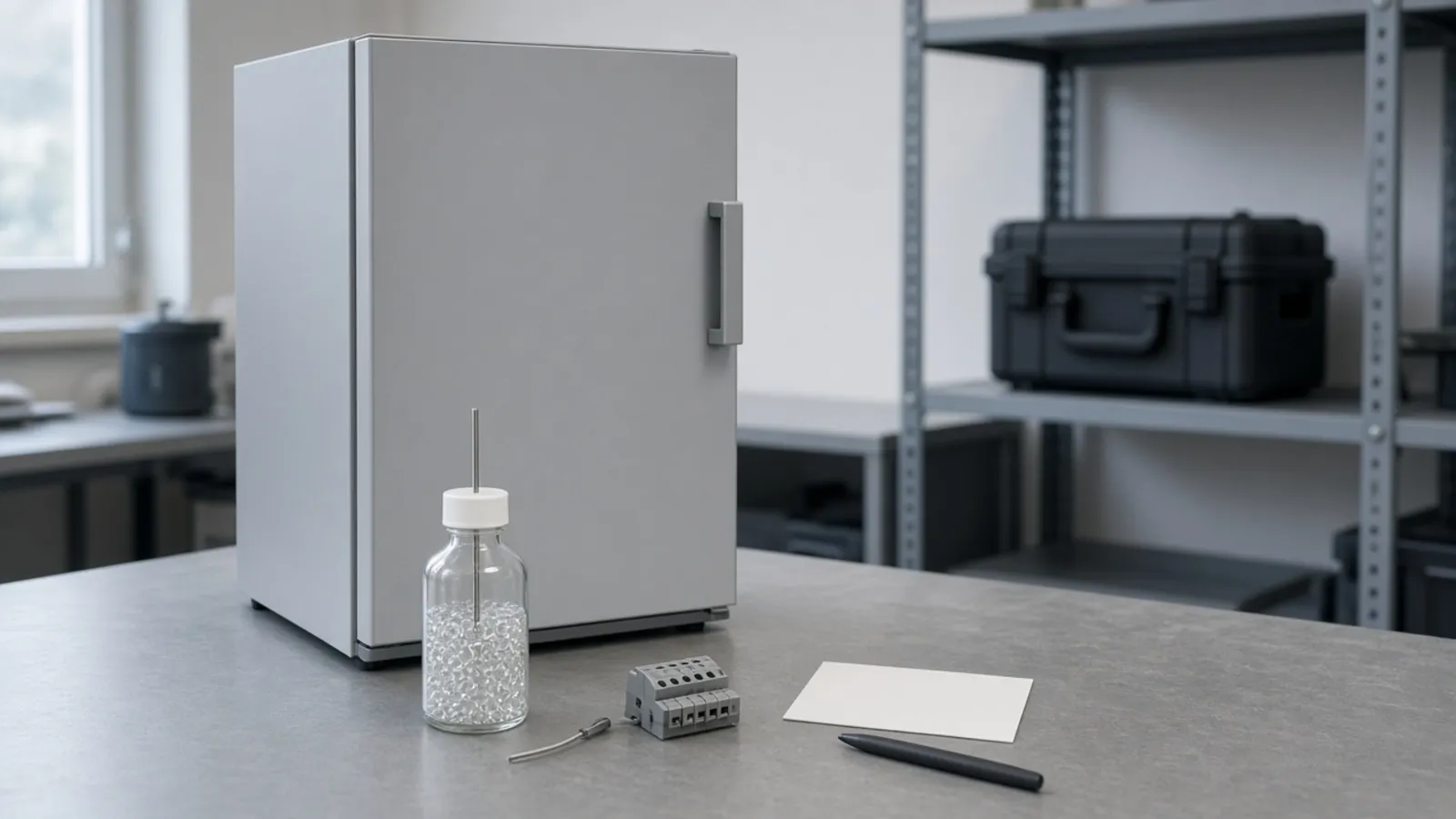
Air temperature moves faster than the liquid in a reagent vial. Manufacturers that publish a buffered sensor are telling you not to treat a bare air probe as the product temperature. The Revco manual, in its chart-recorder calibration steps, measures solution temperature inside the sensor bottle. The LabRepco Ultra Touch LHCT-30-RF specification lists the display probe as a product simulator bottle with glass-bead media. That LabRepco model is a flammable-storage refrigerator with a 2 °C to 10 °C operating range, so the bottle is evidence of how that controller is supplied, not a part you can assume is on every cabinet.
On the unit being tested, confirm the probe arrangement the manual specifies: bottle present, media in the bottle, probe immersed, wiring intact. Do not invent a temperature rise for a 15-second door opening. If the manual does not specify a buffer, say so in the record and follow that manual.
Link 2: Thresholds Versus the Laboratory Range
Factory defaults are a starting point for one model, not a compliance limit. On Revco laboratory refrigerators the published factory defaults, for a +4 °C operating setting, are a warm alarm at 5.5 °C and a cold alarm at 1.5 °C. Those numbers can be changed. The manual also notes that alarm setpoints cannot be adjusted while the key switch is in the alarm position, and that the warm and cold simulations in the built-in test may not work if the setpoints are at extreme values.
On the PHCbi MPR-715F combo, the factory refrigerator setpoint is 5 °C, not 4 °C. The refrigerator high-temperature alarm starts 5 °C above the chamber setpoint, adjustable from 2 °C to 14 °C above that setpoint. The refrigerator low-temperature alarm starts 5 °C below the setpoint, with the same style of adjustable band. At startup with those factory settings, the instructions say the high-temperature alarm activates when refrigerator temperature is above 10 °C, and the buzzer sounds after 15 minutes. Those are MPR-715F settings. They are not targets for a Revco, and they are not a recommendation to alarm at 10 °C for materials that must stay at 2 °C to 8 °C.
Lab Manager's 2026 guidance on remote monitoring makes the same distinction in trade language: generic factory thresholds and an undocumented on-call arrangement are weak controls, and thresholds should be tied to the stability of what is stored and then tested. That is editorial guidance, not a regulation. The defensible record is the programmed threshold, the laboratory's defined range, and the material instruction it was checked against.
Link 3: Delay, Door, and Mute Recovery
Delay is model-specific. Revco sounds the audible warning when the door is ajar for more than 2 minutes, with the alarm activated. The MPR-715F door alarm sounds the buzzer two minutes after the door indicator has lit, and the instructions call that the default. Neither figure is a reason to time every other brand to two minutes.
Mute recovery is also model-specific. Revco's ringback returns the audible warning after approximately 6 minutes if the alarm condition is still active. Pressing Scan silences the audio and leaves the visual indicator on. The MPR-715F buzzer suspended period starts at 30 minutes and can be set to 10, 20, 30, 40, 50, or 60 minutes, or to no recovery. The instructions say a no-recovery setting does not bring the buzzer back, and they tell the user to keep a recovery setting if the stored items need that protection. The Revco ringback and the MPR recovery setting are different controls and stay with the unit that publishes them.
Link 4: Local Sound and Light
The local test asks only what that manual says the test should produce. On Revco, the built-in test should sound the alarm and light the alarm icon at the simulated warm condition, then again at the simulated cold condition. On the MDF-C8V1 ultra-low freezer, the service manual's ALARM TEST description is a blinking alarm lamp and an intermittent buzzer. None of the manuals reviewed here states a minimum sound level. Record whether the horn and the visual indication named in that manual occurred. If the horn cannot be heard where staff actually stand, write that observation and follow the manual's failed-test instruction.
Link 5: Power Failure and the Battery
A power-failure alarm has to work when mains power is absent, so it needs its own supply. Confirm first that the unit even has that supply.
Revco. The alarm section says the system gives visual and audible warning for power failure and a rise in temperature, and that it has battery backup. A battery-low indicator lights when the backup battery is low. The optional chart recorder has a separate nine-volt battery for the recorder, described as keeping the chart moving for about 24 hours in a power failure. That recorder battery is not the alarm battery.
MPR-715F. The power-failure alarm (blinking indicator and intermittent buzzer) does not activate without the optional MPR-48B1 battery kit. With that kit, maintenance code F1 alternates with the chamber temperature when about three years have passed with the power switch on. The instructions say to replace the power-failure alarm battery every 3 years, that a flat battery will not operate the alarm indicator or buzzer, and that replacement is for a qualified engineer or service personnel because of electric-shock risk. They also say to contact the manufacturer's representative. This article does not turn that warning into a battery-swap procedure.
MDF-C8V1 ultra-low freezer. A different PHCbi manual, for a −60 °C to −80 °C class freezer, says E09 blinks when the alarm battery switch is off, and the error-code section says to press ALARM TEST to display E09 when that switch is off. E09 is not the MPR-715F battery code. The freezer manual's battery lamp at about three years of accumulation time is a separate indication on that freezer.
A power-failure test removes cooling for as long as the cord is out or the breaker is open. Agree the check with the laboratory, keep it only long enough to see the alarm behavior the manual describes, and restore power immediately afterward. Do not use the test as a way to watch how warm the cabinet gets.
Link 6: Remote Notification
A local horn does not call anyone in an empty laboratory. Remote equipment is optional on several of these units, and the wiring is not something to improvise from a general article.
Revco remote-alarm terminals are identified as Common, Open on Fail (normally closed), and Close on Fail (normally open). The manual's installation section gives wire colors and mounting steps for Revco's own remote-alarm accessory. Follow that manual, or the facility's qualified installer, rather than a paraphrased wiring recipe. The test result that matters is whether the connected system receives the alarm event.
The MDF-C8V1 service manual rates that freezer's remote contact at a maximum of 30 VDC, 2 A, with normally open and normally closed terminals. That rating belongs to that freezer. It is not a safe assumption for another cabinet's contacts, and it is not a reason to apply 30 volts during a functional test.
The MPR-715F instructions say that if the unit is in an unmanned location, a marketed remote-alarm device should be connected to the remote-alarm terminals, and they tell the owner to contact the representative to install it. During an alarm, silencing the buzzer does not cancel the remote alarm. The evidence to file is the event on the receiving system, or an explicit statement that no remote path is installed.
| Link | What to identify on this unit | Evidence to record | If that evidence is missing |
|---|---|---|---|
| 1. Probe | The sensor arrangement in the manual: Revco solution temperature inside the sensor bottle, or a glass-bead simulator where the manufacturer supplies one | Probe location, buffer present or not applicable, wiring condition | Do not treat a bare air reading as product temperature if the manual specifies a buffer |
| 2. Thresholds | Programmed high and low alarms versus the laboratory range and the material instructions. Revco factory example: 5.5 °C warm and 1.5 °C cold at +4 °C. MPR-715F factory refrigerator example: 5 °C chamber, high alarm initially 5 °C above setpoint | Both programmed values and the range they were judged against | A factory default outside the laboratory's range is not an approved setpoint |
| 3. Delay, door, mute | That unit's door time and mute recovery. Revco: door ajar more than 2 minutes; ringback about 6 minutes. MPR-715F: door buzzer default 2 minutes after the indicator; buzzer recovery initially 30 minutes, or no recovery if set to 000 | The setting found, and whether it matches the laboratory procedure | An unapproved delay or a no-recovery mute leaves the audible path unverified |
| 4. Local alarm | The sound and light the manual says the test produces. No decibel criterion is stated in the sources used here | What was heard and what stayed lit during mute | A silent horn or a dark indicator is a failed local path |
| 5. Power-failure battery | Whether a battery is installed. MPR-715F has no power-failure alarm without optional MPR-48B1; F1 is the three-year maintenance code. Revco has a battery-low lamp. E09 is the MDF-C8V1 freezer battery-switch indication | Kit present or absent, any maintenance code, and the result of the manual's power-fail check | A missing or flat battery means a power cut will not annunciate |
| 6. Remote path | Whether contacts are installed and connected. Confirm the event at the receiving system. Do not apply another model's contact voltage | Event received, or a statement that no remote path is installed | A local horn in an empty room is not after-hours notification |
Model-Scoped Test Evidence
Thermo Scientific Revco Laboratory Refrigerators
The Revco installation and operation manual, in the copy hosted by NIST, says it is important to test the alarm after any maintenance operation or temperature-control adjustment. The alarm provides visual and audible warning for power failure and a rise in temperature, with battery backup. Factory defaults for +4 °C operation are 5.5 °C warm and 1.5 °C cold. The alarm operates only with the key in Alarm On. The audible signal also sounds for a door ajar more than 2 minutes. Mute, by pressing Scan, turns off the audio and leaves the visual indication on. Ringback returns the audio after approximately 6 minutes if the condition remains.
The published test does not warm the cabinet. A small thermoelectric element at the sensor simulates warm and cold conditions, and the manual states that the refrigerated-space temperature does not change during the test. With the key in the alarm position, the procedure starts by holding the up-arrow (increase) button and Scan together for five seconds. The display shows simulated, not actual, cabinet temperature. The alarm sounds when the simulation passes the warm setpoint, clears as the simulation returns through the operating range, then sounds again at the cold setpoint. If those simulated conditions do not occur in the first five minutes, the service icon lights and the test stops. Turning the key to the non-alarm position stops the test immediately. After a test ends, the manual calls for a 10-minute wait before running it again. If the display does not change, the manual says to check the sensor connections.
That is a user test from the Revco manual, not a repair procedure, and not a script for other brands. The cabinet staying at temperature during the simulation is the point: a successful Revco alarm test still does not prove what the cabinet did during a real excursion last night.
PHCbi MDF-C8V1 Is a Freezer Manual, Not an MPR Procedure
The PHCbi PDF often cited for an "MPR alarm test" is the 2018 service manual whose effective model list begins with the MDF-C8V1 ultra-low freezer. Its temperature-control range is on the order of −60 °C to −80 °C. It is the wrong document for an MPR pharmacy refrigerator.
Within that freezer manual, the ALARM TEST key forces an alarm condition: the alarm lamp blinks, the buzzer sounds intermittently, the digital display goes off, and the remote alarm activates. The manual says normal operation returns after about 90 seconds. The key description says E09 blinks on the display when the battery switch is off, and the error-code section says to press ALARM TEST to display E09 in that condition. High- and low-temperature alarms on this freezer use an about-15-minute delay, and the remote contact is specified at a maximum of 30 VDC and 2 A. Those figures stay with the MDF-C8V1. They are not MPR-715F setpoints, and they are not a reason to look for E09 on an MPR display.
MPR-715F, MPR-722-PA, and a Current LabRepco Controller
The MPR-715F operating instructions are the refrigerator-and-freezer document. Use them for that combo, and do not merge them with the MDF-C8V1 test key.
Alarms the MPR-715F actually describes. High and low temperature, a refrigerator 0 °C alarm, door, and power failure. Sensor faults display as E01 through E12, alternating with chamber temperature, and the manual says to contact the representative rather than troubleshoot those codes in the field. There is no E09 battery-switch code in that list.
Power-failure alarm is optional. It does not activate without MPR-48B1. F1 alternating with chamber temperature means the power-failure battery is due, at about three years with the power switch on. Replacement is a paid service assigned to a qualified engineer or service personnel because of shock risk.
Buzzer recovery. Initial setting 30 minutes, adjustable in 10-minute steps from 10 to 60, or no recovery. Silencing the buzzer does not cancel a remote alarm.
Door. The buzzer sounds two minutes after the door indicator lights, at the default setting.
What the manual tells the operator when an alarm is real. Check the cause, contact the representative if the alarm is still on after about an hour or the temperature is not recovering, and transfer the stored items to another refrigerator or freezer. That transfer instruction is the manufacturer's alarm response for this model.
The MPR-722-PA specification page is a different, current pharmacy refrigerator. It lists high-temperature, low-temperature, door-ajar, and power-failure alarms, with audible and flashing LED indication, and a control range of 2 °C to 23 °C. The page does not document an ALARM TEST key, E09, F1, or a three-year battery. Do not borrow those behaviors from the MPR-715F or the MDF-C8V1.
The LabRepco LHCT-30-RF specification shows what a current flammable-storage controller can include: alarm validation of the audible, visual, and remote alarms; mute with ringback; a customizable alarm delay; battery backup of the temperature display and alarms, explicitly not of cooling; remote contacts; and a glass-bead product-simulator bottle as the display probe. The specification does not publish the validation keystrokes, the ringback time, or the delay values. Plan the test from the manual shipped with the unit. The three-year MPR-715F battery interval does not transfer to this LabRepco model.
| Documented unit | Alarm test the source actually describes | Thresholds and timing in that source | Battery and remote notes |
|---|---|---|---|
| Thermo Scientific Revco laboratory refrigerators | After maintenance or a temperature-control adjustment; hold the increase button and Scan for five seconds with the key in Alarm On; thermoelectric simulation, cabinet temperature unchanged | Factory 5.5 °C warm and 1.5 °C cold at +4 °C; door ajar more than 2 minutes; ringback about 6 minutes; 10-minute wait before repeating the test | Battery backup and a battery-low lamp; remote terminals are Common, open-on-fail, and close-on-fail |
| PHCbi MDF-C8V1 ultra-low freezer (2018 service manual) | ALARM TEST forces lamp, intermittent buzzer, display off, and remote alarm, then returns in about 90 seconds | Freezer control range about −60 °C to −80 °C; high and low alarms delayed about 15 minutes | E09 when the battery switch is off; remote contact maximum 30 VDC, 2 A. Not an MPR refrigerator procedure |
| PHCbi MPR-715F combo refrigerator/freezer | No forced ALARM TEST key in the operating instructions. Power-failure alarm exists only with optional MPR-48B1 | Factory refrigerator setpoint 5 °C; high alarm initially 5 °C above setpoint and buzzer after 15 minutes in the startup description; door buzzer default 2 minutes after the indicator; buzzer recovery initially 30 minutes | F1 alternates with temperature at about 3 years; flat battery means no power-failure annunciation; battery replacement is qualified-service work |
| PHCbi MPR-722-PA and LabRepco LHCT-30-RF | MPR-722-PA lists the alarm types but not a test key. LHCT-30-RF lists alarm validation of audible, visual, and remote outputs, without the keystrokes | MPR-722-PA control range 2 °C to 23 °C. LHCT-30-RF operating range 2 °C to 10 °C, with a customizable delay and mute with ringback, values unpublished on the specification page | LHCT-30-RF backs up display and alarms only, not cooling, and supplies a glass-bead simulator bottle. Do not apply the MPR-715F 3-year interval here |
Retest Triggers and the Record That Survives an Inspection
Repeat the alarm test when something that can invalidate the last test has changed. The defensible triggers are the ones a manual or the laboratory procedure already names:
After maintenance or a temperature-control adjustment on a Revco, because that manual says the alarm test matters then.
After any change to thresholds, delay, door timing, or buzzer recovery, because the previous test exercised the old settings.
After installation or replacement of a power-failure battery, on the schedule that unit's instructions give. For the MPR-715F that schedule is 3 years for the optional kit, signaled by F1, and the replacement itself is qualified-service work.
After the cabinet is moved, placed on a different circuit, or reconnected to a different remote system, because the path that was proved is no longer the path in service.
When the laboratory's procedure, or a blood-bank policy under 493.1271(c), names its own inspection interval. If neither the manual nor the procedure names a calendar interval, record the manufacturer trigger that does exist.
A checkbox that says "alarm checked" is not the record. The work order should let a reader who was not there reconstruct the test. Tie the cabinet to a unique inventory identity, as in the site's guidance on CMMS unique identification, and keep the work-order content consistent with what a service record has to contain. Alarm verification is not the same task as analyzer calibration verification after repair, and it is not the same task as patient-monitor alarm verification. A return-to-service gate after corrective work is discussed in major-repair return-to-service testing. Vendor choice, when the work is contracted, belongs in service-provider qualification.
Fields that match the sources, without invented acceptance numbers:
Identity. Asset identifier, manufacturer, model, serial number, and location, matched to the inventory.
Why this test. Post-maintenance, setpoint change, battery service, relocation, remote-system change, or the laboratory's stated interval.
Which instructions. Manual title and the section used. If the nameplate is an MPR refrigerator, do not cite the MDF-C8V1 freezer manual as the procedure.
Armed state. Key-switch position on a Revco, or the equivalent arming control. A test performed with the alarm switched off does not count.
Threshold comparison. Programmed high and low values, the laboratory's defined range, and the material instruction used for the comparison.
Excitation. The method in the manual's words, for example the Revco five-second increase-and-Scan test, or a statement that this model has no forced-test key and what was done instead.
Local result. Whether the audible and visual indications named in the manual occurred, and how mute and ringback behaved if the manual defines them. No decibel number unless that manual states one.
Power-failure result. Whether the optional battery is installed, any code such as F1 or a battery-low lamp, and what happened when power was removed for the brief check. Restore cooling as soon as the alarm behavior is observed.
Remote result. The receiving-system event, or a statement that no remote path is installed. Do not file a contact-resistance number the manual does not use.
Disposition. Pass or fail, whether contents stayed in the cabinet, who in the laboratory was told, the tester, and the date and time.
| Record field | Source of the criterion | What a passing entry shows | What forces escalation |
|---|---|---|---|
| Armed state | Unit instructions, such as Revco Alarm On | The alarm was enabled before the test | Alarm left in the non-alarm position |
| Thresholds | Laboratory-defined range and the material instructions, compared with the programmed values | Programmed alarms sit where the laboratory approved them | Factory defaults left in place outside that range |
| Local annunciation | The indications named in the manual for that test | Those indications occurred | Missing sound or missing visual indication |
| Mute and recovery | That model's ringback or buzzer-suspended period | Behavior matched the approved setting | No recovery where the laboratory required recovery, or the reverse |
| Power-failure path | Whether the manual's battery is installed, and the code or lamp it specifies | The power-fail alarm annunciated, or the record states the unit has no such battery and the laboratory has accepted another control | Expected battery alarm silent, F1 or battery-low active, or MPR-715F kit absent while the laboratory believed power failure was covered |
| Remote notification | The connected system, if one is installed | The test event was received, or no remote path is installed and that fact is accepted | Contacts or dialer did not deliver the event the laboratory relies on |
flowchart TD
  Start["Identify the model and open its alarm instructions"] --> Arm["Confirm the alarm is armed"]
  Arm --> Compare["Compare thresholds and delay with the laboratory range"]
  Compare --> Test["Run that manual's alarm test"]
  Test --> Local{"Local indication as the manual describes it"}
  Local -->|Missing| Hold["Treat contents as unmonitored and notify the laboratory"]
  Local -->|Present| Remote{"Remote path installed?"}
  Remote -->|Yes, no event received| Hold
  Remote -->|Event received, or no remote path| Power["Check the power-failure path only as that manual specifies"]
  Power -->|Silent or battery indication due| Hold
  Power -->|Path exercised| Record["Record what was forced, what fired, and who was notified"]
Hold --> Repair["Qualified repair, then repeat the test before monitored storage resumes"]When the Alarm Fails
A failed link means the cabinet is not providing the monitoring the laboratory thinks it has. Do not leave the unit, order a part, and assume the morning chart covers the gap.
Tell the Laboratory and Label the Cabinet
Notify the laboratory section that owns the contents, in the way that laboratory's procedure already specifies. Label the door so the next shift can see that the alarm path is not in service. The laboratory decides whether the materials move to a cabinet whose monitoring is intact or stay under a temporary check that laboratory defines. Product-stability decisions stay with the material instructions and the laboratory director.
On the MPR-715F, the alarm-action pages already tell the operator to transfer storage items to another refrigerator or freezer when the alarm does not clear, and to contact the representative. Follow that model instruction when the nameplate is an MPR-715F. For histocompatibility storage, Appendix C also expects an emergency plan for alternate storage. For blood and blood products, follow the immunohematology procedure, not this reagent-refrigerator note.
Where HTM Work Stops
The service decision in this article is the alarm and monitoring path: armed state, thresholds compared with the laboratory range, the manufacturer's alarm test, the power-failure indication, and proof that a remote system received the event. Observing those functions and writing them down is HTM work when the person is authorized for that unit.
Two boundaries stay outside this alarm check. The MPR-715F manual assigns power-failure battery replacement to a qualified engineer or service personnel because of electric-shock risk, and it says to contact the representative. Sealed-system and refrigerant work is also outside alarm verification. Some current laboratory models use hydrocarbon refrigerants, so that work stays with people authorized under the manufacturer's instructions and the applicable refrigerant rules.
After the failed part is corrected, run the same model-specific test again before the laboratory treats the cabinet as monitored storage. A new battery, a new sounder, or a restored dialer is unproven until the path that failed has been forced once more.
Sources
Office of the Federal Register. 42 CFR 493.1252, Standard: Test systems, equipment, instruments, reagents, materials, and supplies. eCFR. https://www.ecfr.gov/current/title-42/chapter-IV/subchapter-G/part-493/subpart-K/section-493.1252
Office of the Federal Register. 42 CFR 493.1278, Standard: Histocompatibility. eCFR. https://www.ecfr.gov/current/title-42/chapter-IV/subchapter-G/part-493/subpart-K/section-493.1278
Office of the Federal Register. 42 CFR 493.1271, Standard: Immunohematology. eCFR. https://www.ecfr.gov/current/title-42/chapter-IV/subchapter-G/part-493/subpart-K/section-493.1271
Centers for Medicare & Medicaid Services. State Operations Manual Appendix C. File retrieved 2026-09-30: table of contents Rev. 236, issued 2026-01-23. Tags D5729 and D5555 are stamped Rev. 233, issued 2025-09-12. https://www.cms.gov/regulations-and-guidance/guidance/manuals/downloads/som107ap_c_lab.pdf
Thermo Scientific. Revco Laboratory Refrigerators, Installation and Operation, alarm-system and alarm-test sections, NIST-hosted copy. https://www.nist.gov/document/revco-thermo-chromatography-large-refrigerator
PHC Corporation. MDF-C8V1 ultra-low temperature freezer service manual, 2018, including the ALARM TEST key and E09. This manual is not an MPR refrigerator procedure. https://www.humeau.com/media/blfa_files/ME_Congelateur-86-VIP_95810000002_EN_290318.pdf
PHCbi. MPR-715F series biomedical refrigerator/freezer operating instructions, including the optional power-failure battery, F1, and buzzer recovery. https://www.bsilab.com/product/phcbi-mpr-series-biomedical-combo-refrigerator-freezer-14-7-6-2-cu-ft?attachment_id=134432&download_file=U3N3N04ZOPRQI
PHCbi. MPR-722-PA upright pharmacy refrigerator, controller and alarm specifications. https://www.phchd.com/us/biomedical/preservation/pharmaceutical-refrigerators/mpr-722-pa
LabRepco. Ultra Touch LHCT-30-RF flammable-storage refrigerator specification, including alarm validation and the glass-bead display probe. https://www.labrepco.com/product/labrepco-ultra-touch-series-30-cu-ft-flammable-storage-refrigerator-solid-door?attachment_id=281575&download_file=pqxh2fkbcyk3d
College of American Pathologists. Laboratory General Checklist copy hosted by Illumina; refrigerator and freezer temperature item carries a revision note of 2016-08-17. Confirm the laboratory's current edition. https://www.illumina.com/content/dam/illumina-marketing/documents/services/laboratory-general-checklist.pdf
American Association of Bioanalysts. Symposium handout restating the CAP refrigerator and freezer temperature check. https://www.aab.org/images/CRBSymposium/Behnke%204.pdf
Helmer Scientific. Blood bank refrigerator standards: a manufacturer summary of AABB requirements, published 2025-11-25. https://blog.helmerinc.com/blood-bank-refrigerator-standards-meeting-aabb-requirements
Lab Manager. Remote temperature monitoring for lab cold storage: setting alert thresholds and alarm protocols. Trade guidance, not a regulatory limit. https://www.labmanager.com/remote-temperature-monitoring-for-lab-cold-storage-setting-alert-thresholds-and-alarm-protocols-35296
Office of the Federal Register. 21 CFR 606.65, Supplies and reagents. eCFR. https://www.ecfr.gov/current/title-21/chapter-I/subchapter-F/part-606/subpart-E/section-606.65
Office of the Federal Register. 21 CFR 606.60, Equipment. eCFR. https://www.ecfr.gov/current/title-21/chapter-I/subchapter-F/part-606/subpart-D/section-606.60