
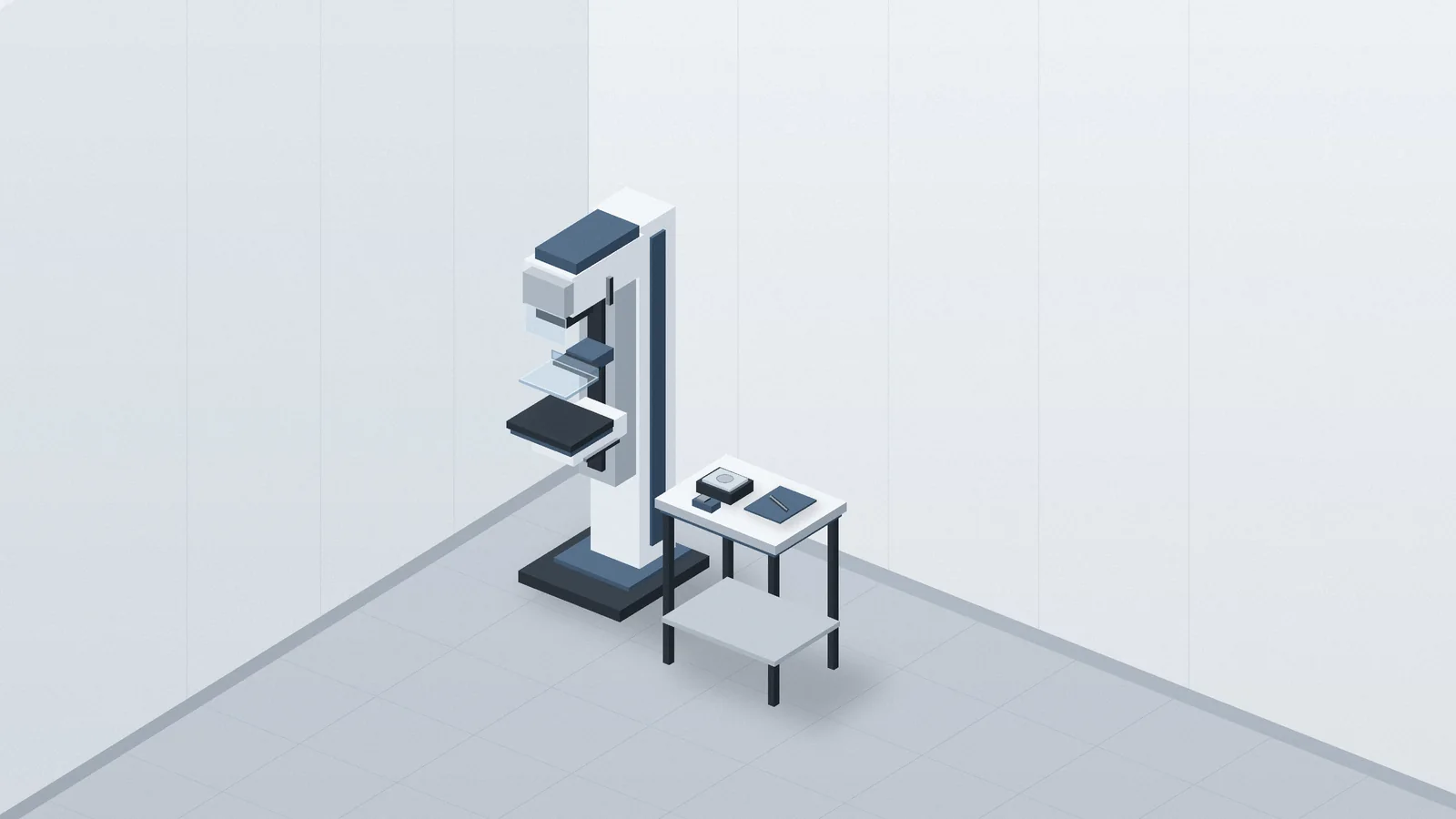
The service engineer has replaced the x-ray tube on a digital mammography unit. The work order is closed, and the technologist has a passing phantom image. Keep the room on hold until the medical physicist’s equipment evaluation shows that the unit meets the applicable requirements and the facility has evidence that any problems identified during the evaluation were corrected. The American College of Radiology (ACR) specifically cites tube replacement as an event that requires an MEE, even though ACR does not require notification of the replacement. ACR mammography quality-control guidance
This guide covers U.S. Mammography Quality Standards Act (MQSA) facilities using screen-film, full-field digital mammography (FFDM), or digital breast tomosynthesis (DBT). Confirm any additional obligations with the facility’s accreditation body and certifying agency. Use the quality-assurance (QA) program that governs the unit to identify specific quality-control (QC) test methods and limits. Federal equipment and QA standards
When the repair triggers an equipment evaluation
An MEE is required when a new mammography unit or image processor is installed, when a unit or processor is disassembled and reassembled at the same or a new location, or when one of its major components is changed or repaired. The evaluation covers applicable equipment standards in § 900.12(b) and QA requirements in § 900.12(e). All problems must be corrected before the equipment is used for examinations or film processing. 21 CFR 900.12(e)(10)
The annual physicist survey is a separate requirement. It includes the applicable annual QA tests and the weekly phantom image-quality test specified in the rule, plus a review of the facility’s QC results, corrective actions, and their effectiveness. The physicist signs and dates the survey report and sends it to the facility within 30 days of the survey. An annual survey performed before the repair cannot evaluate the changed unit. 21 CFR 900.12(e)(9)
For routine QC, the federal baseline in § 900.12(e)(8) ties the correction deadline to the failed test. The tests listed in paragraph (e)(8)(ii)(A), which include paragraph (e)(6) tests, require correction before further examinations or film processing with the failed component. The other tests covered by that routine QC provision have a 30-day deadline. Some FDA-approved alternatives address corrective-action timing for specified systems. The routine rules do not create a grace period for problems found in an MEE. 21 CFR 900.12(e)(8) and (10) and FDA’s MQSA alternatives index
Document what changed before choosing tests
Give medical physics a work order that identifies the unit and subsystem, the component or software version changed, the room and any disassembly, the clinical modes affected, and the facility’s governing QA manual and revision. Identify an acquisition display, a review workstation, or a film printer separately when the work affected one of those devices.
The rule gives no cost, labor-hour, or parts-count threshold for a major component repair. When the trigger is unclear, FDA’s inspection guidance tells facilities to check with the unit manufacturer and present the inspector with documentation if the manufacturer determines an MEE was unnecessary. Describe the actual intervention in the request so the response applies to the work order in hand. Keep the release decision open while that scope is unresolved. FDA annual MQSA inspection guidance
For non-screen-film systems, the default QA program must be substantially the same as the image receptor manufacturer’s recommended program. FDA Alternative Standard #24 permits the ACR digital program for covered FFDM and DBT systems using the applicable manual and supplement with the ACR Digital Mammography Phantom. The federal screen-film maximum dose limit still applies. Verify which manual revision covers the installed model and software. 21 CFR 900.12(e)(6), FDA Alternative Standard #24, and ACR mammography QC
Who produces the release evidence
The medical physicist is responsible for the MEE and its report under § 900.12(d)(1)(iii). The standard MEE takes place on site. Direct supervision requires the supervisor to be present to observe the evaluator and correct their work as needed. Confirm that the medical physicist meets MQSA qualifications, including the training applicable to the modality being evaluated. 21 CFR 900.12(a) and (d), 21 CFR 900.2(o) and (bb), and ACR physicist qualifications
The designated QC technologist is responsible for QA tasks assigned to that role, including making sure qualified staff who perform those tasks meet the applicable requirements. In practice, the QC technologist standardizes the test method, reviews the data, and oversees repeat testing as appropriate. A phantom result documents image quality for the conditions tested. The physicist’s report covers the wider set of requirements applicable to the changed unit. 21 CFR 900.12(d)(1)(iv) and ACR mammography QC
Identify who can reopen the room under the facility’s own workflow. Keep the clinical release entry distinguishable from the physicist’s findings and the service vendor’s completion entry. For ACR submissions, distinguish the MEE forms and written pass/fail results from the full survey package. ACR allows the site technologist QC program evaluation page to be omitted from the pre-use MEE and calls for that page, the signed physicist’s QC test summary, and the supporting data in the applicable annual survey submission, including for new units. ACR mammography QC and ACR testing package overview
Evaluation and records by service event
Use this U.S. MQSA matrix to assign the next action and record. For a standard MEE, the physicist performs the evaluation on site or directly supervises it. The technologist records the assigned QC under the governing program. For a move, check current instructions from the facility’s accreditor and certifying agency before relying on the relevant scenario in FDA’s published table. FDA move protocols and ACR facility change instructions
| Service event | Applicable pathway | Who evaluates | Physicist evidence | Technologist evidence | Before patient use |
|---|---|---|---|---|---|
| New unit or image processor installation | MEE. § 900.12(e)(10) | Standard MEE roles | Written findings for applicable equipment and QA standards | Initial QC required under the facility’s program | Correct every MEE problem before exams or film processing. See the ACR new-unit submission steps below. |
| Unit or processor disassembled and reassembled in the same or a new room | MEE. § 900.12(e)(10) and FDA move protocols | Standard MEE roles | Results tied to the reinstalled equipment and location | Applicable QC for the reinstalled equipment | Correct every MEE problem. Confirm current move-related testing and notices. |
| Major component change or repair, such as x-ray tube replacement | MEE. § 900.12(e)(10) and ACR mammography QC | Standard MEE roles | Applicable requirements, results, and findings after the repair | Assigned QC, including any applicable phantom check | Correct every MEE problem before reusing the unit. |
| Conversion from one mammographic modality to another | New-unit MEE and accreditation procedures. § 900.12(b)(2)(ii) | Standard MEE roles with qualifications for the new modality | Results for the converted configuration | Applicable QC for the converted system | Demonstrate compliance before clinical use and follow the accreditor’s procedures. |
| Software upgrade meeting FDA Alternative Standard #6 | MEE under permitted oversight or onsite by a physicist. FDA Alternative Standard #6 | Physicist oversees qualified personnel or performs the MEE onsite | If using oversight, record who provided direction as a facility practice | Manufacturer-specified evaluation results and follow-up actions | Complete the specified evaluation and correct all failures. Verify every condition before using oversight. |
| Specified GE Senographe automatic exposure control (AEC) modification | Verification under permitted oversight. FDA Alternative Standard #5 | Physicist determines if other personnel can verify compliance or an onsite visit is needed | Record the oversight decision and direction as a facility practice | Verification results and any corrective actions | Verify applicable standards are met after the specified modification. |
| Wheeled plug-in unit rolled within the same building without disassembly | Scenario 1 calls for a post-move pre-exam test. FDA move protocols | The test can be performed without a physicist. ACR recommends consulting one. | Record any physicist consultation as a facility practice | Post-move test result for the new room | Pass the applicable pre-exam test. If disassembly and reassembly occurred, apply the MEE rule. |
| Unit installed at a different facility with its own MQSA ID | MEE and receiving facility accreditation process. FDA move protocols and ACR facility changes | Standard MEE roles | Evaluation linked to the receiving facility | Applicable QC for the new site | Clear the MEE findings and confirm accreditation and certification steps before scheduling exams. |
| Loaner or demo unit installed, or repaired original reinstalled after a loaner | MEE at each applicable installation. ACR unit changes | Qualified physicist for each installation | Separate evaluation records keyed to each unit | Applicable routine QC for the unit in use | Clear each unit’s evaluation before using it. Check ACR’s submission and accreditation instructions for the temporary unit. |
For an ACR new-unit application at an existing MQSA-certified facility, ACR instructs facilities to obtain passing written MEE results and send them with the required application materials before using the unit. For a tube replacement, ACR’s notification rule is different, while the pre-examination MEE still applies. A new location or certification scenario can involve additional steps. ACR mammography QC and ACR location changes
If service touched a display or printer, identify it by function. FDA’s inspection guidance asks for relevant display records, including for off-site workstations. Where a facility maintains a printer, ACR describes physicist testing before mammography and inclusion of printer QC upon installation, after major repair, and annually where the applicable manufacturer’s QC program requires it. For facilities interpreting only hardcopy, ACR removes the need to submit review-workstation QC results for accreditation. Manufacturer-required tests on the acquisition display still apply. FDA annual inspection guidance, ACR equipment guidance, and ACR mammography QC
When a software upgrade qualifies for oversight
FDA treats mammography software changes and upgrades as major repairs. Before relying on Alternative Standard #6, ask the manufacturer to identify the exact model and release, confirm that FDA acknowledged its notification before installation began, and provide written facility instructions by the time the upgrade is complete. An FDA acknowledgement confirms receipt. The facility still needs to verify that the upgrade meets the alternative’s conditions. FDA Alternative Standard #6
The manufacturer must specify tests that cover all applicable § 900.12(b) and (e) requirements. Each test must be part of the manufacturer’s QC technologist program or be no more complex than those tests, and none can require a medical physicist. If these and the other conditions are met, the MEE can take place under medical physicist oversight. Otherwise FDA calls for an onsite physicist MEE. If any necessary test requires a physicist, the physicist must perform the entire evaluation onsite. Complete the evaluation and correct failures before exams, then keep the results and follow-up records under § 900.12(d)(2). FDA Alternative Standard #6
Alternative Standard #5 applies to AEC optical-density modifications in GE Field Modification Instruction 11451 for Senographe 700T and 800T systems and 11450 for Senographe DMR systems. After the specified modification, verification testing is required. The physicist is consulted about whether an onsite visit is needed or other personnel can verify compliance, with direction by phone or in writing as needed. This option attaches to the named modification and model. FDA Alternative Standard #5
Close the file before the next patient
For the tube replacement in the opening example, file the passing phantom result with the QC records. Ask the physicist to identify what the evaluation covered, including any applicable checks of x-ray output, exposure control, dose, or image quality. Use the criteria that govern the unit. The actual tests and results belong in the MEE record. A blank field where an applicable result should appear is a follow-up item for the physicist.
Suppose the physicist records a failed applicable check. Clinical engineering can finish its repair task once the correction is complete, while the imaging team holds the room until the file contains evidence the correction worked. Link the service action to the finding and to the follow-up test or other evidence the physicist accepts for that item. Preserve the initial result alongside the final disposition so the reviewer can see what changed and which configuration was evaluated. ACR cites a physicist re-evaluation or a service ticket as examples of corrective-action documentation it reviews. ACR mammography QC and 21 CFR 900.12(d)(2) and (e)(10)
The following index is a proposed facility workflow. Keep the records your QA program, MQSA, and accreditation process require, and use the work order to link them.
| File item | Owner and what to capture | Basis |
|---|---|---|
| Service scope | Clinical engineering records the unit, component or version, room, affected modes, and QA manual revision. | Proposed facility practice |
| Trigger determination | The facility attaches the manufacturer’s determination for an unclear trigger or written upgrade instructions when using #6. | FDA inspection guidance and Alternative Standard #6 |
| Evaluation | The physicist provides written MEE findings and applicable test data. For ACR submissions, use the checklist and the physicist’s QC test summary as directed. | § 900.12(d)(1)(iii) and (e)(10) and ACR mammography QC |
| QC and corrective action | The QC technologist records assigned results. File each failed item with the correction and evidence it worked. | § 900.12(d)(1)(iv) and (d)(2) |
| Release entry | The designated facility lead records the decision, date, and the evidence reviewed before scheduling exams. | Proposed facility practice |
FDA’s inspection materials identify the annual physicist survey, applicable equipment evaluations, QC data, and corrective-action records as evidence to have available. For QC records covered by § 900.12(d)(2), retain each test record until the next annual inspection is completed and FDA determines QA compliance, or until the test has been performed twice more at its required frequency, whichever is longer. Check any longer retention period that applies to your facility. FDA MQSA inspection resources and 21 CFR 900.12(d)(2)
Revisit the release criteria when the governing manual or software version changes, the facility adds a clinical mode, the manufacturer issues revised upgrade instructions, or the accreditor or certifying agency updates its process. For the facility’s general workflow, see return-to-service testing after major repair and medical equipment service records. For a different modality, see CT quality control after major repair.