
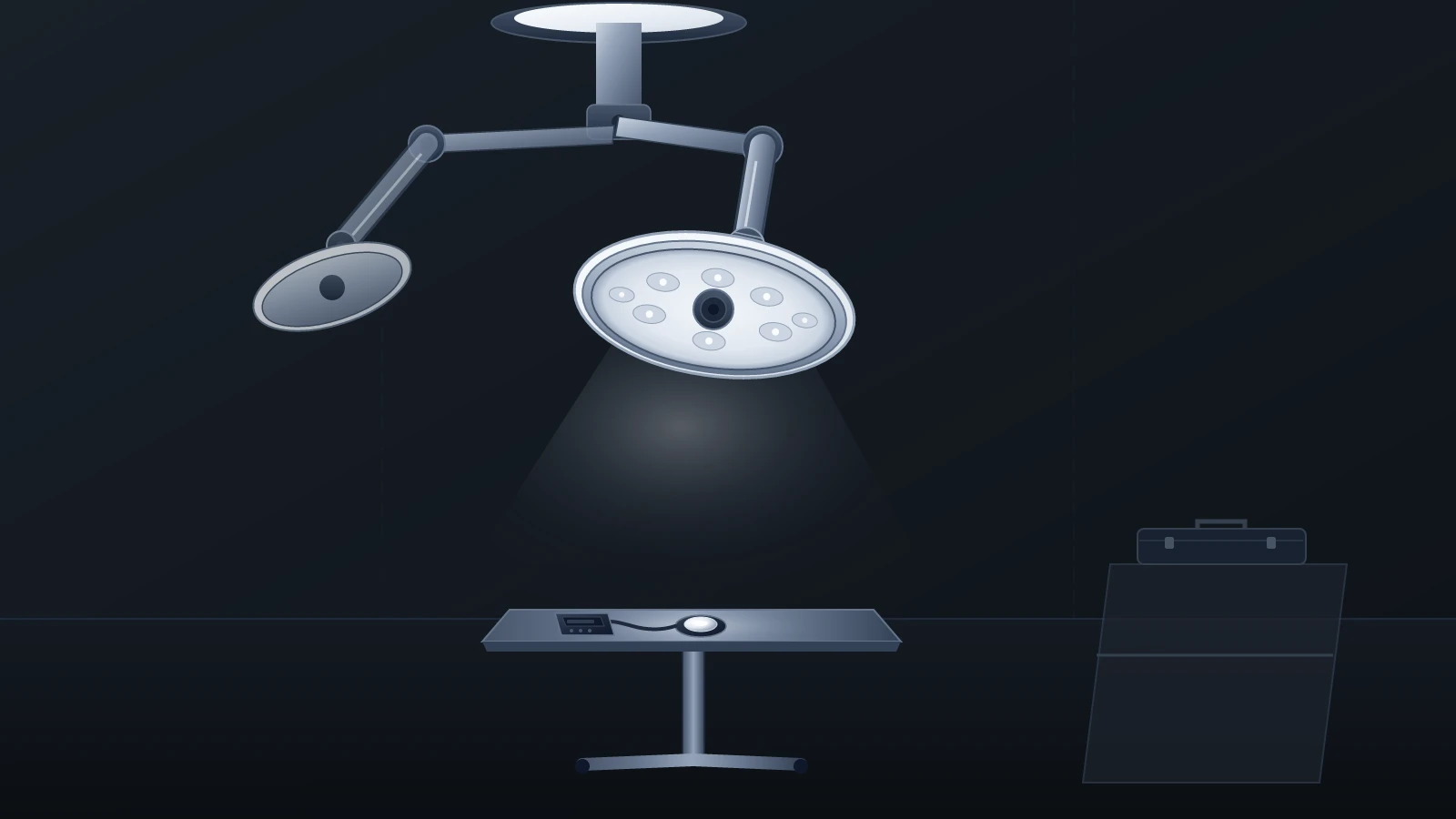
Before releasing a ceiling-mounted surgical light after service, record three findings separately: illumination and its controls, synchronization between lightheads, and suspension or mechanical condition. Identify the affected head and control module, attach the applicable manufacturer criteria and service results, and state what remains unresolved. A light that switches on has only demonstrated one part of the handover.
For a dual-head system returned by an outside vendor, use the same record to answer the original complaint and review the work performed. If a head drifts, illumination results cannot close that mechanical finding. If colors differ between heads, document the synchronization state before assigning a hardware cause. Hold equipment with unresolved safety faults from clinical use and obtain qualified service; release requires the applicable checks and an authorized decision under hospital policy.
Establish the luminaire’s identity and the applicable evidence
The FDA classification entry for ceiling-mounted surgical lights identifies product code FSY, Class II, under 21 CFR 878.4580. Its 510(k) exemption is subject to the stated limitations; exemption from that submission is not evidence that a repaired unit is safe. Record the actual manufacturer, model and configuration before borrowing a criterion from another luminaire.
IEC 60601-2-41:2021, Edition 3 covers surgical luminaires and luminaires for diagnosis. Its public scope excludes general-purpose lighting and endoscopes or laparoscopes and their light sources. The published change list includes a requirement for acceptable lighthead drift on the suspension system. That public summary provides no hospital drift-test duration, displacement limit or illuminance acceptance band. Obtain the applicable manufacturer procedure instead of inventing a limit from the standard’s title.
The model examples here use the iLED 7 en-GB instructions, 7990087_002_06, dated January 15, 2024 and the Maquet PowerLED II maintenance manual, 01810 EN 03, dated September 13, 2023. Confirm the revision and regional applicability for the installed equipment. Baxter/Hillrom document locations and manufacturer instructions can change; a downloaded example does not establish the instructions applicable to your serial number.
Connect the record to the hospital equipment program
For participating U.S. hospitals, 42 CFR 482.41(d)(2) requires equipment to be maintained to an acceptable level of safety and quality. Section 482.41(a)(1) separately addresses emergency power and lighting in specified areas, including operating rooms. An individual surgical-light handover does not establish that the room’s emergency-power arrangements meet that broader duty.
CMS QSO-25-24, Tag A-0724 calls for an equipment inventory and describes useful fields: unique ID, manufacturer, model, serial number, description, fixed location, owning department, service provider and acceptance date. It recommends those fields while allowing effective alternative means of equipment management. It does not mandate a particular CMMS product, a boom-arm field or this article’s three-domain format. Its guidance also permits documented alternate equipment management within stated limits; a generic lighting checklist alone does not establish an appropriate maintenance strategy.
The Joint Commission review tool effective March 1, 2024 distinguishes all-equipment inventories for deemed status from the selected-equipment option for non-deemed hospitals. It lists maintenance activities and frequencies under EC.02.04.01 and a 100% completion expectation for required high-risk equipment activities under EC.02.04.03. These are descriptions of that dated tool, not a claim that its numbering remains unchanged in 2026. Confirm current applicable requirements with the hospital’s accreditation lead, and document the equipment’s risk designation rather than assuming a universal category.
For this handover, make each head identifiable within the system record and link the room location to the service report. If facilities and clinical engineering share responsibility, name the owner of each outstanding action. This is a practical allocation of work: a department name does not tell the next reviewer which component was checked or who may authorize release.
Capture the starting condition before judging the repair
Ask the vendor to identify the complaint, work scope, affected components, configuration changes and checks completed. Reconcile the report to the equipment in front of you. When a report says only “light repaired,” request the head identifier and the work actually performed. Record separately what the vendor reported, what hospital staff observed, and what still needs verification.
Write the complaint in observable terms: which head moved, which direction it moved, which control was being used, and whether the other head behaved differently. Preserve available fault messages and relevant settings before someone changes them. Avoid assigning a cause from a symptom alone. A record of an observation is useful even when the technician is not authorized to diagnose or correct the underlying fault.
Record illumination-control findings against the model’s criteria
For the iLED 7, sections 4.4 and 5.1 specify that more than 10 failed LEDs on one head requires removing the surgical light from service and notifying Technical Customer Service. That is a model-specific threshold, not a fleet-wide release rule. Record the qualified inspection result without treating a lower count as proof that every other function passes. See the iLED 7 instructions.
Organize this domain around the controls and modes actually fitted to the installed system: intensity, field size, endoscopy mode, distance-adaptive control, shadow management and fault indications where applicable. For each relevant item, record the starting setting, control location, observed response, procedure reference and outcome. Mark an absent optional feature as not fitted, with a configuration basis; leave an unperformed required check visibly incomplete.
Separate a commanded setting from a measured optical result. “Intensity command changed” describes a control response. An illuminance result needs its unit, measurement geometry, instrument identity and applicable acceptance criterion. Where the manufacturer procedure requires optical measurement, retain enough setup information for a qualified reviewer to interpret it. A number without its setup cannot show whether the prescribed measurement was performed.
Do not improvise direct viewing of illuminated emitters or deliberately overlap intense light fields for this handover template. The iLED 7 High Intensity Indicator appears when at least two lights are set to 80% or higher; it warns about possible excessive illumination if fields overlap. It does not detect overlap or guarantee protection. The manufacturer’s warning is in section 4.8.6.
Keep head synchronization separate from optical faults
On the iLED 7, synchronization can transfer field size, intensity, ALC Plus, shadow management and on/off; color temperature is always synchronized when the function is active. Chapter 7 lists synchronization as a remedy for differing color temperatures, not proof of the only possible cause. Safe mode disables Sync. See sections 4.6.6, 4.6.7 and 5.18.3.
In the record, name the control module used, the participating heads, the expected linked functions and the observed response at each head. Distinguish a local head control from a wall or mobile control. A setting shown on one interface does not document the response of its companions. Keep the approved configuration reference with the result so a later reviewer can distinguish intended independent operation from a failed transfer.
If a mismatch persists, preserve the operating mode and fault state and seek qualified review. Record any authorized correction and the follow-up result rather than closing the issue because colors appeared similar once. Avoid claims about a bus fault, firmware reset or communications architecture without device-specific service evidence.
Record suspension observations without prescribing adjustments
Describe movement precisely: rise or fall of the arm, rotation after positioning, unusual resistance, or visible damage. Identify the affected joint and the circumstances in which the observation occurred. Do not replace a manufacturer stability criterion with an invented “zero drift for 60 seconds” test. Keep observations obtained within your authorization separate from the qualified service diagnosis.
The PowerLED II manual, section 5 describes balanced raising and lowering and stability in position. Its safety instructions reserve maintenance to Getinge or Getinge-trained technicians and warn about falling parts and servicing with a patient present. Those statements support obtaining a qualified mechanical assessment; they do not authorize a reader to remove safety rings or lubricate suspension assemblies.
Document damaged covers, cracks, missing parts or an unsecured component with its location and the resulting disposition. If the finding presents a potential falling-part or uncontrolled-movement hazard, hold clinical use and escalate through the equipment safety process. Record who controls the equipment while it is held and what evidence is needed to close the finding. Do not use a successful illumination check to override a mechanical concern.
Verify qualifications, maintenance scope and post-repair evidence
The iLED 7 reserves spring, brake and swivel-range adjustments, wearing-part replacement and synchronization-scope selection to Baxter-trained staff. It specifies maintenance every two years after handover, annually after ten years, and electrical safety inspection to Baxter criteria after each repair. See sections 4.6.6, 5.13–5.17 and chapters 8–10.
The PowerLED II preventive-maintenance protocol lists yearly brake-screw replacement and six- or ten-year mounting-screw and snap-ring items according to the arm range. Ask the provider to identify the installed suspension range and the schedule used. A yearly service visit does not establish that every configuration-dependent item was due or completed. Include applicable backup-power test evidence when that option is fitted.
Ask for evidence of the technician’s qualifications for the work performed, the applicable procedure revision, completed inspection results, parts used and unresolved exceptions. Use the site’s service-provider qualification guide for the broader supplier review. A manufacturer qualification restriction describes who may perform the specified task; do not convert it into a claim that the FDA certifies the provider.
FDA’s servicing policy distinguishes restoring original specifications and intended use from activities that significantly change performance, safety specifications or intended use. Its assessment concerns the actual work. Escalate unexplained substitutions or modifications for review rather than accepting the word “repair” on an invoice as their technical justification.
Retain post-repair safety results with the procedure and acceptance criteria used, measured values where required, instrument identity and reviewer disposition. A generic “electrical safety passed” checkbox does not reveal the test scope. The site’s electrical safety testing article and major-repair return-to-service guide address the broader decisions; use the installed luminaire’s applicable criteria for this handover.
Use a three-domain handover table with visible open items
The following is a proposed record structure, not an OEM test procedure or a regulator-prescribed form. Expand each row into as many findings as the work scope requires. Keep source criteria, observations and decisions in separate fields so the reviewer can see how each conclusion was reached.
| Record area | Evidence to retain | Decision or open item |
|---|---|---|
| System and service identity | Asset ID; manufacturer, model and serial; room; head and control identifiers; vendor report; work scope; applicable document revisions. | Reconcile discrepancies before accepting results for this system. |
| Illumination and controls | Installed modes; control and head used; commanded settings; observed responses; required optical measurements with setup, units, instrument and criteria. | Record each result and any missing check. Route faults to the qualified provider. |
| Head synchronization | Approved linked-function scope; participating heads; control module; operating mode; observed response at each head. | Explain intended independent settings; keep unexplained mismatches open. |
| Suspension and mechanical condition | Location and description of movement or damage; authorized observations; qualified assessment; applicable stability criteria and results. | Hold unsafe equipment; identify the owner and evidence needed for closure. |
| Qualified-service completion | Task-specific qualifications; parts and configuration record; due maintenance items; applicable electrical and backup-power results. | Resolve exceptions against the applicable procedure before release review. |
| Release decision | Findings closed; required checks completed; remaining administrative follow-up; reviewer name, date and disposition. | Explicitly record held or released under hospital policy; link supporting evidence. |
Use consistent result terms such as pass, fail, not performed and not applicable, but define them locally. Give a reason for every not-applicable entry. An empty cell must not become an assumed pass when the work order is exported. If the provider has a separate report, link the exact report and relevant result instead of relying on a general vendor invoice.
For example, a report may show satisfactory illumination results while the hospital observes that one head moves after positioning. Keep the illumination result, open a distinct mechanical finding, and record a hold pending qualified assessment. When corrected, attach the follow-up evidence and re-evaluate affected checks. The separate fields preserve what passed without concealing what prevented release.
If a required result is missing, request evidence before release. Schedule nonurgent follow-up only after an authorized reviewer has established that applicable release criteria are met; scheduling service is not a substitute for resolving a safety fault. Record the decision and communicate the equipment’s status to the operating-room team so the clinical schedule matches the documented disposition.
For record retention and general work-order fields, use the medical equipment service-record guide. This luminaire handover adds the finding-level distinction: which head and control were involved, which functions should be linked, and which suspension observations still need qualified closure.