
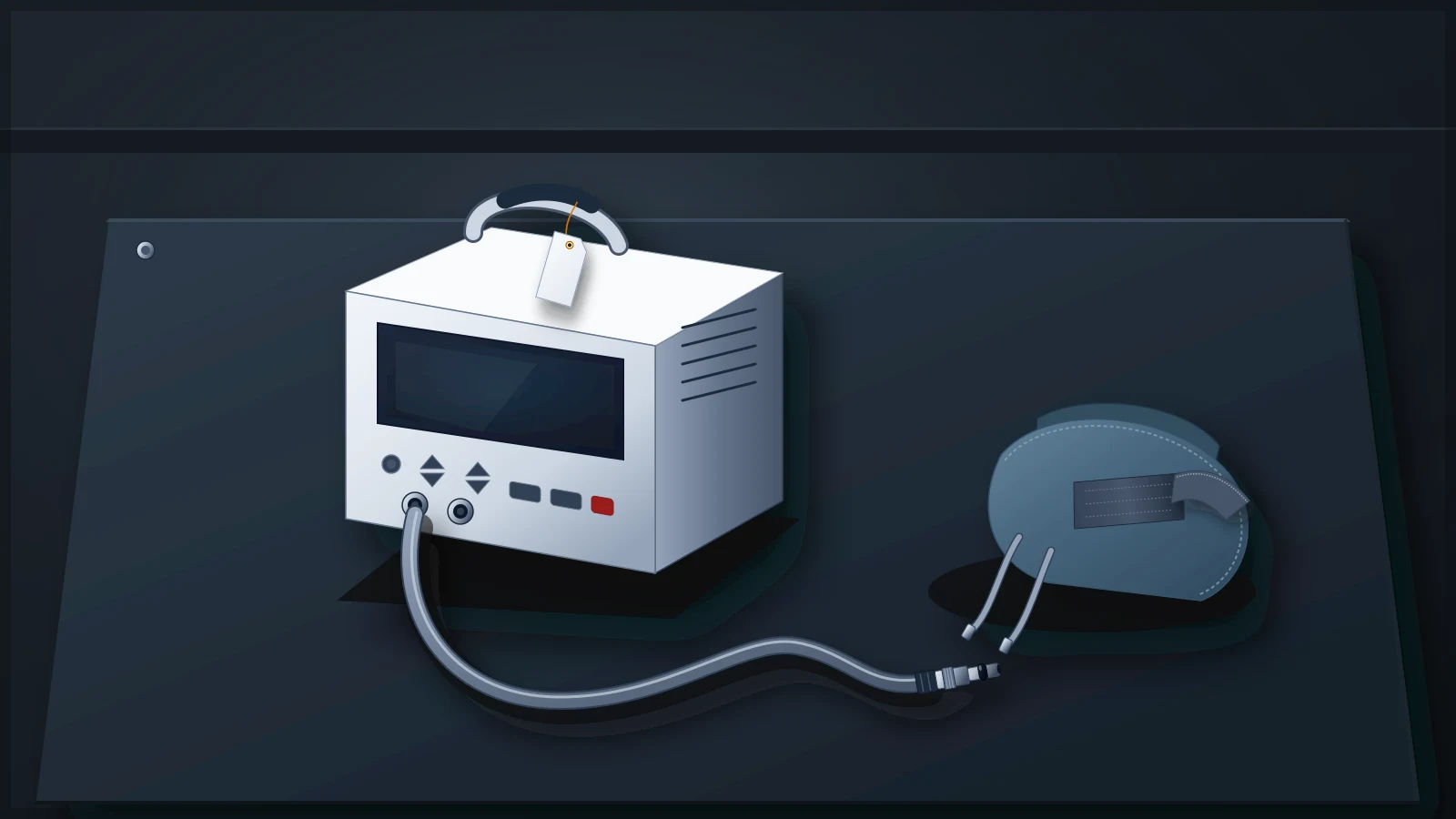
Before sending a pneumatic tourniquet console for repair, capture the console, cuff and hose identities together with the reported pressure, timer and alarm behavior. Separate what operating-room staff reported from what biomed observed. Record the original accessory combination, exact display messages, checks performed and anything still untested. The result should help the next technician investigate without turning an intake observation into an unsupported diagnosis.
The system boundary matters: 21 CFR 878.5910 identifies a pneumatic tourniquet as a pressure-regulating unit, connecting tubing and inflatable cuff. A console-only work order can therefore omit components involved in the complaint. The record design below connects those components; it is an editorial template, not a manufacturer-approved test procedure or a prescribed CMS form. FDA device definition.
Identify the console, cuff and hose separately
Start with one work-order number linking the three components. Label each observation with the component or channel involved. Do not invent a serial number for an accessory that has none: use the available lot, labeled part number or local tracking identifier, and state when identification is unavailable. A replacement accessory used later on the bench needs its own entry so its results cannot be mistaken for results from the returned combination.
Console: manufacturer, exact model, catalog/reference number, serial number, hospital asset number and owning location. Record software version and selected display language when available without unsafe operation; otherwise mark them not obtained.
Cuff: manufacturer and labeled product identifier, size, port configuration, reusable or single-use labeling, and lot or local tracking number if present. State whether this is the cuff involved in the reported event.
Hose: labeled assembly identifier, connector configuration and the console channel used. Note adapters or other attached items actually present. Do not infer compatibility from connector fit or color alone.
Event: staff’s description, when the problem occurred, power source if known, displayed message, timer behavior, components exchanged and any resulting change. Identify the reporter and distinguish recollection from a photograph or recorded observation.
Zimmer Biomet Japan’s Japanese-language ATS4000 sheet identifies catalog 60-4000-301-09 and includes serial, inspector, date and judgment fields. No revision date is visible. Use it as a model/market example, not a universal ATS-series checklist. ATS4000 Japan check sheet.
Describe location and condition: a damaged connector, visible O-ring deterioration, cuff closure contamination or enclosure damage is more useful than “accessories bad.” Include permitted photographs without patient identifiers. Record what was visible as received and what became visible only after authorized handling. A photograph of an intact exterior cannot establish the condition of an internal seal or a pressure sensor.
The Japan sheet covers the enclosure, front controls, power inlet, LOP sensor, hose/cuff O-rings and cuff hook-and-loop condition. These are prompts for model-specific observations, not universal rejection limits. For another system, use its own checklist.
Avoid converting an observation directly into a replacement instruction. A damaged O-ring is a reason to assess the affected assembly against its instructions; it does not by itself identify the cause of the reported alarm. Similarly, a clean cuff closure does not demonstrate an airtight bladder. Record the disposition of each suspect accessory so an unexplained defect is not lost when the console moves to another service provider.
Preserve self-test and display findings
If safe operation is authorized, document the starting configuration, power source, display state and exact message or code. Capture the message before an authorized restart when practicable. If staff already restarted the device, record that history rather than assuming the original message can be recovered. A code should remain a code in the intake record until interpreted using the applicable model’s documentation.
The A.T.S. 4000TS manual includes a Test and Analysis form covering visual, electrical-safety and functional testing, and an error-code section for fault investigation. The cited Revision E copy is hosted by tourniquets.org; its currency has not been confirmed against current OEM service channels. It supports this documentation example, not a current authorization to execute its service procedures. A.T.S. 4000TS operator/service manual.
On the Japan ATS4000 sheet, display checks include a green power indication and successful self-test ending with zero displayed. Do not transfer that sequence to every model, or diagnose transducer drift from a nonzero display alone. Record the actual state and escalate unexplained behavior for qualified assessment.
Keep pressure and timer observations distinct
The Japan sheet separately addresses pressure adjustment, time adjustment, inflation/deflation and LOP operation. Preserve those distinctions in the work order. “Powers on” cannot stand in for a timer check, and “inflates” cannot stand in for controlled deflation or pressure accuracy. Mark a feature not applicable only after confirming that the received model does not have it.
For every authorized bench check, identify the procedure and revision, connected cuff/hose or approved test fixture, relevant channel and recorded result. If a substitute accessory is used, retain the original combination in the record. A passing check with a substitute can guide further investigation, but it does not establish that the original cuff and hose passed.
Distinguish adjusting a timer setting from verifying elapsed time or its warning function. Likewise, observing a pressure display is different from comparing pressure with an independent reference. The expert maintenance discussion at tourniquets.org calls for checking the regulator and display against a calibrated pressure standard. Record reference-instrument identity and calibration status when such testing is performed; keep adjustment and calibration work in the qualified service procedure. Tourniquets.org maintenance discussion.
A steady display does not prove the circuit is leak-free
The A.T.S. 4000TS manual explains that the system can maintain its cuff-pressure setpoint despite internal or external leakage. That is a concrete reason to keep regulation observations separate from leak-test results. A stable display alone cannot clear the cuff and hose.
Tourniquets.org also describes how regulator compensation can conceal sustained leakage, impair battery operation and affect indicated pressure in single-port systems. This is an identified expert source, not a consensus standard. It supports investigating leakage, not assigning a leak rate, pressure error or battery-runtime estimate to the device on the bench.
The Japan sheet includes a hose-removal low-pressure warning with sound and lamp, plus a menu cuff-test leak check. Treat these as examples of recorded alarm and leak evidence for that system. Any challenge test must follow current applicable instructions, including the approved setup and limits. This article supplies no pressure setting, alarm delay, sound-level threshold or leak-decay limit.
Record alarm text, audible and visual responses, channel, test configuration and observed outcome separately. A warning response does not prove pressure accuracy; a completed cuff test does not clear an untested accessory or resolve an intermittent complaint. If a test was unsafe to perform, unavailable or inconclusive, preserve that result explicitly and assign the next assessment. Do not substitute improvised capping or connector changes for an approved test method.
Separate maintenance duties from a model’s schedule
For US hospitals, 42 CFR 482.41(d)(2) establishes the duty to maintain facilities, supplies and equipment at an acceptable level of safety and quality. It does not specify this tourniquet intake template, separate cuff/hose identifiers or a six-month tourniquet interval. The component fields here are recommended record design for investigating the complaint. Hospital physical-environment regulation.
The cited A.T.S. 3000 manual copy specifies periodic testing and inspection at least every six months; its functional/calibration checks have separate scheduling language. AST’s 2018 guideline also recommends a six-month inspection interval and recording equipment identification, inspection/maintenance dates and effectiveness comments. These are model-specific instructions and professional recommendations, respectively, not a universal federal schedule. A.T.S. 3000 manual, maintenance section. AST pneumatic-tourniquet guideline.
The A.T.S. 3000 copy is distributor-hosted and its current revision is unconfirmed. Obtain the applicable controlled instructions before selecting activities, intervals or acceptance limits. Intake does not authorize changing the hospital’s maintenance program. Follow the facility’s approved program and applicable current requirements; this record is one input to that process.
Keep cuff reuse and recall decisions traceable
Record the cuff’s labeling and handling status without treating bench acceptance as permission for reuse. FDA’s June 5, 2023 letter addresses conservation during insufficient supplies of non-sterile single-use pneumatic cuffs. Its recommendations include inspection/discard criteria, manufacturer consultation about sterilization and maximum reuses, tracking reuse and separating sterilized from disinfected cuffs. It is not a general authorization for the repair bench to reprocess single-use products. FDA cuff-conservation letter.
For intake, the useful fields are the cuff identifier, whether it was retained or discarded, and the facility’s applicable handling or conservation record if one exists. Refer unresolved reuse status to the responsible infection-prevention and supply teams. Record the responsible owner and the approved handling decision before the cuff moves to its next destination.
Console identifiers also support recall matching. FDA recall Z-1202-2026 concerns specified A.T.S. 3200TS systems and describes a touchscreen freeze in certain non-English language settings. The record lists software and affected-unit information. A similar complaint on another ATS model is not enough to establish inclusion; compare the exact device with the notice and obtain the applicable manufacturer action. FDA Zimmer Tourniquet Systems recall record.
The separate historical A.T.S. 3000 recall Z-0296-2013 reports out-of-box and intra-procedure failures with alarm, non-operational mode and a blank display; it was terminated in 2014. Use the affected model/catalog and serial information for matching. A past recall does not establish the cause of a new complaint, and neither recall establishes a failure rate for the fleet. FDA A.T.S. 3000 recall record.
Use one intake record with explicit unresolved fields
Adapt the following record to the local work-order system. It combines component identity with the observation domains above; it does not reproduce an OEM acceptance checklist. Keep the source procedure, received assembly and any later test assembly identifiable throughout the record. Use “not tested,” “not available” or “not applicable—with reason” instead of leaving a blank that could be read as a pass.
| Record area | Entry to complete | Interpretation or next action |
|---|---|---|
| Work order and event | Work order; reporter; event date/time; exact complaint; patient-safety escalation reference if applicable. | Separate reported history from biomed observations; follow local incident handling. |
| Console identity | Manufacturer; model; catalog/reference; serial; asset number; location; software/language if available. | Match the actual device to controlled instructions and applicable recall scope. |
| Cuff identity and status | Product/size/port labeling; reusable or single-use; lot/local ID; involved in event: yes/no/unknown; handling status. | Keep original-cuff evidence distinct from substitute-cuff results; route unresolved reuse status. |
| Hose and configuration | Assembly identifier if available; connectors/adapters; console channel; original or substitute. | Record each authorized configuration change and which result belongs to it. |
| Appearance | Component; precise defect location; as-received observation; permitted photograph reference. | Evaluate against applicable instructions; appearance alone does not clear function. |
| Self-test/display | Exact message/code; power source; observed display state; restart history. | Preserve the observation; obtain model-specific interpretation before assigning a cause. |
| Pressure/timer function | Pressure-control response; timer-setting response; inflation/deflation observations; checks omitted. | Distinguish control response from pressure accuracy and elapsed-time verification. |
| Alarms and leakage | Alarm text; sound/lamp response; channel; cuff-test result; exact assembly and approved procedure. | A steady display is not a leak-test result; identify unresolved or untested elements. |
| Test evidence | Procedure/revision; operator/date; test-equipment ID and calibration status where relevant; measurements and applicable limits. | Use approved limits; distinguish measured values from displayed values and reported symptoms. |
| Disposition and handoff | Status of each component; recall review outcome; outstanding checks; responsible person; next service destination. | Intake completion does not authorize clinical release; retain a clear owner for unresolved work. |
For example, a technician might record: “OR reported repeated low-pressure warnings. Console received with a hose; event cuff was discarded before intake. Bench observations used a separately identified test cuff. The reported event configuration could not be reproduced.” This is an illustrative record, not a test result or a diagnosis. It tells the next reviewer why a later passing check cannot establish the condition of the missing cuff.
When closing intake, state what remains unknown and who will resolve it. If the complaint persists or relevant safety checks remain incomplete, retain the appropriate out-of-service status under the facility’s process. Calibration, repair and return-to-service verification need their own authorized evidence. Clinical pressure selection and patient-use decisions remain outside this intake record.
For the broader documentation and release process, connect this intake record to the medical equipment service record and the facility’s return-to-service testing record. Each should identify the same console and the accessories actually assessed.