
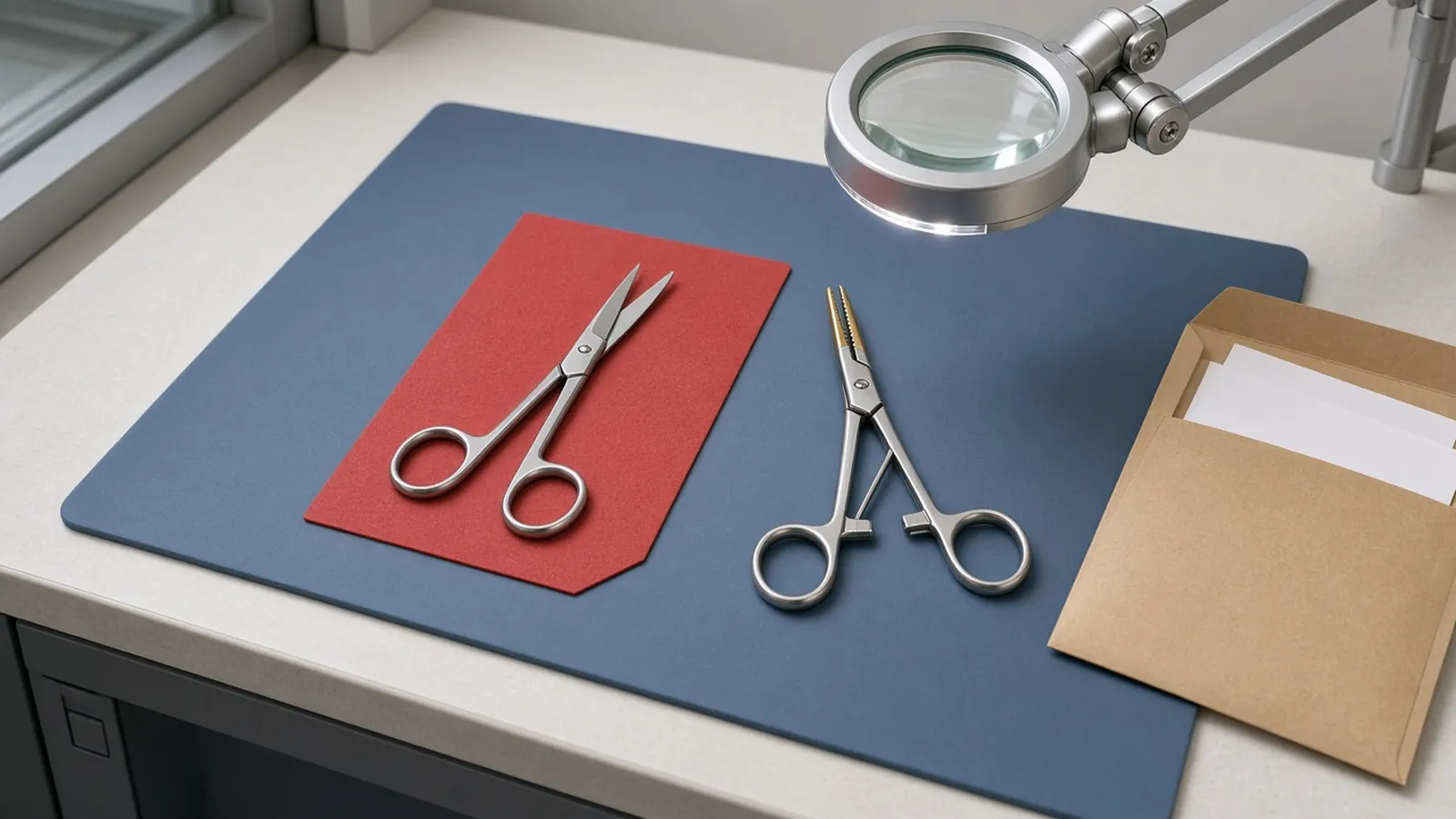
When the Sharpened Set Comes Back: Five Gates Before Patient Use
When a surgical tray containing freshly sharpened scissors, realigned needle holders, and adjusted hemostatic clamps returns from an off-site repair vendor, sterile processing and biomedical engineering teams face a critical operational crossroad. The common temptation is to view the vendor's shipment carton as verified inventory, unwrap the blue protective foam, verify the instrument count against the manifest, and route the container directly to the autoclave for packaging and terminal sterilization. That practice skips the decontamination, inspection, and function-testing gates that professional guidance applies to repaired instruments before patient use.
The primary rule for returned surgical hardware is straightforward: treat every returned set as an unprocessed, unverified assembly rather than sterile or patient-ready inventory. A third-party invoice or packing slip asserting that instruments were sharpened, adjusted, and cleaned is a commercial transaction record—not a validated healthcare verification record. Under the hospital Conditions of Participation and perioperative professional standards, the receiving hospital still has to confirm that repaired instruments are cleaned, inspected, and functionally acceptable before they re-enter sterile supply. A vendor packing slip does not replace that check.
To prevent unverified hardware, residual grinding particulates, and undetected mechanical failures from reaching the operating room, clinical engineering and sterile processing departments (SPD) must execute five sequential gates on every returned instrument set:
Gate 1: Intake Reconciliation and Itemized Audit — Cross-check the vendor's line-item service report against the surgical tray's master count sheet. Every single device must be accounted for, including damaged items returned unsharpened, instruments scrapped due to metal fatigue, and parts substituted during maintenance.
Gate 2: Decontamination and Bioburden Removal — Decontaminate the returned set according to each instrument manufacturer's written Instructions for Use (IFU). AORN's 2015 guideline summary recommends mechanical cleaning unless the IFU says otherwise, so residual oil, metal remnants, and soil are removed before inspection.
Gate 3: Instrument-by-Instrument Functional and Physical Testing — Inspect and function-test under lighted magnification. Check scissors cutting along the blade, needle-holder and clamp ratchet hold, tips, screws, and box locks, and test insulated instruments with equipment designed to detect insulation failure—not visual inspection alone.
Gate 4: Packaging and Terminal Sterilization — Reassemble verified trays and package and sterilize them according to each instrument manufacturer's written IFU before they return to sterile supply.
Gate 5: Service Evidence Archival and Cumulative History Tracking — File the vendor's line-item work order, inspection and test results, and instrument or tray identification so the facility has a maintenance record for later servicing-versus-remanufacturing questions.
flowchart TD
    VendorReturn["Sharpened Set Arrives from Vendor"] --> Gate1["Gate 1: Physical Reconciliation and Intake<br/>Match itemized work order to tray count sheet<br/>Segregate unsharpened or replaced items"]
    Gate1 --> Gate2["Gate 2: Decontamination<br/>Clean per manufacturer IFU<br/>Remove residual oil, metal remnants, and soil"]
    Gate2 --> Gate3["Gate 3: Type-Specific Inspection and Function Testing<br/>Lighted magnification of tips, box locks, screws<br/>Scissors sharpness test and ratchet hold checks<br/>Insulation-failure testing for electrosurgical tools"]
    Gate3 --> Decision{"Verification Outcome"}
    Decision -- "Fail (burrs, slippage, pits)" --> Disposition["Disposition Action<br/>Return to Vendor / Quarantine / Discard"]
    Decision -- "Pass" --> Gate4["Gate 4: Packaging and Sterilization<br/>Assemble tray and package per IFU<br/>Sterilize according to the instrument IFU"]
    Gate4 --> Gate5["Gate 5: Service History Archival<br/>Log technician ID, inspection results, and vendor work order<br/>Record the sharpening event in the maintenance history"]
Gate5 --> Ready["Release to Sterile Supply"]Executing these gates ensures that routine maintenance remains legitimate servicing rather than undocumented remanufacturing, aligning facility operations with the principles detailed in our framework for return-to-service testing after corrective maintenance.
Treat Returned Instruments as Unprocessed, Not Sterile
A dangerous misconception in hospital operations is assuming that because instruments look shiny, clean, and neatly aligned in shipment packaging, they are ready for immediate packaging and autoclave loading. In reality, outside sharpening and repair facilities are industrial environments. Grinding wheels, abrasive belts, diamond honing stones, buffing wheels, and machine lubricants generate fine metal swarf and hydrocarbon residues that are incompatible with sterile surgical fields.
Professional perioperative standards leave no ambiguity regarding returned hardware. AORN's May 2015 Guideline Summary for cleaning and care of surgical instruments states in Recommendation II that before use, all new, repaired, refurbished, and loaned instruments should be cleaned and decontaminated, inspected, and sterilized or high-level disinfected according to the device manufacturer's written IFU. Separately, the CDC Guideline for Disinfection and Sterilization in Healthcare Facilities states that used items arriving in central processing should be considered contaminated unless already decontaminated where they were used.
Some facilities write the same rule into local procedure. The Gwinnett, Newton and Rockdale County Health Departments (GNR) 2019 sterile processing policy states that new, repaired, and refurbished instruments will be examined, cleaned, and sterilized according to the manufacturer's written IFU before patient use, and that items found soiled or defective after decontamination are removed from service until cleaned or repaired. That document is one public example of how a network operationalizes the gate; it is not itself a national CMS requirement.
A critical technical reason for cleaning before inspection is that visual inspection with the unaided eye drastically under-detects residual soil and sharpening contamination. A study cited on CDC's sterilizing-practices page found that 91% of instruments looked clean visually, yet 84% showed residual debris on microscopic examination, concentrated at junctions between laparoscopic insulating sheaths and activating mechanisms and at articulations and grooves of forceps. CDC notes that more research is needed on the clinical significance. Visual inspection alone is therefore a weak cleanliness gate for a returned set; it does not prove that sharpening residue is absent, and it should not be over-read as a patient-harm rate.
Sharpening also leaves residues that cleaning has to remove. Cordero's 2011 note on surgical scissors states that remnants of oil and metal on the instrument can cause inflammation in the eye, which is why ophthalmic sets in particular must be cleaned after sharpening before reuse. AORN's 2015 summary separately requires special handling for intraocular instruments. Follow the device IFU for cleaning method; do not assume a returned set is already safe to package.
Instrument-by-Instrument Checks: Faults, Evidence, and Escalation
Once returned instruments have completed mechanical decontamination and thorough drying, sterile processing technicians must perform physical and functional verification at the prep-and-pack bench. A cursory overall visual scan is inadequate. Technicians need task lighting, lighted magnification for hard-to-clean areas (AORN's 2015 summary), and the function-test medium specified in the instrument IFU or, if the IFU is silent, a purpose-made sharpness test material.
Service providers such as STERIS, Agiliti, and Henry Schein categorize surgical instrument maintenance into distinct mechanical disciplines: sharpening, tip and shank realignment, screw and rivet replacement, tungsten carbide insert replacement, and electrical reinsulation. Each maintenance action carries unique failure modes. The table below maps, by instrument type, defects sharpening or related repair can leave, the objective check that detects them, and the escalation boundary. Test methods follow AORN inspection criteria, ISO 7741's gauze method as described in trade literature, and current SPD practice guidance; where those sources disagree, the device IFU governs. The table does not invent numeric OEM tolerances.
| Instrument Category | Common Post-Sharpening & Repair Defects | Verification & Functional Test Method | Acceptance Standard | Escalation Boundary |
|---|---|---|---|---|
| Surgical Scissors (Mayo, Metzenbaum, iris, tenotomy) | Wire edges, micro-burrs along cutting edges, uneven blade bevel, loose pivot screw or rivet causing blade overlap failure, excessive thinning of blade tips. | Cut along the entire blade length using the medium specified in the IFU, or a purpose-made sharpness test material if the IFU is silent; cycle the hinge to confirm smooth action without binding. | Clean, single-stroke shear cut through test medium without snagging, folding, or pinching; blade tension holds uniform resistance without binding or loose free-falling. | Return to vendor if wire edges, snags, or loose joints are detected; retire permanently if repeated grinding has narrowed blades so they cannot meet or if deep pitting breaches structural integrity. |
| Needle Holders (Standard & Tungsten Carbide Inserts) | Fractured or delaminated brazing on tungsten carbide jaw inserts, worn or flattened diamond-pyramid cross-serrations, misaligned distal tips, cracked box lock. | Clamp a surgical needle at the first ratchet position and confirm the ratchet holds without spontaneous release; inspect jaw closure and insert condition under lighted magnification. | Ratchet holds at the first position without slipping or spontaneous release; jaws close evenly; inserts are not chipped or visibly separated from the jaw. | Return to vendor if jaw alignment is uneven; quarantine for insert replacement if serrations are worn or brazing shows hairline separation; retire if box lock exhibits micro-fractures. |
| Ratcheted Hemostatic Clamps (Kelly, Crile, Rochester-Péan) | Worn or chipped ratchet teeth, lost spring tension in shanks, misaligned jaw serrations, stiff or gritty box-lock articulation from dried polishing slurry. | Engage the ratchet at each position and confirm it holds without slipping; inspect jaw alignment and serration intermeshing under lighted magnification. | Ratchet engages and holds at each position without slipping; jaws close evenly along their length. | Return to vendor for ratchet recutting or shank realignment; retire if ratchet teeth are worn past functional engagement or if shank metal exhibits fatigue stress cracking. |
| Tissue & Dressing Forceps (Adson, DeBakey, toothed forceps) | Misaligned distal tips, scuffed or bent micro-teeth, uneven spring tension between tines, loss of grasping coaptation under moderate thumb pressure. | Close the tines and examine tip alignment under lighted magnification; for toothed models, confirm the teeth meet without crossing or obvious misalignment. | Tips meet squarely and symmetrically without crossing or scissoring; teeth interlock smoothly without binding; tines provide balanced spring resistance and return cleanly to resting stance. | Return to vendor for tine realignment and tension balancing; retire if distal tips are cracked, bent beyond elastic recovery, or if teeth are fractured. |
| Retractors (Handheld & Self-Retaining, e.g. Weitlaner, Gelpi) | Rounded or blunt prongs on sharp retractor models, bent frame arms, slipping cam locks or thumb-release mechanisms, loose hinge rivets. | Cycle the lock or ratchet through its range and confirm it holds without slipping; inspect prongs and hinges under lighted magnification for bluntness, bends, and cracks. | Moving parts operate freely; the lock or ratchet holds without slipping; prongs are not bent, cracked, or obviously blunted relative to the rest of the instrument. | Return to vendor for ratchet/cam repair or prong re-pointing; quarantine if frame arms warp under moderate spreading load; retire if locking teeth are stripped. |
| Bone & Cutting Instruments (Curettes, Rongeurs, Osteotomes) | Chipped cutting cups, uneven bevel angles, weakened double-action pivot springs, micro-fractures along cutting perimeter, misaligned rongeur jaws. | Inspect cutting edges, cups, and pivots under lighted magnification for chips, nicks, cracks, and pitting; check that movable parts operate freely. | Cutting edges are free of chips, nicks, and cracks; alignment and moving parts function; no corrosion or pitting that would fail AORN post-decontamination inspection. | Return to vendor for precision perimeter honing; retire immediately if cutting cup is cracked, pitted, or thinned beyond structural safe limits. |
| Insulated & Laparoscopic Instruments (Monopolar Shears, Graspers) | Pinholes, micro-tears, or thinning in heat-shrink or ceramic insulation caused by sharpening clamps or abrasive wheels; loose distal pivot pins; stiff internal control rods. | Visually examine the insulation under lighted magnification, then test with equipment designed to detect insulation failure along the insulated shaft; verify jaw actuation. | Insulation tester indicates a pass per the tester IFU and the instrument IFU; insulation is intact on visual exam; jaws actuate without binding. | Quarantine immediately upon insulation test failure; return to qualified vendor for complete shaft reinsulation; discard if internal push-rod or distal clevis is damaged. |
The Scissors Test-Material Controversy: Standards vs Practice
Testing surgical scissors sharpness reveals a significant divergence between international standards, clinical literature, and contemporary sterile processing practice guidance. Clinical engineering and SPD leaders must understand these methodological differences to establish defensible facility testing protocols:
The ISO 7741:1986 Standard Baseline: ISO 7741:1986 specifies general requirements and routine test methods for scissors and shears used in surgery, covering workmanship and cutting ability. The full standard is paywalled. Healthcare Purchasing News describes that standard as specifying gauze as the sharpness-test method; this article does not quote numeric ISO 7741 acceptance limits.
The Clinical Literature Method (Cordero / Cotton Wool): In peer-reviewed ophthalmic and surgical engineering literature, Cordero advocates a practical cut-and-pull check. Technicians cut a thin strip of stretched clean cotton wool along the entire blade length and then gently draw the wool with blades closed. A blunt blade or loose pivot joint immediately clasps or pinches the cotton fibers rather than cleanly parting them, revealing uneven blade contact.
Modern Sterile Processing Guidance (Pure Processing / Synthetic Media): Modern prep-and-pack guidance from Pure Processing tells SPD teams to test scissors on approved red sharpness paper or synthetic test medium—typically a yellow or red rubber test medium or a synthetic test card from the test-material manufacturer—and not on fingernails, gloves, gauze, suture, or ordinary paper, which it says are not validated methods. That vendor guide does not assign a single color to a scissors length.
How should a facility reconcile these methods? The regulatory and quality rule is unequivocal: defer to the instrument manufacturer's written IFU whenever general standards or vendor guidance conflict. If the OEM IFU specifies a test material, that material is the verification method. Where an IFU is silent, current SPD practice favors purpose-made synthetic or rubber test media because they are more reproducible than improvised gauze or cotton; the article does not treat that preference as a substitute for a named IFU.
When Sharpening Becomes Remanufacturing
Sharpening and mechanical realignment can be legitimate servicing under FDA's May 2024 remanufacturing guidance when they return a finished device to the OEM's established safety and performance specifications and original intended use. Repeated or aggressive material removal can still cross into medical device remanufacturing. In May 2024, FDA issued the final guidance, Remanufacturing of Medical Devices. The guidance is nonbinding; its worked examples are hypothetical illustrations, not device-specific rulings.
In that guidance, servicing is the repair and/or preventive or routine maintenance of a finished device, after distribution, to return it to the OEM's safety and performance specifications and original intended use; it excludes activities that significantly change those specifications or intended use. In contrast, remanufacturing is any act done to a finished device that significantly changes its performance or safety specifications, or intended use—matching the remanufacturer definition in 21 CFR 820.3. Remanufacturers are manufacturers. FDA has enforced registration, listing, adverse-event reporting, quality-system requirements, and marketing-submission duties on remanufacturing activities; whether a specific change also requires a new 510(k) or other submission is a separate evaluation.
While FDA Example E.7 specifically analyzes a stainless steel manual drill, applying this framework to surgical hand instruments (scissors, rongeurs, curettes, and needle holders) represents a reasoned clinical-engineering interpretation. A first-time sharpening of Mayo scissors that restores the OEM cutting bevel without changing intended use or performance specifications can be analyzed as servicing under that framework. Cumulative grinding that leaves blades unable to meet, breaches a surface coating, or otherwise changes cutting performance is the analog of the coated-drill example—not an FDA ruling about scissors.
The practical lesson for hospital leaders is that in Example E.7, the illustrative determination turned on the facility's maintenance record. If an instrument later fails and the hospital cannot show what was done, how many times it was sharpened, and who verified function after return, it cannot reconstruct the Example E.7 analysis. That record-keeping need is the same evidence problem discussed in our guide on replacement parts compatibility and remanufacturing risk.
What the Work Order Must Capture — and What to Demand From the Vendor
A chronic vulnerability in hospital repair management is the acceptance of vague, lump-sum vendor invoices. When an outside sharpening vendor returns three surgical trays with an invoice that says only 'tray sharpening and refurbishment' for a batch of instruments, the paperwork cannot support per-item traceability or a later servicing determination. It is a commercial invoice, not an inspection record.
Biomedical engineering and SPD leadership must establish strict contractual requirements with all service providers, requiring work orders to provide itemized, granular technical data. Every returned work order must contain the following core evidence elements:
Line-Item Instrument Identification: Each serviced instrument must be identified by catalog number, description, and source tray barcode or serial number. Generic groupings ('assorted hemostats') must be rejected.
Specific Maintenance Action Taken: The work order must specify whether the item was honed, realigned, screw-tightened, screw-replaced, insert-brazed, polished, or reinsulated.
Unsharpenable / Rejected Instrument Accounting: Any instrument deemed beyond economical repair or unsafe to sharpen must be explicitly listed with the technical rationale (e.g., deep pitting, cracked box lock, blade thinned beyond OEM tolerance).
Replacement Component Provenance and Traceability: If screws, pivot pins, springs, or tungsten carbide inserts were replaced, the vendor must document component provenance, confirming metallurgical compatibility and dimensional equivalence to OEM specifications.
Technician Signature and Objective Quality Sign-Off: The name or ID of the technician who performed the work and the final inspector who verified cutting and locking tolerances.
When negotiating repair contracts, hospital leaders should evaluate vendor quality claims with technical skepticism, as emphasized in our guide to qualifying medical equipment service providers. For instance, large providers like Agiliti market ISO 13485:2016 quality management certification, parts traceability, and comprehensive inspection regimes. Distributor repair operations like Henry Schein ProRepair adopt strict technical boundaries, explicitly declining to re-tip instruments because altering the integrity of the original handle-tip assembly creates structural failure risks. Meanwhile, boutique and mobile sharpeners like The Sharpist offer 16x magnified before-and-after photographic documentation and return unsharpenable items free of charge. These marketing statements and service scopes represent vendor claims; the hospital's internal intake inspection remains the legal and clinical verification backstop.
On the hospital side, AORN Recommendation XIV in the 2015 summary lists the cleaning and decontamination documentation that should be maintained: date, time, identification of instruments, method and verification of cleaning and cleaning-audit results, washer identity and washer-efficacy testing results, name of the person performing cleaning and decontamination, lot numbers of cleaning agents, testing results for insulated instruments, disposition of defective equipment, and maintenance of cleaning equipment. FDA separately recommends that servicing-versus-remanufacturing determinations record product name (model/serial), dates, a description of the device and activities including components involved, the determination, supporting references, and signatures. Aligning an itemized vendor work order with those SPD fields is how a sharpening event becomes usable later.
Send It Back, Quarantine It, or Retire It
When an instrument fails intake inspection at the prep-and-pack bench, technicians must not simply place it aside without a documented workflow. Facilities require a formal, standardized disposition policy categorizing failed items into three distinct operational pathways: Return to Vendor (RTV), Technical Quarantine, or Permanent Retirement.
| Disposition Category | Trigger Criteria & Defect Findings | Operational Action & Handling | Required Documentation & Evidence Trail |
|---|---|---|---|
| Accept for Release | Clean cut along the blade on the IFU-specified or purpose-made test medium; ratchets hold at each position; box locks operate freely; insulated instruments pass insulation-failure testing; no visible oil or metal remnant; work order matches the tray count sheet. | Route to tray assembly, packaging, and sterilization according to the instrument manufacturer's written IFU. | Record technician ID, tray ID, and successful test verification in SPD tracking system; archive vendor work order in equipment service repository. |
| Return to Vendor (RTV) | Wire edges or burrs along the cutting edge; scissors snagging or folding test material; ratchets slipping at the first position; stiff or binding box locks; residual grinding slurry; unsharpened items without explanation. | Segregate defective instruments; tag the specific functional failure; open a vendor return; and keep the item out of tray assembly. | Log vendor RMA number, specific defect description, magnified photo of defect if available, and date of return; record vendor credit or warranty re-service status. |
| Technical Quarantine | Failed insulation-failure test on an insulated laparoscopic shaft; undocumented part substitution; a missing tray item pending vendor reconciliation; or a maintenance history that suggests cumulative material removal may have changed performance specifications. | Isolate instruments in designated secure quarantine locker; notify clinical engineering / biomedical department for formal engineering risk assessment. | Generate biomedical risk assessment ticket; record part metallurgy verification and dimensional checks against OEM technical specifications; document disposition. |
| Permanent Retirement / Discard | Deep pitting where polishing would prevent blade coaptation (Cordero); cracked box lock or shank; stripped screw threads; delaminated tungsten carbide insert brazing; repeated sharpening breaching hardened surface layer (FDA Example E.7). | Permanently decommission the instrument and render it unusable per facility policy before disposal so it cannot re-enter a tray. | Update SPD tray master inventory and CMMS equipment record; document decommissioning reason, catalog/serial number, and date; initiate replacement procurement. |
Understanding the retirement boundary is vital for clinical safety. As Cordero underscores in peer-reviewed surgical engineering literature, deep surface pitting cannot simply be polished away indefinitely. If pits on the inner mating surfaces of scissors blades are too deep, grinding them smooth removes so much base metal that the shearing edges will no longer make physical contact along their stroke. Similarly, when tungsten carbide jaw inserts delaminate, re-brazing them in an uncalibrated field shop risks annealing and weakening the stainless-steel handle shanks. Knowing when an instrument has reached its structural end-of-life protects surgeons and patients from catastrophic intraoperative breakage.
Who Owns the Record: SPD, Biomed, or Both
The ultimate breakdown in surgical instrument sharpening management is institutional: an organizational split between Sterile Processing and Healthcare Technology Management (HTM / Clinical Engineering). In the majority of acute care hospitals, these two departments operate in complete administrative silos:
Biomedical engineering manages powered, electronic, and diagnostic capital equipment. HTM tracks those assets in a computerized maintenance management system (CMMS), logging preventive and corrective work to support CMS Tag A-0724 equipment-record expectations, as discussed in our review of medical equipment service record requirements. However, HTM rarely touches surgical hand instruments, viewing them as disposable supplies or sterile processing property.
Sterile Processing, conversely, manages tens of thousands of stainless-steel hand instruments organized into hundreds of procedural trays. SPD utilizes tray tracking barcode software (such as Censitrac, SPM, or Impress) focused on tray assembly count sheets, washer loading, and autoclave cycle logs. When scissors become dull, an SPD lead packs them into a box, ships them to an outside sharpening vendor, and files the paper invoice in a binder or forwards it to accounts payable. Neither department maintains an asset-level maintenance history.
When CMS surveyors ask for equipment-maintenance evidence under Tag A-0724, or when a facility has to reconstruct a servicing-versus-remanufacturing determination, this split of ownership supplies the missing record: a qualified vendor, an itemized work order, post-decontamination inspection and function-test results, and a sharpening history tied to the tray or instrument. The returned carton is then incoming work, not finished sterile inventory.