
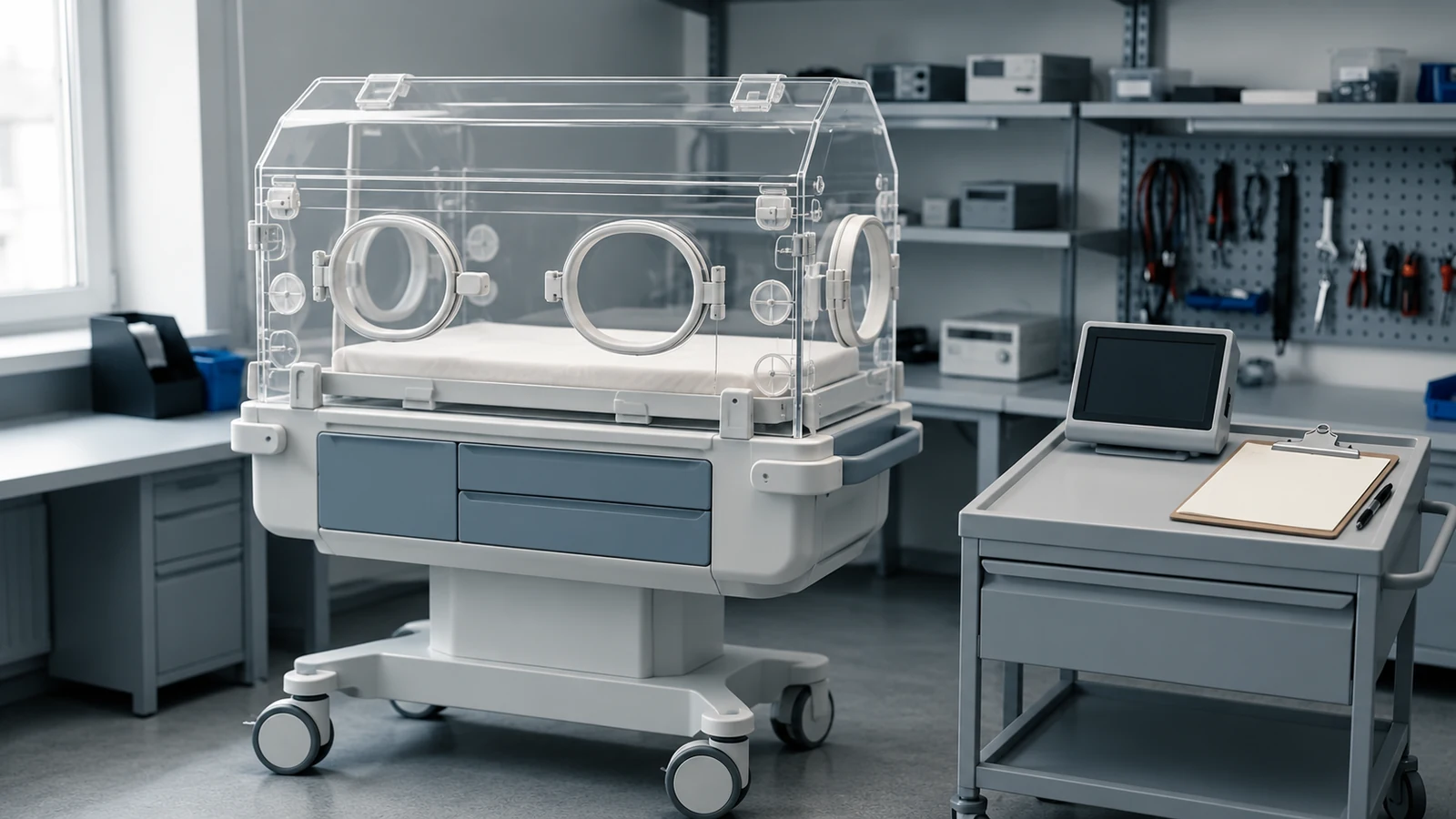
Before an Incubator Returns to Patient Use
After preventive maintenance or a heater, fan, or sensor repair, the useful question is whether the incubator has been verified against the applicable procedure and whether the record explains that decision. A normal temperature display is only one observation. It does not document the environment throughout the compartment, the alarm response, or completion of a safety correction.
The current hospital Condition of Participation at 42 CFR 482.41(d)(2) states: “Facilities, supplies, and equipment must be maintained to ensure an acceptable level of safety and quality.” This sentence establishes a safety-and-quality obligation; it does not enumerate incubator test tolerances or CMMS fields.
For historical context, CMS S&C 14-07-Hospital, issued in 2013, used mandatory language for inspection and performance-and-safety testing before initial use and after major repairs or upgrades. Its older paragraph reference is 482.41(c)(2). The memo supplies historical context; use current requirements and the facility’s approved procedures when making a present-day decision. The record structure below is a practical recommendation, not a universal CMS field list.
This guide addresses incubator-specific evidence. For the broader repair-trigger decision, see when a repair is major; for general documentation design, see medical equipment service records.
Identify the Device and the Applicable Standard
21 CFR 880.5400 identifies a neonatal incubator as an enclosure providing a controlled environment for medical care and classifies it as Class II. FDA’s FMZ classification record lists neonatal incubators under that regulation with a 510(k) submission type. Neither record supplies an in-service repair procedure.
FDA recognition 6-461 identifies IEC 60601-2-19 Edition 3.0, 2020-09, for infant-incubator basic safety and essential performance. Recognition supports use of a voluntary consensus standard in premarket submissions; it does not itself authorize hospital release of a repaired unit.
The IEC catalogue for the 2020 edition also lists a consolidated 2020+AMD1:2023 publication. The catalogue excludes transport incubators and radiant warmers from this particular standard’s scope. A combination incubator/warmer therefore needs documentation appropriate to the function being checked. Name the edition used instead of assuming that publication of an amendment changes the cited FDA recognition.
| Evidence layer | What it establishes | How to use it in the record |
|---|---|---|
| Current regulation | Hospital safety-and-quality obligation; neonatal-incubator classification. | Separate the legal context from individual test criteria. |
| FDA recognition and IEC catalogue | Standard identity, edition, and scope. Public records do not expose the full test clauses. | Identify the relevant edition without inventing its numerical requirements. |
| Model-specific labeling and service documentation | The applicable checkout method, conditions, and acceptance criteria. | Record document identifier, revision, section, and selected configuration. |
| Test-equipment guidance | A published measurement approach with its own limitations. | Attribute the method and reconcile it with the approved device procedure. |
| Facility procedure | Assigned review, documentation, and release responsibilities. | Identify who completed testing and who authorized the next use. |
Before testing, reconcile the asset tag, model, serial number, accessories, operating mode, and installed options. A humidifier, scale, or oxygen-control option should not disappear from the checkout merely because the thermal test template lacks a field for it. Conversely, do not mark an absent option as a passed test. Record the scope and the reason a check is not applicable.
Temperature Evidence: Record the Run, Not One Display Value
Fluke Biomedical’s incubator-testing white paper describes measurements 10 cm above the mattress, with temperature and airflow at the mattress center and four quadrant centers. This is vendor method guidance. Confirm placement against the approved procedure; distinguish a quadrant center from a mattress corner.
For a useful temperature record, separate warm-up, overshoot, stability over time, and differences between measurement locations. A single final temperature cannot reconstruct all four. Preserve the configured setpoint, ambient baseline, start and end times, sensor-position identifiers, and the applicable limit beside each measured result. If an access door is opened during a run, identify the disturbance rather than silently treating every sample as undisturbed operation.
| Parameter | Public Fluke example — not a universal release limit | Record for the model-specific decision |
|---|---|---|
| Warm-up | Within ±20% of the manufacturer’s specified warm-up time. | Starting conditions, endpoint definition, elapsed time, and cited model criterion. |
| Overshoot | No more than 2 °C above the setpoint. | Peak temperature, setpoint, calculated difference, and applicable limit. |
| Steady temperature condition | Variation no greater than 1 °C over one hour. | Observation window, minimum, maximum, and model-specific criterion. |
| Humidity | Displayed value within ±10% of the tester indication. | Display/reference pair, units, conditions, and acceptance definition. |
| Airflow | No greater than 0.35 m/s at each measurement location. | Location-specific measurements and model procedure. |
| Sound | Below 60 dBA inside the compartment. | Operating condition, instrument setup, background context, and applicable criterion. |
For skin-probe verification, identify the probe and use the test arrangement and reference source specified for that device. Record the reference and displayed temperatures, the comparison result, and any prescribed control-response evidence. Do not introduce generic bath temperatures, immersion methods, probe tolerances, or expected heater-output percentages. The appropriate method depends on the probe and system being tested.
A failed thermal result is evidence of a problem, not proof of a particular failed component. Avoid recording “bad fan” solely because warm-up was slow, or “sensor drift” solely because two readings differed. Preserve the observation, verify the test conditions, and route diagnosis through the model’s qualified-service process.
Humidity, Airflow, and Sound Need Test Context
Treat each applicable environmental parameter as a separate result. For humidity, keep the displayed value and independent reference reading together rather than recording only a difference. State how the approved procedure defines the tolerance: a percentage of a reading and a difference in percentage points are not interchangeable. Do not translate ambiguous guidance into a new acceptance rule.
For airflow, retain measurement locations and instrument orientation so another technician can understand the comparison. For sound, distinguish normal operating noise from alarm audibility. A sound reading without the operating state and measurement setup is difficult to interpret. These recordkeeping recommendations help make a repeat measurement comparable; they do not establish new acceptance limits.
What the Independent-Monitoring Study Actually Shows
A 2023 Sensors study compared manually recorded incubator displays with calibrated independent sensors during four-hour post-maintenance tests. The pilot involved two Atom incubators at one hospital, without infants in them. It reported temperature correlation r = 0.602 (p = 0.0018), a humidity mean difference of 2.52 percentage points, and relative error of 4.2%.
Correlation does not establish agreement or demonstrate compliance with a service tolerance. The study does not prove that displays generally mask overshoot, nor does it validate every incubator model. Its authors say clinical use could change the results and would require further study. The practical lesson is to retain paired observations and time information rather than treating one display reading as complete verification evidence.
When an independent reading and the display disagree, first preserve both results with their locations and times. Check whether they describe the same condition before assigning a cause. Document any repeat test and why it was needed. A reviewer should be able to distinguish the original observation from the result obtained after setup correction or further service.
Alarm Verification: Define the Check and the Responsible Role
Separate operator pre-use checks from technical service verification. The GE Giraffe OmniBed CareStation CS1 participant guide illustrates this boundary: an unplugged unit is one possible cause of a power-up alarm, while service-screen changes are directed to authorized service personnel. GE expressly describes the guide as educational material that does not establish specifications or maintenance methods; official product labeling governs.
Build the alarm checklist from the exact device documentation. For each applicable alarm or interlock, record the procedure reference, permitted test method, expected indication or response, observed result, and tester. If the procedure calls for timing or sound measurements, retain those results. Do not assume every model has the same priority, battery duration, cutout architecture, or fallback operating mode.
A proposed handoff separates three responsibilities: the technician documents the service checkout; the assigned reviewer resolves failures and incomplete evidence; clinical staff complete the model’s pre-use checks through the facility’s process. Record those roles clearly. A bench-test signature should not imply that cleaning, safety-action completion, and bedside readiness have all been addressed.
The FDA Giraffe OmniBed heater-door correction gives a specific stop instruction: if a high-priority alarm sounds and canopy movement stops, do not move the canopy. Loose heater-door screws can lead to door damage and a potential fall onto the patient if motion is forced. FDA also directs users to perform the manual’s pre-use steps, including heater-door function checks.
That notice concerns updated use instructions and explicitly does not involve removing the devices from where they are used or sold. Do not translate the notice into a universal removal order. An individual unit with a failed checkout or unresolved unsafe condition still needs a documented disposition through the facility’s service process.
What the Incubator Service Record Should Show
The following is a recommended evidence structure for a work order. It helps a reviewer connect the repair to the checkout and the release decision. Keep the measured result, criterion, and disposition together; a checkbox labeled “temperature passed” loses the information needed to reconstruct the comparison.
| Record group | Suggested contents | Question it answers |
|---|---|---|
| Identity and scope | Asset tag, manufacturer, model, serial, options, mode, service trigger, and work performed. | Which unit and configuration were verified after which work? |
| Acceptance reference | Service document identifier, revision, section, approved procedure, and applicable criteria. | Where did the method and pass/fail decision come from? |
| Measurement system | Instrument and sensor identifiers, calibration-status evidence, and setup description. | Which reference produced the recorded result? |
| Thermal run | Conditions, setpoint, times, position readings, warm-up, overshoot, stability, and uniformity results as applicable. | Does the record cover behavior across time and space? |
| Other performance | Humidity, airflow, sound, skin probe, and installed-option results required by the procedure. | Was the relevant configured functionality covered? |
| Safety checks | Prescribed mechanical, electrical, alarm, and interlock checks with observed outcomes. | What safety evidence supports the decision? |
| Safety actions | Applicable notices, model/serial matching, action taken, completion evidence, and unresolved items. | Were safety instructions and corrections addressed for this unit? |
| Disposition | Failures, repeat-test reason, corrective actions, evidence attachments, reviewer, date, and release authorization. | Who decided what happens next, and on what basis? |
Retain results in their actual units and make the reference understandable. An instrument sticker may identify a due date, but the work order should also make the relevant calibration evidence findable. Record the calibration evidence applicable to each measurement and use the approved electrical-safety method and its criteria. The broader electrical safety testing guide explains that separate decision.
Consider a hypothetical blower replacement. The post-service record contains a final display temperature but no spatial readings or alarm-check results required by the selected procedure. The correct documentation outcome is incomplete verification. Request the missing evidence rather than inferring completion from the new part or the stable display. If further testing finds a failure, retain the first run and identify the subsequent corrective action and retest.
For intermittent complaints, attach the reported operating state, alarm text or code, timing, and circumstances alongside the bench results. “No fault observed during this run” is more precise than declaring that the reported event never occurred. The record should show what was evaluated and what remains unresolved without substituting an unexplained pass for a diagnosis.
Recall Evidence: Match the Unit and the Required Action
The following records illustrate three distinct hazards. They are examples from the Giraffe family, not an exhaustive list of incubator safety actions. Match the actual model and serial number to applicable instructions and preserve completion evidence; a category-wide recall flag is too coarse for a release decision.
The 2019 Class I porthole/panel recall, Z-0541-2020, describes panels and portholes that could look closed while remaining unlatched, creating a fall risk. The record permitted continued use under specified safety instructions and now lists termination on August 15, 2024. It supports checking closure integrity and applicable instructions, not automatic replacement of every latch.
The Class 2 power-cord recall, Z-1505-2017, involved certain Taller Bridge cords that could overheat at the wall outlet. The firm’s long-term action was replacement of affected cords. FDA lists termination on July 13, 2018. This is historical intake and service-history context; match the affected cord and any required action to the actual asset.
| Finding during checkout | Recommended disposition | Evidence to preserve |
|---|---|---|
| Closure does not pass the prescribed check | Withhold use and seek qualified assessment under the applicable instructions. | Unit identity, failed check, observed condition, and disposition. |
| Power cord is damaged or matches an unresolved applicable correction | Prevent use until the condition and required action are resolved. | Cord identity/condition, applicable notice, and completion record. |
| High-priority alarm stops canopy movement on an affected OmniBed | Stop movement; follow the FDA-linked instructions and seek service assistance. | Alarm, stopped motion, device identity, and action taken. |
| Applicable notice or action completion cannot be established | Keep the release decision open while resolving applicability or completion. | What was searched, what was matched, and the outstanding evidence. |
A terminated recall is not proof that this particular asset’s history is complete. Conversely, a correction does not automatically require every device to be removed. Follow the applicable action and resolve the unit’s condition. For the organization-wide workflow, see medical device recall response for HTM.
Do not assign universal repair permissions by job title. Whether a hospital technician, contractor, or manufacturer specialist can perform a particular task depends on the model’s documentation, training, authorization, tools, and the facility’s arrangements. When those are absent, escalate the task. This article does not authorize component-level repair, sensor recalibration, or firmware changes.
Maintenance Frequency and Cleaning Are Separate Decisions
Use the manufacturer’s maintenance recommendations as the planning baseline. The 2013 CMS memo describes a documented, qualified-personnel risk assessment for alternate maintenance activities or frequencies, including identification of critical equipment and evaluation of the program. That historical framework does not establish a universal incubator interval, an automatic exclusion for every incubator, or a requirement for years of zero-failure data.
Any proposed interval change should go through the facility’s current equipment-management process. Make the reasoning inspectable: which model and use setting, what maintenance history, what failure consequences, who evaluated the evidence, and how the outcome will be reviewed. A general online calendar or an interval copied from another device is not a model-specific justification. The separate AEM decision guide covers program governance.
Keep cleaning and patient-turnover responsibilities identifiable without treating them as substitutes for the service checkout. Record the relevant cleaning completion separately from technical verification, and follow the exact product instructions for materials and methods. Do not infer that a reservoir can be autoclaved or a hood subjected to a particular disinfectant from a generic incubator example.
The release record should ultimately let the next responsible person see the unit’s identity, the applicable procedure, the results against its criteria, completion of relevant safety actions, and the authorized disposition. If one of those elements is missing, identify the gap and resolve it. A concise record with linked evidence is more useful than a long list of unexplained passed boxes.