
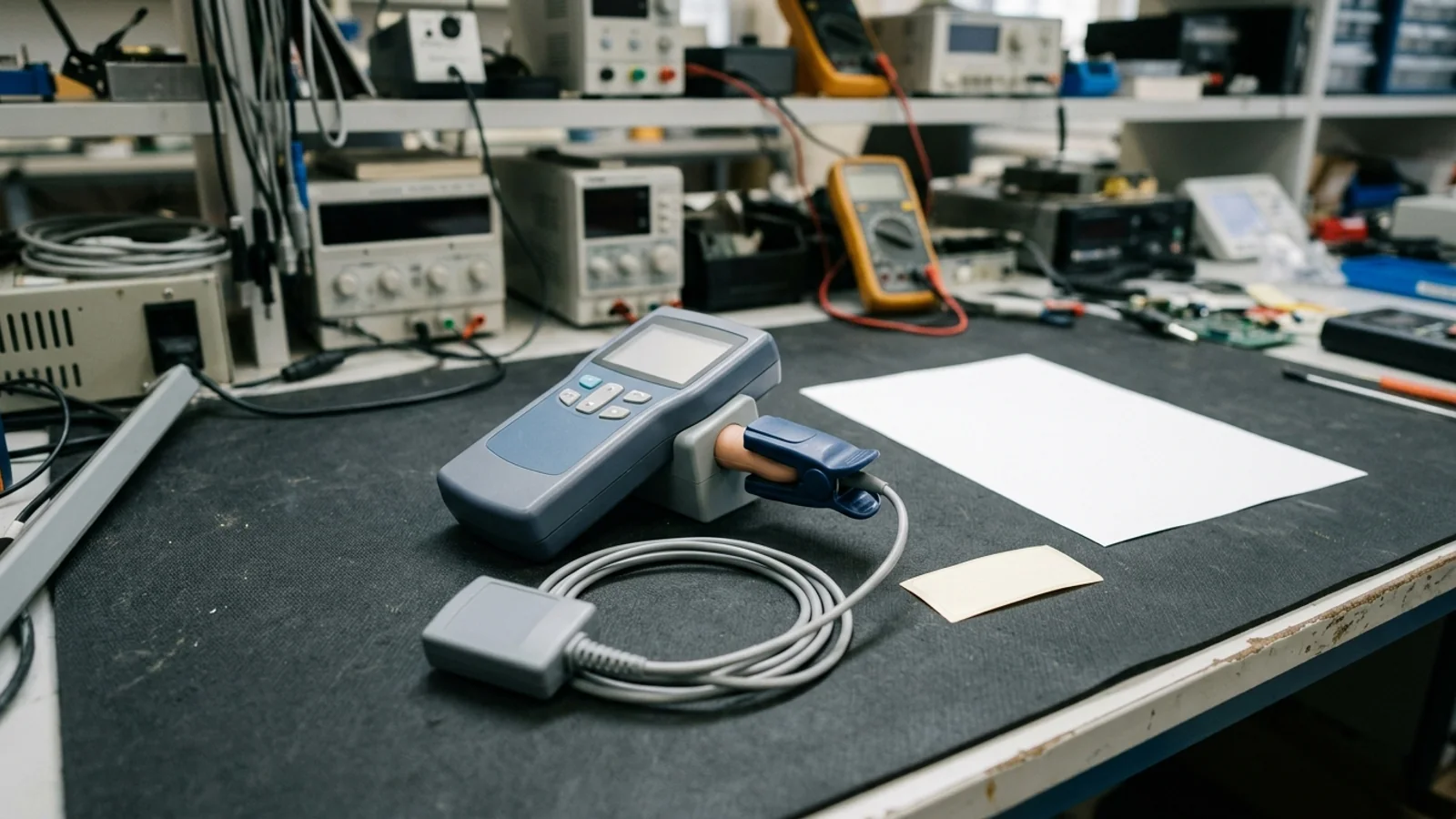
SpO2 functional testers, sold as SpO2 simulators or pulse oximeter testers, are routine tools on healthcare technology management (HTM) benches. Products such as the Fluke Biomedical ProSim SPOT Light and the Pronk Technologies OxSim Flex let a technician present a monitor with a set saturation, pulse rate, perfusion level, and other signal conditions in seconds. That speed makes them practical for incoming inspection, preventive maintenance (PM), and post-repair checks.
The risk lies in how the result is recorded. Calling a routine simulator run "SpO2 calibration" or "clinical accuracy verified" overstates its scope, and tester makers draw the same line. Manufacturer guidance quoted in a 2026 study describes the SPOT Light's purpose as "to test and verify the basic operation of patient monitoring devices or systems used to monitor SpO2," and says of the ProSim 8: "This Product is not intended to be used to calibrate medical equipment." This guide turns that distinction into a decision table and work-order language, while keeping the device and tester procedures in control of acceptance criteria. Source: Elmankabadi et al., Table 1.
What a Passing Simulator Run Actually Verifies
Fluke Biomedical's 2013 white paper describes electronic and optical interfaces. Their coverage differs, so identify the interface before interpreting a result. Source: Fluke white paper.
Optoelectronic artificial-finger interface: On an interface such as the ProSim 8/SPOT setup evaluated in the study below, the sensor is placed on a fixture that returns synthetic light to its detector. This exercises the assembled signal path, but does not independently establish the sensor emitters' wavelength or output in tissue. Other optical tester designs can differ; confirm the architecture in the manual.
Electronic interface (cable or adapter): The sensor is removed and the tester connects through the sensor cable or monitor input, injecting electrical signals that stand in for the photodetector output. Some electronic interfaces add LED and photodiode continuity checks.
The tester must also be set to an R-curve or probe setting that matches the SpO2 technology installed in the monitor, which is not always the monitor's own brand. Fluke's white paper notes that every tester on the market when it was written required the user to select the monitor manufacturer, or a group of manufacturers, to accommodate their R-curves, and it describes the SPOT Light as offering R-curves for eight manufacturers; the current datasheet names Masimo, Nellcor, and Nonin among them. Pronk advertises automatic detection of the oximeter manufacturer for the OxSim Flex. Treat automatic detection as a convenience rather than a compatibility determination: confirm in your unit's operator's manual which probes and saturation ranges it covers, and record the setting actually used. Sources: Fluke white paper; SPOT Light product page and datasheet; OxSim Flex product page.
Judge the observations against acceptance criteria in the approved device-specific service procedure, with setup and compatibility checked against the tester manual. A test only supports conclusions about the functions, settings, and points actually exercised:
Signal acquisition: The connected path carries a usable synthetic signal at the tested settings. A pass does not rule out intermittent faults, untested sensors, or failures outside those conditions.
Processing and display: The displayed saturation and pulse rate follow the documented simulated inputs. Record waveform behavior separately if the procedure requires it and the device displays it.
Alarm behavior: Moving the simulated saturation or pulse rate past configured limits produces the expected alarm condition. Priority, sound, and inhibit evidence is covered in patient monitor alarm verification after service.
Low-signal behavior, if exercised: Reduced modulation or transmission can challenge acquisition and signal-quality indications. Compare the response with the applicable procedure rather than assuming every monitor must respond the same way. This remains a functional check of synthetic conditions.
flowchart LR
  subgraph BENCH["Evidence depends on interface and checks performed"]
    T["Compatible tester setting or R-curve"] --> P["Optical sensor path OR electronic monitor input"]
    P --> M["Observed acquisition and display at tested points"]
    M --> A["Alarm response only if separately exercised"]
  end
  subgraph GAP["Not established by a routine pass"]
    L["Sensor emitter output, wavelength and tissue coupling"]
    B["Clinical performance across patients and conditions"]
    R["SpO2 agreement with arterial co-oximetry"]
endWhere the R-Curve Comes From and Why the Bench Cannot Recreate It
A pulse oximeter shines red and infrared light through tissue and measures how much of each is modulated by pulsing arterial blood. Oxygenated and deoxygenated hemoglobin absorb the two wavelengths differently, so the monitor computes a ratio of ratios:
R = (AC red / DC red) / (AC infrared / DC infrared)
Real tissue scatters light in ways a simple absorption model does not capture, so R is converted to SpO2 with an empirical calibration curve rather than a formula derived from first principles.
Manufacturers build that curve in controlled desaturation studies. Healthy volunteers breathe reduced-oxygen gas mixtures to reach stable saturation plateaus across roughly 70% to 100%, and arterial blood drawn at each plateau is analyzed by co-oximetry, the reference method for arterial oxygen saturation (SaO2). The paired R and SaO2 values define the curve. Because volunteers cannot ethically be desaturated much below that range, a 2023 review in Physiological Measurement notes that the calibration is valid over a limited range and extrapolated below it. Sources: 2023 review of pulse oximeter accuracy; Elmankabadi et al., introduction.
Fluke's 2013 white paper describes conventional bench testers as transfer devices that emulate a previously established R-curve. Its discussion of an impractical primary-reference simulator explains why a routine synthetic-signal check cannot independently validate the patient measurement. Keep that explanation within its date and scope; it is not a claim that every possible laboratory research apparatus is incapable of studying accuracy. Source: Fluke white paper.
Functional testers still have a legitimate, narrower role. The 2026 authors describe them as useful for challenging an oximeter across combinations of signal modulation and light transmission, and for biomedical engineers checking gross functionality, such as intact electrical hardware, in devices already in clinical use. Keep any manufacturer-specified bench test in the procedure, but do not turn its result into a claim about all patients or all operating conditions. Source: Elmankabadi et al., introduction.
The Evidence: Bench Passes Did Not Predict Human Accuracy
Elmankabadi and colleagues compared 12 oximeters—11 fingertip devices and one handheld unit—on a Fluke ProSim 8 with its SPOT optical accessory against controlled-desaturation results from healthy adults. The paper appeared online in November 2025 and in the journal's 2026 volume. The plateau protocol covered 70–100% simulated SpO2; the signal-space protocol varied modulation and transmission at 90%. The investigators used ARMS, root mean square error, to classify performance. Their 3% study threshold is not a universal bench acceptance limit. Source: Elmankabadi et al. study in PMC.
No predictive relationship: Bench ARMS and human ARMS were essentially uncorrelated, with R² = 0.08 for the plateau protocol and R² = 0.01 for the signal-space protocol.
Rank inversions: The Nonin CO-Pilot had the best human result (ARMS 1.39) but failed the plateau protocol (ARMS 3.49 with its own R-curve, 3.68 with the default curve). The Biolight M70 had the worst human result (ARMS 5.08) and the best plateau score (ARMS 0.96).
Bench passes with human failures: Six of 12 devices passed the plateau protocol, and three of those six failed human testing. Ten passed the signal-space protocol, and two of those failed in humans. Agreement with synthetic inputs therefore did not establish clinical accuracy.
Overestimation at low set points: At a set SpO2 of 70%, eight of the 12 devices read more than 3 percentage points above the set value.
The study also reports aid organizations using testers to rank procurement choices and published studies drawing accuracy conclusions from bench results. For service teams, the practical lesson is to avoid converting functional evidence into a clinical ranking or a certificate of accuracy.
What a Pass Leaves Unverified: Sensor Optics and Patient Physiology
The untested territory falls into two groups: the optical condition of the sensor in clinical use, and everything the patient contributes to the signal.
The Sensor Optics Blind Spot
Reusable finger sensors take heavy wear from drops, cable flexing, and repeated cleaning. Three limits follow from how testers work:
Emitter condition: In the tested ProSim 8/SPOT architecture, the authors note that the tester uses its own LEDs, so faulty oximeter emitters may escape detection. This is a limitation of that measurement arrangement, not proof that every optical tester ignores all emitter function.
Window and coupling damage: A functional pass does not establish that the sensor's optical surfaces and tissue coupling are suitable for clinical use. Record visible damage or contamination and apply the sensor's inspection and cleaning instructions separately. Treat possible masking of damage by synthetic conditions as a reason for inspection, not as a quantified finding from this study.
Electronic bypass: In electronic-injection mode the sensor's emitters, detector, and housing are out of the circuit, so the result speaks for the monitor, not the sensor at the bedside. Continuity checks confirm connection, not optical performance.
There is limited counter-evidence. An earlier intensive-care study cited by the 2026 authors used a different functional tester to sort reusable probes into accurate, under-reading, and over-reading groups, but it covered only three probes from one manufacturer. Treat probe-level bench findings as a screening signal, not an accuracy determination.
Patient-Side Physiological and Physical Variables
No bench run reproduces the patient. Regulators and peer-reviewed evidence document accuracy limits that lie entirely outside the tester:
FDA-listed factors: FDA states that poor circulation, skin pigmentation, skin thickness, skin temperature, current tobacco use, and fingernail polish can affect pulse oximeter accuracy. Source: FDA pulse oximeter page.
Skin pigmentation and hidden hypoxemia: The 2023 review summarizes a Sjoding dataset of 10,001 patients in which hidden hypoxemia—SaO2 below 88% while SpO2 read 92–96%—was nearly three times as common in Black patients as in White patients. The grouping used race, not a direct measurement of skin pigmentation. This observational result cannot diagnose bias in an individual model or explain a particular patient reading. Source: 2023 review, evidence table.
Width of the decision band: Australia's Therapeutic Goods Administration (TGA) notes that a displayed 90% may correspond to a true saturation anywhere from 86% to 94%, and that overestimates of 3 to 4 percentage points against arterial blood gas have been reported more often in people with darker skin around the 88% to 94% range. TGA also lists device fit, peripheral blood flow, nail coatings, tattoos and dyes, and maintenance and cleaning as accuracy factors. Source: TGA safety update.
Motion and interference: The 2023 review describes motion, ambient light, and low perfusion as limitations. Tester artifact settings can challenge selected responses, but do not reproduce the full clinical interaction of the patient, sensor, and environment.
Fitting the Simulator Into Intake, PM, and Post-Repair Workflows
None of this removes the simulator from the bench. It changes what the service record should claim.
CMS Survey & Certification memo S&C 14-07-Hospital, Hospital Equipment Maintenance Requirements, dated December 20, 2013, revised the hospital interpretive guidelines to state that all equipment must be inspected and tested for performance and safety before initial use and after major repairs or upgrades. It also addresses the qualifications of the hospital or contracted personnel doing that work. The memo cites the equipment-maintenance requirement as 42 CFR 482.41(c)(2), the paragraph numbering in use when it was issued; check the current CFR text before quoting a paragraph number in policy. A documented SpO2 functional check can contribute to performance evidence when it is part of the applicable procedure. It does not by itself establish compliance or authorize return to service. Source: CMS S&C 14-07-Hospital, attachment on page 7 of the PDF.
In practice, the SpO2 check sits beside related verification work:
Electrical safety testing after repair: identify the applicable OEM, facility, and legal requirements before selecting test methods and limits. IEC 62353 and NFPA 99 have different roles; selecting a bench method does not replace an applicable legal requirement.
Patient monitor alarm verification: using the simulator's adjustable setpoints to drive limit alarms, with priority, audible, and inhibit states checked against IEC 60601-1-8 and OEM criteria.
Major repair return-to-service testing: deciding when corrective work on an acquisition board, mainboard, or power supply triggers full performance testing.
Calibration certificate review: confirming the tester itself is within its calibration interval and that its certificate is complete and traceable.
Parallel device programs: the same functional-versus-performance discipline applies to infusion pump return-to-service verification and defibrillator energy verification.
Work-order wording matters as much as the test. For each SpO2 check, record:
Task name: "SpO2 functional verification" or "SpO2 operational check." Avoid "SpO2 calibration" or "accuracy verified."
Test instrument: Make, model, asset or serial number, and calibration-due date.
Configuration: Monitor model and installed SpO2 technology, device software where relevant, sensor model and identifier, tester interface, tester software/revision, and the R-curve or probe setting actually used. Record compatibility against the applicable manuals.
Points exercised: The setpoints specified in your approved procedure, the displayed values, stabilization or averaging settings where required, and the procedure identifier/revision. Use that procedure's acceptance criteria with the tester manual's compatibility and performance information. Do not import the study's ARMS threshold as a service tolerance.
Alarm results: Which limits were crossed and whether the expected alarm condition occurred.
Scope statement: One line such as "Functional check only; does not verify clinical SpO2 accuracy."
Decision Table: Service Scope, Test Mode, Evidence, and Escalation Boundary
Apply the service-trigger matrix only after fixing the monitor, installed SpO2 technology, sensor, tester interface, and procedure revision. The model examples below show why a generic "simulator pass" field is insufficient. They describe documented configuration differences, not interchangeable devices or universal service thresholds.
| Tester/model scope | Configuration evidence | What the result cannot establish | Escalation boundary |
|---|---|---|---|
| Fluke SPOT Light with a compatible monitor/sensor | Fluke describes eight manufacturer R-curves, with Masimo, Nellcor, and Nonin named in the datasheet, and its white paper notes that testers require selecting the monitor manufacturer or manufacturer group. Record the curve selected and the manual revision used. SPOT Light product page and datasheet; Fluke white paper | Clinical SpO2 accuracy, sensor optical calibration, or operation with an unsupported pairing. | Resolve compatibility or unexpected results through the tester vendor and device OEM; use the approved device procedure for acceptance. |
| Pronk OxSim Flex OX-2 | Pronk advertises automatic manufacturer detection, Masimo rainbow SET compatibility, and saturation settable in 1% steps from 10% to 100%. Confirm in your unit's operator's manual which probes and saturation ranges auto-detection covers, and record the probe mode used. OxSim Flex product page | Clinical accuracy from a normal reading, or that auto-detection selected an appropriate curve for an untested pairing. | Verify the probe mode and expected response against the operator's manual before diagnosing a fault or releasing the device. |
| Fluke ProSim 8 with SPOT accessory in the published study | Only three of twelve oximeters had model-specific curves; nine used the default Nellcor setting. These are study configurations, not a validated service procedure for an arbitrary bedside monitor. Study methods and limitations | Transfer of the study's scores, rankings, or 3% classification to another configuration. | Obtain the applicable device/tester procedure and compatibility evidence rather than using the research protocol as a release test. |
| Service trigger | Indicated bench check | What a pass supports | What remains unverified | Escalation boundary |
|---|---|---|---|---|
| Incoming inspection (new, leased, or loaner monitor) | Compatible functional run with the sensor model that will be deployed, at the approved procedure's setpoints; separately document required alarm checks. | Acquisition and displayed values at the tested settings; only the alarm responses actually checked. | Clinical accuracy; performance at low perfusion, with motion, or across skin pigmentation. | Resolve compatibility and setup uncertainty before calling a result a device failure. Hold from service for unresolved failures under the approved procedure; refer clinical accuracy questions to labeling and the OEM. |
| Scheduled preventive maintenance | Applicable PM procedure, with compatible optical or electronic testing as specified, sensor inspection, and required alarm checks. | The observed path responds at the documented points; comparison with earlier records is meaningful only when configuration and methods match. | Clinical accuracy; untested sensors and conditions; emitter wavelength/output and subtle optical damage not covered by the selected method. | Quarantine visibly damaged or intermittently failing accessories pending OEM-directed assessment. Do not improvise cable-flex tests or substitute the bench result for the sensor inspection procedure. |
| After major repair (SpO2 board, mainboard, or power supply) | The device-specific post-repair procedure, including compatible functional, electrical-safety, and alarm checks when that procedure calls for them. | The repaired configuration meets the documented checks performed; a simulator observation alone covers only its synthetic-signal test scope. | Clinical accuracy; any parameter the OEM procedure verifies by other means. | Hold until the applicable return-to-service procedure is complete and failures are resolved. Escalate when the required OEM method, compatibility evidence, or acceptance criteria are unavailable. |
| Clinical discrepancy report (reading disagrees with blood gas or clinical picture) | Preserve the reported configuration; perform the applicable monitor and accessory checks, using a verified compatible reference sensor when the procedure allows. | Whether the monitor and the suspect sensor pass a functional check. | Whether the reading on that patient was correct; patient factors listed by FDA and in the labeling. | Keep the clinical discrepancy open until findings are reviewed through the facility process. Preserve or quarantine suspect accessories as appropriate, route to clinical leadership and the OEM, and follow applicable event-reporting policy. |
| Suspected sensor damage or intermittent dropout | OEM-directed inspection and compatible functional checks of the suspect sensor/cable; record the conditions of any dropout without improvising stress tests. | Signal acquisition under the tested conditions; gross failures observed during those checks. | Emitter output and wavelength; subtle window degradation. | Remove damaged or unresolved intermittently failing accessories from clinical use pending the OEM-directed disposition. A normal bench reading does not override visible damage or justify optical repairs outside OEM instructions. |
Regulatory Transitions: 2025-2026 Standards and What to Watch
These dated publication and recognition records matter when reviewing labeling and fleet evidence. Publication of a newer standard does not itself establish FDA recognition, legal adoption, or a new maintenance requirement for every installed device.
1. ISO 80601-2-61 Edition 3 Published (April 2026)
ISO published the third edition, ISO 80601-2-61:2026, on April 10, 2026, and the ISO catalog now lists the 2017 edition as withdrawn. This article relies on catalog information for the new edition, not its full text. Check the 2026 text before citing clause or annex numbers, because references in older sources, including the 2013 Fluke white paper, which cites the 2011 edition, may have moved. Source: ISO catalog and lifecycle.
2. FDA Consensus Standards Recognition Status
As of October 4, 2026, the FDA recognition entry reviewed here lists the 2017 edition under number 1-139, with the accuracy-specification exclusion. Check the current database for superseding entries, and confirm the edition in the manufacturer's labeling or declaration. The ISO catalog's withdrawal of 2017 is a separate event from FDA recognition status. Source: FDA recognition entry.
3. FDA Draft Guidance on Pulse Oximeters for Medical Purposes (January 2025)
On January 7, 2025, FDA issued the draft guidance Pulse Oximeters for Medical Purposes - Non-Clinical and Clinical Performance Testing, Labeling, and Premarket Submission Recommendations (docket FDA-2023-N-4976). It is marked as a draft, not for implementation, and contains non-binding recommendations. Once finalized, it will supersede the 2013 510(k) guidance. It addresses non-clinical and clinical performance testing and labeling, including performance across the range of skin pigmentation, and follows FDA's earlier actions: a 2021 safety communication on accuracy limits, real-world evidence studies begun in 2022, and advisory committee meetings in November 2022 and February 2024. Sources: FDA draft-guidance page; FDA timeline.
As of October 4, 2026, FDA's guidance page still identifies this document as a draft. If finalized, it would inform premarket performance evidence and labeling; it would not make a routine hospital bench check a clinical accuracy study. Check its status before relying on it and do not treat draft recommendations as binding requirements.
A passing simulator run is useful evidence of the functions actually exercised in a documented, compatible configuration. Clinical accuracy is a separate claim supported by clinical validation and affected by sensor and patient factors. Record the functional observations, complete the applicable service procedure, and route unresolved accuracy concerns to the OEM and clinical team.