
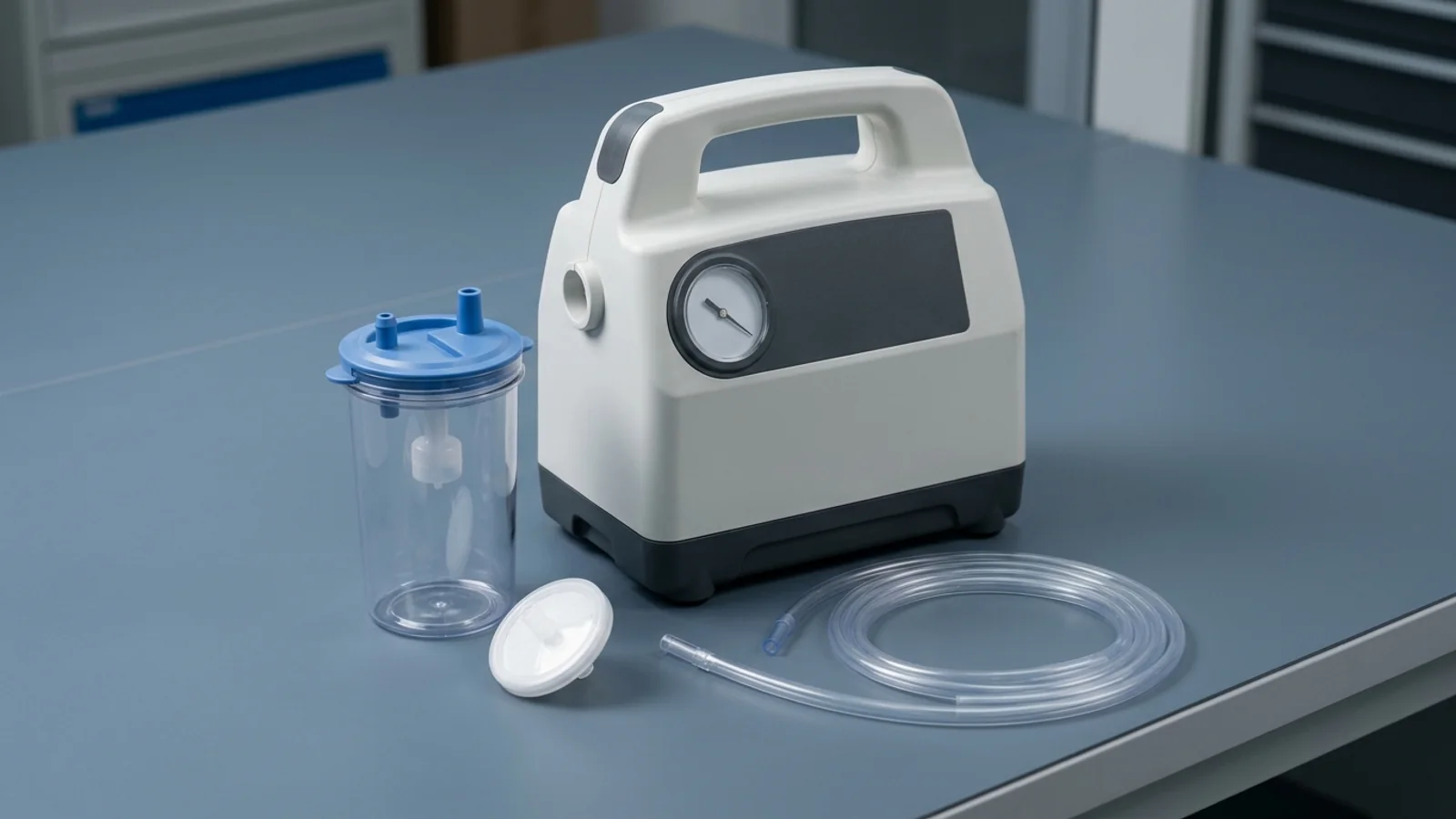
The Direct Answer: Which Side Owns This Suction Fault?
A portable suction pump that runs but delivers little or no vacuum at the catheter is not automatically a biomedical work order. It is also not automatically a bad canister. The useful question is narrower: does this model's own check still fail after the circuit causes in that model's troubleshooting table have been ruled out?
Three current manuals draw that line in three different places. The Medline VAC-ASSIST HCS7000 leak check detaches all tubing, raises suction to 21 inHg, and occludes the hose barb on the valve assembly. If the gauge drops, the manual says to contact the Medline representative. That is the equipment branch. If 21 inHg holds, the same procedure adds the filter and tubing, then the canister, and replaces the last part that made suction drop.
The SSCOR VX-2 operating check does not start on a bare barb. It says to occlude the patient tube, turn the regulator fully clockwise, and watch the gauge rise to -300 mmHg from zero in 3 seconds and max out at approximately -525 mmHg or greater. Lower readings are expected at altitude. The separate battery test uses the same patient-tube occlusion, expects -300 mmHg in less than 3 seconds and a maximum of at least -525 mmHg, then 15 minutes on internal DC power. A miss on that gauge check still has circuit causes in the troubleshooting table — loose vacuum line, defective canister, loose lid, open catheter thumb vent, disconnected tubing — before the one pump cause, debris in the pump, whose listed action is "replace pump."
The Laerdal Suction Unit (LSU) uses a four-step Device Test with the patient tubing installed and then occluded, and with the operating knob at 500+ mmHg. A pass is not a single vacuum number. Step 1 passes below 100 mmHg (no meaningful occlusion). Step 2 passes above 300 mmHg within 3 seconds. Step 3 passes above 500 mmHg within 10 seconds. Step 4 passes above 450 mmHg. Steps 1 and 4 include the canister and tubing. If a step fails, the Directions for Use first tell you to check connectors, tubes, the canister lid, and exhaust occlusion, and to run the test again. Only after those actions does the manual say the device might need to be returned for service.
Those three results answer the equipment-versus-circuit question for the models they belong to. Passing the HCS7000 bare-barb hold does not prove an LSU battery. Passing LSU steps 2 and 3 does not prove the canister lid, because step 4 still includes the canister and tubing. And -525 mmHg, 21 inHg (about 533 mmHg if you convert at 25.4 mmHg per inch of mercury), and the LSU's greater-than-500 mmHg step are different tests. None of them is a fleet-wide acceptance limit.
What You Are Actually Servicing
The device identity starts in 21 CFR 878.4780. A powered suction pump is a portable, AC-powered or compressed-air-powered device intended to remove infectious materials from wounds or fluids from a patient's airway or respiratory support system. The identification says the device may be used in the operating room or at the bedside, and that it may include a microbial filter. The classification is Class II. The regulation does not list vacuum acceptance numbers, filter change intervals, or a hospital return-to-service protocol.
FDA product codes for this regulation, listed both in the 1998 powered-suction-pump 510(k) guidance and on the current recognized-standards record, include BTA (pump, portable, aspiration, manual or powered) and JCX (apparatus, suction, ward use, portable, AC-powered). Those codes identify cleared device types. They are not a rule that every canister, lid, disk filter, and length of tubing is outside regulatory control, and they are not a finding that a non-OEM canister is automatically a different device. The practical control is the manual in front of you: Medline says to use only VAC-ASSIST hydrophobic filters because substitution may lead to contamination or poor performance; SSCOR says to use only SSCOR Quickdraw canisters fitted with hydrophobic filters; Laerdal says to use only accessories supplied by Laerdal or an authorized dealer. How far a parts change can move servicing toward remanufacturing is covered in the separate discussion of replacement parts compatibility and remanufacturing risk.
The 1998 510(k) guidance is still the public FDA document for this device type, and it says what it is: guidance, not a binding servicing statute. In the device-description examples it asks for a filter such as a bacterial filter having a pore size range of 0.3 microns. The HCS7000 manual states a separate hydrophobic-filter pore size of 0.45 microns. The same 1998 guidance gives an example of an electronic safety feature: a sensor that monitors pressure created by the unit and pressure generated in the suction bottle, and stops suction if those pressures become unequal, to keep fluid from backing up into the pump and the patient. It also describes an overflow valve in the bottle cap as a manual example. Those are 1998 submission examples. The service test remains the one in the model manual.
On the standards record, FDA gives complete recognition to ISO 10079-1, fourth edition 2022-03, including Amendment 1 (2026), as recognition number 1-203 on Recognition List 066, with an entry date of May 25, 2026. That recognition supersedes recognition 1-157 of the fourth edition without the 2026 amendment. FDA says it will accept declarations of conformity to 1-157, in support of premarket submissions, until July 2, 2028. Recognition here is a premarket conformity path. It does not convert ISO 10079-1 into the hospital's maintenance regulation, and the standard text itself is not reproduced in this article. The LSU Directions for Use still cite ISO 10079-1:1999, which is the edition named in that manual. Cite the manual for the LSU test, and cite the 2026 recognition record for the edition FDA currently recognizes. Do not treat either sentence as a correction of the other.
Fault Map: Symptom, Circuit Cause, and Equipment Cause
Use the row that matches the symptom, then stay inside the manual that matches the model. A cause listed for one platform is not a finding about the others. The AAMI note in the low-vacuum row is a 2007 biomedical commentary; the full article is paywalled, so this table uses only the limited public characterization and does not rank causes beyond what that characterization supports.
| Symptom | Disposable-circuit causes named in the manuals | Equipment-side branch | Where the manual draws the line |
|---|---|---|---|
| Motor runs, but there is little or no suction | LSU: floater valve closed, canister full, poor vacuum connection between pump and canister, or patient tubing twisted or blocked. HCS7000: loose tubing, leaks or kinks, float shut-off activated, bottle leaks or cracks. VX-2: loose vacuum line, defective canister, loose lid, open catheter thumb vent, or disconnected tubing. Quickdraw: canister not latched, regulator vent cap off, catheter tip cover on, or fluid has shut the filter down. | VX-2 lists one pump cause in this row: debris collected in the pump, with the action "replace pump." The VX-2 service section says not to service the vacuum pump; return it to SSCOR. LSU: if the Device Test still fails after the suggested circuit checks, the unit might need service. There are no user-serviceable parts inside the LSU cabinet. | LSU troubleshooting actions for this row are all circuit-side: release the vacuum by unplugging the filter/vacuum tubing, replace the canister, reseat the vacuum connector, or clear or replace the patient tubing. Quickdraw's matching actions are latch the canister, replace the vent cap, remove the tip cover, or replace the canister. |
| Vacuum builds slowly or will not reach the level that model specifies | HCS7000: regulator setting and system leaks. Rebuild from the hose barb; lost suction after a part is added means change that part. VX-2 and Quickdraw: the same canister, lid, tubing, and vent problems as the row above. Before a VX-2 test above -300 mmHg, check the canister expiration date. SSCOR warns that an aged or damaged canister can implode. | HCS7000: if the occluded hose barb does not hold 21 inHg, contact the Medline representative. A 2007 AAMI note describes low vacuum as many times caused by leakage in the accessories, and on mechanically regulated units often by faulty check valves. That is a reason to look at the circuit and a reason not to assume the circuit is the whole story. | Do not treat 21 inHg, -525 mmHg, and the LSU step limits as one specification. SSCOR also says its units are not designed for extended high-vacuum, low-airflow uses such as wound drainage or endoscopy. Some "low suction" complaints are the wrong application, and the manual says to turn the unit off when it is not in use. |
| Suction works, then stops while the pump is still in the procedure | Quickdraw: when the hydrophobic filter contacts fluid, the system occludes and the unit will not suction until a new canister is installed. The 300 mL canister also shuts off if that limit is exceeded or if liquid is held against the filter. LSU: the lid shut-off valve closes if the canister is full or the unit tips over. Reset it by removing the angled connector from the vacuum inlet. Laerdal recommends replacing the canister at three-quarters full. HCS7000: the float shut-off stops suction at the safe full level. | HCS7000: the thermal overload protector shuts the motor off if it overheats. Turn the switch off and allow about 5 minutes to cool, then restart. If it still will not start, the manual says to inspect the fuses and then call the provider. Frequent overload trips can be a low-voltage supply, which that manual names directly. This is not the SSCOR warning about prolonged occluded operation. | A wetted Quickdraw filter is corrected by installing a new canister. If liquid from an LSU canister is suspected inside the pump, return the unit for service. |
| The pump does not run | None of these manuals list a canister, filter, or tube as the cause of a motor that will not start. A disposable circuit cannot be the first explanation for a silent unit. | LSU: check the power cord and source; if the external-power indicator is lit and the unit still will not run, return it for service. If it will not run on the internal battery, charge it and replace the battery if it is still faulty. HCS7000: check the outlet, cord, and connection; the manual says the unit has no user-serviceable parts. VX-2 and Quickdraw "does not function" rows name a discharged battery and, for a qualified technician, disconnected internal connectors or a damaged PC board. | Peri et al., citing an inspection of 9,631 EMS suction units, report that 126 of 233 failures (54.1 percent) were battery failures. Use that figure as a reason to test runtime. Do not read it as the share of failures in your hospital. |
| The gauge shows vacuum while the patient tubing is open | LSU: the vacuum indicator shows more than 100 mmHg with free air flow when a tube is kinked or twisted. Straighten or untwist it. HCS7000 troubleshooting includes tubing kinks. Peri et al. report a separate occlusion finding: in a study by Vanderberg et al., 6 mm internal-diameter tubing obstructed in 11 of 12 trials while evacuating simulated vomitus. Peri notes that study used hospital wall suction at 500 mmHg. | The LSU action for a vacuum indication above 100 mmHg with free air flow is to straighten the tube. If the model's pump-side check still fails after the circuit is clear, use the equipment branch in the rows above. | Peri et al. state that ISO 10079-1 sets a suction-tubing inside diameter of no less than 6 mm. This article did not re-read the paywalled standard text. SSCOR specifies VX-2 patient tubing at 9/32 inch inside diameter (7.1 mm). Use the tube the model names. |
Model-Specific Pass Values
Keep this table with the device, not in a generic procedure. A pass means the manual's stated result for that setup. It does not transfer to the next model on the cart.
| Check | Setup the manual specifies | Pass result | What a miss means |
|---|---|---|---|
| Medline HCS7000 leak check | Detach all tubing from the machine and the canister. Turn the unit on and increase suction to 21 inHg. Occlude the hose barb on the valve assembly. | The level remains at 21 inHg. | If the level drops, contact the Medline representative. If it holds, add tubing and filter and occlude the far end; lost suction means change the filter and tubing. Then add the canister; lost suction means replace the canister. Keep adding the rest of the setup and replace the last part that caused the loss. |
| SSCOR VX-2 operating vacuum check | Occlude the patient tube and turn the regulator clockwise to the stop. | Vacuum rises to -300 mmHg from zero in 3 seconds and maxes at approximately -525 mmHg or greater. Expect lower negative pressure at altitude. | The published pump characteristic is clinical airflow of at least 30 L/min and vacuum that exceeds 525 mmHg. The operating check itself is the gauge reading above, not a separate flow-meter method. Troubleshoot the circuit causes before treating debris in the pump as the cause. |
| SSCOR VX-2 battery test | Disconnect the unit from 2310-series chargers and brackets. Run it on the internal battery. Occlude the patient tube with the regulator at maximum. | Rise to -300 mmHg in less than 3 seconds, maximum at least -525 mmHg, then 15 minutes of DC running without stopping, slowing, or blinking battery indicators. | Replace the battery if the runtime test fails. SSCOR also recommends battery replacement after 3 years. A blinking charge LED means low capacity and irreparable battery damage, in that manual's words. |
| Laerdal LSU Device Test | Patient suction tubing not occluded or bent before you start. Press and hold the test button and set the operating knob to 500+ mmHg. Occlude the patient tubing when the test prompts you. | Step 1, occlusions: below 100 mmHg. Step 2, vacuum build-up: above 300 mmHg within 3 seconds. Step 3, maximum vacuum: above 500 mmHg within 10 seconds. Step 4, air leakage: above 450 mmHg. | The failed-step actions are to check occlusions, connectors, tubes, the canister lid, and the exhaust outlet, then repeat the test. If it still does not pass, the manual says the unit might need service. |
| Laerdal LSU battery-quality check | Charge at least 24 hours, disconnect external power, run the Device Test, then run continuously at 500+ mmHg with free flow. | The unit completes 20 minutes. | If it stops before 20 minutes, discard the battery. Laerdal also says to replace the battery when it fails this check or after 3 years. This is not the SSCOR 15-minute test. |
| SSCOR Quickdraw regulator | Full power with the regulator vent cap installed. Low setting by removing that cap. | The manual states full power as -500+ mmHg and the low setting as -100 to -80 mmHg. A fresh alkaline pack is described as running about 60 to 100 minutes, depending on the batteries. | "No suction when the pump is running" with the vent open is corrected by replacing the vent cap, not by condemning the pump. A red battery LED means replace the alkaline batteries; a blinking red LED means do that immediately. Do not apply the VX-2 sealed-lead-acid test to this holder. |
A Workflow That Stops Where the Manual Stops
Train the first check to the model on the work request. The shared rule is only this: do not dispatch the chassis until that model's circuit actions have been tried and the pump-side result still fails. The diagram below is a decision aid. It is not permission to open a cabinet or to use one vacuum number for every brand.
graph TD
    A["Motor is running but suction is weak or absent"] --> B["Identify the model and use its checklist"]
    B --> C{"Which check applies?"}
    C -- "HCS7000" --> D["Set 21 inHg and occlude the hose barb"]
    C -- "VX-2" --> E["Occlude the patient tube and read the gauge"]
    C -- "LSU" --> F["Run the four-step Device Test"]
    C -- "Quickdraw" --> Q["Vent cap, latch, tip cover, or a new canister if the filter shut off"]
    D --> G{"Does that model's result pass?"}
    E --> G
    F --> G
    Q --> R{"Suction restored?"}
    G -- "Yes" --> H["Replace or reseat the canister, filter, lid, or tubing the manual names"]
    H --> I["Retest with the same model check"]
    I --> J["Suction restored: record the part and the reading"]
    R -- "Yes" --> J
    G -- "No, after the manual's circuit actions" --> K["Qualified service"]
    R -- "No" --> K
    K --> L["Leave a sealed cabinet closed and keep liquid out of the pump"]
    L --> M["After a major repair or upgrade, inspect and test before reuse"]
M --> JIf the model check passes, the capital unit has met the test you actually ran. Replace the single-use part the manual names and test again at the patient end. If the model check fails after those circuit actions, the call leaves bedside troubleshooting. Laerdal says there are no user-serviceable parts inside the cabinet and not to open it. Medline says the unit contains no user-serviceable parts and to involve the provider. SSCOR says not to service the VX-2 unless you are a qualified medical repair technician, and not to service the vacuum pump or PC board at all: return those to SSCOR. The Quickdraw manual says not to attempt service unless you are a biomedical technician, and that unauthorized opening or tampering is not allowed.
What Each Sequence Proves
Laerdal LSU: four steps, four different questions
The Device Test is user-initiated. The battery-status LEDs show which step is in progress. The vacuum-indicator bar graph shows the result; each fully lit segment is 50 mmHg. Read that bar graph against the pass levels above.
Step 1 asks whether the suction system, including canister and tubing, is occluded. A pass is less than 100 mmHg, which is the opposite of a "high vacuum is good" reading. Step 2 asks whether the pump builds vacuum within 3 seconds, with a pass above 300 mmHg. Step 3 asks whether the unit reaches its maximum within 10 seconds, with a pass above 500 mmHg. Step 4 asks whether the pump system, again including canister and tubing, holds enough vacuum, with a pass above 450 mmHg. A failed step 2 or 3 still starts with the tubing, connector, canister-lid, and exhaust-outlet checks, then a repeat of the test.
The LSU also separates a power fault from a vacuum fault. Little or no suction while the unit operates is the floater, the full canister, the vacuum connection, or twisted tubing. A unit that will not run on external power, with the external-power indicator lit, is a return-for-service condition. A unit that will not run from the battery is a charge-or-replace-battery condition. The published maximum vacuum in the specifications is greater than 500 mmHg (67 kPa), which matches the direction of step 3 but is not a substitute for running the test.
Medline HCS7000: hold 21 inHg, then add one part
The HCS7000 is specified at a maximum vacuum of 560 mmHg, plus or minus 3 percent. The leak check does not tell you to drive the regulator to that maximum and watch for 21 inHg. It tells you to increase suction to 21 inHg, occlude the hose barb, and see whether the level remains there. Staying at 21 inHg clears the machine side of that test. Dropping below it sends you to the Medline representative.
Filter and tubing. Add them and occlude the farthest opening. If suction is lost, change the filter and tubing and repeat.
Canister. Add it and repeat. If suction is lost, replace the canister.
The rest of the setup. Continue until the last part added is the one that lost suction, and replace that part.
The hydrophobic filter is specified at 0.45 microns. Replace it every 2 months of use, or immediately if the canister overflows, and use only VAC-ASSIST filters. The float shut-off is the overflow control for the collection bottle. None of those intervals or pore sizes belong on an LSU or SSCOR work order unless that model's manual says the same thing.
SSCOR VX-2 and Quickdraw: same brand, different checks
On the VX-2, "in 3 seconds" and "in less than 3 seconds" are both in the manual, on different pages. The operating adjustment says the gauge should rise to -300 mmHg from zero in 3 seconds and max out at approximately -525 mmHg or greater. The battery test says less than 3 seconds, a maximum of at least -525 mmHg, and then the 15-minute DC run. Record which test you ran. Both occlude the patient tube, so a failure still has to be sorted with the troubleshooting table rather than labeled a bad pump on the gauge alone.
The Quickdraw is a different suction unit. Full power is stated as -500+ mmHg with the regulator vent cap on. Removing the cap selects -100 to -80 mmHg. The troubleshooting table treats an open regulator vent as a cause of no suction while the pump is running, and the action is to replace the cap. The canister is 300 mL. When the hydrophobic filter contacts fluid, or when the canister is overfilled or tipped so liquid reaches the filter, airflow shuts off and stays off until a new canister is installed. Change the canister immediately after moisture shuts the unit down. Do not carry the VX-2's -525 mmHg battery test, or the LSU's 1,200 mL canister and three-quarter recommendation, across to this model.
When Circuit Triage Ends
Fluid past the filter
Laerdal's warning is specific. If overflow of liquid from the canister into the pump is suspected, the LSU must be returned for service. Overflow of suctioned material can damage the device. The same manual says there are no user-serviceable parts inside the cabinet, not to open the cabinet, and to refer servicing to personnel qualified by Laerdal. Separately, it says not to pump any cleaning solution or other liquids through the vacuum pump, that is, through the vacuum connector, because that can damage the LSU. Use a minimum of liquid when cleaning the outside, and do not immerse the unit.
On the VX-2, if a procedure produced a large amount of fluid, check the vacuum line between the pump and the canister. Moisture there means fluid may have reached the vacuum pump. The internal-access section says it should not be necessary to open the exhaust door unless fluid has entered, and it says to return the vacuum pump and the PC board to SSCOR rather than service them. The troubleshooting action "replace pump" for debris belongs to a qualified medical repair technician under that warning, not to a bedside disassembly.
On the Quickdraw, the manual says the only foreseeable way fluid reaches the vacuum pump is a canister filter that has been compromised or bypassed. The sanitation note says that if bodily fluids reach the pump mechanism, the device must be disposed of as biohazardous waste. The disinfection section says the engineering department has to open the unit to check the pump, that a contaminated vacuum pump should be replaced, and that a defective pump or PC board goes back to the factory. It also says not to repair the PC board or the vacuum pump. Those statements are the service boundary. They are not a procedure for cleaning aspirate out of the valving.
Batteries are a separate failure, with separate tests
A no-suction complaint and a dead battery are different calls, and the only broad count in this source set is an inspection count. Peri et al. report an inspection of 9,631 EMS suction units with 233 failures, 54.1 percent (126) of them battery failures. Treat that 54.1 percent as the battery share in the cited inspection. For the unit in front of you, run the runtime test that belongs to its manual.
The runtime tests are model-specific. The LSU battery is an internal rechargeable lead-acid pack. Laerdal recommends continuous charge when the unit is not in use, a full 24-hour charge to reach capacity, and replacement when the 20-minute free-flow check fails or after 3 years. The VX-2 battery is a 12 V sealed lead-acid pack, SSCOR part number 80635 in that manual. The test is the 15-minute DC run after the vacuum rise, and the recommendation is replacement after 3 years, or sooner if the test fails or the battery LED blinks. The Quickdraw manual describes a 10-cell alkaline holder, about 60 to 100 minutes from fresh batteries, and a red or blinking battery LED as the cue to replace those cells.
CMS Tag A-0724 after major repair or upgrade
S&C 14-07 places hospital equipment maintenance at 42 CFR 482.41(c)(2), survey tag A-0724: facilities, supplies, and equipment must be maintained to ensure an acceptable level of safety and quality. The interpretive guidance says all equipment must be inspected and tested for performance and safety before initial use and after major repairs or upgrades. It also expects an equipment inventory that includes a record of maintenance activities, with the maintenance itself documented for the specific item. The trigger is initial use or a major repair or upgrade. The letter does not say "after every maintenance task," and it does not set a suction vacuum limit.
For a suction unit, the performance evidence you can actually tie to a manual is the model check in the table above: the HCS7000 hold at 21 inHg and the stepwise rebuild, the VX-2 gauge and 15-minute runtime, or the LSU Device Test and 20-minute battery check. Tag A-0724 also says to test safety. It does not name IEC 62353, ground-continuity limits, or touch-leakage limits for a suction pump. If your electrical-safety program uses one of those methods after a major repair, record the method and the result, and use the hospital's existing discussion of electrical safety testing after repair to choose the method. Whether the work was a major repair or upgrade in the first place is the decision in major repair return-to-service testing. If a third party does the repair, service provider qualification is the separate supplier question.
Circuit Controls That Prevent a Repeat Call
These controls follow the manuals. They are not a claim that consumables cause most suction-unit failures. The battery inspection above is the counter-evidence, and SSCOR's application warning is the other one: the wrong procedure can look like a weak pump.
LSU canister level. Laerdal recommends replacing the canister at three-quarters full. When liquid reaches the top, the unit will not suction more liquid. The lid shut-off also closes if the unit tips over; the reset is to remove the angled connector from the vacuum inlet. If you suspect liquid has entered the pump, stop and return the unit for service.
Quickdraw filter. Once the hydrophobic filter contacts fluid, the unit will not suction until a new canister is installed. Change it immediately. The manual does not offer a dry-out, a rinse, or a shake as the corrective action.
HCS7000 filter. Replace the 0.45-micron hydrophobic filter every 2 months of use or immediately after canister overflow. Use only the manufacturer's filter. Medline's stated reason is contamination or poor performance from a substitute.
Tubing bore. Peri et al. attribute a minimum inside diameter of 6 mm to ISO 10079-1 and report that 6 mm tubing obstructed in 11 of 12 simulated-vomitus trials at 500 mmHg of wall suction. They propose moving a future minimum from 6 mm to 8 mm and calculate a 68.4 percent drop in hydraulic resistance for that change. They also describe a 10 mm prototype. That is a standards argument and a bench observation, not a measured drop in your "low suction" work orders. The VX-2 manual already specifies 7.1 mm inside-diameter patient tubing. Fit the tubing the model specifies.
Canister age on the VX-2. Check the expiration date before a test above -300 mmHg, and change an expired canister so you are not testing an aged or damaged vessel that SSCOR says can implode.
Single-patient Quickdraw disposables. The Quickdraw sanitation section says the canister, patient tubing, and catheter are single-use and are not reused. That is a different rule from a durable hospital canister program, and it does not transfer to the HCS7000 collection bottle unless Medline's labeling says so.
What the Work Order Should Capture
A suction call is auditable when the next technician can see which branch you proved. The record standard in medical equipment service record requirements is the general work-order shape. For this equipment, fill it with the model check rather than with a generic "PM completed" line. S&C 14-07 expects maintenance on a given item to be documented for that item.
Symptom and model. Write whether the motor ran, and write the model. "No suction" on a Quickdraw with the vent cap off is a different finding from "no suction" on an HCS7000 whose hose barb will not hold 21 inHg.
The check and the numbers. Record the test name and the result against that test's pass level. Examples of a complete entry: "HCS7000 hose barb held 21 inHg; suction lost after the canister was added; canister replaced; hold restored." "VX-2 battery test, charger disconnected: -300 mmHg in under 3 seconds, maximum -530 mmHg, 15 minutes completed." "LSU Device Test: steps 1 through 4 recorded individually against less than 100, greater than 300, greater than 500, and greater than 450 mmHg." The -530 mmHg figure in that sentence is an example of a reading, not another specification.
The part that fixed it. Name the canister, filter, or tube, and keep the lot or part identity your system already requires. The manuals already publish some of those identities: HCS7000 replacement hydrophobic filters such as AGIBF405, VX-2 canister part 48041, VX-2 patient tubing part 43200, and VX-2 battery part 80635. Those numbers are model references, not a universal kit.
The escalation, if you made one. Fluid suspected in an LSU pump, moisture in a VX-2 vacuum line, a Quickdraw filter that was bypassed, or a Device Test that still failed after the circuit actions. State why bedside work stopped.
Return to use after major repair or upgrade. Record the performance result from the model check and the safety test your program requires. Tag A-0724 is the reason for that inspect-and-test. It is not a certification that the unit meets ISO 10079-1, and it is not a promise that every future complaint will be a disposable.
The decision this article supports is a documented split. Use the model's circuit actions while the motor is running and the model's check can still pass. Send the chassis to qualified service when that check fails, when fluid may have entered the pump, or when the battery test fails. Keep each vacuum number, filter interval, and runtime attached to the manual that states it.