
The complaint covers more than one device
When an electric dental handpiece cuts out under load, bogs down during crown preparation, or shows an error code, the usual response is to ship the whole assembly out. That can send an intact attachment away while the fault is in the cord, the control unit, or the dental unit's air supply.
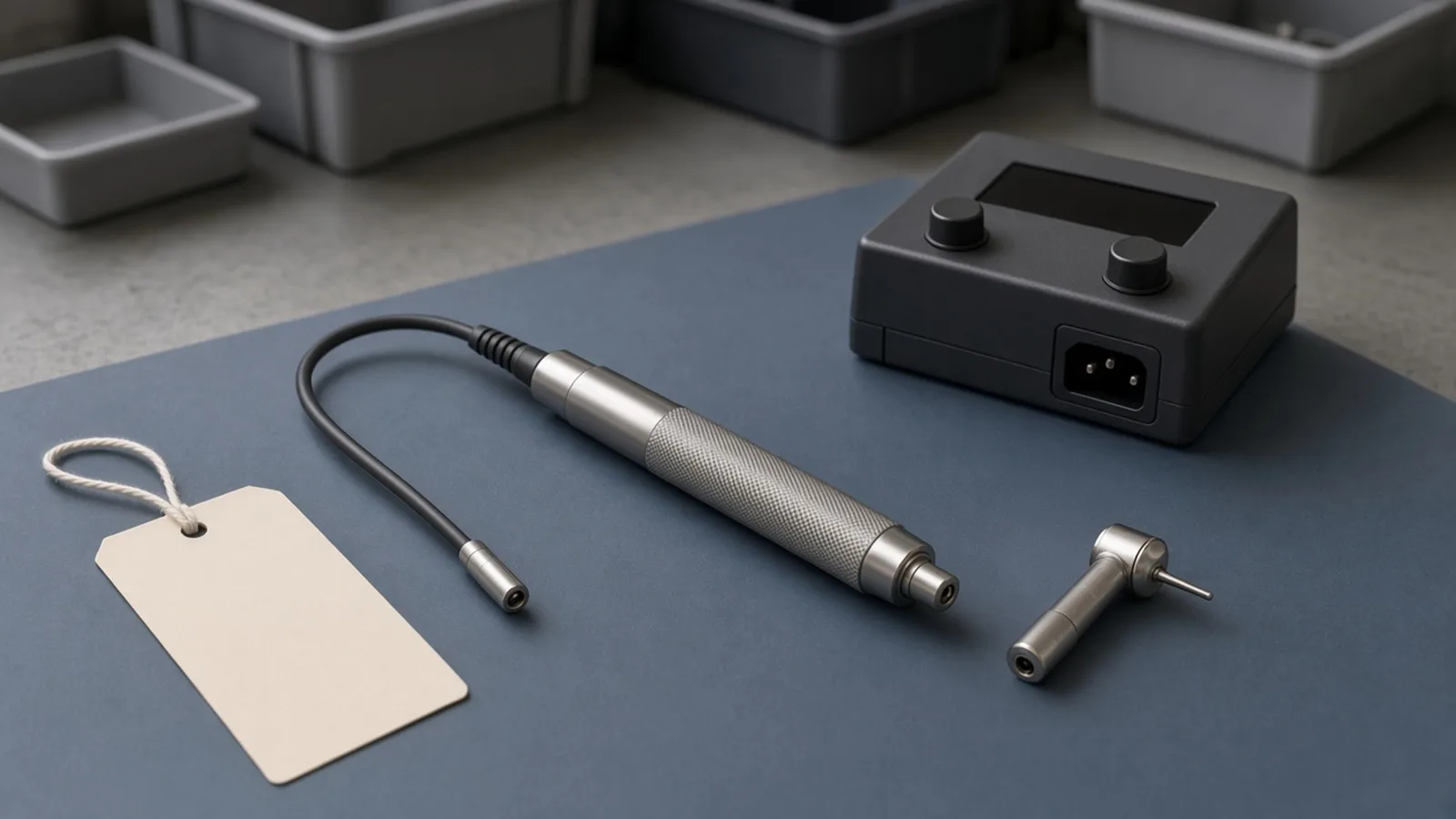
Separate the parts that can actually be removed for service: the attachment, the electric micromotor and its cord, and the control console. Some complaints that feel like a motor fault are dental-unit air findings instead. Those parts are not three copies of one device. Handpieces, contra-angle attachments, and foot controllers with cords are identified under 21 CFR 872.4200. FDA's recognition record for ISO 14457 lists the operative dental unit under a different section, 21 CFR 872.6640. A tabletop motor console is not automatically that unit.
Under 21 CFR 872.4200, a dental handpiece and accessories is an AC-powered, water-powered, air-powered, or belt-driven hand-held device that may include a foot controller for speed and direction or a contra-angle attachment. FDA classifies it as Class I. FDA's recognition record for ISO 14457:2017 maps that regulation to product codes that include AC-powered direct-drive handpieces (EKX), contra- and right-angle attachments (EGS), and foot controllers and cords (EBW). The same record lists the dental operative unit, product code EIA, as Class I under 21 CFR 872.6640. That entry is a related regulation on the handpiece standard's recognition record. It does not make a tabletop motor console the operative unit. Use the product-code split to choose a servicer, and do not treat a standalone electric console as that unit.
Two standards mark what this article will not invent. ISO 14457:2017, identically adopted as ANSI ADA Standard No. 35-2019, Dentistry - Handpieces and motors, covers straight and angle handpieces, high-speed air turbines, air motors, electrical motors, and prophy handpieces. FDA's recognition is partial: clause 5.8.1 is not recognized because it conflicts with Section 7, Performance Testing, of FDA's May 2007 dental handpieces 510(k) guidance. The standard text is paywalled, so no torque, speed, temperature, or leakage limit is quoted from it. IEC 80601-2-60:2019, Edition 2.0, states particular requirements for the basic safety and essential performance of dental units, dental patient chairs, dental handpieces, and dental operating lights. It is paywalled as well. Cite it as the shared safety standard for the handpiece and the dental unit, not as a source of numeric pass-fail limits.
Chairside checks that stay inside the instructions
Before uncoupling any hardware for off-site dispatch, clinical staff or biomedical equipment technicians (BMETs) should execute a structured sequence of non-invasive chairside checks. These checks remain strictly within manufacturer instructions for use (IFU), require no tool-based teardown, and systematically gather evidence to isolate the fault to a single subsystem.
Check the bur and chuck before blaming the motor: Hayes starts there. A bent, worn, or poorly seated bur can imitate power loss, and a bur that slips, will not seat, or is hard to remove points to the chuck. Do not force the bur. If retention is unreliable, take the attachment out of clinical use. DENTALEZ's Star maintenance guide, written mainly for air-driven high-speed handpieces, lists debris in the chuck and non-ISO burs as chairside causes of a bur that locks or slips. Follow the attachment's own bur and chuck instructions. Do not treat Star's in-office turbine replacement as permission to open an electric motor.
Reseat the cord and inspect user-serviceable seals: Power down the control unit. Disconnect the motor cord at the console and at the motor. HandpieceMD's chairside sequence is to power-cycle, reseat the cord at both ends, and clean coupling contacts as the manufacturer instructs. Hayes says to inspect user-serviceable O-rings and seals and, on an electric system, to confirm the attachment is seated on the motor without forcing a connection that will not lock. Then power-cycle and retest.
Separate dental-unit air from a failed motor: On NSK's NLZ page, abnormal motor heating during rotation is caused by coolant air that is not supplied or not properly connected from the dental unit. The published action is to check air pressure on the dental-unit side. A rotation speed that will not rise has a different listed cause: dental-unit air pressure is lower than the controller's upper limit of air pressure. NSK's action is to set that upper limit below the unit's air pressure. Check those two findings before condemning the motor. They are NLZ instructions, not a universal pressure or flow limit.
Substitute one known-good attachment: Hayes and HandpieceMD both use this split. Connect a second attachment to the same motor. If the second attachment runs normally, the fault is more likely in the original attachment. If several attachments show the same symptom, look to the motor, the connection, the control system, or the dental-unit supply. One passing attachment does not prove the motor is healthy under every load, and one failed attachment does not prove the console has failed.
The diagram is that same order: bur and chuck, cord reseat, one substitute attachment, then dental-unit air versus a cord or console code. It does not add steps the sources above do not already describe, and it is not a teardown procedure.
graph TD
    A["Cutout, noise, heat, or an error code"] --> B["Check the bur and chuck per the attachment instructions"]
    B --> C{"Does the symptom remain with a known-good bur?"}
    C -- "No" --> D["Record the bur or seating finding"]
    C -- "Yes" --> E["Power down and reseat the motor cord at both ends"]
    E --> F["Inspect user-serviceable O-rings. Do not open housings"]
    F --> G["Power-cycle and test a second attachment"]
    G --> H{"Does the symptom follow the original attachment?"}
    H -- "Yes" --> I["Send that attachment. Do not open it"]
    H -- "No" --> J{"Which published finding remains?"}
    J -- "NLZ heat while rotating, or speed will not rise" --> K["Check dental-unit coolant air and the air-pressure setting"]
    J -- "Connection, sensor, or cord code on that model" --> L["Reseat the cord. Request repair if the code remains"]
J -- "Control-unit heat or input-voltage code" --> M["Cool the console or check the adaptor connection. Dealer if it remains"]Reading the symptom: a subsystem decision table
Use the table as a routing aid, not as a shared code book. The NSK rows quote NSK-Nakanishi USA's troubleshooting page for the named model only. An E1 or E4 on NLZ is not the same statement as E1 or E4 on Surgic Pro2, and neither meaning transfers to KaVo, W&H, Bien-Air, or Star. The first two rows are bench reports from HandpieceMD and Hayes. They do not cite a standard.
| What you observe | Where it points | What the source says | What to do next |
|---|---|---|---|
| Stall, noise, heat, or vibration that follows one attachment and clears with a second attachment | That attachment | Hayes and HandpieceMD: if a second attachment runs normally, the original attachment is the likely source. HandpieceMD attributes attachment heat and cutouts to worn gears, bearings, or lost lubrication. This is vendor bench experience, not an OEM specification. | Take that attachment out of use. Do not open it. Send it to a handpiece repair channel with the substitution result. |
| The same torque loss, cutout, or heat on every attachment after the cord is reseated | Motor, coupling, or cord | HandpieceMD says noticeable torque loss is usually worn attachment gears, aging motor bearings, or coupling wear, and that the controller can hide early drag. Once a second attachment shows the same symptom, Hayes points to the motor, connection, or control system. Still bench experience, not a measured specification. | If that model has an approved spare cord, substitute the cord once. If the symptom stays, tag out the motor and send the motor and cord. Do not open the housing. |
| NSK NLZ E0, or NLZ E8 (1) | Attachment seating or the handpiece, not an automatic cord failure | NLZ E0 means the motor shaft is locked. The published action is to check that the handpiece is connected properly. NLZ E8 (1) is a handpiece heat-generation error; maintain the handpiece and run the contra-check. NLZ E8 (2) is a different code and means motor heat. | Reseat the attachment and repeat with a known-good attachment. If E0 locks every attachment, stop and send the motor. Do not keep cutting through a shaft-lock code. |
| NSK NLZ E9, ED, or an E7 that remains; Surgic Pro2 E1. NLZ E1 is a different code. | Motor-cord boundary, with different published meanings | NLZ E9: the motor does not start; check the motor connection. NLZ ED: sensor signals cannot be read; check the motor-to-cord connection. NLZ E7: residual overvoltage when the motor starts; wait about 5 seconds and retry, and check the motor and cord connection only if it remains. Surgic Pro2 E1: motor voltage or current detection error, with causes of extended heavy load, a short in the motor, or motor-cord power-line failure. NLZ E1 is overcurrent from heavy cutting; ease the load and press the foot pedal again. | Power down, reseat both ends of the cord, and retry. If the code remains, request repair. Do not copy an E1 meaning from NLZ onto Surgic Pro2 or onto another brand. |
| NSK Surgic Pro2 E3 | Motor sensor, cord signal line, or water in the motor | NSK lists four causes: motor sensor failure, an unplugged motor cord, motor-cord signal-line failure, and ingress of water into the motor. The action is to reseat the cord and to fit the protection plug when cleaning in a washer-disinfector. E3 is not a water-only code. | Reseat the cord and record whether the protection plug was used in the washer. If the code remains, request repair. Do not energize a motor you know is wet. |
| NLZ motor heats abnormally during rotation, or rotation speed will not rise | Dental-unit air supply or the controller air-pressure setting | Heating during rotation: coolant air is not supplied or not properly connected from the dental unit; check air pressure on the dental-unit side. Speed will not rise: dental-unit air pressure is lower than the controller's upper limit of air pressure; set that upper limit below the unit's air pressure. | Check the coolant-air connection and compare unit air pressure with the controller setting before condemning the motor. Do not treat either sentence as a universal pressure threshold. |
| NSK NLZ E4, or Surgic Pro2 E4 | Control unit, with different published causes | NLZ E4 is high FET temperature; let the unit cool and try again. Surgic Pro2 E4 is control-unit interior overheating from extended heavy load, or from use immediately after the unit sat somewhere hot, such as a car or a sunlit locker. Cool it, keep the surroundings ventilated, and request repair if the error remains. | Cool the console and clear the area around it. If the code returns, send that control unit through the manufacturer's channel. Do not open the console or replace an internal fuse. |
| NSK NLZ E5 or EF; also NLZ HE0 or E8 (2) | Adaptor connection, or a motor-heat warning | E5 is overvoltage at the input and EF is undervoltage. Both actions are to check the connection of the AC adaptor and AC power cord, not a published finding that the adaptor has failed. HE0 warns of overload or a risk of abnormal motor heating and says continued use stops the motor and shows E8. E8 (2) is a motor heat-generation error; leave the motor until it cools. | For E5 or EF, check the adaptor and power-cord connections, then request repair if the code remains. For HE0 or E8 (2), stop the load and let the motor cool. Do not replace the adaptor or the motor on the code name alone. |
HandpieceMD describes a related pattern from its repair bench, not from a standard. Its account is that control units monitor motor current and keep driving as friction in the gears or bearings rises, so early wear can be hard to feel, and that an overload shutdown during cutting usually means mechanical binding. An air turbine, in that same account, is more likely to stall. Hayes uses the second-attachment test for the same split. That pattern is vendor experience, not a specification. NSK's NLZ E1 is overcurrent in the circuit. The published action is to ease continuous heavy cutting and press the foot pedal again, not to replace the motor.
Do not turn that bench pattern into a rule that every cutout is mechanical. A code that names the adaptor, the control-unit interior, or water in the motor is a different finding, and it is defined only for the model that publishes it.
Keep the two kinds of evidence apart. HandpieceMD groups nearly all torque loss into worn attachment gears, aging motor bearings, and coupling wear. That is a bench pattern, not a verified specification. NSK's page defines codes for named models, and the same characters do not travel. NLZ E1 is overcurrent from heavy cutting. Surgic Pro2 E1 is a motor voltage or current detection error that can be heavy load, a motor short, or the cord power line. NLZ E4 is high FET temperature. Surgic Pro2 E4 is control-unit interior overheating. Read the manual for the model in the room before choosing a servicer.
Where in-practice work stops
Stop when the published chairside checks are done. On NSK's troubleshooting page, internal faults are not a customer repair. NLZ's dark display from a blown internal fuse says to contact an authorized NSK dealer. Surgic Pro2 errors that remain after the published check say to request repair. Varios entries on that same page state that repairs cannot be made by the customer. Hayes tells practices not to open internal components to see what is wrong, and says internal diagnosis of an electric attachment belongs with trained technicians. DENTALEZ does not publish that ban. Its Star guide tells staff they may replace a Star high-speed turbine in the office. That instruction is for those air-driven Star handpieces. It is not permission to open an electric micromotor or a control console.
If the motor is hot, smells of burned insulation, shows fluid at the connector, or still displays a connection, sensor, or overheat code after the cord has been reseated and a second attachment has been tried, tag it out of service. Write the date, model, serial number, and the exact code on the tag. Do not return it to the operatory for another patient while the code is still unexplained.
Routing the fault: two different servicers
Correct isolation also chooses the servicer. Hand-held handpieces and accessories are identified under 21 CFR 872.4200. FDA's recognition record for ISO 14457 lists the operative dental unit, product code EIA, under 21 CFR 872.6640. A tabletop console follows the manufacturer's own dealer route. Sending the attachment to a handpiece shop when the dental unit is not supplying coolant air, or sending the dental unit out when only one attachment fails, creates a second diagnostic cycle and leaves the operatory down.
Repairs generally divide across two distinct service channels:
Handpiece and micromotor channel: When the fault stays with the attachment, the motor body, or the detachable motor cord, send that component to a handpiece channel for that brand. A-dec's authorized repair center services A-dec-brand handpieces to factory specifications, with thorough disassembly and cleaning and genuine factory parts, and it directs KaVo instruments to KaVo Care and W&H instruments to W&H ProService or the dealer. DENTALEZ tells practices to check that a third-party servicer is using original Star parts. For how to qualify a servicer, use the site's criteria for qualifying medical equipment service providers, and judge the estimate against what a dental handpiece service quote should specify.
Dental-unit utilities and the manufacturer's console channel: Missing coolant air, a speed ceiling tied to the unit's air pressure, and umbilical or delivery-head utilities belong with the dental-unit servicer. A standalone control console is not the operative dental unit. NSK tells users to contact an authorized dealer for an internal fuse, for water leakage inside the control unit, and for errors that remain after the published connection check. A shop that only rebuilds attachments cannot fix a dental unit that is not supplying coolant air. Say which check you already ran so the two channels do not repeat it.
Swapping the motor or control unit: servicing or remanufacturing?
When a motor, cord, or console has failed, the next decision is which part goes back in. FDA's servicing and remanufacturing definitions turn on whether that part returns the device to the original specifications or changes them.
FDA's final guidance, Remanufacturing of Medical Devices, was issued in May 2024. Servicing is repair or preventive or routine maintenance of one or more parts of a finished device, after distribution, to return it to the safety and performance specifications established by the original manufacturer and to its original intended use. Remanufacturing is processing, conditioning, renovating, repackaging, restoring, or any other act that significantly changes the finished device's performance or safety specifications, or its intended use. FDA looks at the activities performed, not at whether the organization calls itself a servicer.
When the activity is remanufacturing, FDA enforces manufacturer requirements that include establishment registration and device listing, adverse-event reporting, the Quality Management System Regulation, and marketing submissions where they apply. FDA states that the QMSR became effective on February 2, 2026, amending 21 CFR Part 820 and incorporating ISO 13485:2016 by reference. This article does not decide whether any particular swap needs a new 510(k). Handpieces identified under 21 CFR 872.4200 are Class I; that classification is not a finding that a changed motor is exempt from manufacturer duties.
Applying these principles to electric dental handpiece systems:
Clearer servicing case: Replacing a failed motor, motor cord, or control board with the original manufacturer's part for that model, in order to restore that manufacturer's safety and performance specifications, fits FDA's servicing definition. A shop's statement that a substitute part was verified as identical is not, by itself, that finding.
Remanufacturing question: A motor or controller with a different speed range, torque behavior, thermal performance, or connector interface can significantly change performance or safety specifications. HandpieceMD's bench account is that an electric motor keeps driving a binding attachment and turns that drag into heat at the head, which is why a thermal or speed change is a safety question. That is the boundary in drawing the servicing versus remanufacturing boundary and in replacement parts compatibility evidence.
Reprocessing rules that shape the fault and the handover
CDC's dental handpiece page includes high-speed, low-speed, electric, endodontic, and surgical handpieces and all attachments. They should be heat-sterilized between patients. Surface disinfection and immersion in germicides are not acceptable. Cordless devices that are independent of air and waterlines, and handpiece couplers, follow the validated manufacturer instructions for cleaning, lubrication, and sterilization. This article does not set cycle temperatures or lubrication steps. Those belong in the instructions for that model.
Two published links connect reprocessing to a specific fault. They do not rank the causes of every electric-handpiece failure.
Washer-disinfector exposure: Surgic Pro2 error E3 is a motor-sensor error. NSK's published causes include ingress of water into the motor, and the action says to fit a protection plug when cleaning in a washer-disinfector. Record whether that plug was on. E3 also lists motor sensor failure, an unplugged motor cord, and motor-cord signal-line failure, so a wet-motor story is only one of the published causes.
Lubrication stays in the instructions for use: DENTALEZ's Star guide, aimed mainly at air-driven handpieces, says excess lubricant left in the handpiece can congeal during sterilization and that the handpiece should be run long enough to expel excess lubricant beforehand. The same guide covers lubricated and LubeFree Star models and says not to lubricate a LubeFree instrument even once. Electric motors and contra-angles follow their own instructions. Do not copy a Star turbine procedure onto an electric motor, and do not adopt one sterilization cycle for every brand.
What leaves the clinic: CDC requires heat sterilization between patients, so clean and heat-sterilize the handpiece, motor, and attachment under their own instructions before they go to a repair shop, and say in the packet that this was done. Do not ship a visibly soiled instrument, and do not copy one model's sterilization cycle onto another.
The evidence packet to send with the repair
NSK's actions and HandpieceMD's repair-form note both ask for the specific finding: the code, or the result of the attachment swap. A note that only says the handpiece cuts out leaves the shop to repeat checks the clinic may already have done.
Send the finding with the part. The packet should record five items:
Exact Hardware Identification: Record the manufacturer, model name, and individual serial numbers for the micromotor, the flexible motor cord, the attachment, and the control console.
Alphanumeric Error Codes and Readouts: Record the exact code on the console, such as NLZ E0, E4, E8 (2), or HE0, and whether it appears at power-up, in free rotation, or only under cutting load. Do not translate that code into another brand's table.
Substitution Test Findings: Document the results of the known-good attachment test: did the stall or noise disappear when an alternative attachment was mounted, or did it persist across multiple attachments? Note whether reseating the motor cord altered the fault.
Utility findings: Record whether the NLZ checks applied: coolant air supplied and connected, or not, and whether unit air pressure was below the controller's upper-limit setting. Do not write that a value was within range unless that model's instructions state the range you checked.
Reprocessing and Service History: Note the cleaning and heat-sterilization performed under that model's instructions before shipment, and the lubrication step if those instructions require one.
When the part comes back, use the practice's protocol for return-to-service testing after major corrective repairs, then the electrical-safety checks that apply to the device as it is configured, under post-repair electrical safety testing. Do not copy a leakage or ground-continuity limit onto every micromotor from this article. The linked electrical-safety article owns which test applies.