
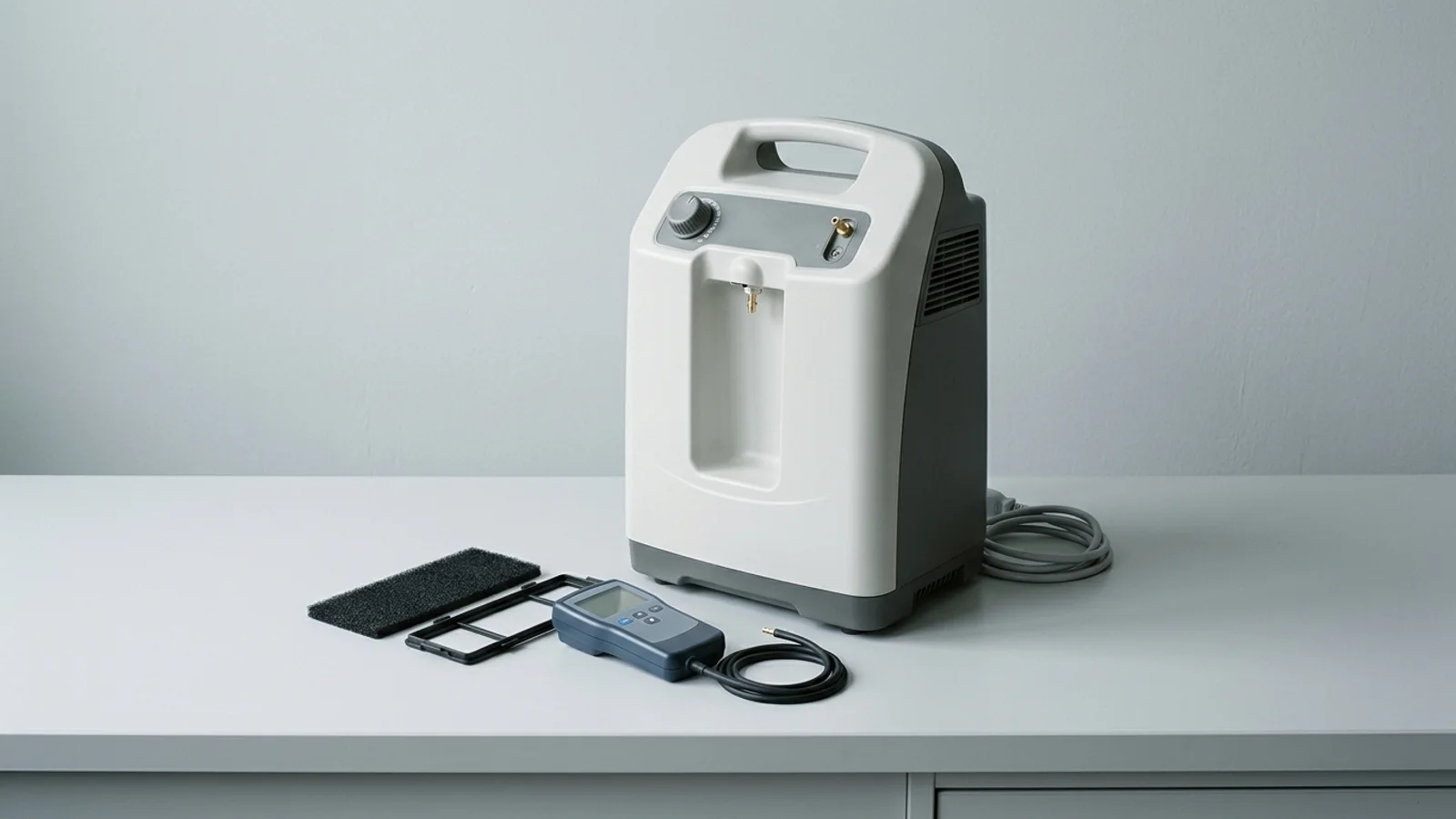
What to Do With the Unit in Front of You
A post-acute fleet of stationary 5 L/min molecular-sieve concentrators will not share one maintenance card. The three jobs that show up together — a purity light soon after power-on, a filter interval that has already passed, and a hot or scorched cabinet — are three different decisions. The first is a warm-up question. The second is a filter-ownership question. The third is a stop-and-quarantine question.
Startup lights are read against that model's warm-up, not against a shop habit. Invacare Perfecto2 user manual 1163145 says a SensO2 unit may be used during the initial warm-up of about 30 minutes while purity reaches maximum. On models IRC5PO2AW and IRC5PO2VAW, the green light at power-on means system OK and oxygen greater than 85%; after five minutes the sensor controls the indicator lights. That is not a license to ignore a yellow or red light that is still on after the warm-up. Inogen At Home model GS-100 normally reaches its required concentration within five minutes, and the specification lists warm-up as less than five minutes. Waiting half an hour does not apply to that platform. The portable Inogen Rove 6 is a different product: its Extended start up alert means oxygen concentration is below 87% two minutes after the start-up sequence when at least 10 breaths were detected in the last minute. If the alert clears, the manual says to wait. If it repeats at start-up, column maintenance may be coming. It is not evidence about an At Home stationary unit.
If the onboard alert is still present after that model's window, measure with a calibrated analyzer at the flow the manual uses for the check. Release only against that model's number. EverFlo service manual 1039055, Rev. 05, accepts above 90% for the listed models and above 87% for 1020007, 1020008, and 1039367, after at least 15 minutes, at 5 L/min (1 L/min on a pediatric flowmeter). A Perfecto2 that reads 88% at 5 L/min can still be inside its labeled 87% to 95.6% band. An EverFlo held to the 90% dealer floor cannot. Backup oxygen for the patient is a clinical decision. The service record does not change the prescribed flow.
An overdue filter is handled by the tier that manual names. Washable gross-particle and cabinet filters — the Inogen At Home particle filter, weekly, and the DeVilbiss cabinet air filter on units that still have one, weekly in maintenance log A-1007 Rev. I — are cleaned, rinsed, and put back only when completely dry. DeVilbiss LT-2023 Rev. N says not to run the unit without that air filter or while it is damp. The same guide says that operating without the air filter, or in extreme environments, can occlude the intake bacteria filter and reduce performance. Philips says the EverFlo compressor intake filter is changed every 2 years; the service manual says to check and replace it every two years, and to check and replace the micro-disk filter as necessary. Inogen replaces output filter kit RP-107 between patients and replaces air inlet filter RP-401 when the visual indicator shows it is dirty. An internal filter that the manual assigns to a provider is not washed in a sink and returned to the loaner pool.
A hot smell, a warped cabinet, or discoloration at the vents ends routine service. Unplug the unit, leave the cabinet closed, and move it out of the patient area. Oxygen accelerates combustion. EverFlo service warnings say oxygen vigorously accelerates combustion and that oil or grease on the concentrator or its components can greatly increase the chance of fire. Screen the model and serial on the FDA recall database before anyone treats the unit as a repair. Match the letter, not a generic rule that every Class 2 record forbids field work.
What the Regulation Requires, and What It Does Not
21 CFR 868.5440 identifies a portable oxygen generator as a device intended to release oxygen for respiratory therapy by chemical reaction or by physical means, for example a molecular sieve. Classification is Class II (performance standards). FDA product code CAW is a 510(k) device in the anesthesiology panel, and the classification record is not flagged life-sustaining or life-supporting. The regulation does not set filter intervals, alarm percents, or a return-to-service purity number. Those come from the model's documents.
For CAW, FDA's recognized-standards list includes ISO 80601-2-69:2020 (second edition, 2020-11) and the ISO 18562-1 through 18562-4 second editions of 2024 for breathing-gas-pathway biocompatibility. The public preview of the 2014 edition describes the common molecular-sieve concentrator as producing typically 82% to 96% oxygen by pressure swing adsorption. That sentence is a description of typical output in a preview of an older edition. It is not a service acceptance limit, and it is not a quotation of the 2020 text FDA recognizes. UNICEF's March 2020 target product profile says the WHO 2015 concentrator specification and ISO 80601-2-69 require the low-oxygen technical alarm to activate before concentration drops below 82% volume fraction, at all flow settings. The same passage notes that a manufacturer may publish different purities at different flows, for example 95% at 1 L/min and 90% at 5 L/min. The EverFlo brochure limits of 55°F to 90°F (12°C to 32°C) and 0 to 7,500 feet are operating limits for that product. They are not ISO test-room setpoints.
Hospital fleets also sit under 42 CFR 482.41(d)(2): facilities, supplies, and equipment must be maintained for an acceptable level of safety and quality. CMS memorandum S&C 14-07 (December 20, 2013) tells surveyors that equipment is inspected and tested before initial use and after major repairs or upgrades. A hospital may adjust maintenance frequency from the manufacturer's recommendation only inside a documented Alternative Equipment Maintenance program, with a risk assessment by qualified personnel. Imaging equipment and medical lasers are excluded. Concentrators are not on that exclusion list, and the CAW life-support flag is No, so a hospital can evaluate them for an AEM program. S&C 14-07 is hospital survey guidance. It is not a Medicare DMEPOS supplier rule, and the memorandum's paragraph lettering does not match today's (d)(2) citation one-for-one. Stretching a filter interval past the manual is a weak AEM case: the manuals tie dust loading to heat, restricted intake, and shorter service life.
A Return-to-Service Sequence That Stays Model-Scoped
The sequence below is a gate order, not a universal test recipe. Recall and thermal screening come first. Filter work uses only the filters that model has. Stabilization time and flow come from that manual. The analyzer comparison uses that model's labeled output or, where a service manual states one, the dealer acceptance value. Electrical safety testing is added when the facility's procedure requires it, including after a major repair, not after every cabinet-filter wash.
flowchart TD
    A["Intake, scheduled PM, or work order"] --> B{"Thermal check and recall screen"}
    B -- "Burning odor, scorched case, or TruAire-5 serial match" --> C["Stop. Quarantine. Follow that recall letter. Do not open the cabinet."]
    B -- "No burning odor and no remove-from-service match" --> D["Filters named in this model manual"]
    D --> E["Wash only washable filters. Reinstall fully dry. Replace specified consumables."]
    E --> F["Stabilization and flow from this manual"]
    F --> G["EverFlo: at least 15 min, then 5 L/min or 1 L/min if pediatric. DeVilbiss check: at least 20 min. Perfecto2 SensO2 warm-up: about 30 min."]
    G --> H["Calibrated oxygen analyzer. Record percent, flow, hours, analyzer identity."]
    H --> I{"Meets this model label or service-manual value, and purity alerts are clear?"}
    I -- "Yes" --> J["Return under the facility procedure. Add electrical safety testing when that procedure or a major repair requires it."]
I -- "No" --> K["Qualified service. Do not repack sieve media."]Who Owns Which Filter, on Which Model
Filter jobs split by who the manual assigns and by whether the part is washed or replaced. Coarse cabinet and particle filters are often a caregiver or provider cleaning task. Compressor intake filters, micro-disk filters, outlet filters, and bacteria filters are model-specific consumables. Copying one brand's interval onto another brand is how a fleet both over-services and misses the part that actually failed.
On the Inogen At Home technical manual, the side particle filter is cleaned weekly with a mild liquid detergent and water, rinsed, and air-dried. If it is not cleaned, the manual says internal temperature rises and concentrator life shortens. The user manual also says not to run the unit without the intake filter and the particle filter in place, because particles drawn in may damage the concentrator. The air inlet filter, part RP-401, is replaced when the visual indicator shows it is dirty, by the provider or the user. Output filter kit RP-107 is replaced between patients. Other internal filters, the technical manual says, do not need routine maintenance under normal operation.
DeVilbiss maintenance log A-1007 Rev. I tells the patient or caregiver to clean the cabinet air filter weekly, and the between-patient list says to wash or replace that filter. LT-2023 Rev. N tells the user to wash the air filter in warm water and dishwashing detergent, rinse it, and reinstall it only when completely dry. The same guide says units must not be run without the air filter or while it is damp. Frequency of that cleaning depends on dust and lint. A separate note in LT-2023 says production changes eliminated the need for the gross-particle filter: the redesigned door is standard on 525 models as of October 2020, the filter is no longer required with that door, and a recess remains if a provider still wants a filter. The preventive-maintenance line in the same manual says units manufactured since October 2020 do not have a gross-particle or cabinet air filter. Check the door on the unit. Do not wash a filter the unit was built without, and do not assume an older cabinet still has one.
EverFlo and EverFlo Q brochure 1038667 lists required maintenance as a compressor intake filter change every 2 years and says the internal micro-disk filter is the second filter. Service manual 1039055, Rev. 05, says to check and replace the inlet filter every two years and to check and replace the micro-disk filter as necessary. That micro-disk work is dealer maintenance, not a sink wash. Invacare Perfecto2 user manual 1163145 says to inspect the cabinet filter every month and clean it as needed, with a vacuum or warm soapy water, and to dry it before reinstallation. Do not run the unit without the filter. The preventive-maintenance record on that manual is more specific than a single 26,280-hour filter change: each inspection records the date, hour meter, cabinet-filter cleaning, and prescribed flow. Units without SensO2 get an oxygen-concentration check every 4,380 hours. Units with SensO2 get that check every 26,280 hours or 3 years, whichever comes first. During that preventive-maintenance schedule, or between patients, the record also calls for cleaning or replacing cabinet filters and for a qualified technician to check the outlet HEPA filter, the compressor inlet filter, and the power-loss alarm, using the service manual. The 26,280-hour figure is the SensO2 concentration check. It is not a replacement interval for an unnamed internal bacteria filter.
WHO's field checklist for care, cleaning, and disinfection of oxygen concentrators is written for field and low-resource use. It calls for intake-filter inspection and cleaning about once or twice a week, with a dry spare swapped in, and it says bacterial filters are not washed in water and are changed by the maintenance department according to the manufacturer. That checklist does not override a U.S. home or hospital instructions-for-use, and it does not create a part-number documentation rule of its own. Where it is used, it still loses to the model manual when the two differ.
| Model and document | Filter | Who | Interval in that document | Limit that keeps the action safe |
|---|---|---|---|---|
| Philips EverFlo / EverFlo Q, brochure 1038667 and service manual 1039055 Rev. 05 | Compressor intake filter | Provider or dealer | Check and replace every 2 years | Do not treat this as a weekly wash. Confirm the part against the manual for that revision. |
| Philips EverFlo / EverFlo Q, service manual 1039055 Rev. 05 | Internal micro-disk filter | Dealer maintenance | Check and replace as necessary | Cabinet access for this filter is qualified service. There is no calendar life stated beyond as necessary. |
| Invacare Perfecto2, user manual 1163145 | Cabinet filter | User or provider | Inspect every month and clean as needed; also clean on each PM-record inspection | Dry completely. Do not operate without the filter. The manual also says to keep the unit at least 3 inches from walls, draperies, and furniture when intake is blocked. |
| Invacare Perfecto2 with SensO2, PM record in 1163145 | Outlet HEPA filter and compressor inlet filter | Supplier or qualified technician, per the service-manual note | During the PM schedule or between patients | The 26,280-hour or 3-year item, whichever comes first, is the SensO2 oxygen check. Units without SensO2 are checked at 4,380 hours. |
| Inogen At Home GS-100, technical manual 96-05070-00-01 C and user manual 96-04564-00-01 B | Particle filter RP-400 | User or provider | Clean weekly | Mild liquid detergent and water, rinse, air dry. A skipped weekly cleaning raises internal temperature. |
| Inogen At Home GS-100, user manual 96-04564-00-01 B | Air inlet filter RP-401 and output filter kit RP-107 | Provider or user, as the manual allows | Inlet when the visual indicator shows dirt; output filter between patients | Do not run without the intake filter and particle filter in place. |
| DeVilbiss 5-liter units that still have a cabinet air filter; log A-1007 Rev. I and LT-2023 Rev. N | Cabinet air filter | Patient, caregiver, or provider | Clean weekly in the maintenance log; wash when dirty in LT-2023 | Warm water and dishwashing detergent, fully dry. Never run without the filter or while damp. October 2020 and later 525 doors do not require this filter. |
| DeVilbiss 525 series, LT-2023 Rev. N | Intake bacteria filter and final bacteria filter | Homecare provider; final filter requires cabinet removal by a qualified technician | Inspect the intake bacteria filter every PM and replace as necessary. Inspect the final bacteria filter at compressor service. | Do not copy the log's purity-check interval onto these filters. Purity timing is a separate row in each DeVilbiss document. |
DeVilbiss purity timing is the clearest example of why the rows stay split. Maintenance log A-1007 Rev. I sets a purity check at 2 years for 515ADS/515AKS, the 525 series, 515DS/515KS, and 303DS, and at 6–12 months for 515ADZ/515AKZ, 515DZ/515KZ, and 303DZ. The same log says a provider may document a different interval. LT-2023 Rev. N, for the 525 series, says provider preventive maintenance not to exceed 3 years and an oxygen-concentration check with analyzer part R217P62 every 3 years, at 5 L/min, after at least 20 minutes, with the reading recorded. Use the document that matches the unit in hand. Do not average those schedules into one fleet number.
How to Read a Purity Alarm Without Borrowing Another Model's Number
The 82% figure is an alarm floor, reported by UNICEF as a requirement of the WHO 2015 specification and ISO 80601-2-69, before delivered concentration drops below 82% volume fraction at all flows. It is not the concentration a repaired unit must make. A reading of 83% or 85% can sit above an EverFlo OPI low-oxygen light, which the brochure and the service manual both place at 82% on OPI models only, and still miss EverFlo's labeled 93% ± 3% at 5 L/min and the dealer floor above 90%. On a DeVilbiss unit whose yellow light is defined below 85%, that same 83% would already be in the alert band. The light and the analyzer answer different questions.
EverFlo OPI models, and only those models, alarm for low oxygen at 82% purity and for very low oxygen below 70%, in both brochure 1038667 and service manual 1039055 Rev. 05. Release uses the analyzer table in that service manual, not a lamp pattern. Section 6.2.6 says that if the yellow or red LED is still on after 10 minutes at 5 L/min, measure with a calibrated analyzer. Section 6.2.5 says to run at least 15 minutes, set 5 L/min (1 L/min if the unit has a pediatric flowmeter), and accept above 90% for the listed models or above 87% for 1020007, 1020008, and 1039367. If the unit is alarming and the analyzer reads 82% or higher, the same manual tells the dealer to check leaks and then replace the main PCA. That PCA replacement stays with qualified service.
Perfecto2 SensO2 in user manual 1163145 monitors purity and lights the panel when purity falls below factory preset standards. The manual does not publish a yellow-at-this-percent and red-at-that-percent pair for the technician to generalize. It does say the unit may be used during the roughly 30-minute warm-up, and that on IRC5PO2AW and IRC5PO2VAW the green light at turn-on means oxygen greater than 85%, with the sensor in normal control after five minutes. Labeled output, reached after that warm-up, is 87% to 95.6% at 0.5 to 5 L/min, and 93% ± 3% at 2 L/min. Do not change the flow knob unless the prescription changed. A yellow or red light that remains after the warm-up is a reason to measure with an analyzer and to follow the troubleshooting list: filters, kinked tubing, a flow set at 0.5 L/min, blocked intake, or a call to the service provider. It is not, by itself, a diagnosis of sieve failure.
Inogen Rove 6 user manual 96-13115-00-01 B defines Extended start up as concentration below 87% two minutes after start-up when at least 10 breaths were detected in the last minute. The instruction is to wait and see if the alarm clears. Frequent start-up alarms may mean column maintenance will soon be required. Replace columns on that manual means column maintenance is required within 30 days and the provider should be contacted. The stated action is to contact the provider and arrange service. Rove 6 column service uses the column specified for that model. At Home part RP-402 is not the Rove 6 instruction. Inogen At Home has its own red indicator: column maintenance is required within 30 days, and the provider is contacted to arrange service. The user manual also documents a column-change procedure for when that maintenance is required. Only columns specified in the manual may be used. Non-specified columns may create a safety hazard, impair performance, and void the warranty. Disassembly beyond the tasks in the manual is described as a shock hazard and a warranty void. The GS-100 specification is 90% +6%/−3% at all settings, normally reached within five minutes. Do not release an At Home unit against the EverFlo 90% floor or against the Rove 6 two-minute rule.
DeVilbiss OSD behavior in LT-2023 Rev. N depends on the serial family. One alert list in that revision is yellow from 84% to 75%, yellow plus a beep from 75% to 60%, and red plus a beep below 60%. For serial numbers starting with B, the same manual says that after 15 minutes of stabilization the yellow low-oxygen LED and a beep occur if oxygen is below 85%, and that yellow and red together with a beep occur below 60%. A start-up test note in that revision says the yellow light can remain on until concentration reaches 85%. Green means normal oxygen. Yellow means low oxygen and servicing is required. Red is the lower service alert on that map, not an automatic below-75% rule. None of these onboard bands is the return-to-service specification. LT-2023 also says to check the audible alert and indicator lights at every service, and to record the analyzer percent. Power-failure and low-flow alerts exist on the same panel. A red light is not automatically a purity failure.
| Platform and document | What the indicator means | Number in that document | When it is valid | What the shop does next |
|---|---|---|---|---|
| EverFlo with OPI, brochure 1038667 and service manual 1039055 Rev. 05 | Low oxygen, OPI models only | 82% purity | Not a non-OPI EverFlo, and not a pass mark | If yellow or red remains after 10 minutes at 5 L/min, measure with a calibrated analyzer. Dealer output test: above 90%, or above 87% for 1020007, 1020008, and 1039367, after at least 15 minutes. |
| EverFlo with OPI, same documents | Very low oxygen | Below 70% | OPI models only | Take the unit out of patient use and route it to qualified service. Do not treat 70% as the release criterion. |
| Invacare Perfecto2 SensO2, user manual 1163145, models IRC5PO2AW and IRC5PO2VAW | Green at power-on is system OK. Yellow or red means low purity or another listed fault. | Green corresponds to oxygen greater than 85%. Labeled output after warm-up is 87% to 95.6% at 0.5–5 L/min, and 93% ± 3% at 2 L/min. | About 30 minutes of warm-up is allowed. Sensor control is described after five minutes. | Do not change the prescribed flow. If the abnormal light remains after warm-up, measure with an analyzer at the flow you will record. |
| Inogen Rove 6, user manual 96-13115-00-01 B | Extended start up | Below 87% at two minutes, and at least 10 breaths detected in the last minute | This portable model only | Wait to see if it clears. Repeated start-up alarms may mean column service is approaching. Do not apply this rule to At Home. |
| Inogen At Home GS-100 red column light, and Rove 6 Replace columns | Column maintenance required | Within 30 days. Contact the provider. | At Home columns in the user manual are RP-402. Rove 6 is a separate column. | No lockout time is stated. After any column work the manual permits, compare an analyzer reading with that model's label. GS-100 is 90% +6%/−3% at all settings. |
| DeVilbiss OSD, LT-2023 Rev. N | Yellow low oxygen, then red service, by serial family | One list: yellow 84% to 75%; yellow plus beep 75% to 60%; red plus beep below 60%. Serials starting with B: below 85% yellow and beep after 15 minutes; below 60% yellow and red with beep. | After the start-up window in that section. Other serial prefixes are described separately in the same manual. | Confirm which serial family you have. Record an analyzer percent against the labeled specification. Do not release on the yellow threshold. |
What the Analyzer Reading Must Show
A concentrator goes back to use with a measured oxygen percent, the flow at which it was measured, and the identity of the analyzer. A note that says the unit passed does not preserve the number a surveyor or the next technician can compare.
The analyzer is regulated on its own. 21 CFR 868.1720 identifies an oxygen gas analyzer as a device intended to measure oxygen concentration in respiratory gases by techniques such as mass spectrometry, polarography, thermal conductivity, or gas chromatography, and says this generic type also includes paramagnetic analyzers. Classification is Class II (performance standards). That identification classifies the analyzer and names those techniques. It does not set the calibration interval. Follow the analyzer manufacturer's procedure. DeVilbiss LT-2023 Rev. N says to calibrate the analyzer before the concentration check using the analyzer manufacturer's procedure, and notes that temperature, altitude, and humidity can change the reading, so the calibration conditions should be similar to the place where the concentrator is checked. A drifted analyzer can misstate concentrator output in either direction. That is a reason to trust the analyzer's own check, not a reason to invent a regulatory percent.
Use the procedure written for the unit, not a single five-step card:
EverFlo output test, service manual 1039055 Rev. 05. Run at least 15 minutes. Connect a calibrated analyzer to the outlet. Set 5 L/min, or 1 L/min if the unit has a pediatric flowmeter. Accept above 90% for the models listed in section 6.2.5, and above 87% for 1020007, 1020008, and 1039367. The brochure's 93% ± 3% at 5 L/min is the labeled concentration for the standard specification, not a second pass rule that replaces the model table.
DeVilbiss initial inspection, maintenance log A-1007 Rev. I. Confirm the filters that belong on that unit are in place, check audible and visual alarms, run at the maximum recommended flow for 20 minutes, then check concentration with an analyzer. LT-2023 Rev. N repeats a minimum of 20 minutes at 5 L/min for the 525-series provider concentration check and says to record the reading. The acceptable band is the specification for that model and flow, not a borrowed 90% floor.
Invacare Perfecto2, user manual 1163145. Labeled levels are stated after about 30 minutes of warm-up: 87% to 95.6% at 0.5 to 5 L/min, and 93% ± 3% at 2 L/min. Record which flow was used. The SensO2 concentration check on the PM record is every 26,280 hours or 3 years, whichever comes first. Without SensO2, the same record says every 4,380 hours.
Inogen At Home GS-100. The specification is 90% +6%/−3% at all settings, with warm-up listed as less than 5 minutes and normal concentration usually reached within five minutes. Settings are discrete, from 1 to 5 L/min, not a ball flowmeter set to 5.0. Power is 100–240 VAC, 50–60 Hz. Do not write 120 V, 60 Hz into the procedure as if every concentrator used that supply.
The work order should carry the equipment control number, serial number, hour-meter reading, test flow, measured oxygen percent, analyzer model and serial or asset number, and the technician identity. DeVilbiss asks for hours and the oxygen percent on the PM log. EverFlo's maintenance record has a column for the concentration check. Tie the entry to the service-record fields the facility already uses. Record the percent the analyzer displays, the flow, and the acceptance source, whether that source is the model label or the named service-manual table, so the next reader can see why the unit was released.
When the Unit Comes Out of Service Instead of Going Back
Concentrators enrich room air. EverFlo's warnings state that oxygen vigorously accelerates combustion and must be kept away from heat or open flame, and that oil or grease on the device or its components raises the fire hazard. DeVilbiss LT-2023 says oxygen causes rapid burning and that the concentrator and cannula stay at least 6.5 feet (2 meters) from hot, sparking objects or naked flame. Those are use warnings. They are also the reason a hot cabinet is not a filter job.
Two FDA records show why the serial check comes before repair. TruAire-5 (JMC5A Ni, model O2C5L, serials JA2311000001 through JA2312000740) is identified by FDA as the most serious type of recall. The reason is incidents of melting and fire during use. The cause remained under investigation on the FDA page. There have been no reported injuries and no reports of death. Continued use may cause serious harm, including burns and possibly death. The instruction is immediate discontinuation, removal from service, and return to Compass Health Brands. The device-use statement on that page also says the concentrator is not intended to sustain or support life. Affected serials are not a field-repair candidate.
Invacare PerfectO2 V is a different action and a different status. FDA recall record 184169, recall number Z-0514-2021, was initiated on October 30, 2020. The FDA database lists the recall as terminated on December 31, 2024. The reason is breakdown of the sound-abatement washer and metal-on-metal wear inside the pressure-equalization valve, which may lead to failure that can result in self-extinguishing fires or cap explosions. The recorded action was a field correction: providers were told to identify affected serials, order service kits, and complete the correction during maintenance, with a completion date in the 2020 letter. It was not a remove-and-return, and it is not authority to open a PE valve from this article. Recheck the FDA record before acting on a serial, because termination does not describe the condition of a unit that now smells hot. Any concentrator with a burning odor, charred plastic, or a distorted case is quarantined and escalated, whether or not a historical recall matches. The facility recall path is the one already described in medical-device recall response for HTM.
Low purity that remains after the correct filter service and an external tubing check is a qualified-service finding, not a bench diagnosis that the sieve is always poisoned. EverFlo's troubleshooting list for low oxygen output includes sieve-bed failure, leaks, and compressor failure, each verified with an analyzer or a leak check and corrected by sieve-canister, tubing, or compressor replacement in that dealer manual. The same manual says to avoid handling molecular sieve material and recommends returning the sieve canister assembly to Respironics for any service that involves sieve disposal. Do not repack a canister with bulk media. The zeolite grade inside a given canister is not stated in these sources, and it is not something the shop should guess.
Inogen's column rule is the parts boundary for that platform. The At Home user manual limits columns to those specified in the manual, lists column pair RP-402, and warns that non-specified columns may create a safety hazard, impair performance, and void the warranty. Column replacement, including the counter reset described in the technical manual, is the maintenance task the manual defines. Anything beyond that task is for qualified and trained personnel. FDA's May 2024 final guidance, Remanufacturing of Medical Devices, is how an organization evaluates whether a change is servicing or likely remanufacturing. The guidance is FDA's current thinking. It is not a finding that every non-OEM sieve refill is automatically a new 510(k). A shop that changes performance specifications, materials, or the gas path still has to make that evaluation and document it. The practical control is simpler: use the column the manual names, and do not refill sieve beds with uncharacterized media. The reasoning is the same one used for replacement-part compatibility and remanufacturing risk. ISO 18562 is on the CAW recognized-standards list because breathing-gas pathways need a biocompatibility evaluation. It is not, by itself, a verdict that a particular repair is remanufacturing.
Between Patients, and After a Repair That Matters
Between-patient work is the list in that model's document. DeVilbiss maintenance log A-1007 Rev. I says to discard oxygen tubing, the cannula, and the humidifier bottle; wash or replace the cabinet air filter; wash the cabinet; and check oxygen concentration. If concentration is within specification, that log says the intake bacteria filter does not need replacement between patients. Inogen requires output filter RP-107 between patients. Invacare's Perfecto2 PM record, during the PM schedule or between patients, calls for cabinet-filter cleaning or replacement and for qualified checks of the outlet HEPA filter, compressor inlet filter, and power-loss alarm. Invacare's daily humidifier wash, including a vinegar rinse, is a user-cleaning instruction in the manual. It is not permission to send one humidifier bottle to the next patient, and it is not a DeVilbiss instruction. DeVilbiss discards the bottle.
Cabinet cleaners are also model-specific. Inogen's user manual says not to use cleaning agents other than those specified, and it names alcohol, isopropyl alcohol, ethylene chloride, and petroleum-based cleaners as products that may impair function or increase the risk of fire and burns. DeVilbiss LT-2023 says to wipe the exterior with a damp cloth or sponge and a mild household cleaner, not to pour liquid on the cabinet, and not to use petroleum-based solvents. Invacare says a mild household cleaner and a non-abrasive cloth. EverFlo's service manual specifies 70% isopropyl alcohol for the humidifier connector tube and connector, not as a cabinet wipe for every brand. A fleet rule that reaches for quaternary ammonium or bleach will violate at least one of these manuals.
Accessories. Discard single-patient tubing, cannulas, and humidifier bottles where the model log says to discard them. Do not disinfect a DeVilbiss humidifier bottle into the next assignment when the log says to discard it.
Filters. Wash and fully dry only the washable filter that unit has. Fit RP-107 on an At Home unit between patients. On a DeVilbiss unit, inspect the intake bacteria filter and replace it if the PM finding says so. October 2020 and later 525 doors may have no cabinet filter to wash.
Purity. Repeat the analyzer check that applies to the model before the unit is issued again. Record the percent.
Electrical safety. After a major repair or upgrade, and before first clinical use, S&C 14-07 expects a performance and safety test. When the shop's procedure calls for an in-service electrical safety test, use the limits in the standard that procedure names. IEC 62353 and NFPA 99 do not collapse into one resistance value or one leakage value for every concentrator. Those limits stay in the standard and in the facility's electrical safety testing practice. A washed particle filter is not, by itself, that major-repair test.
Decision Map: Finding, First Check, Record, and Stop Rule
The map keeps the model in the finding so a 90% EverFlo floor is not applied to a Perfecto2 or an At Home unit. First checks stay outside the cabinet.
| Finding | First checks the in-house team can do | What the record must contain | Stop or escalate when |
|---|---|---|---|
| Purity indicator on within the first minutes | Identify the model. Perfecto2 SensO2 may still be in a 30-minute warm-up. At Home GS-100 is normally at concentration within five minutes. Rove 6 Extended start up is the two-minute, 10-breath alert. Confirm the washable filter is present and dry. | Model, serial, minutes since power-on, hour meter, and whether the light cleared inside that window. | The alert is still present after the model's window, or an analyzer reading misses the label or the service-manual value for that model. |
| Analyzer reading outside the model's value | Repeat the model's test point: EverFlo at least 15 minutes then 5 L/min or 1 L/min pediatric; DeVilbiss at least 20 minutes at the stated flow; Perfecto2 after about 30 minutes at the flow you will record. Check external tubing for kinks. Do not change the prescribed setting. | Measured percent, flow, analyzer identity, and the acceptance source (label or service-manual table, including the EverFlo 87% models). | The reading still misses that source after filters and external tubing are in order. Route to qualified service. EverFlo sieve disposal goes back to the manufacturer rather than a media refill. |
| Filter interval overdue | Match the row in the filter table. Wash and fully dry a washable filter. Replace EverFlo intake filters on the 2-year check, At Home RP-107 between patients, and RP-401 when the indicator shows dirt. | Filter action, part number when a part was replaced, hours, and the technician. | The overdue item is an internal filter the manual assigns to qualified service, the filter was reinstalled damp, or the unit has no cabinet filter because it is an October 2020 or later DeVilbiss 525 door. |
| Inogen column alert | At Home red light or Rove 6 Replace columns: maintenance is required within 30 days. Rove 6 Extended start up: wait, and treat repeats as a sign that column service may be due. Use only the column that manual specifies. RP-402 is the At Home pair. | Which alert, the date the provider was contacted, the column part used if a permitted change was done, and the analyzer percent afterward. | The alert remains after the manual's column service and counter reset, or someone proposes a non-specified column or a sieve refill. |
| Burning smell, hot housing, or scorched plastic | Shut the unit off, disconnect it, and do not open it. Photograph the serial plate and the exterior damage. Compare the serial with the FDA recall database. | Serial, description of the odor or damage, quarantine tag, and the recall search result. | Any burning odor, char, or heat damage. This stop does not wait on a recall match. |
| Serial matches a recall | Open the specific FDA record or the manufacturer letter. TruAire-5 O2C5L in the stated serial range is remove-and-return to Compass Health Brands. PerfectO2 V record 184169 was a PE-valve field correction and is listed terminated on December 31, 2024. | Recall number, serial comparison, and the action the letter required. | The letter says remove and return, as TruAire-5 does. Do not treat every Class 2 record as a repair ban, and do not ignore a hot unit because an old recall has been terminated. |
| Low flow with a normal purity reading | Check the cannula, tubing, and humidifier fitting for kinks or a loose connection. On a Perfecto2, the user manual ties a low-flow alarm to flow at or below about 0.5 L/min and to blocked tubing. Confirm the ball or the digital setting is the prescribed value, not a higher setting chosen to chase the alarm. | Prescribed flow, observed flow, and what external restriction was found. | Flow is still wrong after the external path is clear, or a pressure-relief pop is heard. That is qualified service. Do not introduce a leak-test fluid the model manual does not name. |
Sources and Regulatory References
Intervals, alarm percents, and recall actions above are taken from the document named in the sentence. A number without a model and a document is not a fleet rule.
21 CFR 868.5440. Portable oxygen generator. Class II (performance standards). Identification includes chemical reaction or physical means such as a molecular sieve. No service interval.
FDA product classification, product code CAW. Generator, oxygen, portable. Device class 2, 510(k), life-sustain/support flag No. Recognized standards include ISO 80601-2-69 second edition 2020-11 and ISO 18562 parts 1–4, second edition 2024-03.
21 CFR 868.1720. Oxygen gas analyzer. Class II (performance standards). Techniques named in the identification include mass spectrometry, polarography, thermal conductivity, gas chromatography, and paramagnetic analyzers.
FDA TruAire-5 recall page. JMC5A Ni / TruAire-5, model O2C5L, serials JA2311000001–JA2312000740. Class I removal for melting and fire. Cause under investigation. No reported injuries or deaths. Return to Compass Health Brands. Firm letter November 26, 2024.
FDA recall record 184169. Invacare PerfectO2 V, Class 2, recall Z-0514-2021. PE-valve washer wear, self-extinguishing fires or cap explosions. Field correction initiated October 30, 2020. Database status: terminated December 31, 2024.
FDA, Remanufacturing of Medical Devices. Final guidance, May 2024. Evaluation of whether an activity is servicing or likely remanufacturing. Nonbinding current thinking.
42 CFR 482.41(d)(2) and CMS S&C 14-07. Hospital maintenance duty, inspection and test before initial use and after major repairs or upgrades, and the documented AEM path for adjusting frequency. Hospital survey context, December 20, 2013 memorandum.
ISO 80601-2-69 preview (2014) and UNICEF target product profile, March 2020. Preview describes typical molecular-sieve output of 82% to 96%. UNICEF characterizes the low-oxygen alarm before 82% volume fraction and notes purity can differ by flow. The 2020 edition is the one on the FDA recognition list.
WHO checklist, care, cleaning, and disinfection of oxygen concentrators. Field guidance: intake filter about once or twice a week; bacterial filters not washed in water. Defers to the manufacturer for the maintenance department's change interval.
Philips EverFlo brochure 1038667 and service manual 1039055 Rev. 05. 93% ± 3% at 5 L/min; intake filter every 2 years; OPI low oxygen 82% and very low oxygen 70%; operating range 55°F to 90°F (12°C to 32°C) and 0 to 7,500 feet. Dealer oxygen-output test above 90%, or above 87% for models 1020007, 1020008, and 1039367.
Invacare Perfecto2 user manual, part 1163145. SensO2 warm-up about 30 minutes; labeled 87% to 95.6% at 0.5–5 L/min and 93% ± 3% at 2 L/min; cabinet filter inspected monthly; PM record separates 4,380-hour and 26,280-hour or 3-year oxygen checks.
Inogen At Home user manual 96-04564-00-01 B and technical manual 96-05070-00-01 C. Model GS-100. Weekly particle filter. RP-401 when dirty. RP-107 between patients. RP-402 columns only. Specification 90% +6%/−3% at all settings. Column maintenance within 30 days.
Inogen Rove 6 user manual 96-13115-00-01 B. Extended start up below 87% at two minutes with at least 10 breaths in the last minute. Replace columns within 30 days.
DeVilbiss maintenance log A-1007 Rev. I and instruction guide LT-2023 Rev. N. Weekly cabinet-filter cleaning where the filter exists. Model-specific purity intervals in the log. 525-series 3-year provider check in LT-2023. October 2020 filter-door change. OSD alert maps that differ by serial family.