
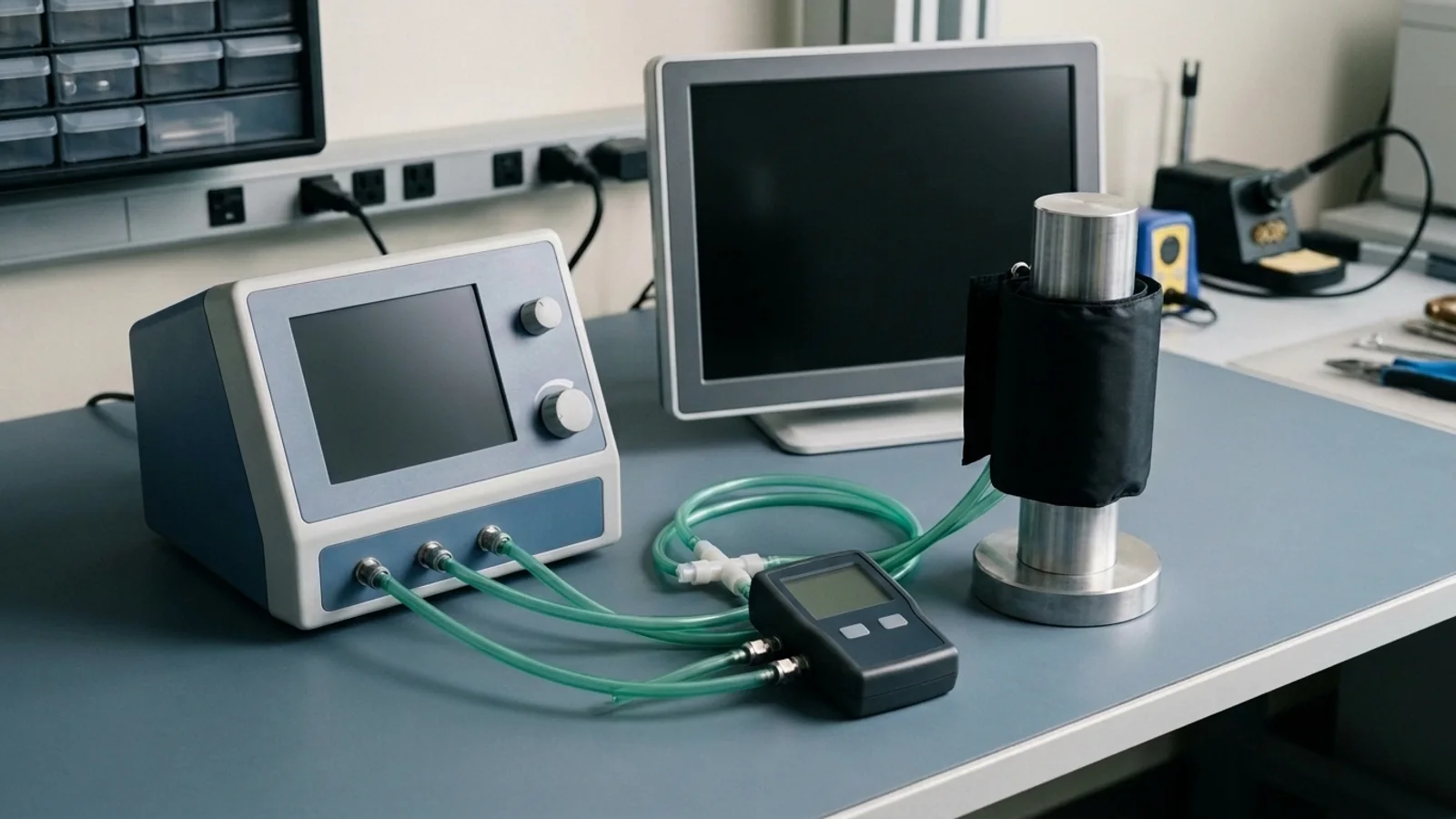
A patient monitor shows 132/84 mmHg while the NIBP simulator is playing 120/80. Is the monitor failing? Not necessarily, and the simulator alone cannot tell you. A bench non-invasive blood pressure (NIBP) check is really three different tests, and only one of them speaks to accuracy. Static pressure, compared against a reference traceable to national metrology standards, checks the pressure-measurement path. A leak test checks the pneumatic system against that model's own acceptance rule. A dynamic simulated pulse envelope checks whether the monitor's algorithm gives repeatable determinations; it does not establish accuracy. Oscillometric monitors use proprietary algorithms, so the same synthetic envelope legitimately produces different readings on different monitors. In one peer-reviewed comparison of 18 patient monitors driven by a simulated 120/80 mmHg setting, systolic estimates ranged from 112.6 to 126.6 mmHg and diastolic estimates from 74.8 to 86.9 mmHg, even though the simulators' envelopes repeated within 0.2 mmHg.
The boundary is written into the standards. ISO/TS 81060-5:2020, the technical specification for NIBP simulators, defines them with a note that they are not able to confirm the accuracy of an automated sphygmomanometer and are used to assess its repeatability and reproducibility. Clinical accuracy of an automated NIBP device is established by clinical investigation under ISO 81060-2:2018, while IEC 80601-2-30:2018 sets the particular basic-safety and essential-performance requirements for these devices. A service bench reproduces neither. So judge a simulator reading against the OEM's acceptance criteria rather than the preset, confirm the pressure path with a traceable static reference, leak-test to the model's own criterion, record exactly what you ran, and escalate suspected clinical-accuracy problems instead of tuning the simulator until the numbers match.
One Bench Query, Three Different Tests
Biomedical equipment technicians, independent service organizations, and clinical engineering teams verify NIBP function during scheduled inspections and after repairs. Recording that work as a single “NIBP calibration check” hides what was actually proven. A monitor can pass a static pressure check and hold pressure without leaking, yet read several mmHg away from a simulator preset because its algorithm interprets the synthetic envelope differently. Conversely, a reading that happens to land near the preset says nothing about a slow leak, because a dynamic run was never designed to test pneumatic integrity.
The decision asset for this article is a test-purpose matrix. Use it to choose the test that answers the suspicion in front of you and to decide where the acceptance number has to come from.
| Test | What it establishes | What it cannot establish | Reference it requires | Where the acceptance number comes from |
|---|---|---|---|---|
| Static pressure verification | Whether the monitor's displayed cuff pressure agrees with a known applied static pressure (the pressure-measurement path). | Pneumatic integrity, determination-algorithm behavior, or clinical accuracy. | A pressure reference traceable to national metrology standards: a calibrated digital or mercury manometer, or a simulator's verified static-pressure function. | The OEM service procedure for that model (example: GE Dash 3000/4000/5000 requires monitor and manometer to agree within ±1 mmHg for at least one full minute). |
| Pneumatic leak test | Whether the closed pneumatic circuit (pump, valves, hoses, cuff or test vessel) holds pressure. | Pressure-measurement accuracy or determination quality. | The monitor's service or calibrate mode to close the vent valve, a rigid vessel or a cuff on a rigid mandrel, and a reference manometer or simulator. | The model's own criterion (example: in the GE Dash calibration hold, a drop of 1 mmHg or more every five seconds indicates a leak). Fluke's note that most manufacturers recommend under 8 mmHg/min is context, not a universal limit. |
| Dynamic simulation | Whether the monitor produces stable, repeatable determinations from a consistent synthetic envelope. | Accuracy of the reading, agreement with the preset, or clinical performance on patients. | An NIBP simulator whose own pressure measurement and output repeatability are verified; ISO/TS 81060-5 sets those simulator requirements. | The OEM's acceptance criteria for simulator checks where the manufacturer provides them, plus your written repeatability rule; never the preset itself. |
Each row targets a different part of the system: the measurement path, the pneumatic circuit, and the algorithm. Matching the suspicion to the right row first prevents unnecessary parts replacement and keeps the work order honest about what was proven:
Readings look offset at every setting: start with static pressure against a traceable reference.
Failed or prolonged determinations, or inflation-failure, measurement-time or pressure-leak alarms: start with the leak test. The Dash service manual, for example, lists system alarms for inflation failure, measurement time exceeded, and system pressure leak.
Readings scatter from cycle to cycle on an unchanged simulator setting: check the setup, then run a dynamic repeatability series.
Readings are consistent but differ from the preset: compare them with the OEM's criteria. A preset mismatch is not by itself a failure.
Static Pressure: The Only Bench Accuracy Statement
Fluke Biomedical's ProSim 8 NIBP test optimization application note puts it plainly: NIBP accuracy is determined using static pressures, whether generated by an NIBP simulator or by another pressure source traceable to national standards for metrology. In a static check, one stable pressure is shared between the monitor's NBP circuit and a reference, and the two readings are compared. Because nothing is pulsing, the comparison isolates the pressure-measurement path from the oscillometric algorithm.
A monitor in normal measurement mode will not simply hold a static pressure for comparison, so manufacturers provide a service or calibration function for this check. How to enter that function, and what it does internally, is model-specific. It belongs to qualified service personnel working from the current OEM manual for the exact model and software revision.
The GE Healthcare Dash 3000/4000/5000 service manual (document 2000966-542D, read from a public mirror) is a useful bounded example. Its functional checkout calls for a digital manometer with a range of at least 0 to 1000 mmHg and 0.5% of full-scale accuracy, or a calibrated mercury manometer, teed into the monitor's NBP line with the cuff wrapped around a rigid pipe. With the CHECK CAL function running, the monitor's NBP reading and the manometer must agree within ±1 mmHg for at least one full minute; if they do not, the manual states that the NBP circuit requires calibration and refers to its NBP calibration procedure. That rule belongs to GE, that monitor family, and that revision. It is not a generic NIBP tolerance and should not be copied onto another manufacturer's monitor.
Static verification is also where documentation matters most. Under 42 CFR 482.41(d)(2), hospital facilities, supplies, and equipment must be maintained to ensure an acceptable level of safety and quality. The regulation does not prescribe NIBP test methods, but a static check against a named, traceable reference with a recorded OEM criterion is the kind of evidence that shows the maintenance duty was served. Our guidance on medical equipment calibration certificates and service record requirements covers how to make that evidence auditable.
Leak Testing: The Model's Own Rule Governs
A leak lets cuff pressure bleed away while the monitor is trying to control inflation and deflation, which can disturb pulse detection and lead to failed or prolonged determinations. Fluke's reconciling note adds that small leaks may not be audible but still contribute to measurement error, which is why a leak can hide behind readings that look merely noisy.
Leak acceptance is where generic rules of thumb cause the most trouble. Two documented procedures show why the specific model's criterion governs:
The OIML R 16-2 procedure as quoted by Fluke: the ProSim 8 application note reproduces the leak procedure from OIML R 16-2 (2002 edition). The cuff is replaced with a rigid metal vessel of 500 ml ±5%, a reference manometer and pressure generator are connected through a T-piece, and leakage is measured at five equally spaced pressure steps (at least 50, 100, 150, 200 and 250 mmHg), waiting at least 60 seconds at each step for thermal equilibrium and measuring over five minutes. The result is expressed as pressure loss per minute. The note then adds that most monitor manufacturers recommend a leak rate below 8 mmHg/min. That figure is Fluke's summary of manufacturer practice, not a limit set by the OIML procedure.
The GE Dash family criterion: in the Dash 3000/4000/5000 calibration procedure, the monitor's own pump inflates the circuit until it shuts off at about 250 mmHg, and pressure settles to about 240 mmHg and holds. The manual states that if pressure continues to drop at 1 mmHg or more every five seconds, there is a leak in the NBP plumbing that must be repaired before calibration is restarted. Arithmetically that is 12 mmHg per minute, but the two criteria are not interchangeable: they use different volumes, pressures, durations, and purposes, so neither number converts into the other's pass/fail limit.
The practical rule is simple. Apply the leak criterion in the current service documentation for the exact model and software revision in front of you, record which document and revision you used, and treat vendor summaries as background rather than acceptance limits.
When a pneumatic component has been replaced, a passing leak test is part of the evidence described in major repair return-to-service testing. Localizing a failed leak test, for example separating the cuff and hose from the monitor's internal pneumatics, follows the OEM troubleshooting procedure and stays with qualified service personnel. Fluke's reconciling note also recommends testing overpressure relief valve function alongside system leaks during NIBP performance testing.
Dynamic Simulation: You Are Testing Repeatability
An NIBP simulator does not create a blood pressure. As the monitor inflates and deflates the cuff or test volume, the simulator adds small pressure pulses whose size follows a stored envelope curve relating pulse size to system pressure; Fluke describes the ProSim 8 as making pressure pulses that mimic pulses in a human arm.
Oscillometric monitors read that envelope. According to Fluke's application note, the cuff pressure at which the pulse amplitude is greatest is known as mean arterial pressure (MAP), and systolic and diastolic values are derived from the envelope using techniques proprietary to each manufacturer. Fluke's reconciling differences application note illustrates that some algorithms use pulse height and others use slope to mark the systolic and diastolic points. Different algorithms, same synthetic envelope, different numbers.
That is why the definition note in the ISO/TS 81060-5:2020 preview matters: NIBP simulators are not able to confirm the accuracy of an automated sphygmomanometer and are used to assess its repeatability and reproducibility. The same document states that it does not test the agreement between a simulator's set values and a monitor's displayed values, notes that accuracy is usually tested by clinical investigation according to ISO 81060-2, and cautions that not all NIBP simulators and automated sphygmomanometers are compatible.
The spread is measurable. Sims and colleagues (Journal of Medical Engineering & Technology, 2005) studied three simulator models and 18 patient monitors with NIBP function, using a purpose-built pressure measurement system with 0.048 mmHg accuracy. Simulators produced repeatable envelopes (under 0.2 mmHg), although envelope magnitude and shape depended on the simulator model. Monitors were highly repeatable (under 2 mmHg) when given a repeatable envelope, yet at a simulated 120/80 mmHg setting their systolic estimates ranged from 112.6 to 126.6 mmHg (SD 3.0 mmHg) and diastolic estimates from 74.8 to 86.9 mmHg (SD 3.5 mmHg). Those devices predate today's fleets, so treat the figures as evidence of algorithm variability, not as a benchmark for any current monitor.
Fluke's ProSim 8 application note adds a manufacturer example that carries a second lesson. Its table reports readings for a 120/80 (93) mmHg setting on four monitors, both at the default 0% envelope shift and after an envelope shift was applied (MAP in parentheses):
| Monitor (as named by Fluke) | Reading at 0% envelope shift (mmHg) | Envelope shift applied | Reading after shift (mmHg) |
|---|---|---|---|
| GE Medical Dash 4000 Pro | 117/80 (93) | 1% | 117/81 (94) |
| Spacelabs Ultraview SL2600 | 126/89 (98) | −7% | 118/83 (92) |
| Nihon Kohden MU-631RA | 124/85 (95) | −4% | 118/82 (92) |
| Philips Medical MP80/90 | 115/85 (91) | 0% | 115/85 (91) |
Read the table two ways. First, at the default setting none of the four monitors displayed exactly 120/80, and one read 126/89, not far from the 132/84 scenario that sends technicians looking for a fault. Fluke does not present any of these readings as failures; the note observes that results vary among monitors and even among monitors from the same manufacturer. Second, the right-hand column shows how easily the stimulus can be adjusted until the display sits closer to the preset. Fluke presents envelope shift as a way to bridge readings, and in the same passage reminds readers that a simulator determines dynamic repeatability rather than the accuracy of patient monitors. The data is from 2012-era models and firmware, so it illustrates the mechanism rather than predicting any current unit.
A Bench Decision Path for NIBP Discrepancies
The flow below orders the three tests so that each result is interpreted only after the conditions it depends on have been confirmed. It describes what to verify and when to stop, not how to open, adjust, or recalibrate a monitor.
flowchart TD
  A["NIBP discrepancy or scheduled check"] --> B{"Simulator and reference manometer verified and in calibration?"}
  B -->|No| B1["Stop: verify or replace the test equipment first"]
  B -->|Yes| C["Static pressure against traceable reference in OEM service mode"]
  C --> C1{"Within the OEM criterion for this model?"}
  C1 -->|No| F1["Refer for OEM-qualified calibration or repair"]
  C1 -->|Yes| D["Leak test with rigid vessel or cuff on rigid mandrel"]
  D --> D1{"Meets the model's own leak criterion?"}
  D1 -->|No| F2["Localize per OEM troubleshooting: accessory or internal"]
  D1 -->|Yes| E["Dynamic run: fixed setup, several determinations per preset"]
  E --> E1{"Repeatable and within OEM simulator criteria?"}
  E1 -->|Yes| P1["Finish alarm and electrical safety checks, document, return to service"]
  E1 -->|"No, readings scatter"| S["Recheck tubing, cuff, leaks and first-reading effect; do not change envelope shift"]
  S --> E
E1 -->|"No, repeatable but outside OEM criteria"| X["Remove from service; escalate to OEM or qualified repair"]When Readings Differ From the Preset
Before suspecting the monitor, rule out the setup. Fluke's reconciling note states that the design factors unique to the unit under test make it unrealistic to expect values identical, or even very close, to the simulator preset; what you should expect is precision. Several bench variables move the displayed numbers without anything changing inside the monitor:
Pulse volume: Fluke found that values displayed for the same preset varied noticeably between the ProSim 8 and two earlier Fluke models (BP Pump 2 and Cufflink) while staying very repeatable, and identified pulse volume as the one user-variable factor that explains some of the difference. The ProSim 8 default is 1 ml; on the older models the default varied with the preset from 0.55 to 0.75 ml. Record the pulse volume you used and keep it constant between visits.
Tubing: use the same tubing set between monitor, cuff, and simulator for every test. Fluke recommends tubing that is flexible but not soft (not latex or Silastic) and only as long as needed, because excess length adds volume to the test system.
Leaks in the test setup: the setup must be absolutely leak-free. Check the cuff and connectors before blaming the monitor.
Cuff or chamber: use a medium adult cuff or a rigid 100 or 500 mL chamber. Fluke calls an undersized or oversized cuff, which produces consistently offset values, one of the most common NIBP testing errors. If you use a cuff, wrap it around a fairly rigid mandrel with a cross-section similar to an adult upper arm (8 to 10 cm in diameter). The GE Dash static checkout specifies its own fixture, a 6-inch PVC pipe, so follow the OEM setup whenever you apply an OEM criterion.
First reading and disturbances: after a large preset change, the first reading can differ markedly because some monitors raise cuff pressure gradually. Fluke advises discarding that first reading, testing from high to low settings, and not bumping or shaking the setup during a cycle.
Simulator model: changing simulators, even within one brand, can shift displayed values, and Sims 2005 found envelope magnitude and shape differ by simulator model. Compare trends only across visits that used the same simulator model and settings.
For the repeatability series itself, Fluke suggests three readings at each of three presets (hypertensive, normal, and hypotensive). If one reading differs significantly from the other two, take more readings to decide whether the monitor is unacceptably imprecise. If the readings are consistent but outside the accuracy specification in the maker's documentation, Fluke's guidance is to take the monitor out of service and have it repaired.
Once static, leak, and dynamic results meet the model's criteria, finish the remaining functional checks, including patient monitor alarm verification after service, before returning the device to clinical use.
The Simulator Is Test Equipment Too
An NIBP simulator is a measuring instrument, not a primary standard. Gersak and colleagues (Medical & Biological Engineering & Computing, 2009) note that simulators are used for quick checks of blood pressure monitors as part of technical maintenance and are often subject to mechanical and electromagnetic shocks that could affect their measuring function. They proposed an evaluation procedure that pairs a static test, derived from common electromechanical manometer calibration, with a dynamic test of the repeatability of the simulator's output. After applying it to one commercial simulator, they concluded that simulator evaluations should be performed regularly, at a suitable interval, to track metrological quality over time.
ISO/TS 81060-5:2020 now sets requirements for the repeatability and reproducibility of NIBP simulators. Its introduction says it should be used to determine the quality of a simulator when it is produced, sold, or received by the responsible organization, and thereafter in periodic quality-control testing. Among the requirements visible in the official preview, the simulator's own pressure measurement needs a resolution of 0.1 mmHg or finer and a maximum error of ±1.0 mmHg across its nominal range (at 15 to 25 °C and 15% to 85% relative humidity, non-condensing) unless its accompanying documents specify otherwise. The document is a technical specification, not an International Standard.
For a biomed shop, the consequences are practical. When buying a simulator, ask how the vendor supports any ISO/TS 81060-5 repeatability and reproducibility claim, and treat marketing that promises bench “accuracy” testing of monitors as positioning, because the specification's own definition disclaims it. Set the simulator's calibration and verification interval in your test-equipment program, starting from the manufacturer's recommendation. Record the simulator's asset number, calibration due date, and settings on every NIBP work order. The certificate checks that apply to an electrical safety analyzer used for post-repair electrical safety testing apply equally to NIBP simulators and reference manometers.
Where the Bench Stops: Clinical Accuracy and Escalation
A service bench can confirm the pressure-measurement path, pneumatic integrity, and repeatability. It cannot validate clinical accuracy. That boundary is set by device standards that the U.S. Food and Drug Administration lists as recognized consensus standards:
ISO 81060-2:2018 (FDA recognition 3-196): the FDA recognition entry covers the third edition including Amendment 1:2020 and Amendment 2:2024, with partial recognition. The standard specifies requirements and methods for the clinical investigation of automated equipment that estimates arterial blood pressure intermittently and non-invasively by cuff. Clinical investigation with human subjects, not bench simulation, is the pathway that establishes clinical accuracy.
IEC 80601-2-30:2018 (FDA recognition 3-123): the FDA recognition entry lists Edition 2.0 (2018-03), also with partial recognition. The standard sets particular requirements for the basic safety and essential performance of automated sphygmomanometers that use an inflatable cuff for non-continuous indirect blood pressure estimation.
Both standards address the device as designed and placed on the market. A passing bench check does not re-establish conformity with either, and a preset mismatch does not prove nonconformity. When clinicians report that a monitor reads consistently high or low on patients, do not close the complaint because the unit is repeatable on a simulator. Confirm the static pressure path and leak integrity, check the cuff sizes and accessories in clinical use, and if the concern persists, escalate to the manufacturer and through your facility's device-problem reporting process.
Finally, make the work order reconstructable. A record that says only “NIBP OK” cannot show which question was answered, and it gives a surveyor nothing to evaluate against the maintenance duty in 42 CFR 482.41(d)(2). For each NIBP check, record:
Test identity: separate lines for static pressure, leak, and dynamic repeatability.
References used: make, model, asset or serial number, and calibration due date of the manometer and simulator, plus simulator settings such as pulse volume, envelope shift, and presets.
Criterion applied: the OEM document and revision, and the acceptance value used for each test.
Results: as-found and as-left values at each pressure point the OEM procedure specifies, the measured leak result, and the repeated dynamic readings.
Disposition: returned to service, removed from service, or escalated, with the reason.
Kept separate, the three tests give an honest answer to the 132/84 question: the pressure path is right or wrong, the pneumatics hold or leak, and the algorithm is repeatable or not. Clinical accuracy remains a question for the manufacturer's clinical evidence, not the bench.