
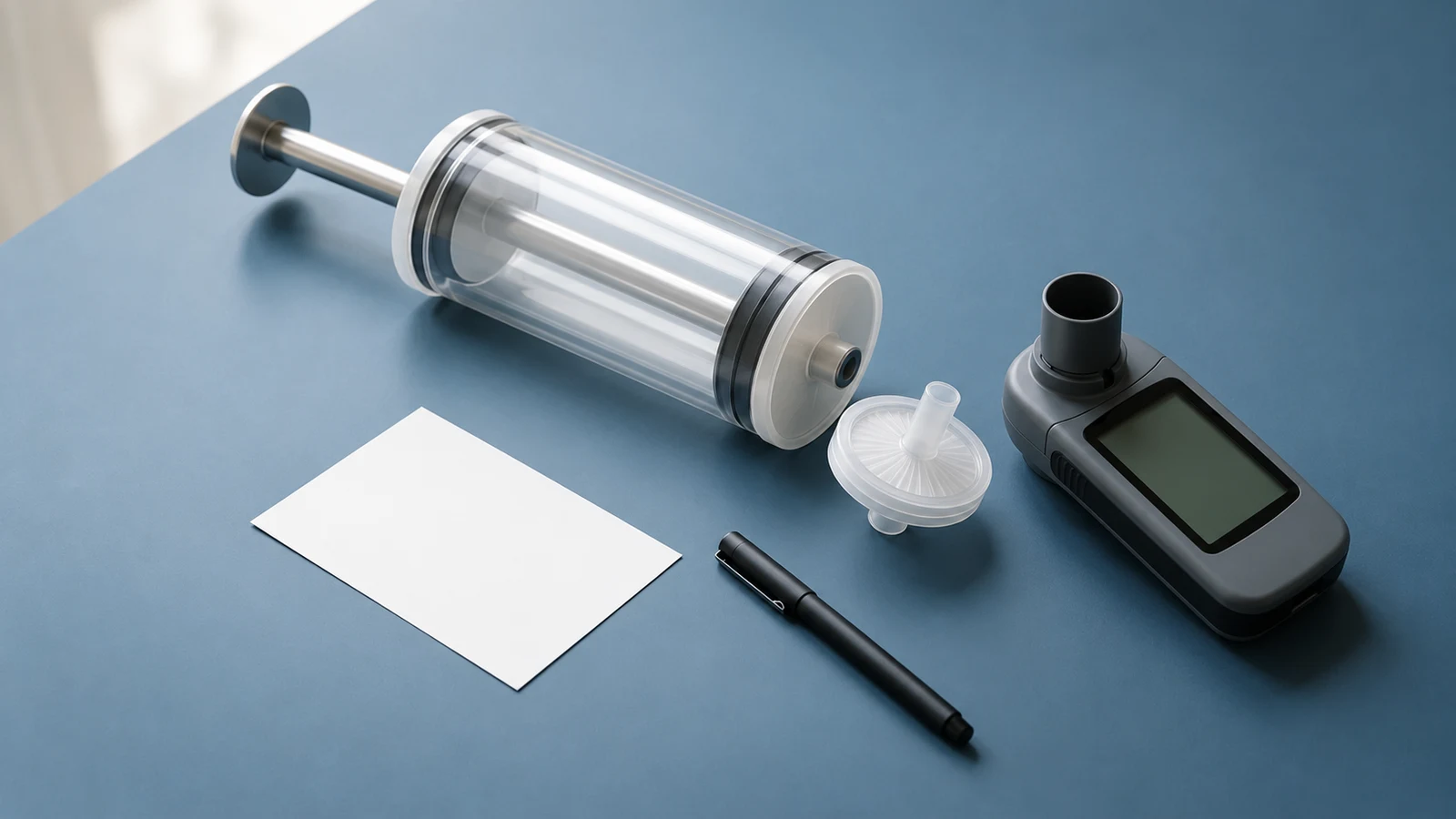
For a reliable daily spirometer calibration verification, start with an identified, accuracy-verified 3-liter syringe, the filter and sensor configuration used for patient testing, current environmental entries, and the instructions for that exact model. Verification checks a known volume without adjusting calibration. Under the ATS/ERS 2019 technical statement, it is required at least daily, including for factory-precalibrated devices. The check uses at least three syringe cycles at differing flows between 0.5 and 12 L/s; the statement specifies injection times between 0.5 and 6 seconds. Each measured volume must be within ±3% of 3.00 L, or 2.910–3.090 L. Check inspiration and expiration, with expiration only for volume-based spirometers. ATS/ERS device quality assurance.
Record the setup alongside the individual readings and any failed attempts. A pass from an unidentified syringe, an incorrect accessory configuration, or stale environmental entries leaves a gap in the evidence. The practical record below helps a biomedical equipment technician or laboratory manager review that gap before accepting the day’s equipment check. Its additional traceability fields are recommendations; they are not presented as universal legal requirements.
Separate verification from adjustment
ATS/ERS defines calibration as establishing the relationship between sensor signals and actual flow or volume. Calibration verification checks whether the instrument remains within the specified limits. The distinction matters when selecting a menu option and interpreting a report: an adjustment changes the calibration relationship, while a verification supplies evidence about it. A technician should identify which operation the device performed rather than use the two names interchangeably. ATS/ERS technical statement.
The daily check is an equipment quality-control task. A passing syringe check does not establish patient maneuver quality, diagnostic interpretation, or complete post-repair performance. Keep the device’s other required checks in the applicable procedure. If a repair or software change has occurred, record that event and the required verification results together, so a later reviewer can understand what changed and what evidence supported resuming testing.
Confirm the syringe is a trustworthy reference
The syringe has its own acceptance requirements. ATS/ERS specifies accuracy of ±0.015 L, equivalent to ±15 mL or ±0.5% of full scale for a 3-L syringe. Accuracy is verified by the manufacturer on delivery and at manufacturer-recommended intervals. The statement does not set a universal annual recertification interval. Identify the syringe, review its accuracy-verification evidence, and establish the next check from the applicable manufacturer or program requirement. ATS/ERS syringe requirements.
Daily condition checks: inspect for displacement of the piston stop and confirm smooth operation without sticking or catching. A displaced adjustable stop changes the reference volume. Record an abnormal finding rather than treating it as an instrument error.
Leak checks: ATS/ERS calls for a monthly syringe leak test at more than one volume up to the syringe maximum. Use the syringe’s approved procedure. A leak check and a formal accuracy verification answer different questions, so retain evidence of both.
Temperature and damage: keep the syringe at room temperature and avoid warming its body during verification. ATS/ERS treats a dropped or damaged syringe as out of calibration until checked. Use the syringe manufacturer’s handling instructions and leak-test method.
The CPSBC Diagnostic Accreditation Program’s Spirometry Quality Control Plan, version 3.4, provides a useful example of a stricter local schedule: weekly syringe leak testing. It ties revalidation to the certificate expiry, or two years when expiry is undefined, and asks for validation proof annually. Annual submission of proof is different from annual revalidation. Use this as a British Columbia program example, not as a schedule for every facility. DAP plan, pages 6–8.
Reference equipment can fail even when recently supplied. Wu and colleagues tested 16 calibration syringes from eight brands, including different syringe capacities, and found seven failed at least one of their leak or volume-accuracy tests. Three of eight new syringes failed at least one test. This small, single-center study supports checking reference-equipment condition; its counts do not estimate the failure rate of all 3-L syringes. Its validator methods are not a generic field leak-test procedure. Published syringe inspection study.
Keep the flow challenge and acceptance band distinct
A single in-range stroke is insufficient for the ATS/ERS daily check. The statement calls for low, medium, and high flow verification and requires the measured volume at each flow to satisfy the combined acceptance band. Preserve the results for each cycle and each required direction. Follow the model’s verification routine for generating the differing flows and interpreting its low, medium, and high targets or speed prompts. ATS/ERS verification requirements.
| Quantity | ATS/ERS 2019 value | How to interpret it |
|---|---|---|
| Syringe accuracy | ±0.015 L or ±0.5% for a 3-L syringe | Requirement for the reference syringe, with accuracy checks at manufacturer-recommended intervals. |
| Maximum permissible spirometer error | ±2.5% | Equipment accuracy requirement; distinguish it from the combined verification band. |
| Combined verification band | ±3% of 3.00 L = 2.910–3.090 L | Includes the ±2.5% spirometer tolerance and ±0.5% syringe tolerance. Apply to each required measured volume. |
| Daily flow challenge | At least three cycles; differing flows between 0.5 and 12 L/s; stated injection times 0.5–6 seconds | Both inspiration and expiration, or expiration only for volume-based instruments. Use model instructions for the routine. |
The system must establish zero flow before verification. ATS/ERS specifies a blocked spirometer for determining zero flow and identifies airflow during zeroing as a possible reason for failure. Use the manufacturer’s method for implementing that requirement. Confirm how that model blocks airflow during zero setting before proceeding with its verification routine.
Match the filter and disposable sensor configuration
If patient testing uses an in-line filter, ATS/ERS requires its use during recalibration and verification too. For devices with disposable flow sensors, test a new sensor each day from the supply used for patient tests. The aim is to verify the relevant measurement configuration. This does not instruct staff to reuse a patient-used filter or sensor, and it does not establish that accessories from different manufacturers are interchangeable. ATS/ERS accessory requirements.
The ndd FAQ illustrates why configuration needs a model-specific entry: it lists filter compatibility and software settings for its product family. The Vitalograph Alpha Model 6000 IFU, issue 8, shows verification with a bacterial/viral filter fitted and notes the use of syringe adapters where needed. Record the approved filter, sensor, and adapter type actually used. Retaining a lot identifier can help investigate a supply-related discrepancy, but that extra field is a traceability recommendation rather than a universal ATS/ERS requirement. ndd accessory FAQ; Alpha IFU, section 5.5.
Review environmental entries before accepting the result
ATS/ERS requires recording ambient temperature, barometric pressure, and time of day. It specifies ambient temperature accuracy of ±1°C and reporting spirometry outcomes at BTPS: body temperature, ambient barometric pressure, saturated with water vapor. Verification uses room air at ambient conditions. Use the device’s dedicated verification mode and its environmental-input instructions rather than applying a patient-results correction manually. ATS/ERS laboratory details and BTPS adjustment.
When ambient temperature changes rapidly, by more than 3°C in less than 30 minutes, the statement says continuous temperature corrections may be necessary. That is not a universal instruction to pause for a fixed interval. Check whether the instrument can operate within the manufacturer’s specified environmental range and how its software handles changing conditions. Record the conditions relevant to the check rather than copying yesterday’s entries.
The Alpha IFU provides a concrete example: its verification screen accepts syringe serial number, volume, pressure, altitude, and humidity. The minimum entries are serial number, syringe volume, and temperature. Temperature auto-fills from the internal sensor, and details from a previous verification can pre-populate. Confirm that those stored details still describe today’s syringe and setup. These fields and defaults belong to the Alpha Model 6000; another spirometer may use a different interface. Alpha IFU, issue 8, section 5.5.
Check a calibration-free instrument without attempting unauthorized adjustment
A factory-precalibrated spirometer may offer no operator calibration adjustment. ATS/ERS still requires calibration verification and says the manufacturer must specify what to do after a failed check. In its FAQ, ndd describes EasyOne products as requiring no calibration, while distinguishing a calibration check from adjustment. It offers a 3-L syringe for organizations or programs where checks are required, including its NIOSH/OSHA and Social Security/Disability examples. That vendor explanation is not a legal rule for every clinical setting. ATS/ERS precalibrated devices; ndd calibration FAQ.
For service planning, record both whether the device can be adjusted by the operator and which manufacturer failure instructions apply. Do not assume a verification failure authorizes opening a housing, cleaning an internal transducer, altering software factors, or sending every device through the same depot workflow. The relevant procedure determines the permitted user actions and the point at which qualified service is needed.
Identify which requirement governs the facility
The technical statement, an occupational-surveillance regulation, a regional accreditation plan, and a model IFU have different scopes. Keep their names and revisions visible in the equipment procedure. The following comparison shows why a generic label such as “federal daily calibration rule” would be misleading.
| Source and scope | Relevant requirement | Record implication |
|---|---|---|
| ATS/ERS 2019 technical statement | Daily verification; specified syringe accuracy, flow challenge, accessory configuration, and QC after equipment changes. This is a technical standard, not itself a statute. | Maintain calibration/QC findings and document repairs, adjustments, software or hardware changes, and relocation. |
| 42 CFR 37.93: NIOSH-approved coal-worker surveillance facilities | Incorporates 2005 ATS/ERS calibration-check procedures. Flow-type units need daily 3-L injections at three speeds and weekly flow-linearity checks. Volume units need daily leak and volume-accuracy checks. | Facility calibration-check records must be maintained and available for NIOSH inspection. Do not describe the incorporated edition as 2019. |
| CPSBC DAP plan, version 3.4 | Regional program example: daily calibration/check, weekly syringe leak and linearity checks, and certificate-based syringe revalidation. | Its example log includes date, initials, temperature, pressure, humidity, volumes, pass/fail, leak-test result, and comments. |
| Vitalograph Alpha Model 6000 IFU, issue 8 | Recommends verification daily and after storage or transport, flowhead drop or replacement, or suspected/possible electromagnetic interference. | Use that model’s entry fields, report, and failure instructions; do not apply its menu sequence to other devices. |
The regulatory and program entries above come from the cited section and documents. NIOSH’s training page separately identifies programs requiring completion of a NIOSH-approved spirometry course. It states course certificates are valid for five years and describes a seven-month grace period after initial-course expiry. Completion means passing an approved course; it does not mean the person is “NIOSH certified.” Keep applicable training evidence in the program file without claiming every biomed equipment check requires that credential. 42 CFR 37.93; DAP quality-control plan; Alpha IFU; NIOSH training program.
Diagnostic spirometers are class II devices under 21 CFR 868.1840; the FDA recognition entry associates them with product code BZG. FDA recognition 1-179 is partial for ISO 26782:2009: clauses 7.1, 7.7, and 7.8 are excluded because they conflict with the cited ATS/ERS equipment criteria. Recognition supports use of standards in premarket submissions; this entry does not create a facility’s daily service schedule. As checked on October 10, 2026, ISO lists the 2009 edition as current with ISO/DIS 26782 under development. A draft is not an adopted replacement. Device classification; FDA recognition 1-179; ISO catalog status.
Use a setup record that explains the pass or failure
The table below is a proposed equipment-review template. It combines source-based QC items with recommended identity and traceability fields. It can sit alongside the device report in the facility’s QC register or service record; the cited sources do not require one particular CMMS platform. Its purpose is to make the check reproducible and reviewable, not to turn every suggested field into an accreditation obligation.
| Record group | Suggested entries | Basis and purpose |
|---|---|---|
| Equipment and procedure | Asset ID; make/model/serial; applicable IFU revision; verification-mode name; relevant software revision. | Recommended traceability fields. ATS/ERS requires recording hardware/software changes; the IFU identifies the model-specific method. |
| Reference syringe | Make/serial; nominal volume; last accuracy-verification evidence; next check basis; daily condition findings; leak-test date/result. | ATS/ERS syringe controls. DAP gives a certificate-based revalidation example. Identity links the reference evidence to the day’s result. |
| Accessory configuration | Approved filter/sensor/adapter types; whether a fresh disposable sensor from patient supply was tested; lot identifiers when useful. | ATS/ERS filter/sensor requirements; manufacturer compatibility instructions. Lot recording is an additional recommendation. |
| Environment and operator | Date/time; operator name or initials; temperature and pressure; humidity/altitude where required; source of entries. | ATS/ERS laboratory conditions; Alpha entry fields; DAP example log. Operator identity is a practical record field. |
| Verification results | Each cycle’s volume and direction; flow or speed designation supplied by the device; applicable limits; overall result; all failed attempts. | ATS/ERS flow/direction criteria and verification-report requirements. Preserve readings instead of entering only “pass.” |
| Changes, corrective action, and disposition | Reason for repeat check; failed-result investigation; permitted actions; repeat results; linked service record; person responsible for acceptance. | ATS/ERS QC/repair documentation. Proposed disposition fields distinguish an unresolved failure from evidence supporting resumed testing. |
A useful review asks whether the result belongs to this instrument, this reference syringe, this accessory setup, and these environmental entries. If any connection is missing, resolve it before treating a passing number as sufficient evidence. For a service handover, retain the instrument’s original report and link the corrective work to the subsequent check.
For broader record organization, see the guide to medical equipment service records. For reviewing reference-equipment paperwork, see medical equipment calibration certificates. These guides support documentation practice; their other regulatory frameworks do not replace the spirometry-specific criteria above.
Preserve failures and follow the manufacturer’s escalation path
If a verification fails, withhold further patient testing on that instrument while the problem is investigated and resolved through the permitted procedure. ATS/ERS identifies possible causes including syringe malfunction, connection leaks, improper assembly, blockage, airflow during zeroing, temperature differences, and ambient-entry errors. Those are investigation categories, not a diagnosis from the shape of one failed stroke. Retain the failed result, the finding, any action taken, and the repeat verification. ATS/ERS failure causes and QC requirements.
Calibration-factor changes also need attention even when a volume check appears acceptable. ATS/ERS calls for a manufacturer alert when a new factor changes by more than 6% from the previous factor or varies by more than ±2 standard deviations from the mean. Its Table 3 uses a change of at least 6% as an inspection/maintenance trigger. These are review triggers, not proof of a particular sensor fault or an automatic depot-return rule. Follow the device’s documented response.
Repeat checks after relevant changes. ATS/ERS explicitly requires calibration verification and QC after repairs or alterations, software/hardware updates or changes, and equipment change or relocation, before further testing. The Alpha IFU additionally names daily checks, storage/transport, a dropped or replaced flowhead, and suspected or possible electromagnetic interference. Follow the exact model’s cleaning and maintenance instructions for any associated checks. ATS/ERS change documentation; Alpha IFU repeat-check note.
A reviewer should be able to see why testing resumed: the permitted problem resolution, the complete required verification results, and any other device/program checks. A later passing attempt should not erase the earlier failure. Keep that history available so recurring discrepancies can be reviewed by the responsible laboratory manager and qualified service team.