
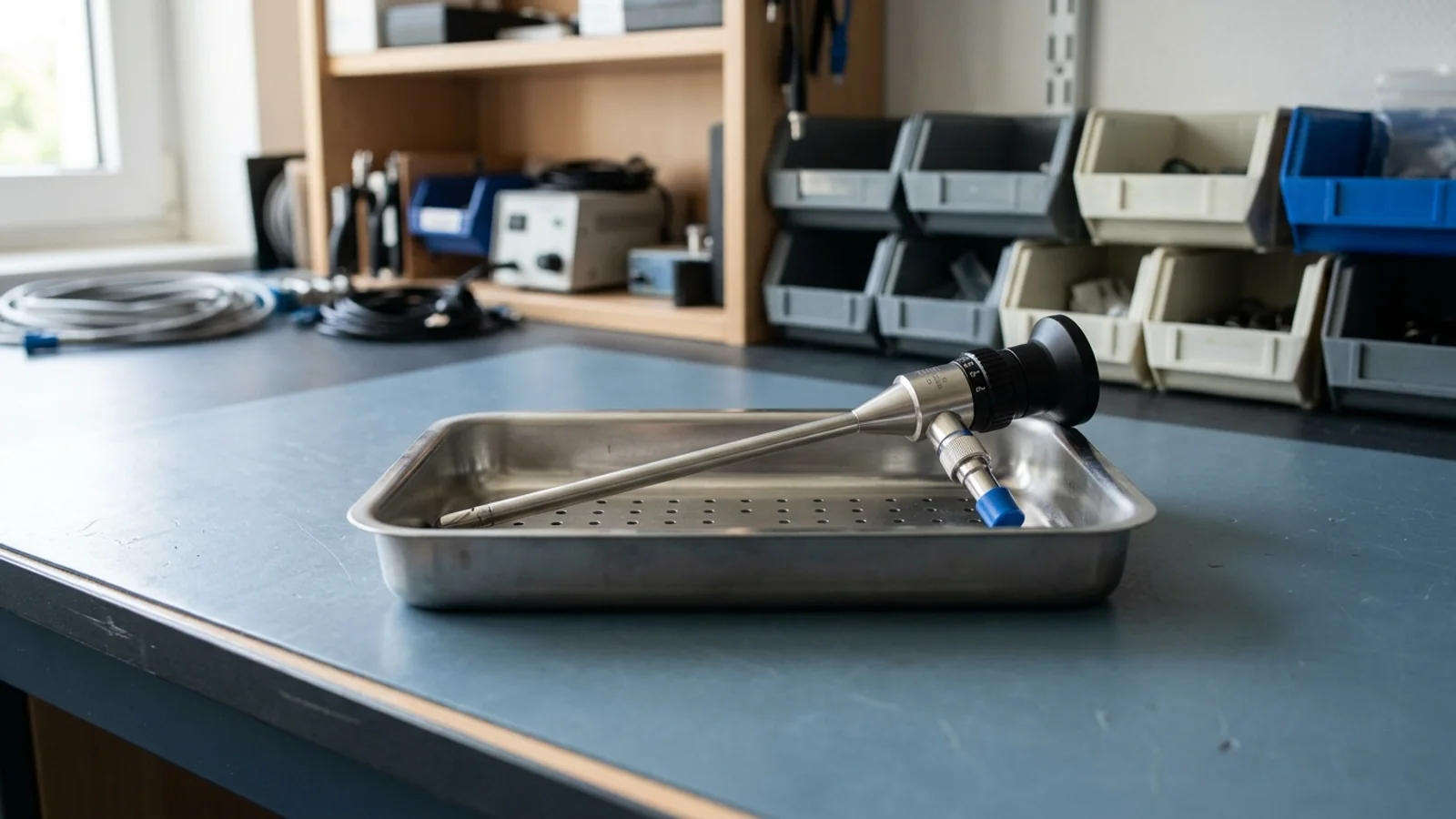
When a rigid telescope comes back cloudy, dark, bent, or unevenly lit, the first record is the nameplate, not a shop menu. Write the manufacturer, catalog or model, serial number, direction of view, outer diameter, working length, and the exact finding before anyone quotes a repair. Take that named telescope out of use when its own instructions call the shaft, image, or illumination unacceptable. A light-cable percentage, a tester default, or a flexible-endoscope leak-test worksheet does not make that decision.
Restoring the cleared direction of view, field of view, diameter, and optical design is the servicing description in 21 CFR 820.3 and the Food and Drug Administration's 10 May 2024 remanufacturing guidance. Changing those specifications can be a significant performance or safety change. This guide maps three publicly documented optical families, separates the PINPOINT cable discard rule from the telescope, and states what a repair quote has to name. It does not give shaft-straightening, lens-replacement, seal, or ultrasonic steps.
Which Finding Takes This Scope Out of Service
Only one of the three public identities prints a before-use inspection list. PINPOINT operator manual 4-0002428 Rev. K (2021-01) tells the user to inspect the laparoscope before each use and to return it to Stryker when a functionality or appearance problem is observed or suspected. The listed examples are cracks, rough surfaces, sharp edges, protrusions, dents, bends, excessive wear, moisture ingress, discoloration, and signs of mechanical or thermal damage. The image shall not be dark, blurry, or cloudy, and it shall not show an obstruction, debris, or other abnormality. Light should transmit from the light-guide connector to the distal end. If cleaning or polishing the optical surfaces does not resolve the problem, return the device.
K221004 and K253411 are 510(k) summaries, not service manuals. They publish cleared dimensions and the standards the submitter listed. They do not publish an in-service image pass-fail test, a magnification, or a repair method. The PINPOINT return list does not transfer to them, and neither summary describes a roll test, a loupe power, or a required rebuild. For a telescope whose instructions are not in hand, record the finding and hold the device until that model's instructions, or the manufacturer, define the next step.
| PINPOINT Rev. K finding | What the manual says to do | Do not transfer this |
|---|---|---|
| Cracks, sharp edges, dents, bends, moisture ingress, discoloration, or mechanical or thermal damage | Return the laparoscope to Stryker for repair | Not a universal rigid-telescope standard, and not a shaft-straightening or tube-opening procedure |
| Image dark, blurry, cloudy, or showing obstruction, debris, or another abnormality | Return it if cleaning or polishing the optical surfaces does not resolve the problem | Not a ScopeControl 70 percent or 30 percent limit |
| Light post aimed at an overhead light; distal fiber pattern uneven, or a surface deposit remains | Evaluate fiber transmission that way, then return the device if the problem remains after surface care | Do not look into light emitted from the distal tip or the light-guide glass |
| Light guide cable PC9004 with dark spots on more than 20 to 25 percent of the light-output surface | Discard that cable | Do not apply the percentage to the telescope shaft or to K221004 or 27033AA |
| White-balance failure, or a brightness or sharpening menu result | Treat it as a camera-chain check in the manual | Not proof that the telescope's optical train has failed |
| A high-definition visible-light laparoscope used for ICG fluorescence | The manual says that laparoscope will not perform ICG fluorescence imaging | Not evidence that a PINPOINT fluorescence laparoscope is broken |
Name the Optic Before Comparing It
A repair quote that says only "rigid endoscope" can mix three different optical trains and a fourth regulatory classification. The numbers below are copied from the cited document for that identity. They stop there.
Stryker PINPOINT Fluorescence Laparoscopes
Table 6 of PINPOINT manual 4-0002428 Rev. K names fluorescence imaging laparoscopes SC9104 (0°, 32 cm), SC9134 (30°, 32 cm), and SC9144 (45°, 32 cm) at a 10 mm diameter, and SC9504 (0°, 30 cm), SC9534 (30°, 30 cm), and SC9544 (45°, 30 cm) at a 5 mm diameter, plus light guide cable PC9004. Table 13 of the same manual is more specific and does not match those rounded figures on every row. It lists a 75° field of view and visible-plus-near-infrared transmission for those six models, outer diameter 10 mm for SC9104, SC9134, and SC9144, and outer diameter 5.5 mm for SC9504, SC9534, and SC9544. Working lengths in Table 13 are 320 mm for SC9104 and SC9134, 323 mm for SC9144, 300 mm for SC9504 and SC9534, and 302 mm for SC9544. Use the nameplate and both tables. Do not collapse 5 mm and 5.5 mm, or 30 cm and 302 mm, into one specification.
The system is described as high-definition visible-light and near-infrared fluorescence imaging used with indocyanine green. A high-definition imaging laparoscope optimized for visible light will not perform ICG fluorescence imaging. Rev. K does not print a product code for these laparoscopes, and it does not describe beam-splitting optics or a wavelength pair. The manual also says the system has no user-serviceable parts: do not disassemble, modify, or attempt to repair it. Repairs through Stryker are described as bringing the device back to manufacturer specifications. That sentence is the manufacturer's description of its own repair. It does not show that a third-party rebuild, or a repair that changes angle or diameter, stays inside servicing.
For the sealed sterilization tray PC9017, Rev. K lists STERRAD 100S, NX, NX ALLClear, 100NX, and 100NX ALLClear on standard cycles, and STERIS V-PRO 1 standard, plus V-PRO 1 Plus, maX, 60, and maX 2 on non-lumen or lumen cycles. It also lists steam exposures of 132°C for 4 minutes, 134–137°C for 3–5 minutes, and 134°C for 18 minutes, with a minimum 30-minute chamber dry time. The 18-minute note is the manual's transmissible-spongiform-encephalopathy cycle, and the manual says a device exposed to that long cycle should be expected to have reduced functional life. The prion-cycle caution is validated only for the laparoscope, not the light guide cable or the camera. Immediate-use autoclave sterilization is prohibited, and the manual says not to cross-sterilize because using multiple methods can reduce performance. These cycles are not the K221004 list.
KARL STORZ HOPKINS Telescopes Cleared in K221004
K221004, cleared 20 December 2022, is a rigid rod-lens telescope subset, product code GCJ, 21 CFR 876.1500, class II. The summary says optical glass rods in the central lumen transmit and magnify the image. Cleared directions of view are 0°, 25°, and 45°. Outer diameter is 5 mm, working length is 29 cm, field of view is 68°, and depth of field is 15.1 mm to 200 mm. Indications are visualization during laparoscopy, thoracoscopy, and general surgery in adults and pediatrics. The summary does not name catalog numbers, so a brochure number cannot be attached to this clearance.
The predicate, K935279, is different. Its directions of view are 0° and 30°, its field of view is 65° to 70°, its outer diameter is 4 mm to 10 mm, its working length is 29 cm to 35 cm, and its depth of field is 11.4 mm to 200 mm. The 30° figure is the predicate's listed direction of view. It is not a direction of view of the K221004 subject device, and it is not an uncleared brochure angle. Sterilization modalities listed for the subject device are steam pre-vacuum, STERRAD 100S, STERRAD NX, STERRAD 100NX, and STERIS V-PRO 1 and V-PRO 1 Plus. Ethylene oxide and chemical disinfection appear on the predicate column. The summary says no performance standards or special controls were developed under section 514 for these endoscopes. It lists ISO 8600-1, ISO 8600-3, ISO 8600-5, and ISO 8600-6 without editions, and IEC 60601-2-18:2009 for thermal safety. Do not state that the submission used ISO 8600-5:2020.
KARL STORZ 27033AA Cleared in K253411
K253411, dated 18 November 2025, clears Miniature Telescope for Urology model 27033AA, product code FGB, 21 CFR 876.1500, class II. It is a semi-rigid fiber-optic telescope. The shaft is phynox or stainless steel. An optical fiber bundle in a central lumen carries the image to the eyepiece, and other fibers carry light. Direction of view is 0°, field of view is 72.5°, diameter is 3.5 Fr, and working length is 21 cm. It is an optic without a working or irrigation channel and is used with a sheath, or with a working element and sheath, for visualization during minimally invasive urological endoscopy in adults and pediatrics.
Rod-lens crack descriptions from a HOPKINS telescope do not describe this image bundle. The summary again says section 514 performance standards and special controls were not developed for endoscopes, and it lists ISO 8600-1, ISO 8600-3, ISO 8600-5, and ISO 8600-6 without editions. That listing is not evidence the file used the 2020 edition. The current ISO/AWI 8600-5 project, which is replacing ISO 8600-5:2020, applies to rigid endoscopes and excludes fiber-optic and opto-electronic imaging systems. A rod-lens resolution method is not the image check for 27033AA. The summary does not publish a sterilization cycle list, so none is stated here.
Arthroscopes Under 21 CFR 888.1100
21 CFR 888.1100 identifies an arthroscope as an electrically powered endoscope intended to make the interior of a joint visible and, with accessories, to perform surgery within a joint. FDA product code HRX is the class II arthroscope under that regulation. The regulation does not publish a direction of view, diameter, working length, sheath rule, or image pass limit. A laparoscope finding from PINPOINT Rev. K, or a urological fiber-optic check for 27033AA, is not an arthroscope acceptance test.
| What the source prints | PINPOINT Rev. K, six fluorescence models | K221004 HOPKINS subset | K253411 model 27033AA | Arthroscope, 21 CFR 888.1100 |
|---|---|---|---|---|
| Classification | Product code is not printed in Rev. K | Class II, GCJ, 21 CFR 876.1500 | Class II, FGB, 21 CFR 876.1500 | Class II, HRX |
| Optical design | Table 13: visible plus near infrared, HD compatible, for these six models | Rigid rod lens; glass rods in the central lumen | Semi-rigid fiber-optic image bundle and separate illumination fibers | Not specified in the regulation |
| Direction and field | Table 6: 0°, 30°, 45°. Table 13 field of view: 75° for these six models | 0°, 25°, 45°; field of view 68°. Predicate K935279 is 0° and 30° | 0°; field of view 72.5° | Not specified |
| Size | Table 6 rounds to 10 mm by 32 cm and 5 mm by 30 cm. Table 13 lists 10 mm or 5.5 mm and working lengths of 320, 323, 300, or 302 mm | 5 mm by 29 cm; depth of field 15.1 mm to 200 mm | 3.5 Fr by 21 cm; no working or irrigation channel | Not specified |
| Number that does not move | PC9004 cable discard is 20 to 25 percent dark spots, not a telescope limit | Do not copy the predicate's 30°, ethylene oxide, or chemical disinfection onto this subset | Do not use a rod-lens resolution target as this optic's image check | Do not apply a laparoscope or ureteroscope image rule |
A cloudy picture can be a deposit on a window, moisture inside a PINPOINT laparoscope, a broken light cable, a camera setting, or the wrong laparoscope on a fluorescence console. Those are different next steps. The PINPOINT manual separates them. The two 510(k) summaries do not.
Surface Deposits Versus a Return-to-Manufacturer Finding
Rev. K includes polishing paste for deposits that normal cleaning does not remove on three optical surfaces: the distal end, the light guide cable connector, and the proximal end. Polishing is not routine cleaning. The manual says repeated application can damage the laparoscope lens. It also says compatibility with ultrasonic treatment has not been evaluated and can affect functional performance. The swab sequence belongs in that manual. It is surface care for those deposits, not an optical-train repair, and it is not reproduced here.
If the image stays dark, blurry, cloudy, or otherwise abnormal after that surface care, Rev. K says to return the laparoscope to Stryker. Moisture ingress is already on the return list. The manual also warns that moisture left on a device after sterilization can cause fog and image occlusion, which is a drying finding, not a diagnosis that the hermetic seal has a named failure mode. Do not convert a cloudy image into an instruction to unseal, dry, and reseal the optical tube.
The 20 to 25 Percent Rule Belongs to Cable PC9004
The cable inspection in Rev. K is specific. Point one end of the light guide cable toward a window or lamp. Look at the other end. Dark spots indicate broken optical fibers. If those spots cover more than 20 to 25 percent of the light-output surface, discard the cable. Table 6 names that cable as model PC9004. Debris on the cable's light entry or exit can leave light output low, and the manual says continued use of a cable with debris may progressively damage the laparoscope.
That percentage is not a telescope-shaft limit, a rod-lens limit, or a fiber-bundle limit for 27033AA. The manual does not describe telescope illumination fibers as epoxy-set or braze-set, and it does not say a rigid scope fails as a crescent blackout at 20 to 25 percent. Inspect the telescope with its own image and distal-fiber check. Discard the cable when the cable rule is met.
Camera Chain and the Wrong Laparoscope
A dark monitor is not, by itself, a broken telescope. Rev. K's white-balance troubleshooting says to confirm that the camera and laparoscope are connected, that the system is in white-light mode, that the laparoscope tip is clean, and that the tip is held about 5 cm (2 inches) from a matte white surface such as gauze or cloth. If white balance fails a second time, the manual says to contact a qualified Stryker service representative. Sharpening and brightness appear as camera menu ranges. They are not telescope acceptance criteria.
The same manual separates laparoscope types. High-definition imaging laparoscopes are optimized for visible light and will not perform ICG fluorescence imaging. Fluorescence imaging requires an ICG fluorescence imaging laparoscope. A black fluorescence image with a visible-light laparoscope is an equipment mismatch. It is not a failed PINPOINT model SC9104, SC9134, SC9144, SC9504, SC9534, or SC9544.
flowchart TD
    A["Record model, serial, direction of view, diameter, and length"] --> B{"Which instruction is in hand?"}
    B --> C["PINPOINT Rev. K laparoscope"]
    B --> D["K221004 or 27033AA summary only"]
    C --> E{"Manual finding on the telescope?"}
    E -->|"Dent, bend, crack, moisture, or image still abnormal after surface care"| F["Remove from use and return to Stryker"]
    E -->|"Cable face more than 20 to 25 percent dark"| G["Discard cable PC9004"]
    E -->|"White balance or menu check fails"| H["Follow the camera check"]
    E -->|"Visible-light laparoscope on ICG fluorescence"| I["Change to a fluorescence laparoscope"]
D --> J["Do not copy PINPOINT, cable, or tester percentages onto that model"]What a Repair Quote Has to Name
42 CFR 482.41(d)(2) requires the hospital to maintain facilities, supplies, and equipment so that an acceptable level of safety and quality is sustained. It does not define a rigid-endoscope transmission percentage or a bench method. A quote that says only "rebuilt telescope" does not show that the cleared specification was the target. Ask the service organization to name four things before the work is accepted.
Device identity: manufacturer, model or catalog number, serial number, and, when the quote relies on a clearance, the 510(k) that actually covers that model. K221004 covers the described HOPKINS subset, not every HOPKINS telescope. K253411 covers 27033AA.
The failed check: the finding from that model's instructions, or a statement that the model's instructions were not available and the device is being held. A shop phrase such as "cloudy optics" is not a substitute for the finding.
The part or work proposed: rod lens, tube, window, fiber bundle, or another named element, matched to this optical design. A rod-lens replacement is not a repair description for fiber-optic 27033AA.
A written statement that direction of view, field of view, outer diameter, working length, and optical design stay as cleared for that model. Commercial turnaround, a flat fee, and a warranty term are not that statement.
Servicing Versus a Specification Change
As displayed on 24 September 2026, 21 CFR 820.3 defines a remanufacturer as any person who processes, conditions, renovates, repackages, restores, or does any other act to a finished device that significantly changes the finished device's performance or safety specifications, or intended use. FDA's 10 May 2024 guidance describes servicing as repair or maintenance that returns a finished device to the original manufacturer's safety and performance specifications and original intended use. Performance specifications include the characteristics the manufacturer established for the device to perform as intended. The guidance's examples are not a definitive list for every device.
For these telescopes, the cleared values are the comparison. K221004's subject directions are 0°, 25°, and 45°, and its field of view is 68°. Moving that telescope to the predicate's 30° direction, or to a different field of view, leaves the subject clearance. PINPOINT's 0°, 30°, and 45° models, and their 75° field in Table 13, belong to that manual. They are not a conversion kit for a HOPKINS subset. Replacing 27033AA's fiber-optic image bundle with a rod-lens train would change the optical design the 510(k) describes. Whether any of those changes requires a new 510(k) is a separate premarket question. It is not settled by calling the work a repair. The general decision path is already covered in medical device servicing versus remanufacturing and in replacement-part compatibility and remanufacturing risk.
Seller Claims Are Not Acceptance Criteria
Repair-shop pages are the current search baseline for "rigid endoscope repair." They describe menus, turnaround, and warranties. They do not publish a model-by-model acceptance rule. Treat the figures below as seller claims. No repair yield, price, or warranty performance was measured for this article.
| Seller page | What the page states | What it does not establish | What to ask instead |
|---|---|---|---|
| Agiliti | Rigid endoscope, cable, and camera repair, including scopes an OEM may flag as non-repairable, and a 98 percent repair-or-refurbish figure | Not an acceptance limit, and not evidence that an OEM non-repairable determination can be overridden | Which model, which finding, which parts, and whether direction of view, field, diameter, and optical design stay as cleared |
| Probo Medical | Rod-lens, light-bundle, and tube replacement, flat-fee rigid pricing, and a 120-day warranty | No optical pass-fail number is published | The same identity and specification statement, plus the failed check the flat fee is supposed to close |
| American Surgical | Leak, condensation, shock, image-clarity, and illumination checks, before-and-after images, a 2 to 4 day turnaround, and a 120-day warranty | Those checks are not tied to a named model's cleared field or direction of view, and a shop leak check is not the flexible-endoscope leak test | Which model's instruction the image and illumination checks used |
After the Scope Returns
A returned telescope still needs an entry check because new and repaired scopes do not start from one optical value. The study below is the public comparison. It is not an OEM specification, and its tester defaults are not house limits unless the named model's instructions adopt them.
What Noordmans and Colleagues Actually Reported
Noordmans and colleagues, in Medical Devices: Evidence and Research (PMC12517457), used ScopeControl to measure fiber transmission, lens light transmission, focus, color, view angle, and field of view. The paper states the device's rejection defaults as lens quality below 70 percent of a new endoscope and fiber transmission below 30 percent of a new endoscope. View angle and field of view often do not change in ordinary use and matter when a new or repaired endoscope is checked. Lens light transmission and fiber transmission tend to fall earlier.
The new-versus-repaired comparison is from UMC Utrecht, not from every center in the paper's title. For types with at least 10 new and 10 repaired units (28 types, five brands), repaired endoscopes had a median time to failure of 50 uses versus 82 uses (p = 0.06), an initial light-transmission ratio of 0.89 (p < 0.001), and an initial fiber-transmission ratio of 0.74 (p < 0.000001). The paper says these results reflect one repair company at that hospital.
Do not blend the paper's summaries with those results. The abstract says repaired endoscopes had a median lifespan of 30 percent fewer usages and median light transmission 11 percent lower than new endoscopes. Eleven percent lower matches the 0.89 light-transmission ratio. Thirty percent fewer usages does not match 50 versus 82 uses. A later passage says repaired quality may be up to 15 percent lower for lens transmission and 20 percent lower for illumination-fiber transmission. Those phrases do not match the 0.89 and 0.74 ratios. Quote the results paragraph when citing the comparison.
The same paper shows why one threshold does not fit every scope. In an example of 24 pediatric cystoscopes at UMC Utrecht, light transmission often returned to its previous level after repair, and two new endoscopes fell into the in-use range after about six months. Guidant, Storz, and Xion endoscopes at that hospital were rejected near 70 percent lens transmission, while Wolf pediatric endoscopes were still used near 55 percent. The authors say the data do not support changing the 70 and 30 percent defaults to the 55 percent lens and 25 percent fiber thresholds proposed by Courault and colleagues from surgeon perception. Neither pair is an OEM or FDA limit. p = 0.06 is not a significant lifespan proof.
The conflict disclosure identifies Menno de Braak as Sales Director of Dovideq Medical and names patent US9354160B2, issued to that company. The acknowledgment says UMC Utrecht collaborated with Dovideq Medical. Incorrect serial numbers were selected for some measurements, and the light-post clamp is built around a Storz post, so other brands may need a different post or the measurement is omitted. Repair records did not reliably classify failure mode: a note might name only a lens replacement while other shaft work was not documented. The paper recommends an entrance inspection because starting quality varies. It does not establish a hospital pass limit.
Tester Defaults Are Not the Cleared Specification
A ScopeControl flag at 70 percent lens transmission or 30 percent fiber transmission means the tester's default was crossed. It does not mean K221004, 27033AA, or a PINPOINT laparoscope has failed an FDA or manufacturer limit. Those instructions do not use those percentages. Adopting 70/30, or Courault's 55/25, as a house limit would be this hospital's choice, documented as such, not a citation of the clearance or of Rev. K.
Which ISO 8600 Edition Is Actually in Force Here
ISO 8600-3:2019 specifies measurement requirements and two methods for field of view and direction of view. Method A uses distance from the distal window. Method B uses distance from the entrance pupil. Other methods are allowed if the results are equivalent. These are type-test methods. An improvised target is not ISO 8600-3 conformity. The 2019 edition is the published text cited here.
ISO published ISO 8600-1:2025 as a revision of the 2015 general requirements. Publication is not FDA recognition. On the FDA product-classification page for FGB, read on 24 September 2026, the recognized list still included ISO 8600-1 fourth edition 2015 (recognition 9-110), ISO 8600-3 second edition 2019-08 (9-123), ISO 8600-6 second edition 2020-09 (9-130), and ISO 8600-5 second edition 2020-10 for optical resolution of rigid endoscopes with optics (9-131). Recognition of a consensus standard for a product code is not a hospital pass-fail number.
The ISO project page for ISO/AWI 8600-5, registered as the successor to ISO 8600-5:2020, says the project applies to rigid endoscopes used in medicine and excludes fiber-optic and opto-electronic imaging systems. The project abstract describes limiting resolution, low-spatial-frequency contrast, and spatial-frequency response. That page is not the text of the 2020 edition, and the project is not a published replacement. K221004 and K253411 list ISO 8600-5 without an edition. Do not fill in 2020 for them. Do not use the rod-lens resolution method as the image check for fiber-optic 27033AA.
Decisions This Check Does Not Make
It does not record a flexible-endoscope leak test. Flexible scopes have bending sections and channels; the evidence to capture after a failed leak test is a different decision.
It does not set the hospital's physical-environment program. Section 482.41(d)(2) requires maintenance for safety and quality and does not prescribe this optical test. Work-order content and the major-repair testing decision have their own pages.
It does not apply the FDA Class 2 recall record for KARL STORZ flexible cystoscopes (RES id 193089). That record removed high-level disinfection methods and told users to sterilize with a method in those instructions or to stop use and return the product. It is not an image standard for K221004 or for PINPOINT laparoscopes.
It does not authorize in-house optical rebuilding. PINPOINT Rev. K says there are no user-serviceable parts and not to disassemble, modify, or attempt repair. Surface polishing in that manual is limited to deposits on three named surfaces and can damage the lens if repeated. Do not straighten a shaft, open an optical tube, replace a rod lens or fiber bundle, or reseal a scope from this article.
For the flexible leak-test record, see what to record after an endoscope fails leak testing. For the work order and the major-repair gate, see medical equipment service record requirements and when a repair is major enough to trigger return-to-service testing. Ultrasound probe repair uses a different imaging chain; see ultrasound transducer repair versus replacement.