
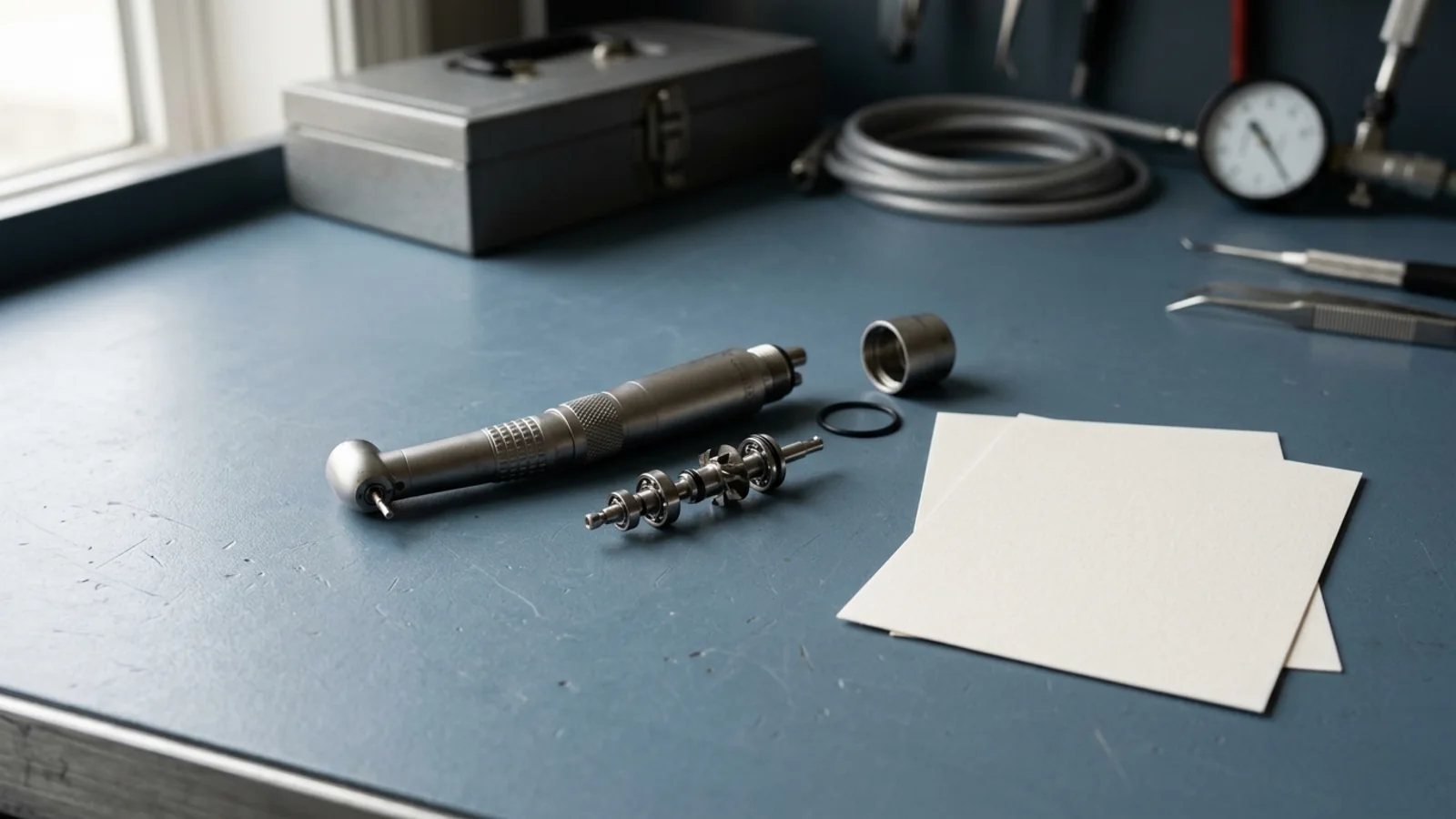
A clinic's high-speed air-turbine handpieces are losing cutting speed and slipping on burs. The estimate in front of the buyer is a flat rate with a warranty sentence. Two published U.S. price structures, both checked on 22 September 2026, show why that sentence is not enough. Avtec Dental lists a $139 standard (manual chuck) overhaul and a $199 push-button or lever overhaul that includes full turbine replacement, each with an advertised six-month warranty and a 48-hour in-office turnaround. Handpiece Express prices bearing replacement and a new turbine separately by model, and states that every rebuild includes ceramic bearings. Neither page is a market index. The decision is the same for either kind of quote: which device, parts, tests, warranty terms, and turnaround must be in writing before the handpiece ships, and which measured results must come back before it returns to patient use?
A price and a warranty length do not show that the chuck still holds a bur, that free-running speed is still within the instructions for use, or that the handpiece can still be heat-sterilized. Bur slip and excessive runout are stop-use conditions. The approvable quote is the one that names the work, the parts, and the measurements the shop will report. FDA's 2024 criteria are the benchmark for that report when the handpiece is inside the guidance's scope. The reported method and the limit both have to be ones the guidance states.
What a Written Dental Handpiece Repair Quote Must Name
Flat-rate menus hide different work under one dollar figure. On the Avtec page checked 22 September 2026, the high-speed overhaul description lists a new complete turbine assembly with ceramic ABEC 9 rated shielded bearings, new O-rings, end-gasket replacement, bearing lubrication, a chuck concentricity test, testing under load, chip-air and water-line cleaning, head and back-cap cleaning, and exterior polishing. The same page prices the manual-chuck overhaul at $139 and the push-button or lever overhaul, which it says includes full turbine replacement, at $199. It also lists a $229 slow-speed overhaul, a $129 sonic-scaler overhaul, straight-nosecone service from $89, and contra-angle sheath or head service at $69. Battery-powered surgical repairs are listed with a three-month warranty; the other listed overhauls advertise six months. Estimates are described as free, with no work without approval.
Handpiece Express, checked the same day, publishes a model table rather than one flat rate. Bearing-replacement prices on that table run from $99.95 to $179, and new-turbine prices from $149 to $259, including a Lares line marked $259 OEM. The page offers an in-house HPX turbine with a six-month warranty or an OEM turbine, says the chuck can sometimes be repaired instead of replacing the turbine, includes ceramic bearings in every rebuild, and advertises same-day turnaround on most repairs. One canister line is marked with a three-month warranty, and the Star 430 lube-free line is marked with a one-year warranty. The page does not publish the acceptance values behind its test step.
HandpieceMD's cost guide, which the page dates as updated July 2026, says industry warranties commonly run about six months and that its own repairs carry nine months on parts and labor. It also says a new premium handpiece costs $800 to $2,000 or more, and that generic imported bearings cost a shop a fraction of precision ceramic ABEC-9 assemblies and fail sooner. Those are the page's claims, not an independent life test. A-dec's authorized repair page says A-dec handpieces are repaired to factory specifications with genuine factory parts, thorough disassembly and cleaning, and free shipping. It publishes no warranty, turnaround, price, or estimate terms, and it directs KaVo handpieces to KaVo Care and W&H handpieces to W&H ProService or the dealer. Henry Schein's handpiece category page promotes its ProRepair service and sells replacement parts, and it publishes no repair prices or test values.
These are single-vendor observations. They are not an average, a ranking, or a stable index, and the pages can change without notice. They do show the gap a buyer has to close. A quote that says only "rebuild handpiece" does not say whether the chuck was kept, which turbine was installed, or which numbers will be on the return paperwork. Before authorization, the written quote should name these seven items.
| Quote element | What the written quote should state | Why the omission matters |
|---|---|---|
| Device identity | Manufacturer, model, serial number, and chuck type (manual or push-button/lever). If the handpiece has a light, say whether it is a transmission element or an internal source. | The returned device cannot be matched to the device that was sent, or a cartridge is quoted for a different head. |
| Reported symptom | The fault the clinic reported — loss of speed, bur slip, noise, vibration, blocked spray, or dim light — and any intake finding the shop will add before it recommends a tier. | The invoice can describe a bearing swap while the chuck, the head shell, or a blocked line was the actual fault. |
| Repair tier | Whether the work is bearing service that keeps the existing chuck, a turbine or cartridge replacement, a chuck repair instead of a turbine, or a broader overhaul. Name the tier in those words. | A push-button price can be read as a full turbine when the shop plans to reuse a worn chuck, or the reverse. |
| Parts origin and grade | OEM, the shop's named in-house turbine, or another named source. If the shop specifies a bearing, quote that description. Avtec's high-speed overhaul states ceramic ABEC 9 shielded bearings; Handpiece Express states ceramic bearings without an ABEC grade on the page. Also name which O-rings, gaskets, and seals are replaced. | "OEM-spec" without a grade, a material, and an origin cannot be compared with another quote. HandpieceMD tells buyers to ask for those specifics. |
| Checks included | The checks this shop will actually perform, not a generic method list. Avtec's published high-speed overhaul names a chuck concentricity test, testing under load, and chip-air and water-line cleaning. Ask which of the FDA benchmark values, if any, will be measured and written down. | "Tested" with no measured value cannot be filed as acceptance evidence. |
| Warranty scope | Duration, whether parts and labor are both covered, which failures are covered, and the exclusions. Observed written examples on 22 September 2026 include three months, about six months, nine months, and one year. None of those lengths is a quality standard. | A six-month slogan can exclude the failure that actually returns, such as a chuck that no longer holds a bur. |
| Turnaround and estimate terms | Bench time, who pays shipping, and whether the estimate is free and binding if the repair is declined. Avtec states 48 hours in office and free estimates with no work without approval. Handpiece Express states same-day turnaround on most repairs. A-dec states none of these. | Downtime and a diagnostic fee are otherwise unknown until the handpiece is already at the bench. |
Use the same itemization when the servicer is new to the facility. A separate article covers how to qualify a medical equipment service provider before a shop is approved for recurring work. Qualification of the company does not replace the device-level quote.
The Acceptance Numbers: What a Cleared Handpiece Must Do
Repair pages rarely publish the numbers behind "tested" or "factory specifications." FDA's 30 September 2024 guidance does. It is written for 510(k) submissions under the Safety and Performance Based Pathway, and it states performance criteria from the FDA-recognized version of ISO 14457:2017, Dentistry — Handpieces and motors. ISO's catalog lists that edition as published in October 2017, stage 90.92 (international standard to be revised), and last confirmed in 2023, with a revision under development. The ISO text is paywalled. Every numeric criterion below is taken from the FDA guidance, not from an unverified clause quotation.
Scope comes first, because several criteria do not apply to every handpiece a dental clinic owns. The guidance covers metal-bodied, prescription-use, end-user-sterilized air-powered handpieces and air motors, with a maximum rotational speed up to 450,000 rpm, for general dentistry such as cutting teeth, cavity preparation, and finishing restorations. It excludes non-metal bodies; handpieces with electrical, battery, internal light source, or software components (product codes EBW, EFA, EKX, and EKY); prophy handpieces; bone-cutting instruments under 21 CFR 872.4120; ultrasonic scalers under 21 CFR 872.4850; single-use handpieces; and handpieces that are not intended to be sterilized by the user. Electric systems and many surgical consoles fall outside this table. For those devices, the acceptance basis is the device's own instructions for use.
FDA's Recognized Consensus Standards database, identification number 42249, recognizes ISO 14457:2017 only in part. It states that Clause 5.8.1 general requirements are not recognized for air motors and high-speed air turbine handpieces, because that clause conflicts with Section 7 of FDA's May 2007 guidance, Dental Handpieces - Premarket Notification [510(k)] Submission. The 250-cycle figure below is stated in the 2024 guidance, separate from the unrecognized clause.
| Performance parameter | What the 30 September 2024 FDA guidance states | What to file from the repair | Limit of the criterion |
|---|---|---|---|
| Free-running speed | The free-running speed of the handpieces and motors should be within ±10% of the speed specified in the instructions for use. | Measured free-running speed, the instructions-for-use speed, and the supply condition used. | Compare the measurement with the speed in the instructions for use for that model. The guidance publishes no single clinical rpm. |
| Chuck extraction force | For a metallic chuck, extraction force at least 32 N for Type 1 through Type 4 test mandrels, and at least 22 N for a Type 5 test mandrel. The guidance points to ISO 13295 for the Type 5 mandrel description. | The mandrel type and the measured extraction force in newtons. | 32 N applies to Type 1 through Type 4. A Type 5 result is compared with 22 N. |
| Chuck torque transmission | While locked, the test mandrel should transmit at least 0.02 N·m (Type 1 through Type 4) or at least 0.016 N·m (Type 5) without slipping or visible destruction. | Whether the shop measured transmission torque, the mandrel type, and the result. | The criterion is transmission of the guidance's mandrel torque without slip. |
| Total dynamic eccentricity | For a Type 4 test mandrel in a high-speed air turbine, without applied load, total dynamic eccentricity should not exceed 0.03 mm. For Type 1, 2, and 4 test mandrels in straight and angle handpieces, without applied load, it should not exceed 0.08 mm. | Mandrel type, handpiece family, and the measured eccentricity in millimeters. | 0.03 mm applies to a high-speed air turbine with a Type 4 mandrel and no applied load. Straight and angle handpieces use 0.08 mm for Type 1, 2, and 4 mandrels. |
| A-weighted sound pressure | The A-weighted sound pressure from the handpiece and motor, or from the high-speed air turbine, should not exceed 80 dB. The guidance says the test applies to each handpiece and motor as a system in actual use. | The measured A-weighted value and a statement that the handpiece was run as the system in which it is used. | The criterion is 80 dB A-weighted for the handpiece and motor as a system in actual use. The guidance states no microphone distance. |
| Coolant water, if the device provides it | A handpiece should provide coolant to the working end at a flow of at least 50 mL/min at 200 kPa (2.0 bar). A motor should provide water to a handpiece at least 50 mL/min at 250 kPa (2.5 bar). | Which device was measured, the stated pressure, and the measured flow. | The water criterion applies when the device provides coolant. The guidance marks the test "if applicable." |
| Spray air, if it is separate from drive air | The handpiece should be capable of at least 1.5 NL/min at 200 kPa (2.0 bar). The motor should provide at least 1.5 NL/min at 250 kPa (2.5 bar). When water and air are used together, a cooling mist should reach the working end of the rotary instrument. | Whether spray air is separate on that model, the measured flow if the shop reports it, and whether a mist is produced. | The 1.5 NL/min handpiece figure applies when spray air is separate from drive air. |
| Output power, if the instructions state one | The instructions should also state the supply air pressure, measured at the inlet, required to produce the stated power. Measured maximum power at that pressure should be at least 90% of the stated value. | The instructions-for-use power, the inlet pressure, and the measured power, when the instructions state a power. | The 90% comparison applies when the instructions state an output power and the inlet pressure that produces it. |
| Stall torque of a high-speed air turbine | For a high-speed air turbine handpiece, torque should be at least 0.0005 N·m. The guidance marks this test "if applicable." | The measured stall torque if the shop reports this test. | 0.0005 N·m is the guidance's stall-torque floor for a high-speed air turbine. The guidance marks the test "if applicable." |
| Light, when the guidance's light criteria apply | Measured illuminance at least 7,000 lx at the manufacturer's recommended settings. If the handpiece has no internal light source but has transmission elements, output should be at least 7,000 lx when the input side is illuminated at no more than 65,000 lx. Handpieces with an internal light source are outside the guidance scope described above. | Whether the device transmits light or has its own source, and the measured lux if the shop is applying this criterion. | Use the lux figures for the light cases the guidance describes. A handpiece with an internal light source is outside the guidance scope. |
| Reprocessing cycles | Handpieces and motors, or parts of them, should withstand 250 reprocessing cycles without deterioration in performance. If the instructions recommend a maximum below 250, that maximum should be used. The guidance also says the performance tests should be evaluated on devices that have been through reprocessing cycles. | The cycle limit stated in the device instructions, and a statement that the repair does not change that limit or the validated reprocessing method. | The criterion is a premarket cycle count. The guidance states no sterilization temperature. A repair record uses the cycle limit in the instructions, including a stated maximum below 250. |
| Drive air and over-pressure | Air-powered handpieces and motors should be operated from a pressurized air supply per the instructions, with flow less than 80 NL/min at 300 ± 100 kPa (3.0 ± 1.0 bar). Applicable devices should not rupture at a pressure 50% above the manufacturer's maximum recommended operating pressure. | Confirm the shop is not "correcting" low speed by telling the user to exceed the instructions-for-use supply pressure. | The supply pressure remains the pressure in the instructions for use. Low speed is not corrected by exceeding that pressure. |
The same guidance also lists premarket checks that a routine repair file will usually not repeat: drop, surfaces, leakage, operating controls, usability, and connector geometry. It says high-speed air-turbine connections for drive air, exhaust, spray air, cooling water, and fiber-optic light, as applicable, should follow the FDA-recognized version of ISO 9168, and the handpiece-to-motor coupling should follow the FDA-recognized version of ISO 3964. Those citations are the guidance's, not a quotation of the ISO clauses. A distorted housing or a substituted connector is a reason to stop and compare the returned device with the cleared configuration, not a cue for a shop-floor dimensional study.
If the returned paperwork has no measured speed, no chuck extraction force, and no eccentricity for an in-scope high-speed air turbine, the facility does not yet have evidence against this benchmark. Ask for the numbers or hold the device. The guidance's test-report form is a premarket artifact. A repair record can be shorter, but it still has to contain the values the quote promised.
flowchart TD
  Intake["Record model, serial, and the reported symptom"] --> QuoteReview{"Quote names tier, parts origin, warranty, turnaround, and which results will be reported?"}
  QuoteReview -->|"No"| Revise["Hold approval and request a revised estimate"]
  QuoteReview -->|"Yes"| Approve["Approve that written scope"]
  Approve --> ReturnDevice["Handpiece returns with measured results and the written warranty"]
  ReturnDevice --> Check{"Serial matches, housing is intact, and reported results cover the criteria that apply?"}
  Check -->|"No"| Hold["Do not release to patient use"]
  Check -->|"Yes"| Reprocess["Reprocess under the device instructions for use"]
Reprocess --> FileRecord["File the estimate, results, and warranty in the equipment history"]Fault-to-Quote Map Across Handpiece Families
The repair tier has to match the family and the symptom. HandpieceMD's guide separates high-speed turbine work (bearings or a complete turbine, O-rings, chuck service, testing under load), low-speed motor work (bearings, vanes, seals, gaskets, attachment gears, and corrosion from oil that was not purged), electric work (tiered from the attachment to a motor rebuild), and surgical or implant work (disassembly, bearings and seals, and what that page calls validation before clinical use). Those are scope descriptions from one vendor guide. They are not pass/fail limits. Where the 2024 guidance does not apply, the instructions for use are the acceptance basis.
| Handpiece family | Symptom to write on the quote | Tier the quote should distinguish | Evidence that applies | When to stop repairing |
|---|---|---|---|---|
| High-speed air turbine inside the guidance scope | Noise, vibration, loss of speed, bur slip, loss of spray, or dim transmitted light. | Bearing service that keeps the chuck, versus turbine or cartridge replacement, versus a broader overhaul. Avtec's page separates a $139 manual-chuck overhaul from a $199 push-button overhaul that includes full turbine replacement. Handpiece Express says some high-speed chucks can be repaired instead of replacing the turbine. | Speed within ±10% of the instructions for use, chuck extraction against 32 N or 22 N for Type 5, eccentricity no more than 0.03 mm without load on a Type 4 mandrel, A-weighted sound pressure no more than 80 dB, and coolant or spray air only if that function exists. | Cracked, dented, or distorted head or neck; a connector that no longer matches the instructions; or a device that cannot meet its validated reprocessing instructions. Housing damage is a service judgment to retire the device, not a number in the FDA guidance. |
| Air motor | Low speed, stalling, or roughness. HandpieceMD specifically flags internal corrosion when oil was not purged. Avtec's slow-speed overhaul text lists bearings, O-rings, an impeller, seals, an end gasket, and spindles or vanes as needed, at a published $229. | Which of those parts are included on this repair, rather than "motor overhaul" alone. | Free-running speed within ±10% of the instructions for use. If the motor supplies water, the guidance's motor criterion is at least 50 mL/min at 250 kPa. If it has a cooling-air system under the guidance's ISO 3964 reference, cooling air is no less than 5 NL/min and no more than 40 NL/min, at a recommended 250 kPa to 500 kPa. | The same housing and reprocessing stops as a high-speed handpiece. Acceptance stays on speed, the motor water criterion when water is provided, and the instructions for use. |
| Straight and angle attachments, product code EGS when they are in scope | Rough drive, a chuck or latch that does not hold, or a leak at the head. Avtec lists straight-nosecone service from $89 and contra-angle sheath or head service at $69 as published examples, not as a price cap. | Bearing, chuck, gear, or sheath service, with the included parts named on the quote. | Total dynamic eccentricity no more than 0.08 mm for Type 1, 2, and 4 mandrels, without applied load, plus the attachment's own instructions for use. | Bent sheath, stripped latch, or gears the shop cannot return to the instructions-for-use configuration. Those are inspection findings, not standard limits. |
| Electric handpiece systems | Noise, loss of drive, or a motor fault that the instructions identify. Keep this family to one decision: attachment, gear train, or motor and electronics. | The tier HandpieceMD describes, from attachment service through a motor rebuild. Avtec says electric repairs are estimated rather than flat-rated. | The device instructions for use. The 2024 air-powered guidance excludes handpieces with electrical components. If the work opens a console or power supply, use the facility's electrical-safety process for powered equipment. | The manufacturer says the model cannot be returned to its instructions, or the device cannot be reprocessed as those instructions require. |
| Surgical and implant handpieces | Loss of drive, seal leakage, or an irrigation path that will not clear. HandpieceMD treats irrigation condition as a cost driver and says this family needs performance validation before clinical use. That phrase is the vendor's, and it does not publish the validation numbers. | Seal and bearing service versus a gearbox or collet repair. Avtec lists implant repairs and battery-powered surgical repairs as estimates; the battery-powered line is the one it marks with a three-month warranty. | The device instructions for use. Bone-cutting instruments under 21 CFR 872.4120, and devices with electrical or battery components, are outside the 2024 air-powered criteria. | Cracked body, a chuck or collet that will not hold, or reprocessing instructions the facility cannot follow. Acceptance stays on the surgical device's own instructions. The 2024 air-powered table supplies no surgical torque percentage. |
A distorted housing is a replacement decision for that handpiece, not a cue to pinch a new cartridge into it. The economics of repair versus replacement for a different device family are covered in MRI coil repair versus replacement. The coil article does not supply dental acceptance numbers. HandpieceMD's statement that a new premium handpiece costs $800 to $2,000 or more is that vendor's price context for the economic comparison, not a surveyed street price.
Sterilization Compatibility Is Part of the Repair
CDC's current dental handpiece page says handpieces include high-speed, low-speed, electric, endodontic, and surgical handpieces and attachments such as prophy angles and nose cones, and that these devices should always be heat-sterilized between patients. It says the internal components of air-driven handpieces, both low-speed and high-speed, can become contaminated with patient material during use, so the next patient may be exposed if the device is not cleaned and heat-sterilized. Surface disinfection, immersion in chemical germicides, high-level disinfection, and wiping with a low-level disinfectant are not acceptable reprocessing methods.
The 2024 FDA guidance's 250-cycle criterion is design evidence for a new air-powered device, with the instructions-for-use exception already noted: a stated maximum below 250 replaces 250. It is not a shop test to repeat on every $139 or $199 ticket, and it does not state a sterilization temperature, a steam pressure, or an elastomer or bearing chemistry. The quote should say that the installed bearings, O-rings, gaskets, and seals are compatible with the handpiece's validated cleaning, lubrication, and sterilization instructions, and that the repair does not change the cycle limit those instructions state.
Which wear parts are replaced, and does the quote tie them to the device's reprocessing instructions rather than to an unnamed "autoclave-rated" material?
What cycle limit do the current instructions state, and is the shop using that limit when it is below 250?
Are the returned instructions still the ones the facility will follow, including lubrication if the instructions require it before sterilization?
Parts Origin and the Servicing Boundary
The price gap is mostly the parts description. A quote should say which of these was installed. The dollars below are the same single-shop observations as the quote section, checked 22 September 2026, not a three-tier market.
| What the quote can say | What a published page actually states | What the facility can conclude |
|---|---|---|
| OEM or genuine factory parts | A-dec says its own handpieces are repaired with genuine factory parts to factory specifications, and it publishes no price. Handpiece Express says it stocks OEM turbines and, on the checked table, marks a Lares turbine at $259 OEM. Other OEM prices on that page are "call." | The record identifies the source. It does not, by itself, prove the returned handpiece met the FDA benchmark or the instructions for use. |
| Named aftermarket or in-house turbine and a stated bearing | Avtec's high-speed overhaul-includes list states a new complete turbine assembly with ceramic ABEC 9 shielded bearings. The priced lines are the $139 manual-chuck overhaul and the $199 push-button or lever overhaul, and the page attaches the phrase includes full turbine replacement to the $199 line. Handpiece Express states an in-house HPX turbine with a six-month warranty and ceramic bearings in every rebuild. HandpieceMD says buyers should require bearing grade, materials, and origin when a shop says "OEM-spec," and it contrasts generic imported bearings with precision ceramic ABEC-9 assemblies as its own cost claim. | The grade is whatever the quote names. Ceramic ABEC 9 is an example shops publish. It is not a minimum grade in the FDA guidance. |
| Unspecified or do-it-yourself parts | Henry Schein's category page promotes ProRepair and replacement parts and publishes no prices, no bearing grade, and no acceptance values. | Without a named origin and the measured speed, extraction, and eccentricity, the facility still lacks the acceptance record in the table above. |
FDA's May 2024 remanufacturing guidance, which is not binding and is not written for dental handpieces specifically, describes servicing as repair and/or preventive or routine maintenance of one or more parts in a finished device, after distribution, to return it to the safety and performance specifications established by the original equipment manufacturer and to its original intended use. The current text of 21 CFR 820.3(a) defines a remanufacturer as any person who processes, conditions, renovates, repackages, restores, or does any other act to a finished device that significantly changes the finished device's performance or safety specifications, or intended use. FDA's guidance says it looks at the activities performed, not at whether the company calls itself a servicer.
That definition does not decide a particular turbine swap. A poorly described cartridge is a documentation problem first. The quote and the completed record should state what was installed and that the work was intended to return the handpiece to the original equipment manufacturer's specifications and intended use. Significant change is a case-by-case assessment. This article does not label a named shop's parts as remanufacturing. The wider parts question is covered in replacement parts, compatibility, and remanufacturing risk.
Acceptance, Records, and Return to Service
The handpiece is not back in service when the box arrives. Release depends on identity, condition, the paperwork the quote promised, and reprocessing. The checks below use the evidence already defined. They do not add a fixture, a run time, or a decibel method.
Identity. The serial number on the returned handpiece matches the device that was sent, the shipping papers, and the approved quote.
Condition. The sheath, head, neck, and connector show no new crack, dent, or distortion from the bench or the shipment. A push-button or lever, if the device has one, returns and latches.
Paperwork. The package includes the itemized description of parts installed, the written warranty with its exclusions, and the measured results the quote said would be reported.
Comparison. Compare those results with the criteria that apply: the 2024 guidance benchmark for an in-scope air-powered handpiece, or the instructions for use when the guidance does not cover the device. If the facility repeats a measurement with equipment it already controls, record the value beside the shop's value. Do not treat an improvised check as the FDA method.
Reprocessing. Clean, lubricate if required, and heat-sterilize under the validated instructions before patient use. CDC's between-patient heat-sterilization expectation still applies after a repair. Patient use waits until that reprocessing is done.
File the approved estimate, the parts description, the measured results, the incoming check, and the warranty with the equipment history. A computerized maintenance system is one place to keep that file. It is not itself the regulatory requirement. What belongs in a service record more generally is set out in medical equipment service record requirements, and how hospitals decide that a repair is major enough to trigger return-to-service testing is set out in major repair return-to-service testing. A handpiece turbine overhaul can be the event those articles call a major repair for a hospital. The dental acceptance numbers in this article are still the ones in the table above, not the imaging or infusion examples in those articles.
For an electric micromotor, a surgical console, or a scaler with a power supply, chassis or mains work is outside the air-powered guidance. Use electrical safety testing after repair for the IEC 62353 and NFPA 99 questions that apply to powered equipment. That article does not set dental chuck or speed limits.
Summary Checklist: Approving a Handpiece Repair Quote
Hold the authorization until the quote, and then the returned record, can answer each of these.
Identity and symptom. Manufacturer, model, serial number, chuck type, and the fault being repaired.
Tier. Bearing service, chuck repair, turbine or cartridge replacement, or a broader overhaul, in those words.
Parts. Origin, and the bearing description if the shop makes one. Ceramic ABEC 9 shielded bearings are a published example, not a universal minimum. O-rings, gaskets, and seals that will be replaced are named.
Measured results. For an in-scope high-speed air turbine, the return states speed against the instructions for use (±10%), chuck extraction against 32 N or 22 N for Type 5, and eccentricity against 0.03 mm. Other rows in the acceptance table are included when that function exists.
Reprocessing. The quote says the installed parts follow the device's validated instructions. The 250-cycle figure is used as the 2024 guidance states it, including a lower maximum when the instructions state one. No sterilization temperature is added.
Warranty and time. Duration, parts and labor, exclusions, bench turnaround, and whether the estimate is free and binding. A six-month term is a common published example, not a minimum.
Release. Serial and housing check are done, the results are filed in the equipment history, and the handpiece is heat-sterilized under its instructions before patient use. Hospital programs cite 42 CFR 482.41(d)(2) and the S&C 14-07 inspect-and-test instruction. Standalone practices do not inherit that hospital citation.
The file then shows what was promised, what was measured, and which limit was used. It does not certify every future cycle, and it does not turn a vendor warranty into a regulatory clearance.