
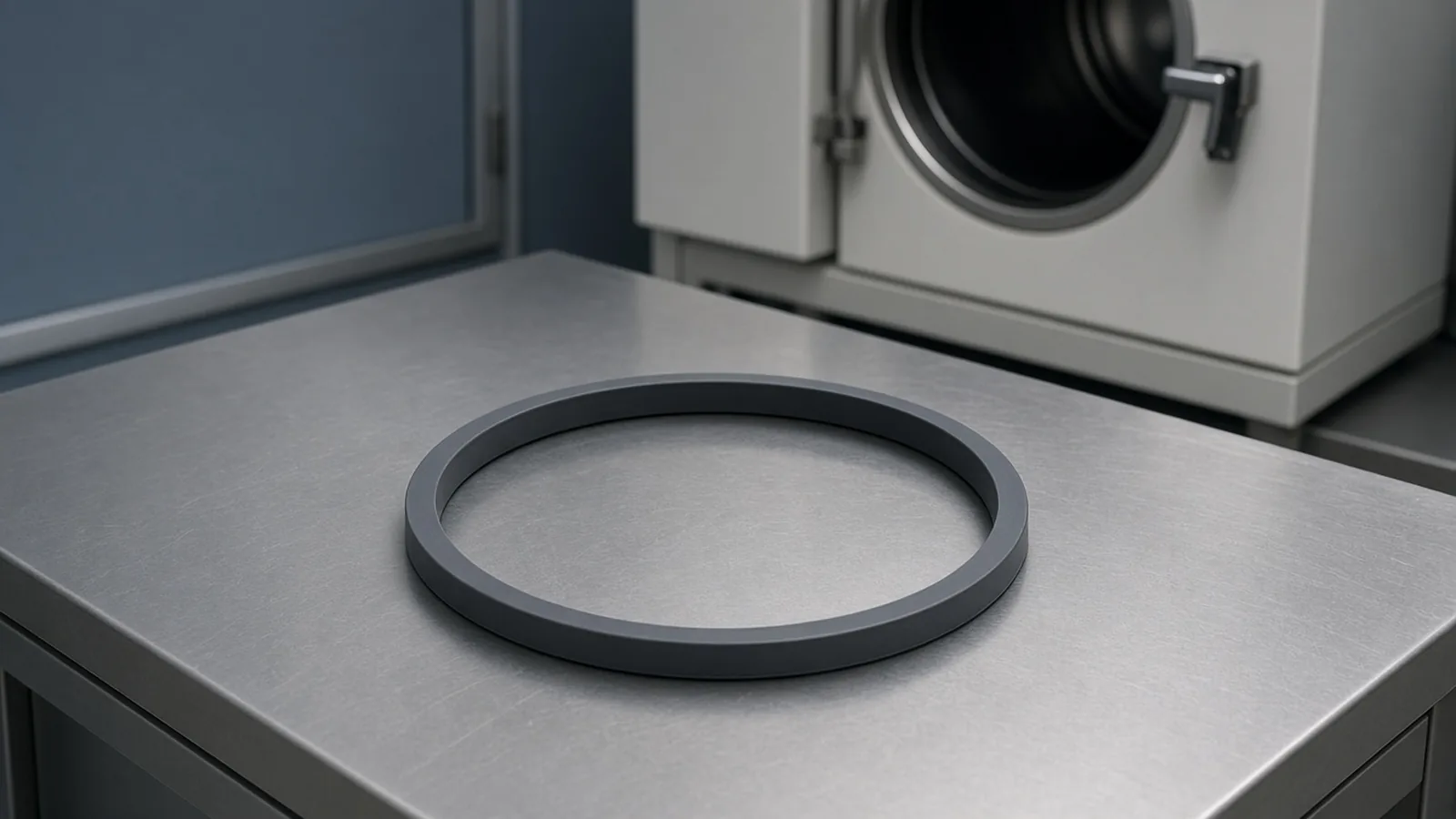
The Short Answer: Confirm the Gasket Before You Buy It
A whistling door, a low-pressure abort, or a wet pack is a reason to identify the door gasket, not a reason to buy the first seal that looks close. Under 21 CFR 880.6880, a steam sterilizer is a Class II device intended for a health care provider to sterilize medical products with pressurized steam. The door gasket is the elastomer that closes that chamber. Dealer and marketplace pages already sell these seals by model nickname or outer diameter, and those listings do not agree on numbering. The confirmation sequence is the manufacturer's parts document for the nameplate in front of you, that model's orientation and lubricant rule, and only the verification tests that design and the repair class actually require.
Three gates decide whether the replacement is the correct one:
Match the nameplate to the parts document. Record the manufacturer, model, and full serial number, including any suffix the parts library uses. Midmark's -040 through -042 door-gasket page lists door gasket 053-0366-00 for the M9/M9D and 053-0527-00 for the M11, and it tells the reader to specify model and serial number. Those numbers are for that serial range. A Tuttnauer or Melag seller code is not a substitute for that brand's own list.
Read the orientation and lubricant rule in that model's manual. The Tuttnauer M/MK manual and the EZ9, EZ10, and EZ10K manual (MAN205-0263001EN Rev K) both warn that the gasket is trapezoidal and that the widest side goes toward the door. The EZPlus operator manual is a different rule: it calls for a silicone lubricant on replacement and treats missing, excess, or uneven lubricant as a cause of a high-pitched whistle. Melag's Vacuklav 31 B+ manual seats article 58510 with the wider sealing surface toward the chamber and says the door seal must not be greased or oiled. A combined Vacuklav 23 B+ and 31 B+ user manual, from software version 5.17, lists door seal 58512 in its spare-parts table and does not repeat 58510. Those article numbers are edition-specific.
Prove the seal with the tests that apply to this sterilizer. On a STERIS Amsco Century, the vacuum leak test calculates mmHg per minute over a timed 10-minute period, and 1 mmHg per minute or less is acceptable. The same manual says the leak test is not a substitute for the DART, or Bowie-Dick, air-removal test. Melag's vacuum test uses a five-minute equilibration and a ten-minute measurement and flags a leakage rate above 1.3 mbar. CDC's three consecutive empty cycles with biological and chemical indicators are the qualification after installation, relocation, redesign, major repair, or a sterilization failure, with Bowie-Dick cycles added on a prevacuum sterilizer. A gasket change is not automatically all three tests on every tabletop.
FDA's May 2024 remanufacturing guidance treats replacement of a worn part with a component of the same specifications as servicing that returns the device to the original manufacturer's safety and performance specifications. It is guidance, not a statute. For the general parts boundary and for steam-sterilizer monitoring that this article does not re-derive, see replacement parts, compatibility, and remanufacturing risk and steam sterilizer performance testing.
Symptoms That Point at the Door Gasket, and the Ones That Don't
The gasket is one seal in a pressure and vacuum system. Steam at a closed door is the finding that most directly implicates it. A failed air-removal test or a wet pack can involve the gasket and often does not. Replacing the seal before that split is made is how a department buys a second gasket for a vacuum-pump or loading problem.
Midmark's M9/M9D/M11 operator guide pairs door-gasket leaks with a damaged or dirty gasket and the action to clean or replace it. The same guide directs a daily look at the door and dam gaskets and a monthly removal and cleaning of the door gasket, dam gasket, and gasket ring, with inspection for damage, shrinking, or swelling and replacement if damage is apparent. On Tuttnauer EZ9, EZ10, and EZ10K units, the Rev K manual pairs a Low Water or Low Pres message with a door that is fully closed, a gasket that is seated, and no steam leakage, and it says to replace the gasket if necessary. The manual-series M/MK manual, when the unit does not reach operating pressure because the door gasket is leaking steam, says to tighten the door and replace the gasket if leaking persists. Tightening is not evidence that the installed gasket is the specified one. On the EZPlus family, a high-pitched whistle is tied to a door that was not closed firmly, a dirty gasket, a gasket that needs replacement, or lubricant that was omitted or applied in excess. The same manual says the gasket must sit evenly, without waves, humps, or cavities, or it will not seal.
Tuttnauer's troubleshooting guide names vacuum-pump degradation as the most common Bowie-Dick failure cause, lists a door-seal air leak next, and names non-condensable gas above 3.5 percent by volume as another cause. It does not put a door bellows in that list. The manual-series M/MK manual treats a leaking door bellows as a separate fault for a technician. Repeat a failed Bowie-Dick test once with a fresh pack and inspect the gasket. If the second test also fails, stop loads and call service. A second test that passes is not, by itself, a reason to resume routine loads if the first failure is still unexplained.
Melag's vacuum-test failures point at the door seal and the chamber flange together. The 31 B+ manual says a leakage rate above 1.3 mbar can follow a contaminated door seal or chamber flange, a damaged seal, or a seal inserted the wrong way. It does not name a drain solenoid as the cause of that message. Clean and inspect the seal and the flange, then repeat the vacuum test on a completely cold, dry autoclave.
Wet packs need the same restraint. A 2024 single-center paper in Medical Science Monitor cites earlier literature for a split of about 60 percent steam quality, 30 percent equipment performance, and 10 percent loading defects. In that literature discussion, an incomplete chamber door gasket is one equipment example, along with a failed pressure sensor and a clogged drain filter. The paper's own observations associate wet packs with packaging, loading, shelf placement, pack contents, and cooling time. It does not measure what fraction of wet packs a door gasket causes. Tuttnauer's tabletop wet-pack note lists a damaged door gasket among equipment causes, beside trap, drain, strainer, gauge, and vacuum problems. CDC guidance treats a sterilized item that becomes wet as contaminated because moisture can carry microorganisms, so the pack is reprocessed either way. The gasket is on the list. It is not the default verdict.
| What you see | When the gasket is a leading suspect | What else the sources name | What to establish first |
|---|---|---|---|
| Steam or water at a firmly closed door | Midmark pairs this with a damaged or dirty gasket. Tuttnauer pairs a persistent leak with tightening the door and then replacing the gasket. | Door not fully closed; on manual-series Tuttnauer units, a leaking door bellows is a separate technician fault. | Identify the model and serial, then compare the symptom with that manual's troubleshooting row. Do not order by diameter. |
| High-pitched whistle on pressurization | EZPlus operator manual: gasket due for replacement, or silicone lubricant missing, excessive, or paired with uneven seating. | Door not closed firmly; dirty gasket or chamber rim. This is not a Melag lubricant clue. Melag forbids grease and oil. | Use that whistle row only on the EZPlus family. On Melag, look for soil, damage, or reversed seating. |
| Low-pressure or low-water abort | On EZ9, EZ10, and EZ10K, Rev K pairs Low Water and Low Pres with an open door, an unseated gasket, or steam leakage. The M/MK manual pairs a failure to reach operating pressure with a leaking door gasket. | The alarm does not by itself identify the gasket. Rev K names a dirty water-level electrode before the gasket step, and machine leveling as another check. A clogged air jet is a different row in that manual, including High Pres. | Follow that model's troubleshooting order. Gasket replacement is one later step, after the door and seating checks, not the first step on every alarm. |
| Bowie-Dick or DART failure | Tuttnauer lists vacuum-pump degradation as the most common cause, then a door-seal air leak. | Non-condensable gas above 3.5 percent by volume is also named. STERIS says a vacuum leak test is not a substitute for the DART test. A door bellows leak is a separate M/MK fault, not a cause in that Bowie-Dick list. | Repeat once with a fresh pack and inspect the gasket. If it fails again, stop loads and call service. A passing repeat does not explain the first failure. |
| Wet packs | Cited equipment literature includes an incomplete door gasket that blocks steam evacuation. Tuttnauer lists a damaged door seal among tabletop causes. | The same literature split gives steam quality the larger share. Packaging, loading, shelf position, and cooling dominate many investigations. | Treat the wet pack as contaminated. Investigate load and steam path with the gasket, not instead of a part-number check if the door is also leaking. |
Why One Size Fits Most Fails: Model- and Serial-Scoped Parts
A listing titled as a 9-inch or 11-inch silicone seal answers a shopping query. It does not answer which groove, dam gasket, and ring the chamber was built with. The authoritative string is the nameplate: manufacturer, model, voltage if the parts list uses it, and the full serial number with its suffix. Match that string to the manufacturer's parts page before a purchase order is cut. Seller catalogs are evidence that the market is fragmented, not a specification.
Midmark's -040 through -042 door-gasket page makes the trap concrete for that serial range. M9/M9D door gasket 053-0366-00, dam gasket 053-0903-00, ring 057-0790-01, and gasket kit 002-0361-01. M11 door gasket 053-0527-00, dam gasket 002-0508-00, ring 057-0790-00, and gasket kit 002-0504-00. Door-spring part 050-2347-00 is listed once, with quantity two on the M11 and quantity one on the M9. That quantity difference is between the two models on this page. The same page lists door-gasket housings 002-10449-00 for the M9/M9D and 002-10449-01 for the M11, insulation pads 002-10450-00 and 002-10450-01, and maintenance kits 002-10069-00 and 002-10070-00. Those maintenance kits include more than the gasket. Ordering a maintenance kit because it is "the M9 kit" does not identify the door gasket.
The page title limits those numbers to M9/M9D and M11 serial ranges -040 through -042, and the footer says to specify model and serial number. A nameplate with a different suffix is outside this list. Do not copy 053-0366-00 or 053-0527-00 onto a suffix this page does not cover.
Tuttnauer's catalog problem is the opposite of a single published table. Dealer pages list distinct gaskets for families such as the 1730, 2340/EZ9, 2540/EZ10, 3870, 3140/3545, Elara, T-Edge, EZ9Plus, and EZ11Plus. The same visual family shows up under different seller codes, and a marketplace listing may use yet another SKU. None of those codes should be copied into a work order as the OEM number unless it appears in Tuttnauer's own parts list for that nameplate. This article does not endorse a dealer code.
Melag prints the article number inside the manual for that edition, and the editions do not share one number. The Vacuklav 31 B+ user manual tells the reader to install door seal article 58510. The combined Vacuklav 23 B+ and 31 B+ user manual, from software version 5.17, lists door seal 58512 once in the spare-parts table and does not print 58510 in the replacement section. Those two article numbers are not interchangeable. Use the spare-parts list in the manual that belongs to the device, and use an original MELAG part where that manual requires it.
| Nameplate family | What the parts pages actually separate | Numbers checked for this article | Rule that has to travel with the part |
|---|---|---|---|
| Midmark M9/M9D, -040 through -042 | Door gasket, dam gasket, ring, and gasket kit are separate lines. One door spring. Housing and insulation pad are also listed. | Door gasket 053-0366-00; dam 053-0903-00; ring 057-0790-01; kit 002-0361-01. Housing 002-10449-00. Insulation pad 002-10450-00. Maintenance kit 002-10069-00. | These numbers are only for -040 through -042. Do not use the M11 gasket. |
| Midmark M11, -040 through -042 | Same page, different gasket. Two door springs, same spring part number as the M9. | Door gasket 053-0527-00; dam 002-0508-00; ring 057-0790-00; kit 002-0504-00. Housing 002-10449-01. Insulation pad 002-10450-01. Maintenance kit 002-10070-00. | The dam gasket and ring are part of the door system. Replacing only the elastomer leaves a damaged ring in place. |
| Midmark suffix outside -040 through -042 | The -040 through -042 library page does not publish a gasket number for that suffix. | No part number from the -040 page is transferred to a different suffix. | Open the current Midmark page for the nameplate suffix and specify model and serial number before ordering. |
| Tuttnauer manual series and EZ9, EZ10, EZ10K | Each family has its own molded profile. Seller codes conflict and are not a specification. | No dealer SKU is repeated here as an OEM number. Confirm the number in Tuttnauer's parts list for the nameplate. | Trapezoidal section, widest side toward the door, in both the M/MK manual and MAN205-0263001EN Rev K. Manual-series replacement is scheduled at 12 months or as needed. |
| Tuttnauer EZPlus | Separate from the manual-series lubricant practice. | Use the EZPlus parts list for EZ9Plus or EZ11Plus. Do not transfer a 2340M number. | Replace only while the autoclave and door are cold. Silicone lubricant is required; wipe off the excess. |
| MELAG Vacuklav 23 B+ and 31 B+ | Article number depends on the manual edition. Orientation does not flip to the Tuttnauer rule. | 31 B+ manual: article 58510. Combined 23 B+ and 31 B+ spare-parts table, software version 5.17: door seal 58512. | Wider sealing face toward the chamber. Do not grease or oil. Vacuum-test failure is above 1.3 mbar. |
Specification Checks Before Ordering: Profile, Orientation, Material, Lubricant
Profile. These are not interchangeable round cords. Tuttnauer's M/MK operator manual and the EZ9, EZ10, and EZ10K manual MAN205-0263001EN Rev K both warn that the gasket has a trapezoidal cross section and must be placed with the widest side toward the door. The EZPlus manual shows a seating direction and requires an even gasket, but it does not use that trapezoid sentence. Melag's sealing faces are different widths. The 31 B+ manual says to set article 58510 so the wider sealing surface shows toward the chamber, and that only correct seating lets the door close and keeps the chamber tight. The combined 23 B+ and 31 B+ manual says the broad seal face faces the chamber. Reversed seating is a leak and a vacuum-test failure, not a cosmetic error. This article does not turn those warnings into a seating procedure. The person who installs the seal follows the current manual for that model, on a cold chamber.
Lubricant. There is no shared lubricant rule. The EZPlus operator manual says to replace the door gasket using a silicone-based lubricant, and it names Würth Silicone Lubricant and Dow Corning 111 as examples. It says to clean off excess lubricant and reinstall with the proper amount if the gasket was over-lubricated, and it says a gasket that does not sit evenly, without waves, humps, or cavities, will not seal. Melag's 31 B+ manual says the door seal must not be greased or oiled and should be kept clean and dry. Cleaning that seal uses a neutral liquid cleaning agent and a soft lint-free cloth, with the autoclave switched off and the chamber not hot. Silicone grease, vacuum grease, or oil on that seal is contrary to the manual. Copying the EZPlus lubricant step onto a Melag, or the Melag dry-seal rule onto an EZPlus, is a specification error.
Dam gasket and ring. On the Midmark M9 and M11 -040 through -042 page, the door gasket is not the whole door joint. The page lists a separate dam gasket and a gasket ring, and the operator guide includes both gaskets in the daily look and the monthly removal and inspection. A new door gasket installed over a damaged ring, or installed while the dam gasket is torn, does not restore the assembly that parts page describes. Match the dam gasket and ring to the same serial-range page as the door gasket.
Compound. The manuals specify the part, not a generic durometer or a maximum temperature this article can assign to every autoclave. An aftermarket seal sold as "silicone, about the right diameter" does not document the profile, the orientation, or the compound the manufacturer validated. If the part's dimensions or performance differ from the original specification, FDA's remanufacturing guidance says that difference needs a closer evaluation. It does not need a guessed hardness number.
Interval. Tuttnauer's manual-series schedule replaces the door gasket every 12 months or as needed, and it excludes door gaskets from the parts-and-labor warranty as wear items. The EZ9, EZ10, and EZ10K manual uses the same 12-month replacement interval. The EZPlus schedule is a 12-month check for cracks or damage, with replacement if there is a tear or leakage, and that warranty likewise excludes the gasket and the HEPA filter as wear items. The 31 B+ manual says to exchange a seal that has shrunk or gone wavy, because leaks let steam out or raise the vacuum-test leakage rate, and it sets maintenance after 1000 program cycles or two years, carried out by trained technicians. Commentary that recommends replacement twice a year above roughly 600 cycles is field advice, not a Tuttnauer, Midmark, or Melag interval. Use the inspection rule in the manual for the nameplate.
Aftermarket, OEM, and the Servicing Boundary
In May 2024 FDA issued final guidance, Remanufacturing of Medical Devices. It describes servicing as repair and preventive or routine maintenance of parts in a finished device, to return it to the safety and performance specifications established by the original manufacturer and to its original intended use. The guidance says activities described as reconditioning, refurbishing, or rebuilding include replacement of worn parts, and that replacing a component with one of the same specifications is likely not remanufacturing. A door gasket that matches the original dimensional and performance specification fits that example. The guidance also says to compare component dimensions and performance with the legally marketed device. A deviation calls for closer evaluation, such as engineering analysis, verification or validation testing, or a risk-based assessment. The documentation elements include the product name with model and serial number where applicable, and a description of the activities including the parts involved.
That guidance is FDA's current thinking. It says it does not create legally enforceable responsibilities. It is not a sterilizer-specific rule, and it is not a grant of authority to ignore a manufacturer's parts restriction. The combined Vacuklav 23 B+ and 31 B+ user manual says only original MELAG spare parts may be used. It reserves maintenance for authorized technicians: employees of a customer-service provider or stockist whom MELAG has trained and authorized for maintenance and installation. The 31 B+ manual says to have maintenance carried out only by trained field-service technicians or technicians of the specialist trade. STERIS Century operator manuals warn that repairs and adjustments are to be made only by fully qualified service personnel, and that maintenance by inexperienced or unqualified persons, or installation of unauthorized parts, could cause personal injury or costly equipment damage. A hospital or clinic can still record a same-specification part as servicing when the guidance's criteria are met. It cannot record an unknown-profile marketplace seal as "the same specification" without the evaluation the guidance describes.
The servicing-versus-remanufacturing decision tree itself is already covered in medical device servicing versus remanufacturing. Use that article for the guiding principles. Use this one for the gasket facts that change the inputs: the part number, the profile, the lubricant rule, and whether the post-replacement tests still meet the original performance specification.
What the Door Gasket Job Is Not: Safety Boundaries
Cold chamber. Tuttnauer's EZPlus manual says to replace the gasket while the autoclave and the door are cold, to avoid injuries. Melag's 31 B+ cleaning warning says to switch the autoclave off, disconnect power, and make sure the chamber is not hot, and its failed vacuum test is repeated on a completely cold device. The combined 23 B+ and 31 B+ manual likewise runs the vacuum test on a cold, dry sterilizer. Those are the documented boundaries. They are not a measured cool-down time, and they are not a surface-temperature limit this article can invent.
Powered door seals. A tabletop cam door is not a STERIS Century door. The Century vacuum-leak-test description checks the sealed pressure vessel, associated piping, and door seal, and the cycle description retracts that seal with steam exhausted from it. The operator manual assigns repairs and adjustments to fully qualified service personnel. Getinge's 500-series is the same class of boundary: a powered clinical sterilizer, not a user-level gasket swap. Do not carry a tabletop seating rule onto a sliding, interlocked, or actively pressurized door. Energy isolation for that machine is the qualified service procedure for that model.
What a failed seal has already done. FDA MAUDE report 8774950 is a 2019 manufacturer report on a Getinge 500-series steam sterilizer, model 533HC-E, product code FLE. The problem code is Leak/Splash and the remedial action is Replace. The narrative says steam leaked through the door seal into the room, no injury was reported, and the leak size was not known. A corrected submission states the model as 533HC-E after an earlier line had said 522HC-E. The manufacturer's follow-up attributed steam blowing from the door to a damaged door gasket and noted that, in the preventive-maintenance history it reviewed, the door gasket had not been replaced in the prior six months. The clinical code records no consequences or impact to a patient. MAUDE is a set of individual reports. This entry does not say how often door-seal leaks occur, and it does not say that every whistle will flood a room.
Proving the Seal: Leak Tests, Bowie-Dick, and Indicator Runs
A door that closes is not a passed seal. The tests differ by design, and the numbers below are not interchangeable. Run the test the manual names, record the number the control prints or displays, and compare it with that manual's limit. Then decide whether CDC's major-repair qualification also applies. The monitoring scheme for steam sterilizers in general is in the performance-testing article linked above; the points here are the ones that change after a gasket decision.
Vacuum leak test, where the sterilizer has one. The STERIS Amsco Century operator manual describes an automatic vacuum leak test of the sealed pressure vessel and associated piping, including the door seal. It can also confirm that piping is intact after repairs. The control calculates the leak rate in mmHg per minute over a timed 10-minute period. A leak rate of 1 mmHg per minute or less is acceptable. A measured rate greater than 1 mmHg per minute indicates a problem; the manual's parenthetical conversion is 1.3 mbar per minute, and it attributes the limit to AAMI standards. If the sterilizer fails, it must be inspected by a qualified service technician before further use. The manual says this test is not a substitute for the DART Bowie-Dick test. Melag's test is a different procedure and a different reported unit. On the 31 B+, evacuation is followed by five minutes of equilibration and ten minutes of measurement. A leakage rate above 1.3 mbar is too high. The official Melag vacuum-test note says the same 1.3 mbar threshold and tells the user to document the displayed result. Do not write "passed STERIS" on a Melag printout, or the reverse.
Bowie-Dick or DART, on dynamic-air-removal sterilizers. The CDC sterilizing-practices page does not turn every gasket discussion into a daily Bowie-Dick test. It does require three consecutive empty Bowie-Dick cycles on a prevacuum sterilizer after installation, relocation, redesign, major repair, or a sterilization failure. The Century operator manual separately says to run a DART cycle daily before processing loads, and it says the leak test does not replace that DART test, because one checks whether air is admitted during vacuum and the other checks air removal and steam penetration. Tuttnauer describes a non-uniform or incomplete color change on the Type 2 indicator as the failed air-removal result. Gravity tabletop cycles that the manufacturer does not assign an air-removal test do not gain a Bowie-Dick requirement from a Century manual. Where the test is required, Tuttnauer's failure list still applies: vacuum-pump degradation first, a door-seal air leak next, and non-condensable gas also named.
Biological and chemical indicators when the trigger is met. CDC's sterilizing-practices guideline says steam sterilizers are tested with biological and chemical indicators on installation, after relocation, after redesign, after major repair, and after a sterilization failure, before routine use. Three consecutive empty steam cycles are run with a biological and chemical indicator in an appropriate test pack or tray. Each steam cycle type used, such as vacuum-assisted and gravity, is tested separately. On a prevacuum sterilizer, three consecutive empty cycles are also run with a Bowie-Dick test. The sterilizer is not put back into use until all biological indicators are negative and the chemical indicators show a correct endpoint. The steam biological indicator organism in that guideline is Geobacillus stearothermophilus. A door-gasket replacement is this qualification when the facility, the IFU, or the scope of the work classifies it as a major repair, and whenever it follows a sterilization failure. It is not, in the CDC text, an automatic three-cycle qualification for every user-level gasket inspection. Healthcare Purchasing News summarizes ANSI/AAMI ST79:2017/(R)2020 section 12.4 as daily inspection and cleaning per the manufacturer IFU, including the door gasket and mating surfaces. The same article separately describes biological indicators after maintenance, with return to service only after those indicators are negative. ST79's full text is paywalled. That section summary is not the source of the Century 1 mmHg-per-minute number.
| Evidence | Where it applies | Pass criterion in the cited source | What it does not prove |
|---|---|---|---|
| Vacuum leak test | STERIS Century prevacuum vessels after repair, and Melag vacuum tests on the 23 B+ / 31 B+ family. Not a feature to invent for a gravity cycle that has no leak-test program. | Century: 1 mmHg per minute or less, calculated over 10 minutes. Greater than 1 mmHg per minute fails and goes to qualified service. Melag: leakage rate above 1.3 mbar fails. | A Century pass is not a DART pass. A Melag 1.3 mbar result is not a Century mmHg-per-minute result. Neither number is a universal gasket limit. |
| Bowie-Dick or DART | Dynamic-air-removal sterilizers. Century calls for a daily DART before loads. CDC adds three empty Bowie-Dick cycles on a prevacuum sterilizer after installation, relocation, redesign, major repair, or a sterilization failure. | A non-uniform or incomplete color change is the failure Tuttnauer describes. A second consecutive failure: stop loads and call service. | Not a leak-rate measurement, and not required on every gravity tabletop merely because a gasket was discussed. |
| Biological and chemical indicators | CDC triggers: installation, relocation, redesign, major repair, sterilization failure. HPN's ST79 summary also expects biologicals after maintenance before return. | Three consecutive empty cycles; negative biological indicators and a correct chemical endpoint. Prevacuum repairs also get Bowie-Dick cycles. Test each cycle type separately. | Not an automatic three-cycle qualification for a routine gasket inspection the facility has not classified as a major repair. If spore tests remain positive, CDC says to discontinue use until the sterilizer is serviced. |
| Cycle time, temperature, and pressure | Every steam cycle that is released, as CDC's mechanical monitors: time and temperature from the record, and pressure from the gauge. | The printout matches the cycle the department intended to run, under that sterilizer's own recipe. No extra numeric tolerance is added here. | A normal printout does not replace a required leak test, Bowie-Dick test, or biological indicator. |
When the gasket work is part of a larger repair, the question of whether the job is "major" is the subject of return-to-service testing after a major repair. Apply that decision to the work order, then run the rows above that the decision selects. Do not collapse them into one checklist for every autoclave.
flowchart TD
    A["Door whistle, steam at the door, low pressure, or a wet pack"] --> B["Is steam or water at the closed door?"]
    B -->|No| C["Check pump, bellows, flange, drain, and load before buying a gasket"]
    B -->|Yes| D["Read model and full serial number on the nameplate"]
    D --> E["Open the manufacturer parts document for that serial range"]
    E --> F["Confirm profile, orientation, and lubricant in that model manual"]
    F --> G{"Which door is this?"}
    G -->|"Powered or interlocked seal"| H["Stop and use qualified service"]
    G -->|"Cold tabletop door within the IFU"| I["Use the matched part and that IFU only"]
    I --> J["Leak test only if this sterilizer has one, using its own limit"]
    J --> K["Bowie-Dick only on a dynamic-air-removal sterilizer"]
    K --> L["Biological indicators if this is a major repair, a failure, or facility policy"]
    L --> M{"Did the required tests pass?"}
    M -->|Yes| N["Record model, serial, part, and results, then release"]
M -->|No| HEscalate, Don't Iterate: When the New Gasket Doesn't Fix It
After a nameplate-matched gasket is in place and the required test still fails, another gasket is the wrong next purchase. The sources name a stop point.
Failed leak test. The Century manual says a failed vacuum leak test is inspected by a qualified service technician before the sterilizer is used again. The test covers the vessel and piping, not only the new gasket. Melag's failed vacuum test sends the user back to soil, damage, and seating, then a repeat on a cold chamber. If that repeat is still above 1.3 mbar, the manual's maintenance path is trained service, not a third seal from a different seller.
Second Bowie-Dick failure. Tuttnauer says to repeat a failed test with a fresh pack and to call service rather than keep running loads if the second test fails. Vacuum-pump degradation remains the most common cause in that guide even after a new gasket is installed.
Soiled or damaged mating face. Melag names a contaminated chamber flange in the same row as a contaminated or wrongly inserted door seal. Cleaning is the manual's step. A scored flange that still fails after cleaning is a qualified-service problem. This article does not specify a resurfacing method or a vessel replacement.
Spore tests that remain positive. CDC says that if spore tests remain positive, use of the sterilizer should be discontinued until it is serviced. A single positive has a separate follow-up when mechanical and chemical indicators suggest the cycle was adequate. That follow-up is an infection-control decision. It is not another gasket order.
Daily care is the prevention step the standards summaries support. Healthcare Purchasing News summarizes ST79 section 12.4 as daily inspection and cleaning per the manufacturer IFU, including the door gasket and the mating surface. Midmark, Tuttnauer, and Melag each describe a daily look and a wipe with the cleaner that manual allows. That is the routine. A 600-cycle replacement slogan is not.
The Work-Order Record That Survives a Survey
The replacement is ready to defend when the record shows which device, which part, which rule, and which result. For a Medicare-certified hospital, 42 CFR 482.41(d)(2) requires that facilities, supplies, and equipment be maintained to ensure an acceptable level of safety and quality. The regulation text is that sentence. The inventory fields and the expectation of maintenance schedules and ongoing inspections are in CMS interpretive guidance at Tag A-0724, revised by QSO-25-24. That guidance applies to surveyed hospitals. It is not a dental-office rule, and it does not by itself make a completed gasket form a finding of compliance. Alternate equipment-management choices, when a hospital is not following the manufacturer's maintenance frequency, are a separate decision covered in AEM versus manufacturer maintenance.
FDA's remanufacturing guidance asks for the product name with model and serial number and a description of the parts involved when a servicing-versus-remanufacturing call is documented. The work-order fields that satisfy both the hospital record and that guidance are:
Device identity. Manufacturer, model, full serial number and suffix, asset tag, and location. On a Midmark M9 or M11, the serial suffix selects the library page. The door-gasket numbers in this article are the -040 through -042 page only.
Part identity. Description, the part or article number from the manufacturer's document, the supplier, and the lot or invoice if the supplier provides one. State whether the part was accepted as the same specification. If it was not, attach the evaluation instead of a servicing label. Do not enter a dealer SKU as if it were the OEM number.
The rule that was followed. Cold-door condition, the orientation the manual required, and the lubricant outcome: silicone lubricant applied and excess removed for an EZPlus, or no grease and no oil for a Melag. Name the manual revision.
The results that were required. The printed Century leak rate next to 1 mmHg per minute, or the displayed Melag leakage rate next to 1.3 mbar, if that test exists on the unit. The Bowie-Dick result if the sterilizer is dynamic-air-removal. Biological indicator lot, incubation result, and cycle type if the CDC trigger or facility policy required them. Omit a test the design does not have, and say why, rather than writing a pass that was not run.
Who released it. Name of the person, the basis for their authorization on that model, and the date and time the sterilizer was returned to use. Attach the cycle printout or the displayed leak-rate record. A checkbox without the number is weaker than the record the Century and Melag tests already produce.
What the service record has to contain across equipment types is set out in medical equipment service record requirements. A complete gasket record supports a surveyor and supports the next technician. It does not certify the department, the sterilizer, or the part supplier.