
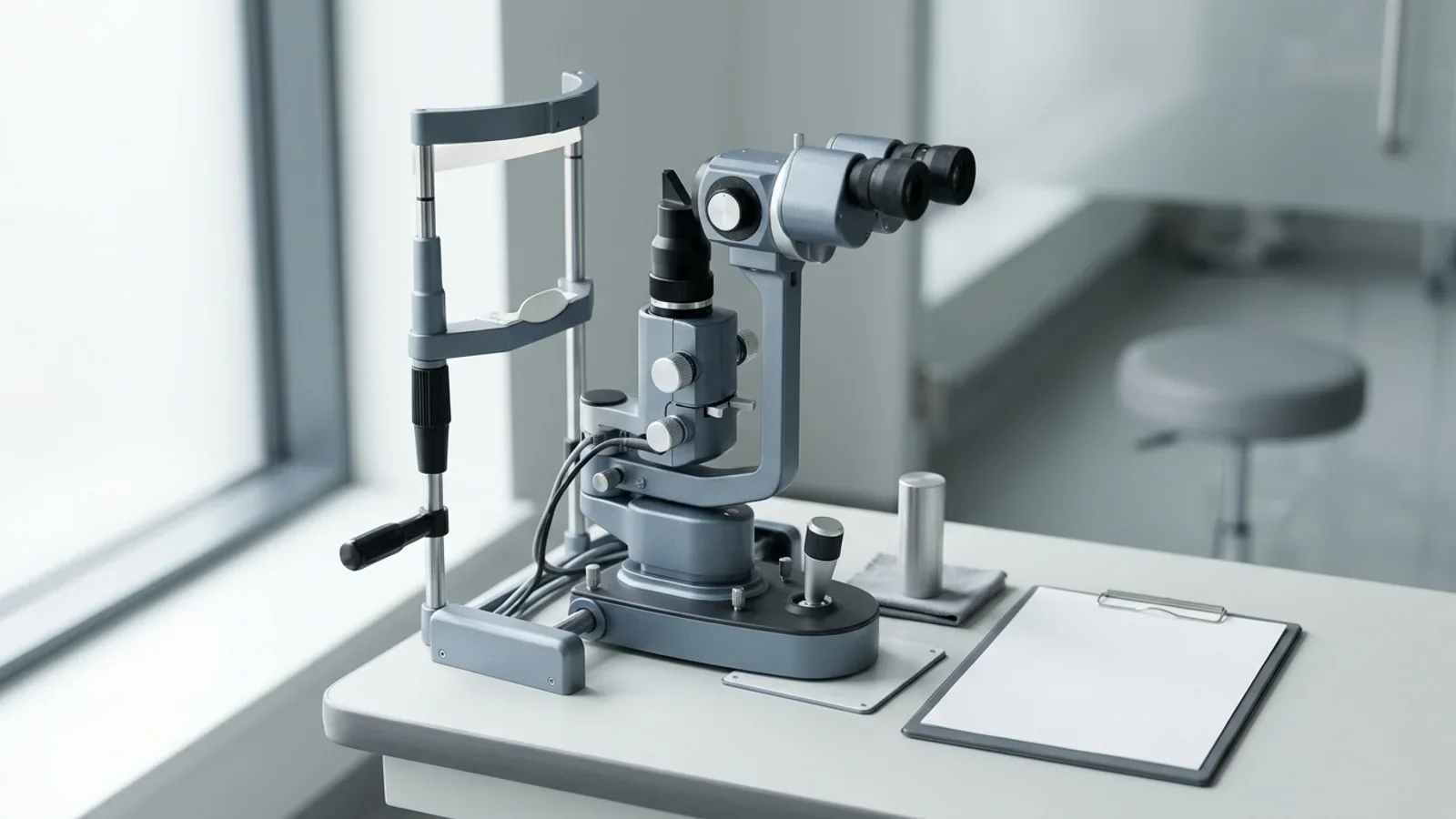
When a Haag-Streit BI 900 slit lamp comes back from service with a note that says “view is clear,” ask for the test rod observation at every magnification available with the fitted eyepieces. Request the separate slit-edge and rotated-rod findings, the inspection setup, and the observer’s name and date. Attach those findings to the service report and identify who will supply any missing evidence. This log covers the optical inspection. The facility’s return-to-service decision also requires the other checks applicable to the work performed.
Match the report to the inspection method
This example follows section 9.1, printed page 21, of the BI 900 Instructions for Use (IFU), seventh edition, January 2023, document 1500.7220505-04070. Confirm the applicable revision for the unit before using the log. To adapt it for another slit lamp, identify that model’s inspection method and fitted settings first. A report that says only “IFU checked” leaves the receiving team without the section or revision it needs to interpret the observation. If the provider used a different applicable revision, ask for the citation it actually followed and reconcile its criteria before reviewing the results. BI 900 IFU, section 9.1
The same IFU describes routine eyepiece preparation before examination in section 6.1, printed page 13. That section uses low magnification for individual eyepiece setup. Section 9.1 uses the highest fitted microscope setting for eyepiece setup during device inspection. A service note about eyepiece preparation therefore needs a section reference before it can be counted as evidence of the inspection. BI 900 IFU, sections 6.1 and 9.1
| Inspection entry | What the service report should show | IFU reference |
|---|---|---|
| Common setup | Rod face perpendicular to the microscope axis, slit length of 8 or 14 mm, and illumination set to 50%. Record the actual slit length used and the highest fitted magnification used for eyepiece setup, with the documented plus-to-minus direction. | Section 9.1, p. 21 |
| Test rod structure | A separate observation of whether the structure was in sharp focus at each fitted magnification. | Section 9.1, p. 21 |
| Slit edges | Whether the edges were in sharp focus with the slit about 0.5 mm wide. Record the setting used for this observation. | Section 9.1, p. 21 |
| Rotated test rod | Whether the sharply focused area was centered on the rod with the slit fully open and the rod turned 45°. Record the setting used for this observation. | Section 9.1, p. 21 |
Use these entries to review the report against the IFU. The all-magnifications wording in section 9.1 applies specifically to the rod-structure observation. For the two other observations, preserve the actual setting and any further coverage the applicable instructions call for. The figures in the setup describe inspection conditions. The section gives qualitative observations and supplies no numerical resolution or centering tolerance. Haag-Streit assigns installation and repair to trained specialists. BI 900 IFU, sections 9 and 9.1
Identify the fitted magnification coverage
Read the eyepiece power from the returned configuration and match it to the pair documented in the service report. Record each magnification changer position together with the corresponding total microscope magnification. A reference to “high power” on its own cannot tell the receiving team which eyepieces were fitted. Haag-Streit gives the following combinations for the BI 900. Haag-Streit’s eyepiece accessory information
| Fitted eyepieces | Lower changer setting | Higher changer setting |
|---|---|---|
| Standard | 10× total | 16× total |
| Optional 25× | 25× total | 40× total |
Review only the pair fitted to the returned unit. If the optional pair was absent, record its settings as unavailable by configuration if they appear on a shared work-order form. If the provider checked a second pair on the bench, ask it to identify that configuration separately and confirm which pair came back on the instrument. If the fitted power is uncertain, resolve the identity with the provider before assigning an expected magnification to a missing row.
Use a blank optical observation log
Copy these two tables into the work order or attach them to the original service report. The record fields and statuses are suggested documentation aids for the receiving team. The applicable IFU supplies the inspection criteria. Use a separate log for each configuration and observation session so each result stays traceable to the person and setup behind it.
| Record header | Value |
|---|---|
| Manufacturer, model, serial number, and facility asset ID | |
| Service event, work-order ID, and provider report reference | |
| Received eyepiece pair and fitted power | |
| Lower and higher changer positions and total magnifications | |
| Test rod identity or kit reference, if available | |
| Observer, date and time, and as-found or as-left record | |
| IFU document number, revision, section, and printed page | |
| Common inspection setup and any deviations | |
| Imaging configuration, if fitted |
Put the actual magnification and any setup differences in the row where they matter. For the finding, describe what the observer saw. For the evidence reference, identify the service report page, line item, or attachment that supports that finding. If one attachment supports several rows, cite the relevant page or entry in each. Add the follow-up owner and due date where the reviewer needs further evidence.
| Observation | Setting and setup | Finding and evidence reference | Status | Follow-up owner and due date |
|---|---|---|---|---|
| Rod structure at lower fitted magnification | ||||
| Rod structure at higher fitted magnification | ||||
| Slit-edge focus | ||||
| Centered focus on the rotated rod |
Give each row a status
Observed criterion met. The finding identifies the applicable setting and agrees with the IFU criterion.
Observed criterion unmet. The recorded finding differs from the criterion. Preserve what the observer saw and refer the item to the qualified service owner.
Evidence missing. An applicable entry is blank or absent from the report and the reason is not yet known. Ask the observer what happened and assign follow-up.
Unperformed. The observer confirms that the applicable check was skipped. Record the reason and assign follow-up.
Uninterpretable. An observation exists, but setup, identity or evidence is too uncertain to judge it. Name the uncertainty and the evidence needed to resolve it.
Unavailable by configuration. The setting belongs to an accessory absent from this unit. Identify the fitted configuration that supports this status.
During a paperwork review, mark a blank or absent applicable entry as evidence missing rather than unperformed. Use “unperformed” only once the observer confirms the check was skipped. If a reviewer later receives a dated supplement or a new result, append it with the source and keep the original entry for traceability.
Review a missing magnification entry
Suppose a service report for a BI 900 with standard eyepieces records sharp rod structure at 10× and gives no 16× entry. In this hypothetical example, the reviewer can account for the 10× finding if the setup and source are documented. The 16× evidence remains missing. Ask the provider for the 16× observation, its setup and date, and the report entry that supports it. Also check that the report records the slit-edge and rotated-rod observations separately. Keep the optical verification item open while applicable evidence is outstanding.
An as-found check and an as-left check answer different questions about the same unit. Keep each dated record with its configuration, observer and findings. Where work intervened, link the as-left entry to the repair or assessment so the reviewer can tell which observation represents the returned configuration. If the qualified observer reports an unmet criterion, keep that finding with the follow-up assignment even when a later observation resolves the issue.
Record the eyepiece and camera views separately
When the optional imaging system is fitted, identify it in the record and state whether a captured image was examined. In a separate entry, record the view through the eyepieces, the image finding, and the settings or attachment reference that lets a reviewer compare them. Where the image was outside the scope of the check, state that explicitly. Use a bench image and an evidence reference free of patient identifiers.
Haag-Streit’s imaging FAQ notes that an observer’s eyes can accommodate while the camera cannot. If the observer saw sharp detail and the captured image looked blurred, describe each finding and send the setup and images for qualified assessment. If both views were blurred, preserve that distinction too. The discrepancy alone leaves the cause unresolved. Section 6.2 of the BI 900 IFU limits images and videos to documentation and identifies the eyepiece view for diagnosis. Haag-Streit’s imaging FAQ · BI 900 IFU, section 6.2
Attach the log to the service handover
The receiving reviewer should be able to locate the optical log, the applicable instructions, the provider’s report and any outstanding action from the same work order. Record who reviewed the coverage and who owns any unresolved row. A general ophthalmic service checklist can help organize evidence about illumination, joystick movement and table stability alongside the optical finding. Keep those work-order items tied to their own applicable checks. BOC Instruments’ ophthalmic servicing checklist
Once the observed findings support the criteria for the returned configuration, document the optical item’s disposition and send the complete work order to the person responsible for release. The log establishes the recorded bench observations under the cited method. Clinical diagnostic validation and full return to service require their own evidence. For a wider handover, see the service provider qualification checklist and the guide to medical equipment work-order records.