
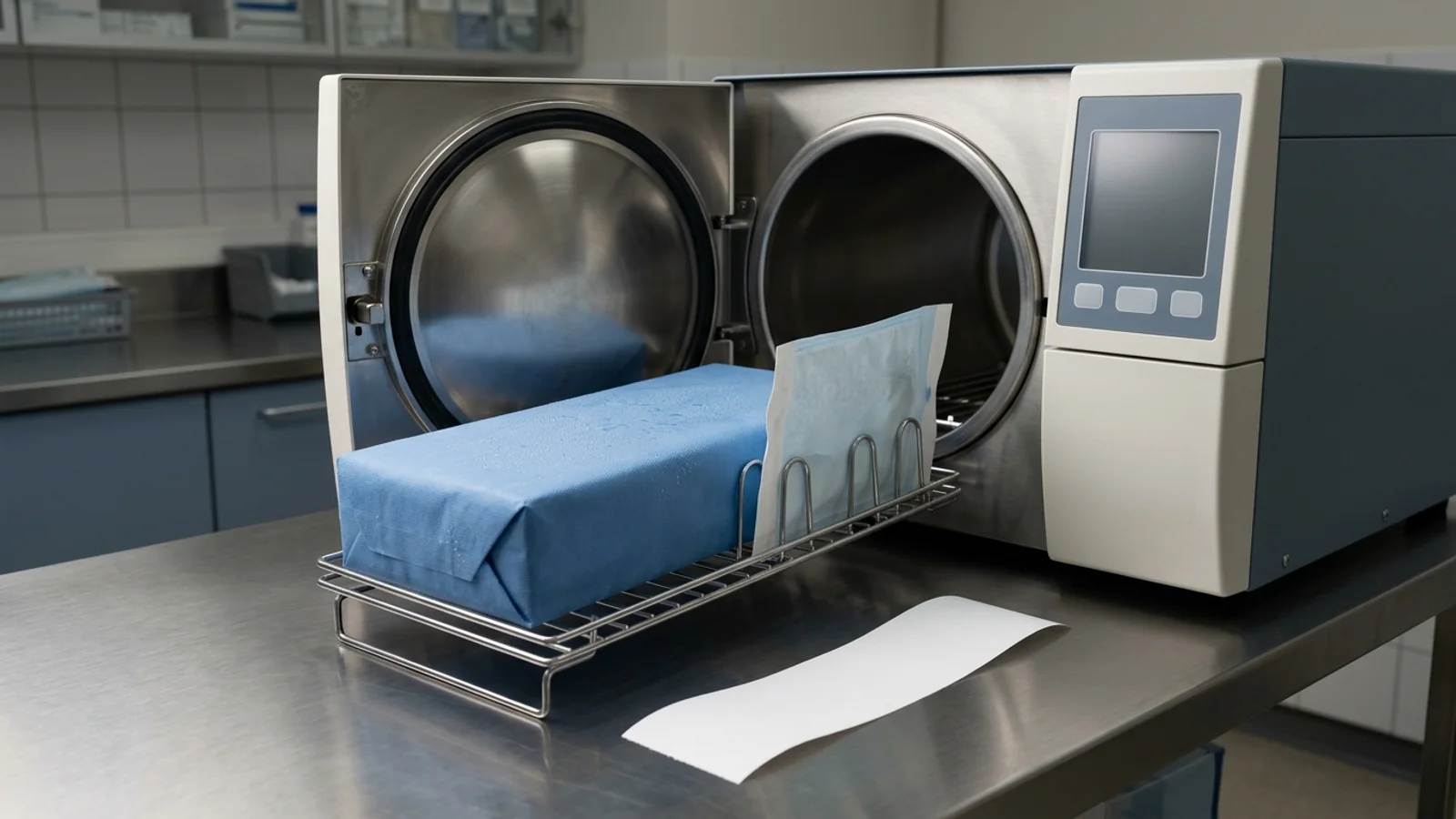
What Counts as a Wet Pack, and Why the Load Cannot Be Used
Treat every wet pack as nonsterile and completely reprocess it; do not dry it and put it on the shelf. A wet pack is a wrapped pack, rigid container, or peel pouch with visible dampness, droplets, or puddled water in or on it after the completed sterilization and drying cycle, including moisture found inside when the pack is opened. Hold the affected load while sterile processing assesses its disposition under facility policy. Then diagnose by pattern before anyone adjusts or opens the sterilizer. Moisture confined to one load, one tray configuration, one packaging style, or one operator makes loading, packaging, and cooling practices useful first checks. Recurrence across correctly prepared loads raises concern about the sterilizer or steam supply. These patterns guide the investigation; they do not identify a cause by themselves, and shared loading or cooling practices can affect several sterilizers.
Start with the cycle record and the manufacturer's permitted diagnostic checks. On a model that provides a vacuum leak-test program, the test can identify air leakage through the vessel or plumbing; it cannot establish that drying or incoming steam quality is satisfactory. MELAG specifies a cold, dry, unloaded chamber for its test. Use your model's IFU for the applicable conditions and limits. A failed test, unexplained cycle alarm or abort, or confirmed malfunction calls for taking the unit out of routine processing and contacting qualified service. There is no universal drying time or leak limit across brands.
The reason is contamination, not appearance. CDC's sterilizing practices guideline states that sterile items that become wet are considered contaminated because moisture brings with it microorganisms from the air and surfaces, and that a sterilized item should not be used if its package is wet, torn, or punctured. Tuttnauer describes the same mechanism as wicking: a wet wrap lets microorganisms enter through the packaging, and the moisture can also corrode instruments. The peer-reviewed study discussed below treats a wet pack as a sterilization failure that delays instrument supply and forces repeated processing.
First Response: Capture the Evidence Before Anything Changes
Hold the affected items and capture the rack configuration before breaking the load down for reprocessing. Photographs and cycle records preserve information that disappears once the cart is emptied: where moisture appeared, what sat above it, and how closely the items were spaced. Collect this evidence without delaying containment or handling hot items contrary to the IFU.
Record five things before the load is broken down:
Rack photographs: Photograph the loading rack from more than one angle before unloading. Capture tray orientation, spacing between items, whether peel pouches stood on edge or lay flat, whether rigid containers sat above wrapped packs, and where the moisture is: one shelf, one corner, or throughout.
The cycle record: Keep the printout or electronic record for the affected cycle. Note the cycle selected, whether the drying phase ran its full programmed time, and any alarm, abort, or early door opening. Add the sterilizer ID, cycle number, operator, and time of day.
Load contents and weights: List what was in the load and weigh the heaviest sets and containers. Flag dense items such as loaner sets, multi-level trays, and containers with heavy metal mass.
Packaging: Record the wrap or container system (non-woven wrap, woven textile, paper-plastic pouch, or rigid container), whether absorbent tray liners were used, and how each wet item was packaged.
Pre-condition and environment: Ask whether instruments went into packaging damp after washing or manual drying. Note conditions in the cooling area, such as nearby vents, drafts, and humidity, plus the outside weather. Patterns by time of day or season matter later.
This is practitioner practice rather than a regulatory requirement, but it is well grounded. In a December 2025 Healthcare Purchasing News column, a sterile processing educator who works for a processing-products company starts with exactly this question: is the department documenting the load configuration and photographing the sterilization rack? The picture can show the cause, such as rigid containers over wrapped items or trays placed too closely together, and the recorded load contents answer the weight question.
The record makes the cross-load pattern visible. Compare affected cycles with comparable dry cycles, including the sterilizer, shelf position, packaging, operator, and date. A repeated pattern helps decide which department should investigate next. It remains a clue rather than a diagnosis: the same packaging or cooling practice can span machines, and one wet shelf can reflect loading or equipment conditions.
Load-Side Causes Your Department Can Correct
Steam sterilizes by condensing on cooler surfaces, so every load produces condensate, and the drying phase and cooldown have to remove it. When packaging or loading puts more water into the load than the cycle can take out, or traps it where it cannot drain, moisture remains. The causes below are under department control.
Heavy or unevenly distributed metal mass: CDC's guideline says there is no longer a specified sterilization weight limit for surgical sets, that set weight should be based on the design and density of the instruments and the distribution of metal mass, and that heavy metal mass is a cause of wet packs; wrap density and set design may also influence drying. Tuttnauer lists packages that are too dense or have uneven metal mass. The HPN educator flags sets weighing over 25 pounds, and loads that exceed the sterilizer's cycle weight limit, as questions to check. Take limits from the set, container, and sterilizer IFUs rather than adopting one number across systems.
Pouch and container orientation: CDC's loading principles call for peel packs on edge in perforated or mesh-bottom racks or baskets, perforated trays parallel to the shelf, nonperforated containers such as basins on their edge, and devices with concave surfaces positioned so water drains. Tuttnauer lists paper-plastic pouches placed in a position that does not facilitate drying as a cause of wet packs.
Shelf order and stacking: The HPN educator's guidance is to space items evenly, with rigid containers and heavier trays on the bottom and lighter wraps and peel pouches on top; rigid containers placed over wrapped items or linen packs are a named cause. Chen et al. describe condensate from packs on an upper shelf dripping onto packs below.
Instruments loaded wet: Tuttnauer lists failure to dry instruments before packaging as an operator error, and the HPN educator warns that excess water carried into the chamber upsets the steam's moisture balance. Lumened and concave items that hold rinse water are the usual suspects.
Interrupted drying and early handling: Tuttnauer lists interrupting the drying cycle, selecting a drying time that does not follow the IFU, removing packs before the recommended cooldown has elapsed, and setting packs on cool, solid surfaces after cooldown. Each can leave condensation on the pack.
Chen et al. (Medical Science Monitor, 2024) quantified several of these practice variables in a single-center, cross-sectional study of 4,099 steam-sterilized packs at a hospital in China. Of those packs, 128 (3.12%) were wet. In binary logistic regression, the factors associated with wet packs included:
Instrument packs versus dressing packs: odds ratio (OR) 3.297. The authors note that metal instruments do not absorb condensate, while the textiles in dressing packs do.
Non-woven wrap versus cotton wrap: OR 3.808. The authors suggest that the denser non-woven material affects how steam permeates and leaves the pack.
Packaging not compliant with guidelines: OR 2.830. The non-compliances they found were instruments that were improperly or incompletely dried and too many instruments in one pack.
Cooling time under 30 minutes: OR 2.209 compared with 30 minutes or more. Staff had been judging readiness by touching the pack, and urgent turnarounds sent items out straight from the sterilizer.
Packs on the bottom shelf were also wet more often than packs on the top shelf. The authors attribute this partly to their sterilizers' inlets sitting on the lower left side of the chamber, combined with possibly unsaturated steam from a long central supply, which is a reminder that a shelf pattern can be an equipment or steam clue and not only a loading one. Their recommendations included absorbent tray liners, perforated instrument baskets, a cooling-time alarm in the tracking system, and an infrared thermometer instead of touch to check pack temperature.
Treat these odds ratios as the authors' reported associations in one setting, not as pass/fail limits, causal effects, or a validated troubleshooting sequence. The packs were sampled during June to December 2021 on two sterilizers fed by a central steam supply. The study did not analyze cycle protocol parameters, and its authors call for multi-center work. The practical checks here combine that observational evidence with CDC and manufacturer guidance; an equipment warning or failed required test takes priority over correcting the load.
Sterilizer-Side Causes That Belong to Qualified Service
When wet packs persist across correctly packaged loads, different tray configurations, and different operators on the same sterilizer, the evidence shifts to the equipment. Tuttnauer lists the autoclave performance issues that produce external or internal moisture: a malfunctioning steam line trap or drain check valve, clogged strainers and screens, poorly calibrated pressure gauges, malfunctioning vacuum systems or other sterilizer components, and a damaged door gasket. The literature reviewed by Chen et al. names the same family: pressure sensor failure, a clogged drainage filter, an incomplete door gasket, and declining function or poor sealing in the vacuum pump. Tuttnauer adds that many of these issues trace back to inadequate maintenance.
Chamber drain and strainer: The HPN educator notes that a blocked or clogged chamber drain could slow the vacuum process in pre-vacuum sterilizers, and Tuttnauer lists inadvertently obstructing the chamber drain as an operator error. Where the IFU assigns drain-strainer checks to operators, check and clean it as instructed and record what you found. Anything beyond the operator-accessible strainer is service scope.
Steam trap and drain check valve: Both appear on Tuttnauer's equipment list. Diagnosing or replacing them involves pressurized steam and drain plumbing and belongs to qualified service.
Vacuum system: On dynamic-air-removal sterilizers, the vacuum system removes air and supports drying. A fault can show up as a failed or rising leak-test result, or as alarms and slow evacuation in the cycle record. The operator's tools are the built-in leak test and the cycle record, not pump work.
Door gasket: A damaged gasket is on both the manufacturer and literature lists, and MELAG describes its vacuum test as checking whether air enters through chamber seals or valves. If the gasket is the finding, part identity matters; see Autoclave Door Gaskets: Confirming the Correct Replacement.
Pressure gauges and sensors: Poorly calibrated gauges and pressure sensor failure appear on both lists. Calibration and sensor diagnosis are service tasks, and a printout that looks normal cannot rule out a sensor that reads wrong.
Sterilizer type also sets expectations before any fault exists. Tuttnauer notes that gravity-displacement autoclaves are less effective at drying instruments than dynamic-air-removal autoclaves. If dense sets repeatedly come out wet from a gravity unit while maintenance is current and no fault is found, the problem may be a mismatch between the load and the sterilizer's capability rather than a failed component. That is a question for the sterilizer IFU and the set manufacturer's validated cycles, and possibly for a different sterilizer, not for a repair ticket.
Steam Supply: The Third Suspect Between Load and Sterilizer
Steam supply is another branch of the investigation, alongside loading practice and the sterilizer's own components. In the HPN column, Adam Okada, a clinical education specialist at Healthmark, a Getinge company, describes a previous facility where testing found 92–93% saturated steam and 7–8% water; he reports that new steam traps on the boiler intake line resolved the wet loads. He also gives 97–98% dry saturated steam and 2–3% water as a practitioner benchmark. Those figures illustrate his account; they do not establish acceptance limits for your installation. Facility engineering needs the applicable sterilizer requirements and steam-testing method to assess the supply.
Wet steam carries water into the chamber with the steam itself, so it can wet loads that are packed and loaded correctly. Supply-side causes named in these sources include:
Boiler supply problems: Literature reviewed by Chen et al. reports that when steam supplied by the boiler system is too wet or insufficient, pressure can become unstable and wet packs can result.
Steam traps on the supply: The HPN facility's fix was new traps on the boiler intake line, and Tuttnauer lists a malfunctioning steam line trap among the causes. Supply-side traps belong to facility engineering.
Long, buried, or poorly insulated lines: Chen et al.'s hospital fed its sterilizers from a central steam supply through an underground pipeline whose protective film had been in use for 14 years. The authors recommend regular pipeline maintenance, replacing the pipeline's thermal insulation, discharging condensate from the line before using the sterilizer, and, for new departments, a dedicated steam generator with a short stainless-steel supply run.
Weather can be a clue in a facility with a central steam supply. Chen et al. report adjusted odds ratios of 1.878 on overcast days and 2.432 on rainy days relative to sunny days. Their proposed explanation concerns cooling along an aging buried steam line; the study did not directly establish that mechanism or measure steam quality to confirm it. Tuttnauer also says time-of-day or seasonal patterns can suggest humidity or temperature effects, including conditions in the cooling area. Record those patterns and involve facility engineering when supply is a plausible suspect, while also checking shared loading and cooling practices. Weather alone does not prove a steam-supply fault.
What the Cycle Record, Leak Test, and Corrected Load Can Tell You
Use these checks to narrow the investigation and preserve evidence for service. The sequence is a practical synthesis of the cited guidance, not a validated diagnostic algorithm. The diagram keeps a stop point ahead of further testing when there is an unexplained alarm, failed test, or persistent wet-pack problem.
flowchart TD
  A["Wet pack found"] --> B["Hold affected load; reprocess wet packs; assess other packs under facility policy"]
  B --> C["Capture rack photos, cycle record, contents, weights"]
  C --> D{"Cycle record and required monitoring acceptable?"}
  D -- "No" --> E{"Known correctable practice error, with no unresolved equipment warning?"}
  E -- "Yes" --> H
  E -- "No or unclear" --> K["Stop routine processing; qualified service and SPD review"]
  D -- "Yes" --> G{"Pattern across comparable loads?"}
  G -- "Isolated load or practice finding" --> H["Correct within IFUs; one fully reprocessed load with required monitoring"]
  H -- "Dry and all release criteria met" --> I["Practice fix supported; keep logging"]
  H -- "Still wet or monitoring fails" --> K
  G -- "Recurs across correctly prepared loads on one unit" --> K
  G -- "Across units or with weather" --> S["Hold affected units; service and facilities review supply and shared practices"]
  K --> J{"Model provides an IFU-permitted vacuum leak test?"}
  J -- "Yes, and permitted under fault conditions" --> L["Run built-in test under model conditions; MELAG: cold, dry, unloaded"]
  J -- "No" --> M["Qualified service follows model-specific diagnostic path"]
  L -- "Fails" --> M
L -- "Passes" --> N["Keep held while persistent fault is investigated; pass does not clear drying or steam quality"]Step 1: Read the cycle record. Confirm that the right cycle was selected for the load, that sterilization parameters were met, and that the drying phase ran for the time the IFU specifies without an abort, alarm, or early door opening. Tuttnauer's rule is direct: if indicators or printouts show that sterilization parameters were not met, or that the drying cycle was curtailed or aborted, the load must be reprocessed. A documented operator interruption or wrong cycle choice may support a practice correction. An unexplained alarm or abort needs IFU-directed assessment and qualified service; it does not identify which component failed.
Step 2: Use the vacuum leak test only where the model provides it. STERIS describes the test as checking pressure-vessel and plumbing integrity; MELAG describes air entry through seals or valves. A gravity-displacement unit may not provide a vacuum-test program. Do not improvise one or apply a pre-vacuum test to it; follow that model's diagnostic path and contact service for persistent problems. For a unit held because of a fault, run only a built-in diagnostic that the IFU permits under those conditions, with service direction where needed. Two manufacturers publish these examples:
MELAG conditions and flag: MELAG specifies a cold, dry, unloaded autoclave and recommends the test weekly, at initial commissioning, after prolonged inactivity, and when faults or leaks are suspected. Its program evacuates the chamber, allows a 5-minute equalization time, measures the pressure rise for 10 minutes, and outputs a message if the leakage rate is above 1.3 mbar. MELAG asks users to document the result and leak rate so that changes are detected early.
STERIS limit and shutdown rule: STERIS states that industry standards, naming ANSI/AAMI ST8 and EN 285, allow up to a 1.0 mm Hg per minute average leak rate over a specified time, typically ten minutes, and that a result above 1.0 mm Hg per minute means immediately shutting the sterilizer down until it can be serviced. Its article cites ST8:2013/(R)2018; this is an attributed manufacturer example, not verification of the latest standard edition or a limit for every sterilizer. STERIS adds that operator manuals typically recommend daily or weekly leak tests.
Preserve the published units: MELAG's blog labels its leakage-rate message threshold as 1.3 mbar without a per-minute denominator. STERIS specifies an average rate of 1.0 mm Hg per minute. Do not interpret the MELAG figure as a total ten-minute pressure rise, infer a missing denominator, or convert either example into your own model's limit. Check the full units, test conditions, and acceptance rule in the applicable IFU.
Read the trend, not only the result: STERIS recommends keeping a log of leak-test results. In its examples, a unit that consistently read 0.2 or 0.3 mm Hg per minute and suddenly reads 1.3 mm Hg per minute probably has a component failing rapidly and needs service immediately, while a slow rise such as 0.7 to 0.8 mm Hg per minute supports a scheduled, non-emergency visit with continued monitoring.
Step 3: Evaluate one corrected, fully reprocessed load when there is a documented practice finding and no unresolved equipment warning or failed required test. Correct the identified problem within the instrument, packaging, container, and sterilizer IFUs, then use the prescribed cycle, drying, cooling, and monitoring. A dry result with all release criteria met supports the correction; it does not prove a single root cause or clear a separate equipment concern. If the packs remain wet, stop routine processing and involve service and facility engineering instead of repeating wet cycles. If the correction makes a major change to packaging, wraps, or load configuration, CDC describes three full-load product evaluation cycles with biological and chemical indicators, correct chemical-indicator responses, and quarantine until biological results are negative; one apparently dry load with routine monitoring is not a substitute for that evaluation.
| Branch | Typical pattern | Discriminator | Who acts |
|---|---|---|---|
| Load practice | One load, set, pack style, shelf, or operator | Cycle record and fully reprocessed corrected load; all monitoring and release criteria still apply | Sterile processing: packaging, loading, cooling, training |
| Sterilizer | Recurs on one sterilizer across compliant loads and operators | IFU-permitted vacuum leak test if provided, leak-rate trend, cycle alarms; a pass does not clear drying | Qualified service with SPD; stop routine processing for failed tests or persistent faults |
| Steam supply | Across sterilizers or with weather/season; shared practices remain alternative explanations | Steam-quality testing by facility engineering | Facility engineering: traps, lines, insulation, boiler |
The published numbers worth knowing, and what each one actually is:
| Evidence | Source | What it states | Decision use |
|---|---|---|---|
| Vacuum leak rate | STERIS, naming ANSI/AAMI ST8 and EN 285 | Up to 1.0 mm Hg/min average, typically over ten minutes | Above it: shut the sterilizer down until serviced |
| Vacuum test message | MELAG autoclaves | Blog labels a leakage-rate message above 1.3 mbar; no per-minute denominator stated | Use model IFU units and acceptance rule; hold on a failed test and contact service |
| Steam dryness | HPN practitioner column, not a regulation | 97–98% dry saturated steam, 2–3% water | Illustrative practitioner benchmark; facility engineering uses installation-specific requirements |
| Set weight | CDC guideline | No specified weight limit; weight based on design, density, and metal-mass distribution | Use set, container, and sterilizer IFU limits; HPN flags sets over 25 lb |
| Cooling time | Chen et al., one hospital | Under 30 minutes associated with OR 2.209 versus 30 minutes or more | Enforce the IFU cooldown; do not release packs by touch |
When the Sterilizer Comes Out of Service
Set the escalation boundary before a wet-pack event. This article's conservative operating recommendation is to stop routine processing when a required test fails its IFU limit, a cycle alarm or abort remains unexplained, a malfunction is confirmed, or wet packs persist despite compliant preparation and loading. Contact qualified service and assess whether facility steam conditions are involved. STERIS directly calls for shutdown when its cited leak-rate limit is exceeded. Keep the unit held until the cause is addressed and the applicable verification and release requirements are met; a passing leak test alone does not provide that clearance.
CDC's guideline frames what happens to the loads. In its procedure for positive spore tests with steam sterilization, CDC says that if spore tests remain positive, use of the sterilizer should be discontinued until it is serviced. Summarizing AORN, it adds that if a sterilizer malfunction is discovered, the items must be considered nonsterile, and items from the suspect load or loads should be recalled, insofar as possible, and reprocessed. That guidance is written for biological-indicator failures rather than wet packs, but the principle carries over: a confirmed malfunction makes the suspect loads nonsterile. CDC's document is a guideline, not a regulation, and your facility policy decides how far back a recall reaches.
Until service clears the unit, do not keep running it with a failed leak test, override alarms, or lengthen drying beyond what the IFU allows in order to mask a fault. When you escalate, hand the service provider the evidence package:
Photographs: the rack configuration and where the moisture appeared, taken before unloading.
Cycle records: printouts or electronic records for the wet cycle and for recent comparable cycles, including any alarms or aborts.
Event log across loads: which loads, shelves, packaging types, operators, sterilizers, and dates were affected, and which were not.
Leak-test history: the current result and the logged trend, so the technician can see whether the change was gradual or sudden.
Drain and steam findings: what the operator-level drain check found, and any steam-quality testing results from facility engineering.
After the repair, return to service is a verification question. CDC lists major repair and sterilization failure among the triggers for testing before routine use. For steam sterilizers it describes three consecutive empty cycles with a biological and chemical indicator in an appropriate test package or tray, with each cycle type used tested separately. A prevacuum sterilizer also runs three consecutive empty cycles with a Bowie-Dick test. The sterilizer is not put back into use until all biological indicators are negative and chemical indicators show a correct end-point response. Apply the verification appropriate to the event and model with sterile processing and qualified service. For the full evidence set, see Steam Sterilizer Performance Testing: Physical, Chemical, and Biological Evidence. For deciding whether a repair counts as major, see When a Repair Is Major: Return-to-Service Testing After Corrective Work.
Recording the Event and the Fix
A wet-pack event is not closed when the packs are rewrapped and the sterilizer is running again. Record it in the CMMS or quality log so that trend review can see recurrence and a reviewer can follow the decision.
For the recognized-practice reference, AAMI's sterilization standards FAQ answers the question of where to find information on wet packs or evidence of moisture by pointing to ANSI/AAMI ST79:2017, Comprehensive guide to steam sterilization and sterility assurance in health care facilities. The same FAQ routes record-retention questions to ST79. This article does not quote the paywalled standard, so use your facility's current copy for its specific recommendations.
A wet-load event record that supports trending and review should show:
Asset identification: equipment ID, model, serial number, and location.
Event and evidence: date, shift, operator, cycle number, and how the moisture presented (outer wrap, inside a pack, or inside a container), with the photographs and cycle record attached.
Branch decision: load practice, sterilizer, or steam supply, with the evidence behind it, such as the leak-test result, the corrected re-run, and any steam findings.
Corrective action: retraining or loading changes, drain cleaning, the service work performed, or the facility steam repair.
Return-to-service evidence: where service was involved, the post-repair testing performed and its results.
Load disposition: which packs were held, retrieved, and completely reprocessed, and any that were used or could not be located. If suspect items reached patient care, involve infection prevention, sterile processing, and risk management to assess the exposure, as CDC describes; do not record an incomplete retrieval as a completed recall.
For work-order fields more generally, see Medical Equipment Service Records: What a Work Order Must Contain. The point of the record is practical: the third wet-pack event on the same sterilizer, or the second one in a rainy week, should show up as a pattern instead of being rediscovered from scratch.