
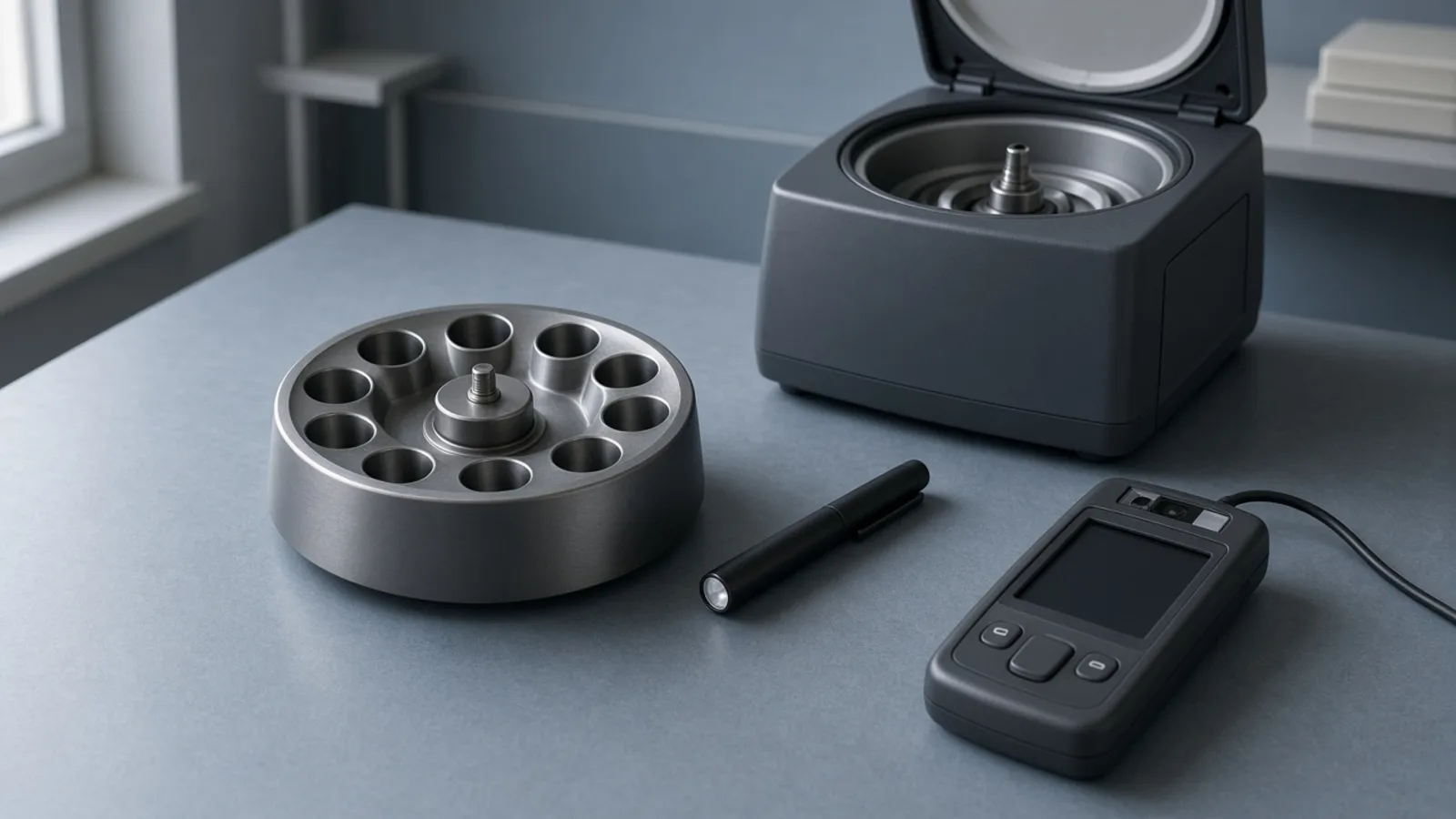
What CLIA Actually Requires for a Centrifuge
A high-speed benchtop centrifuge has run daily for eight years. The motor is quiet, the bowl is clean, and the rotor has not thrown an unrecoverable imbalance fault. Before an accreditation survey, biomedical engineering has to decide whether to keep that rotor in service, send it for manufacturer inspection, or retire it, and which records make the choice defensible.
Start with the rotor in hand, not the drive serial number. In Beckman Coulter's Rotor Safety Guide, document BA99-6049-5, printed in 1999, eight years lands in a different place on each row. An Avanti J or J2/J6 rotor is past the 7-year warranty and short of the retirement columns of 15 years and 50,000 runs, if the run count is known and still under 50,000. The same guide says that once the warranty period has been reached, consider retiring the rotor even when it appears sound, and still follow the retirement recommendations. A Microfuge 18 rotor on that table is already past a 1-year retirement. A JLA-10.500, 8.1000, or 9.1000 cannister is listed for retirement after 7 years, with the date engraved on the part. An Allegra 6, GS-6, or Spinchron series rotor is past a 7-year warranty and short of a 10-year retirement. An Allegra 21, Allegra 64, Avanti 30, GS-15, or Spinchron 15 series rotor is past a 1-year warranty and short of a 10-year retirement. A GH-3.7 rotor is listed for retirement after 7 years, so eight years is already past that row.
Those figures are Beckman Coulter class rows from a 1999 booklet hosted on a university safety site. They are not a universal rotor life, and they are not today's warranty certificate for a named serial number. Before anyone applies a row to a rotor, confirm it in the current rotor manual and the warranty statement that shipped with that rotor. A two-page statement titled Centrifuge Rotor Life and Retirement, with a file creation date of December 5, 2021, and hosted by a reseller rather than the manufacturer site, says that if a customer sends in a rotor past its useful life, Beckman Coulter will not perform the repair because it does not recommend using any rotor past its retirement age. That statement does not reprint the year-and-run table. Treat it as a restatement of the no-repair position, then confirm the useful-life age with Beckman Coulter for the rotor you have.
For a laboratory performing nonwaived testing, the record of that decision sits under 42 CFR 493.1254, Standard: Maintenance and function checks, in the quality-system requirements for nonwaived testing. The section does not name centrifuges. It adopts the manufacturer's maintenance and function-check instructions as the laboratory's duty. A research centrifuge outside a CLIA laboratory is outside this section. The class limit still comes from the rotor manufacturer.
42 CFR 493.1254(a). Unmodified manufacturer's equipment, instruments, or test systems. The laboratory must perform and document the following: (1) Maintenance as defined by the manufacturer and with at least the frequency specified by the manufacturer. (2) Function checks as defined by the manufacturer and with at least the frequency specified by the manufacturer. Function checks must be within the manufacturer's established limits before patient testing is conducted.
Paragraph (b) uses this heading: equipment, instruments, or test systems developed in-house, commercially available and modified by the laboratory, or maintenance and function check protocols are not provided by the manufacturer. In those cases the laboratory establishes a maintenance protocol, defines a function-check protocol, performs and documents both, including background or baseline checks, and keeps function checks inside the laboratory's established limits before patient testing. Paragraph (a) uses the manufacturer's limits. Paragraph (b) uses the laboratory's limits. The service record should name which paragraph applies.
Temperature is a separate duty, in 42 CFR 493.1252. Testing must follow the manufacturer's instructions. The laboratory must define criteria for conditions essential to proper storage, accurate and reliable test-system operation, and reporting. Those criteria must be consistent with the manufacturer's instructions when the manufacturer provides them. The laboratory must monitor and document the conditions, and temperature is one of the conditions listed when it applies. For a refrigerated centrifuge, the chamber-temperature check belongs in that monitored-condition record as well as in any function check the centrifuge manual requires.
Rotor Life Is a Manufacturer Class Limit, Not a Lab Policy
Service templates often offer one rotor life for every head, commonly ten or twenty years. BA99-6049-5 does not. Its warranty and retirement table separates ultracentrifuge, high-speed J-series, cannister, benchtop, and microcentrifuge rows. The booklet also says Beckman Coulter has a Rotor Failure Review Committee that has kept rotor-event records for more than thirty years. The reseller-hosted life-and-retirement statement, whose PDF file was created on December 5, 2021, describes that committee as a weekly review of rotor events by design, manufacturing, quality, repair, metallurgy, planning, and technical support. The design-life calculations behind each row are described as confidential. What the laboratory can use is the published row, plus the current manual.
The table below keeps the rows a clinical laboratory is most likely to need when the rotor on the bench is a Beckman Coulter head, then adds the two non-Beckman sources that are often misread as if they were the same table. Analytical ultracentrifuge rotors, TL and ML series rotors, Airfuge rotors, the H6002, and the VC-53 and VAC-50 composite rotors have their own rows in the 1999 booklet and are omitted here on purpose. Use the row that names the rotor, then re-check it.
| Rotor class | Warranty in BA99-6049-5 | Retirement columns in that guide | Run log | Boundary for the service record |
|---|---|---|---|---|
| Aluminum fixed-angle and swinging-bucket ultracentrifuge rotors | 5 years | 10 years, and 2,400 runs. The prose also says aluminum and swinging-bucket rotors are to be retired after 10 years of service. | Desirable good laboratory practice. The warranty text does not make the log mandatory for this class. | Stress corrosion is the primary cause of aluminum rotor failure. Pitting reduces the metal that carries the load, and cracks can follow. These figures stay with this manufacturer and this class. |
| Titanium fixed-angle, VTi, and NVT rotors | 5 years | 12 years, and 6,000 runs. The prose says titanium rotors are to be retired after 12 years of service. | Desirable good laboratory practice, same warranty exception as other non-zonal classes. | The guide says titanium is quite resistant to corrosion and aluminum is far more susceptible. Lids, knobs, spacers, caps, and plugs on a titanium rotor may still be aluminum. |
| Zonal, continuous-flow, component test, and rock core ultracentrifuge rotors | 2,000 runs or 5 years, whichever occurs first | 10 years, and 2,000 runs | Required. The warranty says: use of a log book or other means of determining rotor usage is required. | The run column and the warranty run limit meet at 2,000 runs. The calendar retirement column is 10 years. |
| Avanti J series and J2/J6 series rotors | 7 years | 15 years, and 50,000 runs | Purchase date kept on permanent file. A run log is desirable, and the warranty text does not make it mandatory for this class. | The guide says these rotors were tested for a fatigue life beyond the cycles that would fit in the 7-year warranty, and that corrosion plus fatigue can still make an older rotor vulnerable. Past warranty, consider retirement and still follow the retirement columns. |
| JLA-10.500, 8.1000, and 9.1000 cannisters | 7 years | 7 years. The guide notes that the retirement date is engraved on the cannisters. | Follow the engraved date on the component. | The booklet says some components have a warranty period that matches their expiration date and must be taken out of service once that date is reached. The guide's spelling is cannisters. |
| Allegra 6, GS-6, and Spinchron series rotors | 7 years | 10 years. Runs are listed as NA. | Purchase date on permanent file. | Eight years is past warranty and short of this retirement column. The consider-retirement language at warranty expiry still applies. |
| Allegra 21, Allegra 64, Avanti 30, GS-15, and Spinchron 15 series rotors | 1 year | 10 years. Runs are listed as NA. | Purchase date on permanent file. | A 1-year warranty with a 10-year retirement column. Do not borrow the Microfuge 18 one-year retirement for this row. |
| Microfuge series rotors other than the Microfuge 18 rotor | 1 year | 10 years. Runs are listed as NA. | Purchase date on permanent file. | The series row and the Microfuge 18 row are different lines in the same table. |
| Microfuge 18 rotor | 1 year | 1 year. Runs are listed as NA. | Purchase date on permanent file. | This is the one-year retirement row. It does not set the life of every microcentrifuge rotor in the booklet, or of any other manufacturer's microcentrifuge. |
| GH-3.7 rotor | 7 years | 7 years. Runs are listed as NA. | Purchase date on permanent file. | Eight years is past this retirement column in the 1999 table. |
| Eppendorf centrifuges and rotors, 2019 epServices flyer | The flyer publishes no universal warranty life. | Service life depends on the number of load cycles and the application parameters. | Eppendorf's own plans include a checklist and a dated service sticker confirming Eppendorf service. | Improper maintenance may turn small surface scratches into critical cracks. Humidity and chemicals may cause corrosion. This row is not a Beckman limit. |
| Thermo Fisher practice note in American Laboratory | An application note, not a warranty table. | Low-speed and superspeed rotors in use for 10 years or longer should be closely inspected and considered for replacement, especially with pits, rust, or corrosion. | The note does not state a warranty-log rule. | Ultracentrifuge rotors, the note says, have recommended life spans based on hours in use or cycles completed. Follow that manufacturer's inspection schedule and retire rotors that show wear. |
Eppendorf's 2019 US epServices flyer, form TSV.C1.0194.C.US.19.CENT, is a service-plan description. It says quality systems increasingly ask for regular service of centrifuges and rotors, in an operational or disassembled state, and that functional inspections check temperature accuracy, rotational speed, and operating time against manufacturer specifications. It does not publish a year or a run count that a hospital can paste onto another brand. The Thermo Fisher note is an undated application article by a Thermo Fisher product manager. Use it as a prompt to inspect a low-speed or superspeed rotor that has reached 10 years, especially when pits, rust, or corrosion are present. The retirement authority for that rotor remains its own manual.
The Rotor Log: Warranty Rules and Essential Contents
Many CMMS records stop at the centrifuge chassis. Fixed-angle heads, swinging buckets, and cannisters move between drives, and each one carries its own warranty clock. A work order that says the motor spun does not show whether a particular rotor is inside its retirement column. Track the rotor as its own asset. The site's guide to CMMS medical equipment inventory unique identification covers how unique equipment identity is stored. The work-order contents themselves are covered in medical equipment service record requirements.
BA99-6049-5 draws a narrow warranty line around the log. With the exception of zonal, continuous-flow, component test, and rock core ultracentrifuge rotors, rotor logging is not mandatory per the warranty and may be desirable for good laboratory practice. For those four classes the warranty condition is direct: use of a log book or other means of determining rotor usage is required. For every rotor, the purchase date should be recorded and kept on permanent file. The purchase date may differ from the manufacturing date shown in the serial number. Stony Brook University's centrifuge and rotor safety guide, which cites Beckman and Sorvall technical guides, asks for the purchase date, the manufacturing date, and the serial number, and calls a well-kept ultracentrifuge log essential, with date, user, rotor used, and problems encountered.
Components that carry a permanently marked expiration date must not be used beyond that date. The Beckman guide names carbon-fiber cannisters, carriers, and some labware, and says the date or the manufacturing date is usually engraved or molded into the component. There is a strong possibility, the guide says, that a highly stressed component could fail with prolonged use past that date, so the component is taken out of service and retired. Stony Brook states the same stop-use rule for an expiration date permanently marked on the rotor or on rotor accessories. That is a manufacturer and institutional safety rule. It is not, by itself, a prediction of a specific survey citation.
A rotor file that can be shown to a surveyor or a service engineer needs these fields:
Identity. Rotor model, serial number, material or class as named on the rotor or in its manual, and the drive models the manual allows.
Dates. Manufacturing date from the serial number, and the purchase or in-service date kept on permanent file because the two dates can differ.
Usage, where the class uses it. Cumulative runs or hours when the retirement column is written in runs or hours. For zonal, continuous-flow, component test, and rock core rotors, the Beckman warranty requires a log or an equivalent usage record. For an ultracentrifuge, Stony Brook's minimum fields are date, user, rotor, and problems.
Speed reductions from the rotor manual. The guide says the maximum speed and sample-density ratings for each rotor should be observed, and that speed reductions required for high-density solutions, plastic adapters, or stainless steel tubes should be observed. Record the manual's reduction when one of those conditions was present. The booklet does not print a single density number to use for every rotor.
Overspeed disk. On a Beckman ultracentrifuge rotor, the correct disk is on the bottom, the disk is in good condition, and a speed-derating disk is installed when the warranty conditions require it. The disk is what the guide says prevents the rotor from exceeding its maximum rated speed through operator error or instrument malfunction.
Inspection. Penlight inspection of tube-cavity bottoms, where the guide says corrosion may be visible, plus any crack, pit, or damage to the anodized layer. Fiber-optic borescopy is described as a method used in Beckman's Field Rotor Inspection Program, not as a tool every in-house inspection must own.
Incidents. A corrosive spill, a severe imbalance, a drop, or any run the manual would treat as excessive stress. The guide says even one run under excessive stress may significantly reduce fatigue life. Record the event and hold the rotor for evaluation. The booklet does not publish a drop height or a pit-depth limit.
Documented Checks Surveyors Ask For: Speed, Timer, and Temperature
CLIA tells the laboratory to follow the manufacturer's function checks and limits. It does not publish a centrifuge RPM interval of its own. Public guidance from the Accreditation Commission for Health Care adds a practical example. In ACHC's article Maintenance Protocols Drive Testing Accuracy, the centrifuge row says centrifuges should be cleaned regularly and when a spill occurs, RPM should be assessed at least annually, the timer should be checked, and the temperature of a refrigerated centrifuge should be verified. Records should include the RPM readings and list the manufacturer's tolerance limits so compliance can be judged. Those sentences are accreditation guidance from one organization. They are not a CMS regulation and they are not a CAP or COLA checklist quotation.
The same ACHC article quotes Standard 06.04.02, Modified System Maintenance Checks, for a different situation: equipment developed in-house, commercially available equipment the laboratory modified, or equipment whose manufacturer did not provide maintenance and function-check protocols. In that case the laboratory establishes a maintenance protocol that supports accurate and reliable results and performs and documents the activities. That standard tracks 42 CFR 493.1254(b). It is not the sentence that sets an annual RPM check, and it does not convert the centrifuge example into a universal legal interval.
Write the function check so a reviewer can see the comparison. Record the setpoint, the measured value, the tolerance stated in that centrifuge or rotor manual, and whether the result was inside the limit. A line that says only that RPM was checked does not list the manufacturer's tolerance. The tolerance itself has to come from the manual for that model. This article does not supply a substitute RPM band, timer band, or temperature band.
Eppendorf's flyer shows what that manufacturer's service visit documents: temperature accuracy, rotational speed, and operating time checked against Eppendorf specifications, a checklist, and a dated sticker confirming that Eppendorf performed the service. An in-house record meets the laboratory's duty when it satisfies 493.1254 and the instructions for use. It does not have to imitate Eppendorf's sticker program, and the sticker is evidence of Eppendorf's visit, not a calibration certificate for the centrifuge.
If biomedical engineering uses a separate tachometer, timer, or temperature instrument, identify that instrument on the work order and keep its calibration evidence where the certificate can be audited. The site's guide to reading a medical equipment calibration certificate is the place for that audit. A refrigerated centrifuge still needs its own temperature result against the centrifuge manufacturer's limit. The site's laboratory refrigerator alarm guide addresses cold-storage alarms, which are a different instrument and a different record.
Stop-Use Findings and the Escalation Path
OSHA QuickFacts 3406, Laboratory Safety: Centrifuges, dated August 2011, is a fact sheet, not a performance standard and not a rotor-life table. It says unbalanced centrifuge rotors can result in injury or death, that the majority of centrifuge accidents result from user error, and that workers should follow the manufacturer's operating instructions for each make and model. It also says not to exceed the rotor's maximum run speed, to seat and balance the rotor, and to wait until the rotor has stopped before opening the lid. Those operating boundaries explain why an imbalance event and an overspeed event belong in the service record. They do not authorize a structural repair.
The Beckman guide and the Stony Brook guide support taking the rotor out of service for the first four findings. The fifth finding is the hold that follows from the guide's warning about a single excessively stressed run:
Cracks, or pitting that the manual treats as damage. The Beckman guide says pitting in a highly stressed area, such as the bottom of a cell hole, acts as a stress concentrator and that repeated use can cause cracks. Corrosion at the bottom of tube cavities may be visible with a penlight.
Damage to the protective coating. If the anodized layer is scratched or otherwise damaged, the guide says corrosion will occur. Alkaline detergents, and most commercially available radioactive-decontamination solutions, are highly alkaline and may remove that coating. The guide tells users to avoid them and to follow the rotor manual's cleaning instructions. This article does not add a cleaning procedure.
Overspeed disk problems. The correct disk must be on the bottom of an ultracentrifuge rotor and in good condition, and a speed-derating disk must be installed when the warranty requires it. A missing, wrong, or damaged disk is a stop-use finding because the disk is the overspeed protection the guide describes.
An engraved or molded expiration date that has passed. Carbon-fiber cannisters, carriers, some labware, and the JLA cannisters called out in the table come out of service at that date.
A run that may have overloaded the rotor. The guide says even one run under excessive stress may significantly reduce fatigue life, and that fatigue is not visible. Hold the rotor for manufacturer evaluation after a severe imbalance, a drop, or a chamber strike, and record the event. The sources do not publish a drop height or a pit-depth limit, so those events are an escalation, not a measured pass-fail number.
The flow below is a documentation decision. It is not a procedure for machining, refinishing, crack repair, or overspeed-disk replacement. Those actions stay with the manufacturer or another service organization qualified for that rotor.
flowchart TD
    A["Identify the exact rotor"] --> B["Record serial, purchase date, and the class limit in the current manual"]
    B --> C{"Stop-use finding?"}
    C -->|"Crack, pitting, bad overspeed disk, or expired engraved date"| D["Quarantine the rotor"]
    C -->|"No stop-use finding"| E{"Retirement limit reached?"}
    E -->|"Yes"| F["Retire the rotor"]
    E -->|"Warranty ended, retirement limit not reached"| G["Consider retirement and request OEM inspection"]
    E -->|"Inside warranty and retirement limits"| H{"Speed, timer, and temperature inside manufacturer limits?"}
    H -->|"No"| I["Hold return to service and follow the IFU"]
    H -->|"Yes"| J["Record the reading and the tolerance, then return to service"]
    D --> K["Decontaminate and include a signed safe-to-handle statement before shipment"]
G --> KWhen Rotor Service Work Triggers Calibration Verification
Rotor retirement, rotor logging, and the centrifuge function checks in this article are maintenance records under 42 CFR 493.1254 and monitored operating conditions under 42 CFR 493.1252. Calibration and calibration verification under 42 CFR 493.1255 are a different decision, already set out in laboratory analyzer calibration verification after repair. This article does not restate that section's triggers. If the work on a centrifuge rises to major preventive maintenance, or to replacement of a critical part that can affect test performance, use the laboratory's own procedure for that question and the published calibration-verification guide.
Hospital return-to-service testing after corrective work is also a separate record, covered in when a repair is major. A rotor that is still inside its class limit can come back to service only after the function checks required for that centrifuge are documented. A rotor that is quarantined for cracks, an expired cannister, or a reached retirement column does not get a pass from a successful tachometer reading on the drive.
Why the New Centrifuge Safety Standard Edition Matters for Service Planning
On September 2, 2026, IEC published IEC 61010-2-020:2026, Edition 4.0, Safety requirements for electrical equipment for measurement, control, and laboratory use, Part 2-020: Particular requirements for laboratory centrifuges. The IEC webstore lists a stability date of 2029. The fourth edition cancels and replaces the third edition published in 2016. The abstract's list of significant technical changes contains one item: alignment with the changes introduced by Amendment 1:2016 of IEC 61010-1:2010. The standard has the status of a product safety publication under IEC Guide 104 and is used with IEC 61010-1. The clause text is sold, not public, so service planning can use the edition, the date, and that single listed change.
For centrifuges already in service, preventive maintenance remains the instructions for use plus the laboratory's duty under 42 CFR 493.1254. When biomedical engineering writes a capital replacement specification, ask the vendor which edition the offered centrifuge was evaluated against, and file that answer with the incoming inspection. If part of the equipment also falls under another Part 2 standard of IEC 61010, the abstract says those requirements apply as well. That question belongs in procurement, beside the rotor-class record this article is about.
The service decision on an eight-year-old rotor is then a short file: the class row from the current manual, the purchase date, the usage record where the warranty or the SOP requires it, the speed, timer, and temperature readings next to the manufacturer's tolerance, and a stop-use note if inspection found cracks, pitting, coating damage, a bad overspeed disk, an expired engraved date, or a stress event. Teams that can produce that file can explain why the rotor stayed in service or why it was retired. Teams that have only a clean housing and a quiet motor are still at the start of the question.