
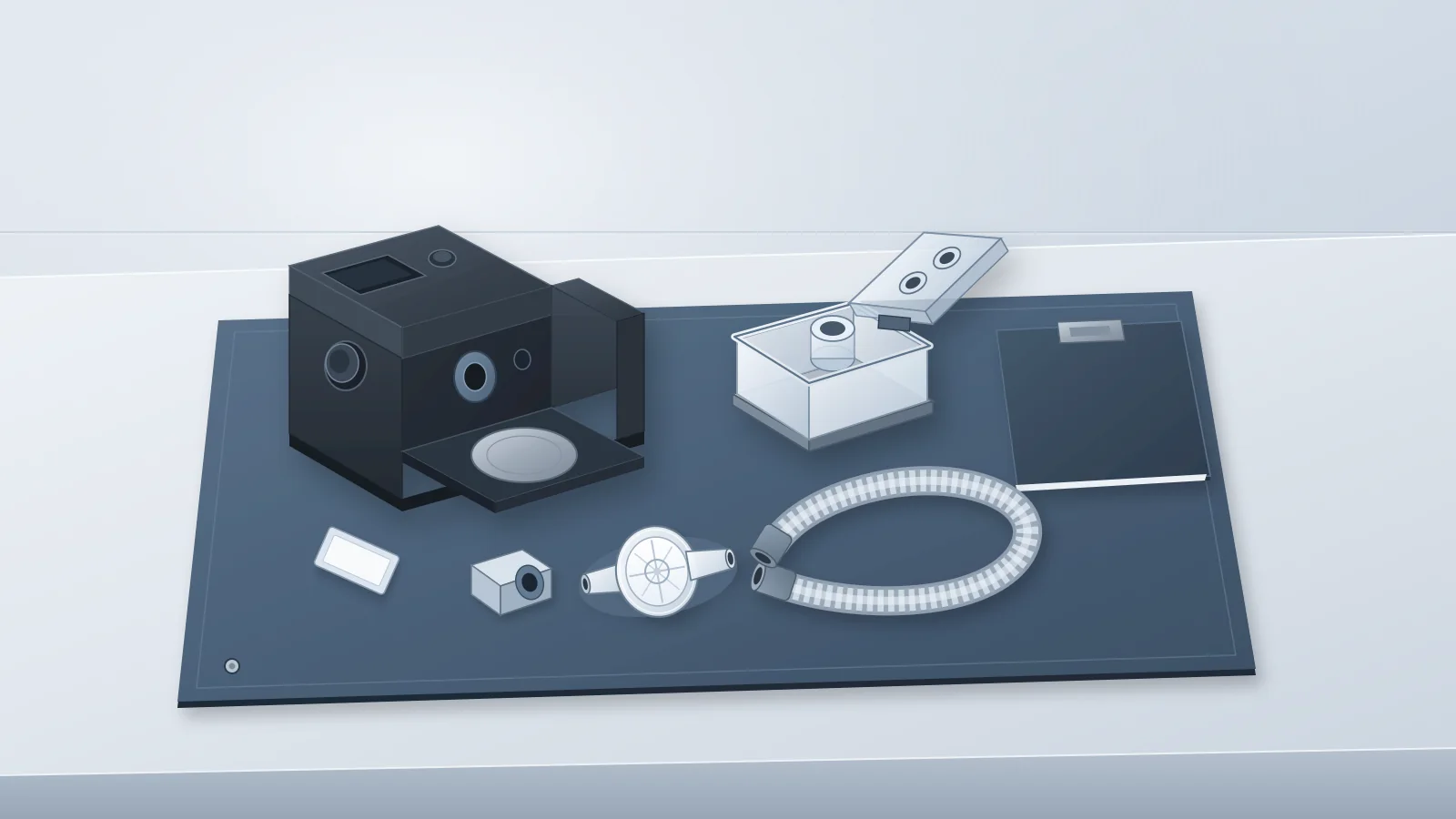
A sleep lab running nightly titrations on a mixed fleet of ResMed AirSense 10, AirCurve 10, AirSense 11 and Philips DreamStation units faces the same question every morning: which parts go through reprocessing, which get replaced, and what has to be in the log before the next patient is connected. The answer is not a house preference. Once a device is used for more than one patient, the governing instruction is the manufacturer's multi-patient document for that model and market region, not the home cleaning sheet that ships to patients. The rules also differ more than most teams expect: the same ResMed tubing carries different validated cycle counts in the AMER guide used in the US and in the rest-of-world addendum, the AirSense 11 adds the outlet connector and enclosure to the routine, and Philips handles the DreamStation mostly by replacement rather than reprocessing.
This guide maps those rules component by component using the ResMed AirSense 10 and AirCurve 10 reprocessing guide (AMER), the Air10 Clinical Guide Reprocessing Addendum (ROW), the AirSense 11 Disinfection Guide (AMER) and the Philips DreamStation user manual. It then covers what FDA has and has not authorized for ozone and UV cleaners, based on its consumer update and SoClean safety communication, and the maintenance records an accreditor or hospital surveyor will ask for under the AASM Equipment Maintenance Fact Sheet, the June 1, 2026 change to AASM Standard L-15 and, for hospital-based programs, 42 CFR 482.41(d)(2). It is a decision map, not a reprocessing procedure: the steps themselves stay in the manufacturer documents and with trained staff.
Why a Clinic CPAP Fleet Is Not a Home Device
Most CPAP cleaning advice is written for one person using their own machine at home. FDA's consumer guidance is typical: most removable parts can be washed with mild soap and water as the owner's manual describes, some manufacturers suggest diluted vinegar, and filters are rinsed or replaced on the manufacturer's schedule. That is reasonable for a single user. It is not a multi-patient reprocessing method, and the guidance does not present it as one.
Manufacturers draw the line in their own labeling. The AirSense 10 / AirCurve 10 AMER guide, the Air10 ROW addendum and the AirSense 11 guide open the same way: when the device is used for multiple patients—for example in a sleep lab, clinic, hospital or at a health care provider—named components should be reprocessed between each patient. The Air10 documents send single home users back to the home cleaning instructions. Crossing that line changes three things for the service team:
The governing document changes. Staff work from the multi-patient guide, or the institutional section of the user manual, that matches the exact model and the market region where the device was placed—not from patient handouts.
Some parts drop out of reuse entirely. A part one owner may wash at home is not necessarily validated for reprocessing. ResMed says the standard AirSense 10 water tub cannot be disinfected and the standard HumidAir 11 tub cannot be reprocessed, and Philips directs replacement of DreamStation non-heated tubing between patients. Soaking such a part in a high-level disinfectant does not bring it back within the labeling.
Cycle counts and records become part of the job. ResMed prints a validated number of cycles for each reprocessable part and method, and accreditation surveyors look for logs showing how each part was processed and how many cycles it has accumulated.
AirSense 10 and AirCurve 10: What ResMed Permits Between Patients
For the Air10 platform, the AMER reprocessing guide names three device-side components for between-patient reprocessing in multi-patient settings—the cleanable water tub, the air outlet and the air tubing—and its tubing section also covers the Air10 tubing elbow. Each part is cleaned and then put through one high-level disinfection process, thermal or chemical, with sterilization validated as an option for some parts. The device exterior gets surface disinfection with the agents the guide lists.
Cleanable water tub: Disassembled, cleaned and given high-level thermal or chemical disinfection between patients. The standard water tub cannot be disinfected; ResMed's note says that if it is contaminated it must be discarded and replaced with a new tub, which in practice keeps standard tubs out of shared rotation.
Air outlet: A removable part that sits inside the device and is pulled out through the air outlet socket at the rear. It is reprocessed between patients unless the side-cover exception described below applies.
Air tubing and Air10 tubing elbow: The guide validates SlimLine, Standard, ClimateLineAir and ClimateLineAir Oxy tubing and the Air10 tubing elbow, each with its own cycle count per method (see Table 1). Any part showing holes, tears or cracks is discarded and replaced.
The detail that matters most at turnover is how narrow the air-outlet exception is. The AMER guide says that if the device is used with the side cover, reprocessing of the air outlet is not required when a recommended antibacterial filter is installed in-line between the device and the air tubing, and that filter must be discarded and replaced between each patient. If the device and side cover are used without the filter, the air outlet must be reprocessed before reuse with another patient. The side cover is fitted in place of the water tub when the device runs without humidification, so a unit that ran a titration with a cleanable tub fitted is outside the exception: its air outlet is reprocessed along with the tub and tubing. The same goes for a night when the filter was left out, cracked or reused.
Region matters as much as model. The Air10 Clinical Guide Reprocessing Addendum replaces the reprocessing section of the Air10 clinical guides for rest-of-world markets and notes that not all products are available in all regions. Both documents say reprocessing steps vary regionally and that each facility should consult its own procedures, and neither gives assurance for deviations. They are not interchangeable. The AMER guide currently posted is printed as document 378406/3 (2018-04); the ROW addendum is 3781058/4 (2024-09). The addendum has no antibacterial-filter exception, so where it governs, the air outlet is reprocessed between every patient. It also validates different detergents, disinfectants and cycle counts: SlimLine tubing, for example, is validated for 100 cycles in the AMER guide and 30 in the ROW addendum. A US sleep lab should not cite the ROW addendum as authority for a step or limit that differs from its current AMER guide, and a lab working under the ROW addendum should not borrow the AMER filter exception.
AirSense 11: New Components, Validated Methods, Cycle Limits
Teams moving titration rooms from AirSense 10 to AirSense 11 cannot carry the old checklist across. The AirSense 11 Disinfection Guide (AMER), printed as document 398013/3 (2021-10), names four items to reprocess between each patient in multi-patient use:
Outlet connector: Removed through the outlet connector socket at the rear of the device, cleaned, and given high-level disinfection.
Air tubing: Standard, SlimLine and ClimateLineAir 11 tubing are each validated for 30 cycles with either disinfection method.
Cleanable HumidAir 11 tub: The only tub eligible for reprocessing. ResMed states that the standard HumidAir 11 tub cannot be reprocessed, and the reassembly section adds that the standard tub must be replaced between patients.
Device enclosure: Cleaned and given low-level disinfection with an alcohol-based cleaning and disinfection wipe (ResMed validated CaviWipes1), then inspected for cracking or crazing. The device itself is never immersed; the high-level processes below are written for the other three items.
Two rules in the guide matter for fleet policy. First, components not identified in the reprocessing instructions either do not require reprocessing or are intended for single patient use. Second, the person executing reprocessing is responsible for ensuring it is completed in line with ResMed's validated procedures—useful wording when a lab decides who may sign the turnaround record. For the outlet connector, tubing and cleanable tub, cleaning is followed by one high-level disinfection process: a 75°C / 167°F water bath for 30 minutes, or CIDEX OPA (ortho-phthalaldehyde 0.55%), the chemical agent ResMed validated. The rinsing, inspection and drying steps that follow are set out in the guide.
ResMed also warns that any deviation from the procedures, or from the claimed maximum number of cycles, can adversely affect the components and, consequently, the safety or quality of therapy. Those maximums differ by component, method and document, as Table 1 shows. Archive the current regional PDF, with its printed document number and date, against each model in the CMMS equipment inventory record, and track cumulative cycles per tagged tub, outlet connector and tube rather than per device.
Table 1 lists the validated cycle counts printed in each ResMed document as posted in October 2026. Use it to set up tracking fields, not as a substitute for the document that governs your devices. Variants not shown, such as ClimateLineAir Oxy tubing, have their own counts, and any part with visible holes, tears, cracks or crazing is replaced before it reaches its count.
| Component | AirSense 10 / AirCurve 10 AMER guide (378406/3, 2018-04) | Air10 ROW addendum (3781058/4, 2024-09) | AirSense 11 AMER guide (398013/3, 2021-10) |
|---|---|---|---|
| Cleanable humidifier tub | Cleanable water tub: 130 (thermal or CIDEX OPA) | HumidAir Cleanable and Cleanable A: 130; HumidAir Cleanable II: 50 | HumidAir 11 Cleanable tub: 80 thermal / 120 CIDEX OPA |
| Air outlet or outlet connector | Air outlet: 130 (thermal, CIDEX OPA or listed Sterrad cycles) | Air outlet: 130 | Outlet connector: 80 thermal / 120 CIDEX OPA |
| SlimLine tubing | 100 (thermal or CIDEX OPA) | 30 | 30 |
| Standard tubing | 20 thermal / 100 CIDEX OPA | 30 | 30 |
| Heated tubing | ClimateLineAir: 26 | ClimateLineAir: 26 | ClimateLineAir 11: 30 |
| Air10 tubing elbow | 26 | 26 | Not listed |
| Standard (non-cleanable) tub | Cannot be disinfected; discard and replace if contaminated | No separate note; only the cleanable versions above are covered | Cannot be reprocessed; replace between patients |
| Device exterior | Surface disinfection with listed agents; no cycle count | Surface disinfection with listed agents; no cycle count | Enclosure: wipe cleaning and low-level disinfection (CaviWipes1); no cycle count |
Philips DreamStation: Replace Instead of Reprocess
The DreamStation CPAP / CPAP Pro / Auto CPAP user manual, in the edition posted on Philips' replacement-device page, covers use in the home or hospital/institutional environment and handles multi-user turnover mainly through replacement:
Main-flow bacteria filter: When the device is used by multiple people (the manual gives rental devices as an example), a low-resistance main-flow bacteria filter should be installed in-line between the device and the circuit tubing. A warning then requires staff to discard and replace the bacteria filter each time the device is used on a different person.
Non-heated flexible tubing: Cleaned weekly, and discarded and replaced every six months and between patients.
Inlet filters: In the hospital or institutional environment, the reusable blue pollen filter is rinsed weekly and replaced every six months and between patients; the disposable light-blue ultra-fine filter is replaced every 30 days or sooner and between patients.
Device and humidifier exterior: Cleaned weekly and between patients in institutional use with the manual's mild dish-detergent solution; the device is never immersed. Humidifier and heated-tube cleaning, and the optional humidifier air outlet port Disinfection Aid, are covered by their own Philips instructions.
One operational warning is easy to miss. Philips notes that humidification can increase the bacteria filter's resistance, so the operator must monitor the filter frequently for increased resistance and blockage to make sure the therapeutic pressure is delivered. In a titration room, that check belongs with the technologist's overnight monitoring as well as the morning turnaround.
This contrast is where mixed-brand labs slip. A technologist used to reprocessing ResMed tubing cannot assume DreamStation non-heated tubing or inlet filters can go through a disinfectant soak for the next patient; Philips says to replace them. A technologist trained on the DreamStation filter swap cannot assume an in-line filter excuses an AirSense 11 outlet connector—the AirSense 11 guide has no filter exception—or an AirSense 10 air outlet with a tub fitted. Because DreamStation units have been through Philips Respironics recall and replacement programs, confirm that the manual and humidifier documentation on file match the hardware generation in each room, and record that check with the fleet's manufacturer maintenance plan.
flowchart TD
    A["Patient session ends: move unit to dirty area"] --> B["Look up model, region and governing document in CMMS"]
    B --> C{"Which platform?"}
    C -->|"AirSense 10 / AirCurve 10"| D{"AMER guide, side cover fitted, recommended in-line antibacterial filter used?"}
    D -->|"Yes"| E["Discard filter; reprocess air tubing"]
    D -->|"No, tub fitted, filter missing or ROW addendum"| F["Reprocess air outlet, cleanable tub and air tubing"]
    C -->|"AirSense 11"| G["Reprocess outlet connector, cleanable tub and tubing; wipe-disinfect enclosure"]
    C -->|"DreamStation"| H["Replace bacteria filter, non-heated tubing and both inlet filters; clean exterior"]
    E --> I{"Part reprocessable and under its validated cycle count?"}
    F --> I
    G --> I
    I -->|"No: standard tub, damage or count reached"| J["Discard and replace the part"]
    I -->|"Yes"| K["Log method, disinfectant prep and test strip, drying, cycle count"]
    J --> K
    H --> K
K --> L["Inspect, reassemble when dry, release to assigned room"]Ozone and UV Cleaners: What FDA Has Actually Authorized
When staffing is tight, someone eventually proposes a countertop ozone or ultraviolet (UV) cabinet to speed up morning turnover. For a shared clinic fleet, that proposal fails on both labeling and regulatory grounds.
On labeling, the Philips DreamStation manual warns that cleaning and disinfection methods using ozone-based products are not approved or recommended and may adversely affect device safety and performance. ResMed's guides do not mention ozone or UV, but they validate specific detergents, disinfectants and temperatures only: the AirSense 10 / AirCurve 10 guide says ResMed cannot give any assurance that deviations will be acceptable, and the AirSense 11 guide warns that deviations can adversely affect the components and the safety or quality of therapy. An ozone or UV cycle is not a validated method in any of these documents.
On regulation, FDA's consumer update Do You Need a Device That Claims to Clean a CPAP Machine? (content current as of August 26, 2024) states that there are currently no FDA cleared or approved devices for cleaning, disinfecting, or sanitizing CPAP machines. FDA says it has received reports of unexpected asthma attacks, headaches and breathlessness after people used devices claiming to clean CPAP accessories with ozone gas, and that ozone levels inside CPAP equipment can be above safe limits even several hours after cleaning is completed. It adds that both UV light and ozone can break down CPAP accessories like hoses and masks, and that it has not received evidence that ozone or UV can clean the inside surface of CPAP hoses.
The SoClean actions mark the procurement boundary. According to FDA's SoClean safety communication (issued November 21, 2023, updated August 2024), SoClean announced a voluntary recall of SoClean2 and SoClean3 equipment on November 16, 2023. The recall consisted of a new user manual and a hose-and-mask adapter intended to reduce the risk of ozone exposure and keep ozone out of the CPAP machine and its water reservoir. The same communication repeats that FDA has not authorized for market any device using ozone gas or UV light to clean, disinfect or sanitize CPAP devices and accessories. Its August 2024 update reports that FDA authorized the SoClean3+ device only as an add-on after regular cleaning, to reduce bacteria on certain CPAP masks and ventilation hoses, and FDA's consumer page adds that an add-on device does not replace the manufacturer's recommended cleaning process. Its authorized use covers certain masks and hoses, not tubs, outlets or enclosures, and it does not substitute for the ResMed or Philips multi-patient instructions.
The Service Side: AASM Logs and the 2026 Inspection Change
A lab can follow the reprocessing guide perfectly and still be cited if its maintenance records are thin. Start by scoping which rules apply. AASM standards bind AASM-accredited programs and applicants—the audience the AASM 2026 update addresses—and are not a general legal mandate for every clinic. The hospital Conditions of Participation at 42 CFR 482.41(d)(2) apply to hospitals, so they reach hospital-based sleep programs but not free-standing independent labs.
AASM's Equipment Maintenance Fact Sheet, which explains Standard L-15 (Equipment Maintenance & Procedures), defines medical equipment as any patient-related equipment that is owned, borrowed, leased, consigned or used for demonstration and data collection, and its list explicitly includes PAP equipment alongside oxygen equipment, sensors, oximeters, beds, AEDs, HSAT equipment and control-room computers. The accreditation standards also require facilities to maintain equipment for delivering PAP therapy, including remote control of the device (for example, pressure output and device mode). That requirement appears as Standard D-15 in the Standards for Accreditation PDF linked here, which is the November 2016 edition. Numbering has changed since then—equipment maintenance, Standard E-5 in that edition, is L-15 today—so cite the current edition's numbers in your binder. For in-lab PAP fleets, the fact sheet translates into four controls:
Post-use infection control: A written procedure for cleaning and inspecting all patient-related equipment, including sterilization, high-level disinfection or germicidal agents after each use, per manufacturer recommendations and OSHA or hospital guidelines, with clean and dirty areas kept separate.
Monthly visual inspection, item by item: Staff inspect for cracks, deformities, loose parts, damaged cords or two-pronged plugs and run a performance check for proper lights or tones. The fact sheet states that monthly inspection logs must list each piece of equipment individually and document the room assignment for each item; grouping equipment is not permitted.
Failure log and in-service training: The service location should keep at least two logs: the monthly inspection log and a failure log. Faulty equipment is removed and sent for repair by an authorized technician; reported or detected failures are recorded, categorized and analyzed for cause with a documented prevention plan, and tested before the next use. In-service training on new equipment or upgrades must be documented before use on patients.
Annual electrical safety inspection: All patient-related equipment receives an annual electrical safety inspection by a certified electrician or biomedical engineer, and the annual reports are signed by that person.
The fourth control changed this year. In its standards update, the AASM Board revised Standard L-15 for in-lab sleep testing, effective June 1, 2026, to specify that the annual electrical safety review is an inspection, rather than testing, conducted by a certified electrician or biomedical engineer; requirements for Specialty Practice programs were not altered. The fact sheet adds that where manufacturer guidelines do not require electrical safety testing for specific equipment, the annual inspection must, at a minimum, document completion of a visual and functional assessment. The change narrows one annual task. It does not relax the monthly inspections, the post-use infection-control procedure or the failure log.
A free-standing lab without an in-house biomedical technician needs a qualified outside provider or certified electrician for the annual inspection, and should keep the provider's credentials with the signed reports; the evidence checklist in our guide to qualifying a medical equipment service provider applies. In a hospital-based lab, the fleet also falls under 42 CFR 482.41(d)(2), which requires facilities, supplies and equipment to be maintained to ensure an acceptable level of safety and quality. Hospital HTM teams can tie each room-assigned PAP serial number to its service record and work orders and decide whether scheduled maintenance follows the manufacturer's plan or an Alternate Equipment Management (AEM) program, while keeping between-patient reprocessing on the manufacturer's instructions either way. Attach a decontamination and shipping record whenever a faulty flow generator goes out for depot repair, and when it comes back, apply the same before-return verification discipline used for other respiratory equipment such as oxygen concentrators.
Building the Model-Level Handoff Table
Why do labs still get cited when the manufacturer PDFs are public? Writing in Sleep Review in August 2021, ACHC sleep-accreditation clinical manager Dottie Covey-Elleby, BS, RPSGT, reported rarely finding manufacturer cleaning and disinfection recommendations followed for multi-use items such as masks, interfaces, tubing and humidifiers, and called it a frequently cited deficiency. That is one surveyor's experience rather than a national dataset, but the record gaps the article describes are specific and easy to check on a walk-through:
Disinfectant preparation and expiry: Containers must be cleaned out before a new batch is mixed, and a log should include the preparation date and the expiration date.
Efficacy test strips: Chemical products and their concentration must be checked with test strips and the results logged.
Drying before reassembly: The tracking log should document the drying method and time before reassembly. ResMed's guides likewise have components dry before they are reassembled or reconnected.
Use cycles: Tracking logs should include the use cycle of equipment that can only be used a certain number of times. The article notes that mask components have a validated number of use cycles (generally 30); do not apply that mask figure to device-side parts, which carry their own counts in Table 1.
Table 2 turns the manufacturer rules into a turnaround reference for a mixed ResMed and Philips fleet. Confirm the document and revision for the serial numbers in your rooms before adopting it as a local procedure.
| Platform and component | Between-patient action | Condition or method | Governing document | Tracking field |
|---|---|---|---|---|
| AirSense 10 / AirCurve 10: cleanable water tub | Reprocess | Clean, then one validated high-level process from the regional document | AMER guide; ROW addendum | Tub ID, method, drying, cumulative cycles against Table 1 |
| AirSense 10 / AirCurve 10: standard water tub | Do not reprocess | Cannot be disinfected; discard and replace if contaminated | AMER guide | Confirm a cleanable tub at room setup; keep standard tubs out of shared rooms |
| AirSense 10 / AirCurve 10: air outlet | Reprocess, unless the AMER side-cover exception applies | AMER: no reprocessing only with the side cover fitted and a recommended in-line antibacterial filter discarded after each patient. ROW: no exception | AMER guide; ROW addendum | Configuration (tub or side cover) and filter swap, or outlet reprocessing and cycle count |
| AirSense 10 / AirCurve 10: air tubing and Air10 tubing elbow | Reprocess | Validated per tubing type; discard if holes, tears or cracks appear | AMER guide; ROW addendum | Tube type and ID, cumulative cycles against the regional count |
| AirSense 11: outlet connector, cleanable HumidAir 11 tub, air tubing | Reprocess | Clean, then a 75°C / 167°F water bath for 30 minutes or CIDEX OPA; rinse, inspect, dry | AirSense 11 guide | Method, bath time and temperature or test-strip result, drying, cycles against 80/120 (outlet, tub) or 30 (tubing) |
| AirSense 11: device enclosure | Wipe-clean and low-level disinfect | Alcohol-based cleaning and disinfection wipe (CaviWipes1 validated); inspect for cracking or crazing | AirSense 11 guide | Wipe product and inspection result |
| AirSense 11: standard HumidAir 11 tub and unlisted parts | Replace the standard tub; unlisted parts need no reprocessing or are single-patient | Standard tub cannot be reprocessed | AirSense 11 guide | Stock cleanable tubs for shared rooms; record replacements |
| DreamStation: bacteria filter, non-heated tubing, pollen and ultra-fine filters | Replace | Multi-user rules; exterior cleaned weekly and between patients; ozone-based methods not approved or recommended | DreamStation user manual | Filter and tubing replacement sign-off; humidifier rules from its own instructions |
Table 3 maps the four record layers that accreditation surveyors and hospital inspectors are likely to ask for.
| Record | Trigger and frequency | Fields to capture | Basis |
|---|---|---|---|
| Between-patient disinfection and part-swap log | After every patient | Device ID and room; governing document; parts reprocessed or replaced; method (bath time and temperature, or disinfectant preparation and expiry dates plus test-strip result); drying method and time; cumulative cycles; staff signature | Written infection-control procedure under the AASM fact sheet; log fields from an ACHC surveyor in Sleep Review (2021); cycle limits from the ResMed documents |
| Monthly visual and functional inspection log | Monthly | One line per PAP unit, no grouping; room assignment; cracks, deformities, loose parts, cord damage, two-pronged plugs; light and tone check; inspector and date | AASM Equipment Maintenance Fact Sheet |
| Annual electrical safety inspection report | Annually | Per-device ID; inspection findings, at minimum a visual and functional assessment where the manufacturer does not require electrical testing; date; signature of the certified electrician or biomedical engineer | AASM L-15 update, effective June 1, 2026; fact sheet; 42 CFR 482.41(d)(2) for hospitals |
| Failure and in-service training log | On any detected fault, and before new or upgraded equipment is used | Removal date; failure category and cause analysis; repair by an authorized technician; prevention plan; test before next use; in-service training sign-off | AASM Equipment Maintenance Fact Sheet (L-15) |
Before signing off a readiness review, check three things. Every ResMed or Philips document in the binder matches the region, model and hardware generation in the rooms, with no newer addendum or FDA safety communication outstanding. Mask cycles stay on their own tracker under the mask instructions rather than being blended with tub and tubing counts. And no home-cleaning shortcut or ozone or UV cabinet has crept in as a substitute for the model-specific reprocessing and replacement steps that keep a shared CPAP fleet inside its labeling.