
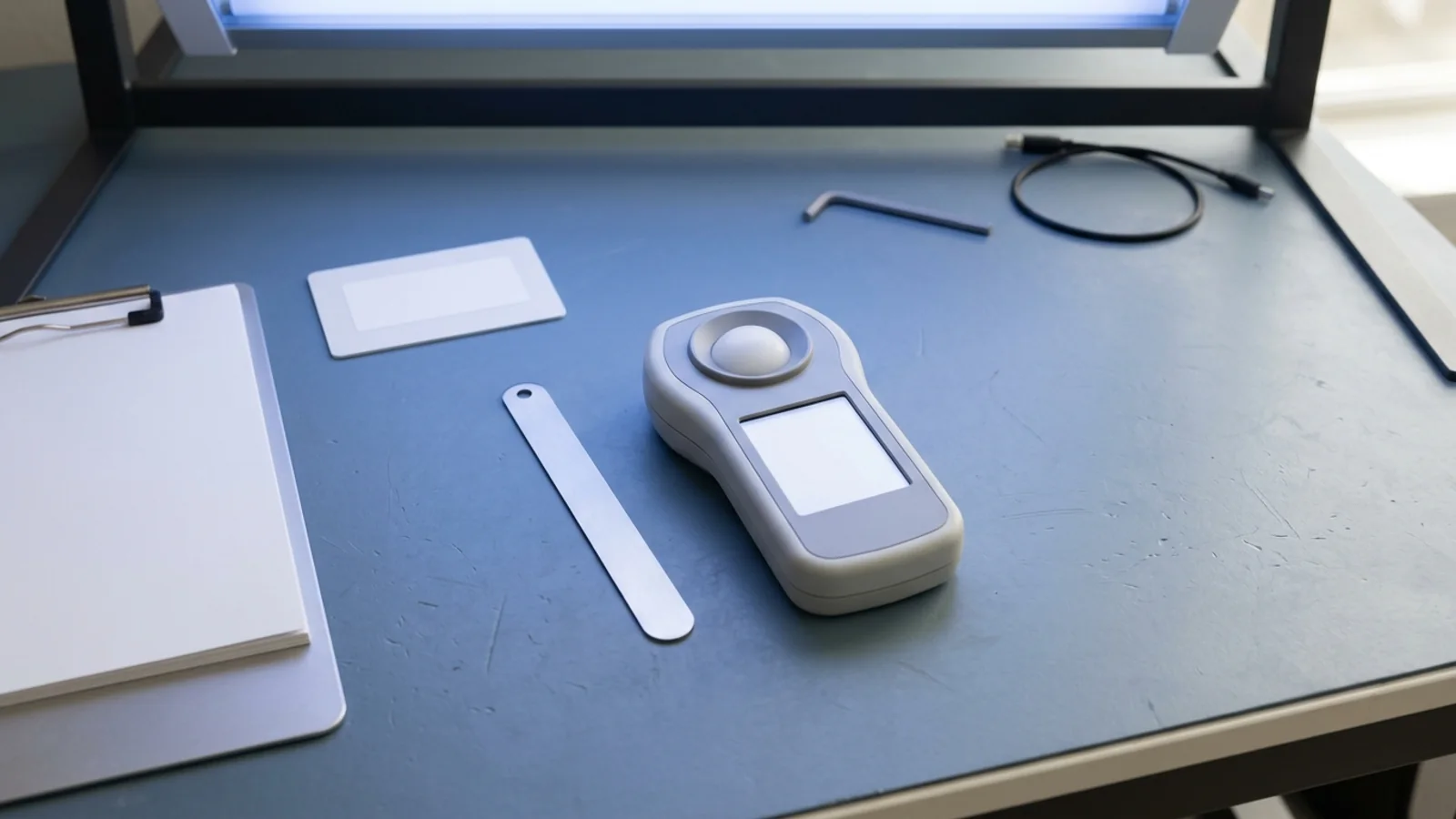
Consider this shop question. A NICU's newer LED phototherapy units read lower than nursing staff expect on the biomed shop's long-serving radiometer, while the remaining fluorescent units read normal. That pattern does not show that the LEDs are failing or that the meter has drifted. The first question is whether that meter is valid for that light at all.
Treat a phototherapy radiometer reading as conditional evidence. It supports an absolute irradiance figure only when three things hold: the meter is specified for the light source's spectrum, the measurement geometry matches the conditions the value is referenced to, and the meter's calibration is current, traceable and applicable to that kind of source. The Fluke DALE40 shows why the first condition matters. Fluke specifies it for fluorescent lamps only, its effective spectral range is 429–473 nm, and its operator's manual says it should not be used to measure energy outside that range. For its blue-LED neoBLUE light, Natus recommends the neoBLUE Radiometer or a meter specifically designed for the narrow blue-LED spectrum, and states that radiometers designed for the broadband spectrum of fluorescent or halogen lights give inaccurate intensity readings. A low LED reading on a fluorescent-only meter is therefore not evidence of LED decline. Before anyone turns an intensity potentiometer, orders an LED panel or signs a return to service, read the light-source manual and the instrument manual together and write down what each one actually promises.
What the Meter Is Actually Telling You
A phototherapy radiometer reports irradiance from the light within a defined wavelength band. Meters express it in one of two forms: total irradiance across the band in µW/cm², or average spectral irradiance in µW/cm²/nm. The DALE40 displays µW/cm²; the neoBLUE Radiometer, the BiliBlanket Meter II and the MTTS light meter described in the published literature report µW/cm²/nm.
The band itself is not standardized. An application note from Gigahertz-Optik, a light-measurement instrument maker, summarizes the IEC particular standard for infant phototherapy equipment, in its 2009+A1:2016 text, as defining total bilirubin irradiance, Ebi, as irradiance integrated from 400 nm to 550 nm with no wavelength preference. The current edition is IEC 60601-2-50:2020; IEC lists re-dating of normative references as its significant technical change, but confirm the definition in your own copy. The same note says manufacturers choose their own reporting ranges, with 425–475 nm widely used, and that AAP guidance has referenced 460–490 nm and, earlier, 430–490 nm. Shop meters add their own bands: 429–473 nm for the DALE40, 420–500 nm for the neoBLUE Radiometer, and 400–520 nm for the BiliBlanket Meter II and the MTTS meter.
Even the width of a band is defined differently. The DALE40 manual gives the meter's effective bandwidth as 44 nm, measured between the 50% response points, and notes that some manufacturers use 10% points instead. It gives a conversion from µW/cm² to µW/cm²/nm (divide by the bandwidth), but warns that unless units, spectral response and bandwidth definitions all correspond, readings from different manufacturers' radiometers are difficult to compare directly or by converting units. The 2011 AAP technical report reaches the same conclusion from the clinical side: calibration methods, wavelength responses and instrument geometries are not standardized, so different radiometers may show different values for the same light source.
Match the Lamp Before You Trust the Number
A filter radiometer does not have a perfectly flat response across its band, and it also responds slightly outside it. The Gigahertz-Optik application note draws the practical conclusion: a radiometer measures accurately only when the lamp's spectrum closely matches the source it was calibrated on. Phototherapy has used fluorescent tubes, tungsten halogen and metal halide lamps, and LEDs, and their spectra differ widely. The same note goes on to promote spectral light meters as the fix; treat that part as vendor positioning rather than independent evidence.
NIST's work on broadband LED radiometry shows how large the effect can be. In its worked example, commercial UV meters measured the same 365 nm mercury lamp. Because their response curves had different peaks and widths, two meters differed from the first by 12% and 42%. That example is ultraviolet, not phototherapy, but the mechanism is the same: a meter's signal is the product of the source spectrum and the meter's response. NIST's condition for uniform results is that the meter's spectral response must be broader than the source's distribution, with the source falling inside it. It also describes field meters being calibrated against a transfer-standard meter using the same source; when a different source is to be measured, the transfer standard should first be calibrated for that source, or corrected using its known spectral response.
Now apply that to a mixed fleet. The neoBLUE manual gives the blue LEDs' emission as 400–550 nm, with a peak between 450 and 475 nm. The DALE40's effective band, 429–473 nm, covers only part of that stated range, and Fluke specifies the meter for fluorescent lamps only. Natus settles the question for its own product: use a properly calibrated neoBLUE Radiometer or, if that meter is not available, a radiometer specifically designed for the narrow spectrum of blue LEDs, because meters designed for the broadband spectrum of fluorescent or halogen lights give inaccurate readings.
Meter disagreement is measurable, not just theoretical. Table 2 of the 2011 AAP technical report lists phototherapy devices measured with several commercial blue-light meters at the manufacturers' recommended distances, with data compiled in 2007 and re-verified in 2010. The table below expresses those readings relative to the BiliBlanket Meter II for two of the devices. The ratios are computed from the published values; they describe those meters and devices at that time and are not correction factors for your own instruments.
| Meter [published band, peak] | neoBLUE LED light at 30 cm | Special-blue fluorescent (Martin/Philips BB) at 25 cm |
|---|---|---|
| BiliBlanket Meter II [400–520 nm, 450 nm] | 1.00 (reference) | 1.00 (reference) |
| Bili-Meter Model 22 [425–475 nm, 460 nm] | 0.74 | 1.45 |
| PMA-2123 Bilirubin Detector [400–520 nm, 460 nm] | 1.12 | 1.01 |
| Joey Dosimeter JD-100 [420–550 nm, 470 nm] | 2.47 | 2.52 |
Two things stand out. On the LED device, the highest reading was more than three times the lowest. And the relationship between two meters changed with the source: the Bili-Meter Model 22 read about a quarter lower than the BiliBlanket Meter II on the LED light but about 45% higher on the fluorescent one, so no single correction factor between two meters carries across source types. The AAP report adds that, for routine measurements, clinicians rely on meters supplied or recommended by the light manufacturer, and that visual brightness estimates and ordinary photometric or colorimetric light meters are inappropriate.
If the recommended meter is not available, start with the light-source manual. Natus lists the neoBLUE Radiometer as available only in the US and Canada, and the neoBLUE manual names the fallback: a radiometer specifically designed for narrow-band blue LEDs. For other systems, ask the light manufacturer which meter and band its factory calibration used. A meter's own documentation may claim broader coverage; GE's 2012 instructions, as reported by Borden and colleagues, state that the BiliBlanket Meter II can be used on LED, fluorescent, halogen and fiberoptic devices. Check the current documentation before relying on a statement like that, and do not assume a multi-source meter reports in the band the light was calibrated in.
Read the Calibration Certificate Before the Display
The DALE40 and the neoBLUE Radiometer both ship with NIST-traceable calibration. Natus states that each neoBLUE Radiometer is individually calibrated to a NIST-traceable standard and comes with a certificate for hospital reference, and the DALE40 manual says the meter is calibrated against a NIST-traceable standard with a calibration certificate furnished. An accredited laboratory's certificate should show more: Techmaster, an ISO/IEC 17025 laboratory accredited by ANAB, describes bili-meter calibrations with as-found and as-left results and reported measurement uncertainty. For the general field-by-field check, use the site's guide on how to read and audit a medical equipment calibration certificate.
For a phototherapy radiometer, add one question the general audit does not ask: calibrated on what source? Following the NIST and Gigahertz-Optik reasoning above, a calibration performed on one source type establishes the meter's accuracy on that kind of spectrum. It does not extend the meter to a source type its documentation excludes. If the certificate does not state the calibration source or wavelength applicability, ask the laboratory before you accept the meter for absolute readings on a different source type.
Set the interval from the documents rather than habit. The DALE40 manual says the meter should be calibrated at least once a year, while its warranty section refers to a recommended semiannual calibration frequency; check which statement your revision carries and record the interval your program adopts. Techmaster says most quality systems calibrate bili-meters every 12 months, and sooner after repair, overload or heavy use. That is a calibration laboratory's description of common practice, not a regulation or an OEM requirement. The DALE40 manual also warns against excessive shock or vibration and notes that a dirty probe lens can cause inaccurate readings, so treat a dropped meter or a contaminated lens as a reason to verify the meter before it is used again.
A current certificate proves that the meter met its specification on its calibration source at that time. Like a passing pulse oximeter simulator test, it has limits: it does not prove that a reading taken on a different source, or at a different geometry, means what the work order says it means.
Geometry: Where, How Far, and at What Angle
Distance. Natus states that neoBLUE intensity is inversely related to the distance from the light source to the infant, and that the light was factory calibrated at 12 inches (30.5 cm) from the light enclosure to the baby; its intensity potentiometers exist partly to accommodate other distances, following the service manual. The AAP report says the ideal distance and orientation should be maintained according to the manufacturer's recommendations. Practice does not always follow: in Borden and colleagues' survey of 39 devices in seven hospitals, three sites adjusted device height, and only one of those measured a standardized distance; the other two estimated it. Measure the distance with a rule and record the reference points used.
Position in the footprint. Borden and colleagues describe irradiance as highest at the center of the light footprint and falling toward the periphery, and the AAP report says center readings may greatly exceed those at the edge, so irradiance should be measured at several sites. Natus specifies its check at the central area of the effective surface area. Stanford's newborn nursery guidance says to measure at the baby's skin below the center of the lamp and, because readings directly under the lights are higher, ideally at several locations averaged. For full characterization, Borden's team used a 90-square grid of 3.8 cm squares across a 34 × 46 cm area to model the exposed front surface of a term infant. They note that mean footprint irradiance is impractical to measure in a busy nursery but could be measured during routine scheduled yearly maintenance by biomedical engineering.
Uniformity. The Gigahertz-Optik note summarizes the IEC requirement that minimum Ebi exceed 40% of the maximum over the effective treatment area, and the neoBLUE specification lists a minimum-to-maximum intensity ratio above 0.4 across a 20 × 10 inch (50 × 25 cm) effective surface area at 12 inches. Use the manufacturer's own figure for the device under test.
Sensor height. The DALE40 manual tells users to take readings with the detector at the level of the infant's chest. If that is not possible and readings are taken at the level of the incubator, in the path of the light, it says to treat them as relative rather than absolute, and to take all measurements under the same test conditions.
Angle. How a sensor responds to light arriving off-axis matters most with large overhead arrays at short distances. The DALE40 probe uses a wide-angle lens intended to match the cosine response of human skin, and the neoBLUE Radiometer uses a dome diffuser to minimize angular sensitivity. A 2026 open-hardware study lists the MTTS light meter's cosine characteristics as ±2% at 30°, ±7% at 60° and ±25% at 80°, and found larger comparison errors at small distances, which the authors attributed to cosine error. Clarkson and colleagues characterized the angular as well as the wavelength response of several commercial meters for the same reason. Hold the sensor the way the meter and light manufacturers' procedures describe, keep it the same at every check, and record the orientation.
Relative Trends Versus Absolute Irradiance
A relative trend asks whether this light has changed since the last check. An absolute reading asks what the irradiance is in a defined band and unit. They need different evidence.
A trend needs consistency. The DALE40 manual says all measurements should be taken under the same test conditions and that the radiometer should give consistent readings, so that an increase or decrease at infant level shows up in the measurement. It also suggests trending lamp output and replacing lamps against a degradation criterion rather than at arbitrary times, giving 80% of original lamp output as an example. That is one meter maker's example, not a standard; use the light manufacturer's criterion or your program's documented one. The AAP report notes that the irradiance of all lamps decreases with use and that manufacturers' useful-lifetime estimates should not be exceeded. Keep the meter, serial number, distance, points and setting the same, and record the meter's certificate number with every reading so that a recalibration step is not mistaken for a change in the light.
An absolute figure needs more: a meter specified for that source type, a current traceable calibration applicable to that source, and the reference geometry the specification uses. Without all three, the result is relative at best. A meter whose own documentation, or the light manufacturer's, excludes that source type gives no valid result for that light.
LED systems change the default assumption. Natus says its LEDs show minimal output degradation over their lifetime with proper use and that life testing showed high-intensity output for over 50,000 hours, though actual results may vary; the AAP report describes LED devices as having a longer lifetime of more than 20,000 hours. The neoBLUE LEDs are installed in groups of six, so a single failure normally darkens six, and Natus notes that intensity is not adversely affected if a few burn out. When an LED unit reads uniformly low on a fluorescent-specified meter, check the meter and the geometry first. If a suitable, calibrated meter at reference geometry confirms that output is below the factory setting or the hospital minimum, Natus directs a qualified technician to test and readjust intensity following the service manual, and to contact Natus Technical Service or an authorized provider if the desired output cannot be reached after several adjustments.
flowchart TD
    A["Reading lower than expected"] --> B{"Is the meter specified for this source type?"}
    B -->|"No, or excluded by the light OEM"| C["Not valid for this source: repeat with a meter the light OEM accepts"]
    B -->|"Yes"| D{"Is the calibration current and applicable to this source?"}
    D -->|"No or unknown"| E["Verify or recalibrate the meter before using the reading"]
    D -->|"Yes"| F{"Taken at the OEM reference geometry?"}
    F -->|"No"| G["Repeat at the measured reference distance, point and orientation"]
    F -->|"Yes"| H{"Visible faults: unlit LED groups or lamps past OEM useful life?"}
    H -->|"Yes"| I["Follow the OEM service manual or escalate to OEM service"]
    H -->|"No"| J["Low output confirmed: qualified technician follows the OEM service manual or escalates"]
The Lamp/Meter Evidence Sheet
The evidence sheet turns these checks into a record. Build it in two parts: a register of the meters your shop owns, and a measurement record for each light, ending in a verdict.
Part 1: Meter Register
Enter each meter with the band, unit and source-type statement from its own documentation. The rows below are the published examples used in this guide; replace them with your own documents and certificates.
| Meter | Published band | Units and range | What the evidence says about sources | Confirm before an absolute reading |
|---|---|---|---|---|
| Fluke DALE40 | 429–473 nm at 50% response points; peak 453 nm | µW/cm², 0–1999; ±5% of full scale | Fluke: fluorescent lamps only. Manual: do not use outside its effective spectral range | The light is fluorescent, and its manufacturer does not exclude fluorescent-designed meters |
| Natus neoBLUE Radiometer | 420–500 nm | µW/cm²/nm, 0.1–150.0 | Designed for the neoBLUE LED line; individually calibrated to a NIST-traceable standard with a certificate; sold only in the US and Canada | The light is a neoBLUE system and the certificate is current |
| GE/Ohmeda BiliBlanket Meter II | 400–520 nm; 450 nm center | µW/cm²/nm, 0.1–299.9 | GE's 2012 instructions, as reported in a 2018 study: LED, fluorescent, halogen and fiberoptic devices | Current GE documentation still says so, and the light's manufacturer accepts it |
| MTTS light meter | 400–520 nm effective | µW/cm²/nm, 0.1–150.0 | Cosine ±2% at 30°, ±7% at 60°, ±25% at 80°; no source-type statement in the evidence reviewed here | The meter manufacturer's source-type statement |
Procurement specifications use yet another band: the open-hardware study cites a UNICEF Supply Catalogue requirement that phototherapy irradiance meters detect within 400–500 nm. The point of the register is not to rank meters but to make each meter's limits visible before it is used.
Part 2: Measurement Record and Verdict
| Field | What to record | Why it decides validity |
|---|---|---|
| Light source | Make, model, serial, source type (fluorescent, halogen, LED or fiberoptic), intensity setting and hour-meter reading | Source type decides which meters are valid; hours support trending |
| Source band | Emission band from the light's manual, such as 400–550 nm with a 450–475 nm peak for neoBLUE blue LEDs | Compare it with the meter's band |
| Meter | Model, serial, band, units, certificate number and date, and the calibration source if stated | Ties the reading to a specific calibration |
| Distance | Measured distance and reference points, such as light enclosure to baby at the 12 in (30.5 cm) neoBLUE factory reference | Irradiance changes with distance |
| Points | Center of the effective area, plus the grid or the several points averaged, and how many | The center reads highest, so the method changes the result |
| Sensor height and orientation | Infant skin or chest level versus incubator level; sensor orientation as held | The DALE40 manual treats incubator-level readings as relative only |
| Conditions | Ambient light, incubator or canopy in the light path, dust on lens or lamps, lamp operating temperature and line-voltage notes | The DALE40 manual lists these among the factors that change delivered irradiance |
| Verdict | Valid absolute, relative trend only, or not valid for this source | Stops a relative number being read as an absolute one |
| Verdict | When it applies | What the record can claim |
|---|---|---|
| Valid absolute irradiance | Meter specified for this source type and not excluded by the light's manufacturer; calibration current and applicable; reference geometry measured and recorded | Irradiance in the meter's band and units at that geometry |
| Relative trend only | Same meter, setting and geometry as earlier readings, but spectral match or calibration applicability not established, or the sensor was not at infant level | Change since the last reading with that meter, not conformance with a specification in another band |
| Not valid for this source | The meter's documentation or the light's manufacturer excludes this source type, the geometry was not recorded, or the calibration has lapsed | Nothing about output; repeat with a suitable meter |
Keep the register with your test-equipment records and attach the measurement record to each work order, so that whoever dispatches the job can see which meter is valid for which light before a technician leaves the shop.
What Belongs in the Service Record
Write the work order so that another technician could repeat the measurement and reach the same verdict. The site's guide to what a medical equipment work order must contain covers the general record. For phototherapy, add these items:
Meter: model, serial, asset number, band, units, certificate number and due date.
Light: model, serial, source type, intensity setting and hour-meter reading.
Geometry: measured distance with its reference points, the measurement points or grid, the number of points averaged, and the sensor height and orientation.
Result: each reading with units and band, the averaged value if one was used, and the verdict from the evidence sheet.
Visual findings: unlit LED groups, lamp hours against the manufacturer's useful-life estimate, and dust on the lens or lamps.
Any adjustment: as-found and as-left readings, the service-manual procedure followed, and who performed it.
Escalation: what was referred to the manufacturer or a calibration laboratory, and why.
Clarkson and colleagues describe hand-held radiometers as a convenient way to monitor phototherapy output as part of planned maintenance and output-monitoring programs, and full footprint characterization fits the yearly maintenance cycle that Borden and colleagues describe. If the light is used over incubators, record whether readings were taken at infant level or at the canopy, and keep that consistent; the guide to infant incubator return-to-service records covers the incubator's own evidence.
Boundaries: Measurement Evidence, Not Treatment Advice
Clinical engineering owns measurement fidelity: the right meter for the source, the right geometry and the right record. Clinicians and the manufacturer's labeling own treatment thresholds, intensity settings and duration. This guide deliberately gives no neonatal dose figures, and a service record should not contain them as recommendations.
On the equipment side, FDA classifies the neonatal phototherapy unit under 21 CFR 880.5700 as a Class II (performance standards) device consisting of one or more lamps that emit a specific spectral band of light, under which an infant is placed for therapy. FDA recognizes IEC 60601-2-50 Edition 3.0 (2020-09), the particular standard for the basic safety and essential performance of infant phototherapy equipment, as recognition number 6-450 for product code LBI, and includes it in ASCA. IEC also publishes a consolidated 2020+AMD1:2023 version. That classification applies to the phototherapy unit; the radiometer is the test instrument that produces the evidence.
Intensity adjustment is qualified work: Natus assigns potentiometer readjustment to a qualified technician following the service manual, and its user manual says only qualified personnel should perform service and repair.
Use the manufacturer's parts: Natus cautions that the unit uses a specific type of LED, that the manufacturer should be consulted for LED repair and replacement, and that incorrect LEDs can adversely affect performance or damage the light.
Escalate missing evidence: if no meter valid for the source is available, record the result as relative or not valid and escalate to the manufacturer's technical service rather than signing an absolute irradiance result.