
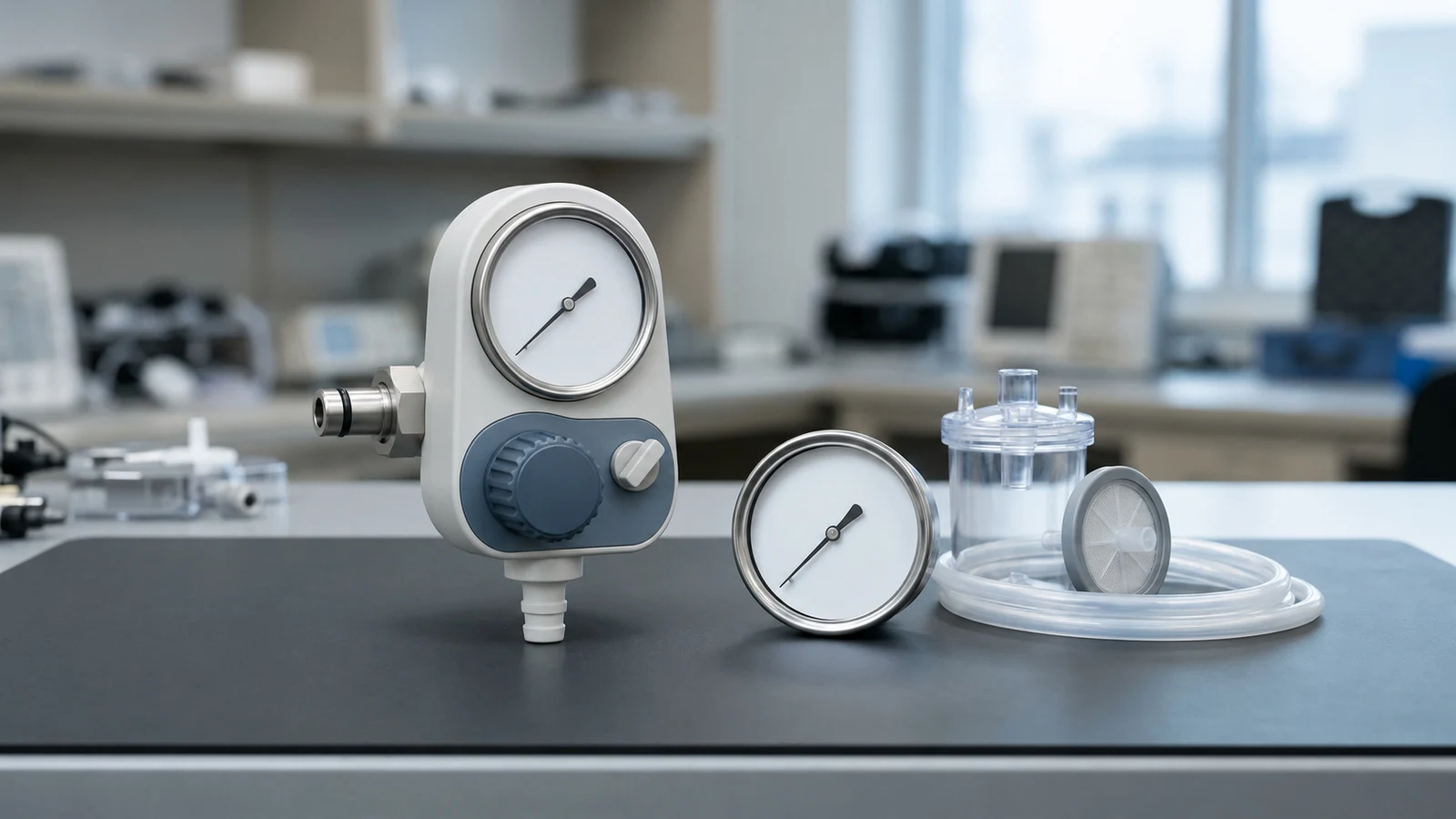
What to establish before blaming the regulator
A wall suction regulator arrives with a report of weak suction, or its gauge appears normal while the connected circuit performs poorly. The service decision is whether the available evidence supports investigating the supply, the regulator, the attached circuit, or more than one of them. Start by recording what was observed and what was connected. A complaint is useful evidence of a problem to investigate; it is not yet a finding that the regulator caused it.
The cited manuals distinguish supply, regulator and external restrictions. For example, Ohio Medical’s ISU troubleshooting table lists both supply and regulator possibilities for insufficient flow (section 6, printed page 13). That supports separating the evidence; it does not establish which cause is most common.
Supply boundary: identify the outlet or bench source and the supply records associated with the observation. Keep a service-bench result separate from evidence about the original location.
Regulator boundary: identify the individual unit, its configuration and mode, then associate any technical result with the applicable service procedure.
Circuit boundary: identify the canister, filter, trap, tubing and fittings that were actually included. Components absent from the investigation remain outside its demonstrated coverage.
For motor-driven portable equipment, use the separate guide to medical suction pump troubleshooting. This article addresses the evidence needed for a wall-regulator complaint. Its worksheet records the boundary of a finding rather than supplying a universal troubleshooting sequence.
Match the model and observation to the source
Create an identity entry before interpreting a result. The following fields are proposed worksheet fields, not a regulatory list or a claim that every regulator has the same features. Record an unavailable detail as unknown and assign someone to resolve it. Do not select a manual merely because the product photograph or a similar model name looks familiar.
Manufacturer, model and population variant: use the unit’s identification and applicable documentation rather than assuming that adult, pediatric and neonatal versions share limits.
Asset or serial identity: connect the complaint, returned unit and technical checkout to the same device. Record uncertainty if that connection cannot be established.
Gauge and fittings: identify analog or digital indication and the installed adapters or fittings. A description of a similar unit does not document this unit’s configuration.
Mode and observation: record the actual selector label, intermittent phase if known, and whether the report concerns an indication, a reference measurement or an observed circuit behavior.
Document provenance: record the manual title, identifier, revision, relevant section and printed page. Confirm applicability to the unit and market before using its procedure.
The documentary examples here are the PTS-ISU manual, 8700-0001-000, Rev. 17, July 2024; the separate ISU manual, 6700-0082-000, Rev. 8, May 2024; and Amico’s Scout and Sentinel manual, APC-IFU-SR-01EN, October 20, 2025. Availability of these revisions does not establish that they apply to every unit currently in service.
Keep the original report distinct from subsequent testing. For example, “gauge appeared normal” is an attributed observation until the record identifies the instrument, location and conditions. Label a user pre-use check as such and retain a separate reference to any technical service checkout. Those records answer different questions; a reviewer should not have to infer which activity took place.
Record supply vacuum and flow as separate evidence
The two Ohio Medical setup sections make the importance of model matching concrete. The values below describe checkout supply prerequisites in the identified documents. They are a documentary comparison, not a complete test method.
| Model and document | Source location | Supply vacuum prerequisite | Supply open-flow prerequisite |
|---|---|---|---|
| Ohio Medical PTS-ISU, Rev. 17 | Section 7.1, printed page 14 | 500 ± 10 mmHg | At least 80 L/min |
| Ohio Medical ISU, Rev. 8 | Section 8.1, printed page 19 | At least 500 mmHg | At least 50 L/min |
These are bench prerequisites, not universal wall-outlet acceptance criteria, clinical settings or evidence that either device is superior. They also are not the regulator’s output-flow limits. A test result cannot establish conformance to a procedure when its prerequisites are missing or unmet. That limitation leaves the regulator’s condition unresolved; it does not, by itself, prove either a regulator defect or a failed hospital pipeline.
In the proposed record, give supply vacuum and supply flow separate fields. A vacuum value cannot fill an unmeasured flow field. For each result, identify the measurement point, date and time, units, source procedure, included connections and instrument reference. If another authorized team supplied the evidence, link its record and identify its scope rather than presenting a secondhand number as your own measurement.
Treat a change of test location as a change of evidence boundary. A result from the shop supply needs the shop supply’s record. It cannot silently become a result for the outlet named in the original complaint. Similarly, an outlet record from another time or configuration needs an explicit explanation of relevance. “Supply not assessed at the reported location” is a useful statement when that is the actual limit of the investigation.
Keep the gauge, mode and connected circuit visible
Use the following table to organize observations and missing records. The source column identifies the documentary anchor. The final column proposes what to retain for review; it is not an instruction to connect, occlude, disassemble or adjust equipment.
| Reported observation | Documentary anchor | Possibilities left open | Evidence to retain |
|---|---|---|---|
| Gauge indication without delivered suction | ISU section 6, page 13 | The manual lists a blocked fitting/port, trap shutoff and external-filter restriction. None is established by the report alone. | Measurement location; attached circuit identities; observation versus reference result; unassessed components. |
| Suction reported without gauge indication | ISU section 6, page 13 | The manual lists gauge sensing or mechanism problems. The report does not identify a failed part. | Gauge type, exact indication and separate reference evidence, with its conditions and procedure. |
| Insufficient flow | ISU section 6, page 13 | The manual lists partial wall-supply and regulator blockage as separate possibilities. | Separate supply and regulator records, units, boundaries and any missing prerequisite. |
| Mode-specific or cycling complaint | Scout/Sentinel troubleshooting, page 16 | The source distinguishes mode selection, supply and timing checks; a cycling complaint alone does not locate a defect. | Model, available mode, selected mode, observed phase and the applicable assessment record. |
| Suspected fluid ingress | PTS-ISU section 4.1, page 8 | The warning extends the possible affected boundary to the wall outlet and pipeline. | Observed condition, affected or unassessed components, handling status and designated recipients. |
Avoid turning a list of possible causes into a diagnosis. A work order that says “external filter listed as a possible cause; original filter unavailable” preserves the uncertainty. “Filter caused the fault” would need findings from the actual investigation. Apply the same distinction to a suspected gauge problem, a timing complaint and a supply concern. More detailed component names do not compensate for missing evidence.
Use a model-matched service evidence worksheet
Copy or adapt this proposed worksheet into the service record. Each row asks a different boundary question. The prompts are blanks to complete or references to attach, not measured examples. Actual responsibility follows the facility’s assignments and personnel authorization. The worksheet has not been validated as a diagnostic tool and does not establish regulatory compliance.
| Boundary / question | Identity / configuration | Source / page | Recorded result / units | Conditions / components included | Instrument / calibration reference | Untested elements | Provisional recipient | Closure status |
|---|---|---|---|---|---|---|---|---|
| Supply: what was documented? | [Outlet or bench-source ID] | [Applicable supply procedure; link checkout prerequisite separately] | [Vacuum and units]; [flow and units, or not measured] | [Location, time, measurement point and included connections] | [Instrument IDs and applicable calibration records] | [Original outlet or conditions not assessed] | [Designated vacuum-system owner] | [Open / reviewed; linked record] |
| Regulator: which checkout supports the finding? | [Model, variant, asset/serial, gauge, fittings, mode/phase] | [Applicable OEM revision, section and page] | [Actual results and units; criterion reference] | [Documented prerequisites and checkout configuration] | [Test instruments and calibration references] | [Missing checks or unresolved complaint] | [Qualified service owner] | [Open / checkout attached; disposition pending] |
| Circuit: what was included? | [Canister, filter, trap, tubing and fitting identities] | [Applicable component instructions; investigation record] | [Observed condition or supported result; units if measured] | [Components present and included in the observation] | [Instrument reference if measured; otherwise not applicable] | [Missing or substituted components] | [Locally assigned circuit owner] | [Open / findings reviewed] |
| Contamination: what requires follow-up? | [Affected device/components; source-location link] | [Applicable OEM and facility handling references] | [Observed condition; assessment record] | [Handling status; components actually assessed] | [Observation or assessment reference; not applicable if unmeasured] | [Regulator, outlet or pipeline status not established] | [Designated infection-control and service/facility contacts] | [Restrictions and assessment pending / documented] |
| Handoff: who owns the remaining question? | [Work order and linked device, circuit and supply records] | [Applicable checkout and local disposition references] | [Supported conclusion; missing evidence] | [Scope covered by each attached record] | [References retained with underlying results] | [Every unresolved boundary] | [Named owner and follow-up task] | [Open / accepted handoff / documented disposition] |
Use “not measured,” “not available” or “not applicable,” with a reason, where appropriate. A blank can conceal a missing check; an invented value creates false evidence. Keep a reported observation separate from a measurement and attach the original record rather than copying only a pass label. For quantitative results, preserve the applicable criterion alongside the value and units. For an observation, record what was seen and by whom without implying laboratory confirmation.
Review the worksheet across rows before writing the conclusion. Does the supply row name the same location as the complaint? Does the regulator row identify the returned unit? Does the circuit row say which original components were absent? Can the next owner find the evidence without interpreting an unexplained “OK”? These are record-review questions. An incomplete row may justify a request for evidence while leaving the technical cause undecided.
Escalate without overstating the cause
The following are hypothetical record outcomes, not completed bench tests or measured case histories. They illustrate how a handoff can be specific even when the root cause remains unresolved.
Supply evidence is missing
The complaint identifies a room outlet, but the returned paperwork contains a regulator gauge observation and no separate supply-flow record. A proposed conclusion is: “Supply evidence incomplete for the reported location; regulator causation not established.” Assign the missing supply question to the designated vacuum-system owner and retain any regulator assessment separately. This does not declare the outlet defective. It identifies the evidence gap and the person responsible for resolving it. Link the accepted handoff rather than closing the complaint solely because the regulator moved to the shop.
The regulator record does not cover the original circuit
A documented regulator checkout is available, but the original canister and filter were not returned. Record which circuit components were absent and which, if any, were included in subsequent observations. A proposed conclusion is: “Checkout covers the identified regulator configuration; original circuit finding unresolved.” Route the circuit question through the locally assigned owner. The record should not diagnose a wet filter, clear the original outlet or certify the whole connected system on that evidence. Any device disposition and remaining complaint follow-up need their own stated scope.
A model-matched checkout records a failure
Qualified service documents an unmet acceptance criterion with the applicable procedure, prerequisites, unit identity and results. A proposed conclusion identifies that failed checkout item and routes the regulator for qualified service under the applicable process. It does not name an internal diaphragm or another failed part without supporting findings. Keep any original-location supply and circuit questions visible. Record the disposition, restrictions and next owner rather than using a general “regulator bad” label that loses the test context.
For suspected contamination, use the applicable OEM instructions and facility handling pathway. The PTS-ISU contamination warning (section 4.1, printed page 8) is why the worksheet retains possible outlet and pipeline involvement. Document handling and follow-up without improvising a swabbing, cleaning, trap-reset or shipping procedure. For the broader facilities/biomed responsibility discussion, see medical air compressor maintenance; local assignments still govern this handoff.
Close the service record with the applicable checkout
The PTS-ISU warnings and repair policy (section 1.2, printed page 5; section 8.3, printed page 18) specify qualified repair personnel and service checkout after repair or disassembly. The separate ISU checkout introduction (section 8, printed page 19) also requires post-repair checkout and states that the complete procedure is performed in numerical order.
Before proposing closure, review the completed record for these article-specific connections:
The complaint, returned regulator and checkout identify the same unit and configuration, or the difference is explained.
Supply vacuum and flow evidence have distinct entries, and the outlet or bench source is identified. Missing prerequisites remain explicit.
The applicable checkout record retains actual findings, criteria, conditions and instrument references. An intake worksheet or gauge appearance does not replace it.
Circuit and contamination questions have documented outcomes or an accepted handoff, with restrictions, named ownership and the scope of the final disposition.
Use the existing guides to major-repair return-to-service testing and medical equipment service records for their broader subjects. This worksheet adds no universal test tolerance, inspection interval, pipeline requirement or release authorization.
The useful closing statement says what the evidence supports, which boundary it covers and what remains unresolved. A documented regulator result and an unresolved room-level complaint can coexist in the record. Preserve both so that the next owner can continue the investigation without mistaking a limited checkout for a conclusion about the entire suction system.