
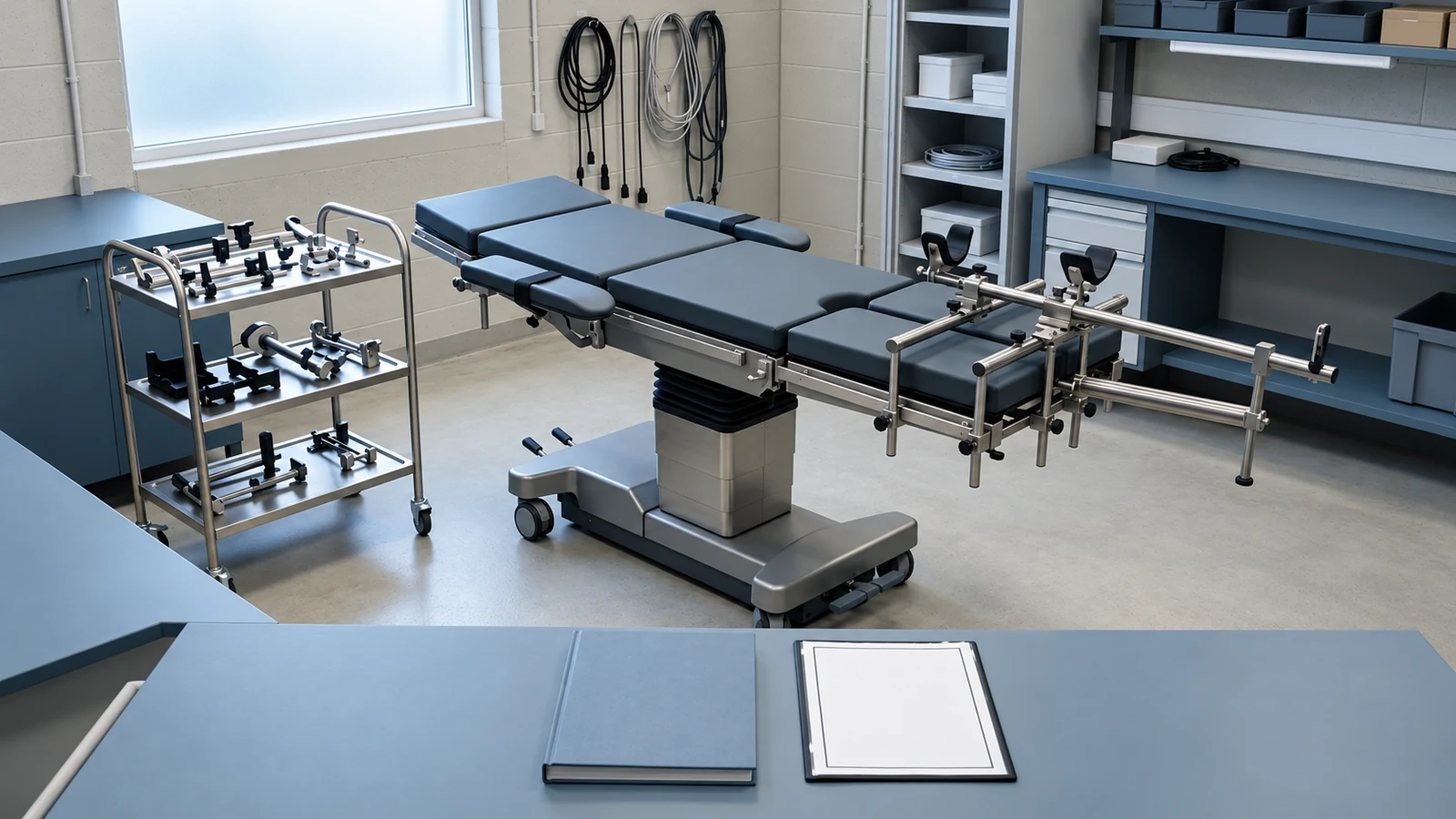
Use the manufacturer’s rating for the exact table configuration and every applicable accessory limit. A table’s largest advertised patient weight does not establish capacity for a reverse-orientation case with slide and extensions. After service, document the model, governing instructions, intended positions, accessory identities, applicable limits, and verification results. If that evidence does not establish the proposed combination, leave its release decision open and obtain manufacturer clarification. The record below helps biomedical equipment technicians and healthcare technology management teams make that evidence visible. It does not authorize a clinical setup or supply a load-test procedure.
Start with the configuration the OR actually needs
Consider a table returning from service while an orthopedic extension and headrest arrive for the next day’s case. The request includes reverse orientation and longitudinal slide for imaging. A work order stating “table repaired” answers whether work was completed; it leaves the intended configuration unresolved. Ask the perioperative team to identify the requested configuration before assigning a capacity. Otherwise, a centered-table rating can be copied into a record that will later be read as covering slide, an extension, or movement of an occupied table.
Identify the table model and serial number, installed tabletop sections, and the operator instructions applicable to that unit and market. Record the document revision and the page supporting each limit.
Describe normal or reverse orientation, the intended slide state, and the articulations needed. Treat rotation, patient transfer onto or off the table, and transport between locations as separate activities when reviewing instructions.
Identify each accessory and required adapter or clamp by its actual part reference. Retrieve its compatibility conditions and capacity statement; a familiar appearance or a shared rail interface does not establish an approved combination.
Reconcile labels, manuals and catalog entries. Record a missing or conflicting condition as an open item instead of choosing whichever document gives the highest number.
This proposed workflow is specific to operating-table evidence. The site’s patient-lift configuration guide addresses sling and attachment acceptance, while the powered exam-table handover guide addresses a different service problem. Their device limits cannot establish an operating table’s capacity.
A configuration-to-rating crosswalk from published examples
STERIS’s public 5085 SRT specification page separates centered raise/lower support, centered articulation with rotation, and articulation with slide. Its published tiers appear below. The page is product information rather than an installed-unit service instruction. 5085 SRT specifications.
The 7080 page publishes different conditions: its highest tier is limited to normal orientation without articulation or slide. The two lower tiers cover normal or reverse orientation, with slide included only in the lowest tier. Do not transfer one model’s values to another. 7080 specifications.
| Model and source | Published configuration | Published patient-weight limit |
|---|---|---|
| STERIS 5085 SRT; product specifications | Raise/lower; centered on column | 1,200 lb (544 kg) |
| STERIS 5085 SRT; product specifications | Full articulation and rotation; centered on column | 1,000 lb (454 kg) |
| STERIS 5085 SRT; product specifications | Full articulation including slide; page also mentions rotation and transfer | 600 lb (272 kg) |
| STERIS 7080; product specifications | Normal orientation; raise/lower only; no articulation or slide | 1,200 lb (544 kg) |
| STERIS 7080; product specifications | Normal or reverse orientation; articulations without slide | 1,000 lb (454 kg) |
| STERIS 7080; product specifications | Normal or reverse orientation; articulations including slide | 700 lb (318 kg) |
The STERIS positioning quick-reference guide, P150832-738 Rev. 1, was printed in July 2012. It describes 5085 SRT, 5085 and 4085 configurations and directs users to the related operator instructions. Its historical orientation and transport wording must not be treated as verification of current operating permissions. It remains useful evidence of why revision and model fields belong in the record. STERIS guide, pages 3 and 32.
For the scenario above, first find the row matching the requested motion, then determine whether the actual extension, headrest and mounting combination are permitted and impose further limits. Do not mark the proposed case accepted simply because patient weight is below a table-only tier. If the accessory identity is missing, the unresolved result is “configuration limit not established,” rather than a guessed lower capacity. A functional service result and a configuration review answer different questions; keep both in the handover.
Record accessory limits without inventing an assembly rating
The 2012 STERIS guide instructs users to respect the lower applicable table or accessory rating, points to its accessory catalog for attachment limits, and warns that platform-extending additions require consultation with STERIS because of instability risk. Keep those instructions within their manufacturer scope; they do not establish compatibility for another brand. STERIS accessory cautions.
Getinge’s 2026 accessory catalog makes the item-level distinction concrete. On printed pages 40–41, head-rest variants 1130.53B0/D0 carry a maximum patient weight of 135 kg, while 1160.64AC/BC variants list 454 kg. Their entries also specify mounting and combination information. These figures describe identified accessories, not a generic Getinge table or a load applied directly to the head support. Getinge 2026 catalog.
Copy the manufacturer’s description of the quantity being limited. “Maximum patient weight,” accessory mass, and an allowable local load are different entries; silently replacing one with another changes the meaning. Preserve the stated units and conditions. Where instructions require a calculation, retain its inputs and method. Where they do not establish the proposed combination, choosing the smallest visible number alone does not resolve compatibility or authorize use.
A useful accessory record therefore has one line for each actual item, its adapter or clamp, the applicable document and revision, the quoted rating location, and any mounting or combination restrictions. A catalog number that cannot be matched to the physical item stays open. Do not populate that line with an illustrative beach-chair rating, a neighboring model’s limit, or a plausible-looking part number. The same identity discipline underlies the site’s returned surgical power-tool records, although the technical evidence required for a table differs.
Keep floor-lock and transport evidence separate
A 2013 APSF case report describes a 148 kg patient on a legacy Amsco 3085 SP in reverse orientation. The table began tipping when its floor locks were released for rotation. The authors reported a shift in the tipping fulcrum and described another similar event. Both patients were within the manufacturer weight recommendations discussed in the report. They also found no unlocked-state weight rating in the manual and identified a base warning against releasing floor locks with a patient aboard. This is historical case evidence, not an incidence estimate or a current rating for other tables. APSF case report.
For a handover, record the applicable floor-lock warning and whether the requested activity is positioning, limited repositioning, or transport. Do not infer that a tabletop articulation rating permits movement on casters, and do not convert a prohibition into a numerical “0 lb” rating. Keep an unestablished permission visibly unresolved. A table designed for patient transport still needs its own orientation, configuration and operating conditions checked; another model’s warning cannot supply those conditions.
Build a service-handover record with visible open items
For hospitals subject to its Conditions of Participation, 42 CFR 482.41(d)(2) establishes the duty to maintain equipment, supplies and facilities at an acceptable level of safety and quality. It does not prescribe an operating-table capacity worksheet. Hospital maintenance condition.
In the cited September 2025 Appendix A revisions, CMS Tag A-0724 says equipment should undergo performance and safety inspection and testing before first use and after major repairs or upgrades. Keep that “should” wording distinct from the regulation’s maintenance duty. The same guidance addresses qualified maintenance oversight and documentation when following manufacturer recommendations. CMS guidance, PDF page 70.
The following is a proposed record structure, not a mandated seven-field federal form. Attach it to the work order so the recipient can distinguish completed service from unresolved configuration evidence. Use named documents and actual results rather than a blanket “compliant” checkbox. The facility should assign review and release responsibilities under its own equipment program.
| Record field | Evidence to retain | Open item to make visible |
|---|---|---|
| Table identity and work scope | Asset ID, manufacturer, model, serial, affected components, service report and completion date | Unexplained exchange unit or unclear work scope |
| Governing documents | Applicable operator and service instructions; revision, date, page or section; accessory instructions and catalog edition | Missing revision, market mismatch or conflicting instructions |
| Requested configuration | Orientation, tabletop sections, slide state, intended articulations, and separate rotation or transport request | A requested state not covered by the reviewed instructions |
| Accessory set | Actual item references and identifiers where provided; required adapters or clamps; rating wording and compatibility conditions | Unidentified attachment or unsupported combination |
| Supported limit and scope | Applicable table and accessory constraints, supporting document locations, and precisely which setup the conclusion covers | Capacity not established; do not replace with a guessed number |
| Post-service verification | Procedure and revision, applicable acceptance criteria, actual results, test-equipment identity where relevant, and qualified service record | A missing check or result outside the applicable criterion |
| Disposition and handover | Authorized reviewer, date, approved scope or hold status, remaining questions, responsible owner and recipient acknowledgment under local policy | Work completed but configuration review or clinical handover incomplete |
Make a completed field auditable. “Accessories checked” leaves the reviewer searching for the list; an attachment reference and instruction page identify what was considered. “All functions pass” leaves the relevant procedure and criteria unknown; a linked test record explains the verification. “Capacity confirmed” conceals the supported positions; a configuration-specific statement identifies its scope. If a field is not applicable, record the reason rather than copying a prior case’s entry.
When the configuration changes after handover, preserve the earlier record and reassess the affected limits. A newly fitted headrest or a later request for slide should not silently inherit acceptance for the previous setup. Keep service completion, configuration review, and the facility’s release disposition separately identifiable. The broader service-record guide and major-repair testing guide cover the surrounding documentation decisions; surgical-light handovers provide a related example of keeping independent findings visible.
Use regulatory and recall evidence within its scope
21 CFR 878.4960 identifies the AC-powered or air-powered operating tables and accessories within its scope as Class I devices, with premarket-notification exemption subject to the stated limitations. That classification does not supply a patient-weight limit or approve a repaired configuration. Operating-table classification.
IEC’s public page identifies IEC 60601-2-46:2023, edition 4.0, as the operating-table safety standard and describes its scope, including certain tabletop transporters. The abstract does not provide field-test acceptance limits, and publication of the standard alone does not demonstrate legal adoption or conformity of a particular unit. IEC scope and edition.
FDA’s historical Mizuho OSI Modular Table System recall Z-0073-2012 was initiated in 2011 and terminated in 2013. The record describes injury-related incidents, categorizes the cause as use error, and records field-advisory recommendations involving awareness, training, pre-use inspection and maintenance. It does not identify the particular error mechanism. Do not cite it as proof of overload, an accessory failure, or a current recall affecting the table being reviewed. FDA recall record.
For the requested reverse-orientation case, the useful handover outcome is either a supported configuration with traceable limits and completed verification, or a specific unresolved question with an owner. Ask the manufacturer which instruction and rating cover the exact table, accessory references, slide state and requested movement. Retain the written response with the record when needed. A deadline on the OR schedule is not evidence that the missing condition is permitted.