
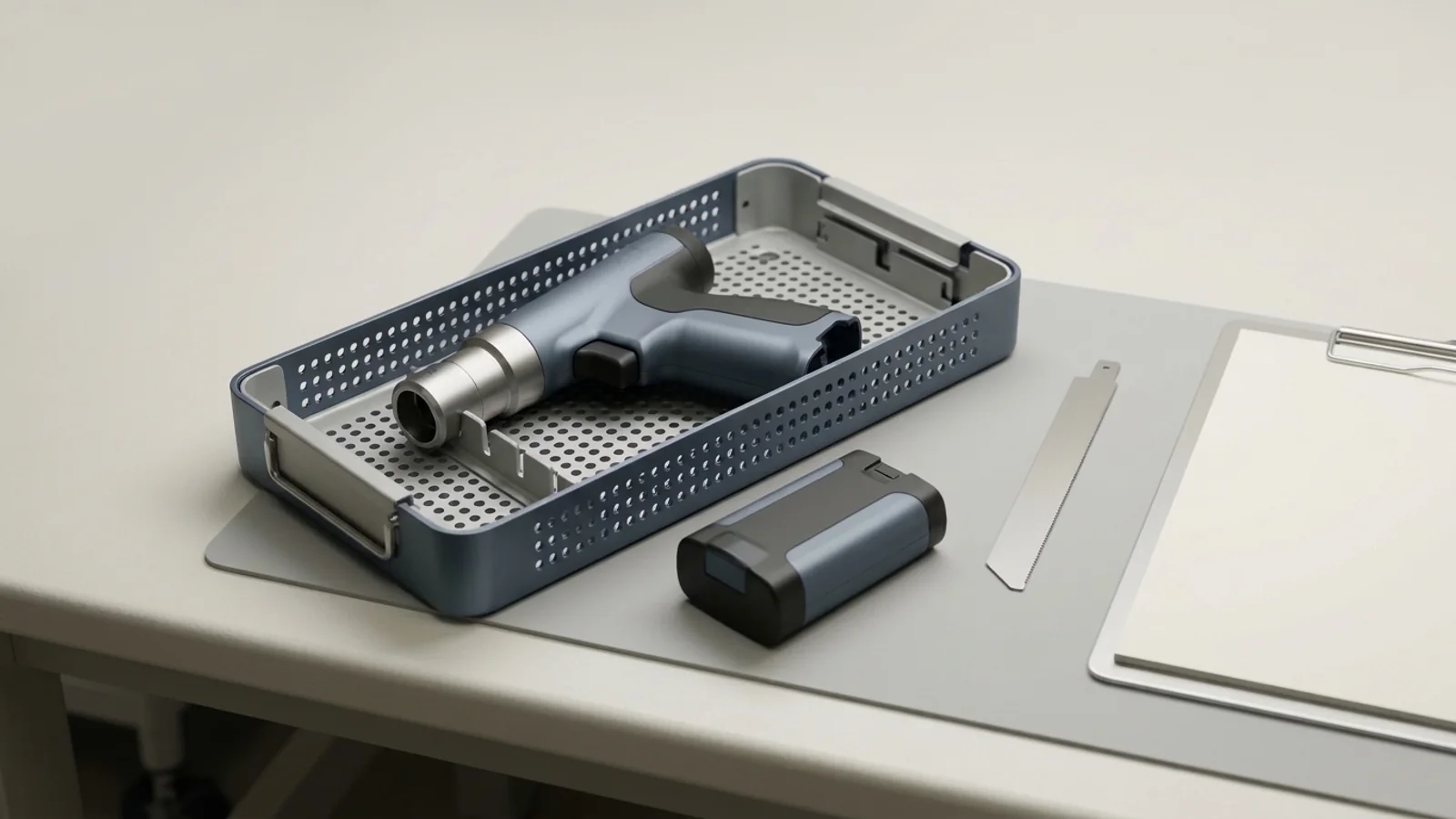
When a battery-powered surgical saw set returns from depot repair, verify the complete set before returning it to operating room (OR) rotation. Use three receiving gates: match component identities to the outbound record and model instructions for use (IFU); establish the governing instruction revision and processing route for each item; and reconcile operator checks with the repair report. Record arrival condition under controlled handling precautions. Complete required cleaning and trained inspection before sterilization, then document facility release only after every applicable component and evidence gate is complete. An unexplained serial change, an unidentified battery generation, an unestablished instruction revision, or missing test evidence keeps the affected set on hold.
What a Returned System 8 Set Owes You Before the OR
For hospitals participating in Medicare, 42 CFR 482.41(d)(2) requires facilities, supplies, and equipment to be maintained to ensure an acceptable level of safety and quality. That regulation assigns the maintenance obligation to the hospital; it does not prescribe the three-gate receiving workflow below, a specific computerized maintenance management system (CMMS) attachment, or a particular warranty log. The structure presented here is a proposed receiving framework to help healthcare technology management (HTM) and sterile processing departments (SPD) document why a returned surgical power tool assembly is ready for clinical preparation and release.
Repair vendors emphasize outbound quality controls. Stryker ProCare describes repairs performed by certified technicians using proprietary original equipment manufacturer (OEM) parts, multi-point inspection, and quality-control testing referenced to 21 CFR Part 820 and ISO 13485. STERIS similarly describes surgical power equipment repairs conducted under its quality management system with parameter verification and validation where required across Stryker, Hall, ConMed, and Midas Rex lines. Those statements are the service providers’ descriptions of their own outbound programs. They complement—but do not replace—device-specific test results on the returned service report or the receiving facility’s verification of what arrived in the shipping carton.
A returned surgical power tool is a multi-component system. A battery pack that physically latches onto the returned handpiece may belong to a generation with different sterilization rules. A non-sterile battery may instead sit inside an aseptic housing: the non-sterile cell must never be immersed or sterilized, while the housing follows its own processing instructions. An insert tray returned with the handpiece may hold equipment in an automated washer-disinfector only if the governing instructions designate that exact carrier as washer-eligible. Resolve these component and instruction pairings before the set proceeds to processing and clinical release.
A System, Not a Single Asset: What Actually Comes Back
This guide begins when a battery-powered surgical bone-cutting set returns from off-site repair. For the separate pre-dispatch fault-isolation decision across a dental motor, cable, and chairside control unit, see electric dental handpiece repair. For returned unpowered cutting instruments, see surgical instrument sharpening, and for matched-component release on mobility equipment, see patient lift sling configuration. Here, the receiving problem is specific to powered surgical sets whose handpieces, battery packs, blades, and sterilization trays share physical interfaces across multiple product generations.
Stryker’s System 8 overview describes a multi-handpiece platform spanning sagittal, reciprocating, rotary drill, and sternum saws alongside dedicated solutions including System 8 EZout, Precision Falcon, the Cordless Driver and Sabo, and CD NXT. On the service side, ProCare lists System 8 and System 9 power tool lines side by side. Within that mixed-generation fleet reality, three component IFUs show why a returned set can look physically matched while silently combining different processing rules:
Handpiece exchanges and loaners: ProCare describes loaner availability on select devices and contract battery replacements. When a carton arrives from any repair depot, record whether the handpiece is the repaired original serial, a temporary loaner, or a permanent exchange unit so the CMMS does not track a returned tool under an old serial.
Cross-generation battery compatibility: the System 8 Battery Packs IFU (8215-001-700 Rev-AA, page 2) states that System 8 packs (REF 8212-000-000 and 8215-000-000) are intended for use with System 8 handpieces (820X-XXX-XXX series), System 7 handpieces (720X-XXX-XXX series), the System 8 Cordless Driver (4505-000-000), Cordless Driver 4 (4405-000-000), the System 8 Sabo Sagittal Saw (4508-000-000), and the Sabo2 Sagittal Saw (4408-000-000). Conversely, the Sabo IFU accessory table (4508-001-700 Rev AA, page 6) permits System 8 packs, SmartLife packs (7212/7215), SmartLife non-sterile batteries with aseptic housings and transfer shields, and System 6 packs (6212/6215) or aseptic kits (6126/6127). Because one battery family legitimately crosses handpiece generations, physical fit never tells SPD which battery sterilization section applies.
Cross-generation insert trays: the Cordless Driver 4/Sabo2 Insert Tray IFU (4405-452-700 Rev-AC, page 2) lists compatible devices across System 8, System 7, Cordless Driver 4, Cordless Driver 3, Sabo2, and Sabo handpieces, with model-specific restrictions: its listed System 7 saws are allowed in REF 4405-452-010 only. Do not assume REF 4405-453-010 has the same device coverage. The Sabo handpiece IFU also lists Trauma Insert Tray REF 4405-451-010 and System 7 Insert Tray REF 7102-453-010. Confirm the exact tray REF and its governing instructions rather than treating every perforated carrier as interchangeable.
Gate 1 — Identity: Match the Record Before Anything Else
Compare every item in the return parcel against the outbound packing list and its shipping record, including any decontamination and shipping certificate. Record arrival condition at intake without assuming that clean appearance or a plastic pouch proves sterility. Apply facility precautions for unknown or soiled returns before close handling, and keep the identity log linked to subsequent cleaning, inspection, and sterilization records.
Verify three identity anchors before the set leaves receiving:
Handpiece identity and transaction type: record the model, REF, and serial number, and note whether the unit is the repaired original, a loaner, or an exchange. Reconcile any serial change with the repair vendor and update the equipment inventory record before release.
Legible markings: Appendix B (page 46) of both 7200-001-700 Rev-AD and 7200-001-700 Rev-AE requires markings on the equipment to be clearly legible. Confirm that the REF, serial number, duty-cycle or safety warnings, and run/safe mode symbols can be read without guessing from housing shape.
Component and accessory pairing: check returned blades, battery packs, chargers, aseptic housings, transfer shields, cases, and insert trays against the Sabo handpiece IFU, the System 8 battery pack IFU, and the CD4/Sabo2 insert tray IFU. Record which accessories accompanied the return, which were used during verification, and which were absent.
| Component | REFs in the cited System 8 Sabo, battery, and tray IFUs | Receiving identity question |
|---|---|---|
| Handpiece | System 8 Sabo Sagittal Saw: 4508-000-000 | Does the returned serial match the outbound work order, or is a loaner or exchange serial documented? |
| Blade families | 2296-003-XXX, 2296-023-XXX, 2296-033-XXX, 5400-003-XXX, 5400-134-XXX | Does the blade match an approved family and its own labeling? Preserve the sterile barrier of unused packaged single-use blades. |
| System 8 sterilizable battery packs and chargers | Packs: 8212-000-000, 8215-000-000; chargers (8215-001-700 Rev-AA, page 3): 7110-120-000 or 6110-120-000, either configured with Charger Module 6110-625-000 | Is the 821X pack identified separately from earlier packs, given that 8215-001-700 Rev-AA also lists System 7 (720X), CD4 (4405-000-000), and Sabo2 (4408-000-000) handpieces? |
| Earlier-generation sterilizable battery packs | SmartLife: 7212-000-000, 7215-000-000; System 6: 6212-000-000, 6215-000-000 | Is handpiece compatibility documented without routing a 721X or 621X pack through the System 8 battery sterilization section? |
| Non-sterile battery and aseptic housing options | SmartLife batteries: 7126-110-000, 7222-110-000; housings: 7126-120-000, 7222-120-000; transfer shields: 7126-130-000, 7222-130-000; System 6 aseptic kits: 6126-000-000, 6127-000-000 | Are the non-sterile cell, aseptic housing, and transfer shield matched by their own kit identifiers, with the cell kept out of immersion and sterilization pathways? |
| Insert trays and sterilization cases | Sabo IFU trays: 4405-451-010, 4405-452-010, 4405-453-010, 7102-453-010; tray IFU 4405-452-700 Rev-AC cases/containers for 4405-452-010 (7102-450-040; 7102-550-030 with 7102-550-020 or 7102-650-020) and 4405-453-010 (7102-453-040; 7102-553-030 with 7102-553-020 or 7102-653-020) | Which exact tray and case/container arrived, which manual revision governs its washer and drying rules, and are excluded right-angle drives (4100-310-000, 4100-335-000, 4100-355-000) kept out? |
Gate 2a — Which Instructions Govern: Resolve the Revision Before You Process
Both the Sabo handpiece IFU (4508-001-700 Rev AA, page 4) and the System 8 Battery Packs IFU (8215-001-700 Rev-AA, page 3) direct the user, upon initial receipt and before each use, to clean, sterilize, and inspect the equipment per the care instructions manual supplied with the handpiece. More than one English revision of Stryker’s Heavy Duty Systems processing manual is publicly available (7200-001-700 Rev-AD, 2019-10 and 7200-001-700 Rev-AE, 2022-06).
Qualifying which revision governs your facility’s set is an essential gate because those two live English revisions diverge on the exact insert trays listed for the System 8 Sabo Sagittal Saw:
Appendix D extended dry times for double-wrapped steam sterilization (page 49 in both revisions): for the Trauma Insert Tray (REF 4405-451-010) and the Cordless Driver 4/Sabo2 1HP Insert Tray (REF 4405-453-010)—both approved carriers in the Sabo IFU—the listed extended minimum dry time is 50 minutes in Rev-AD (2019-10) and 75 minutes in Rev-AE (2022-06). The Hybrid Insert Tray (REF 1900-375-010) changes from 55 minutes in Rev-AD to 75 minutes in Rev-AE, the Cordless Driver 4/Sabo2 Insert Tray (REF 4405-452-010) remains at 50 minutes in both revisions, and Rev-AE adds the Trauma 3 Handpiece Insert Tray (REF 4607-454-010) at 75 minutes.
Automated washer-disinfector carrier eligibility (page 19 and Accessories page 8): Rev-AD states that only System 7, Cordless Driver 4, and EZout insert trays may hold equipment in the washer-disinfector (referencing the Accessories section), while Rev-AE specifies REF series—System 7 (7102-45X-0X0), Cordless Driver 4 (4405-45X-0X0), EZout (7102-459-010)—and adds the Trauma 3 Handpiece (4607-454-010) insert tray; in both revisions, all other insert trays and sterilization cases are for use with the sterilization process only and must be washed separately. Because page 8 lists the Trauma Insert Tray (4405-451-010) on its own line separate from the Cordless Driver 4/Sabo2 Insert Trays (4405-45X-0X0 series) and page 19 includes a specific warning to separate top and bottom trays when using the Trauma Insert Tray or Hybrid Insert Tray in the washer-disinfector, SPD must read the governing revision’s exact text rather than inferring washer eligibility from a 4405 prefix.
Unchanged battery and inspection mappings: across both Rev-AD and Rev-AE, the System 8 battery pack sterilization section (pages 34–37, 821X-000-000 series), the exclusion of pre-System 8 packs (721X-XX0-000 and 621X-000-000 series), the prohibition on immersing or sterilizing non-sterile batteries, the open-lid requirement for aseptic housings, and the Appendix B before-each-use inspection criteria (pages 46–47) are identical.
| Processing or component topic | 7200-001-700 Rev-AD (2019-10) | 7200-001-700 Rev-AE (2022-06) and component IFUs | Receiving verification action |
|---|---|---|---|
| Appendix D double-wrapped steam extended dry time: Trauma Insert Tray 4405-451-010 and CD4/Sabo2 1HP Insert Tray 4405-453-010 | Lists 50 minutes for 4405-451-010 and 50 minutes for 4405-453-010 (page 49). | Lists 75 minutes for 4405-451-010 and 75 minutes for 4405-453-010; adds Trauma 3 tray 4607-454-010 at 75 minutes; Hybrid tray 1900-375-010 moves from 55 to 75 minutes (page 49). | Do not copy either dated number into a standing protocol. Confirm and record the manual revision that governs your facility’s equipment before SPD processes the tray; hold if unresolved. |
| Appendix D double-wrapped steam extended dry time: CD4/Sabo2 Insert Tray 4405-452-010 | Lists 50 minutes (page 49). | Lists 50 minutes (page 49); tray IFU 4405-452-700 Rev-AC (2021-12) covers 4405-452-010 and 4405-453-010 and defers processing parameters to the care instructions manual. | Record the exact returned tray REF (4405-452-010 vs 4405-453-010 or 4405-451-010) and verify the governing revision’s table. |
| Washer-disinfector carrier holding restriction | Names System 7, Cordless Driver 4, and EZout insert trays (page 19); all other trays and cases are for sterilization only and washed separately. | Names System 7 (7102-45X-0X0), Cordless Driver 4 (4405-45X-0X0), EZout (7102-459-010), and Trauma 3 Handpiece (4607-454-010) insert trays (page 19); tray IFU 4405-452-700 Rev-AC covers 4405-452-010 and 4405-453-010 only. | Verify carrier washer eligibility and loading rules in the applicable revision and tray IFU before automated washing. |
| Battery pack pathways and non-sterile battery rules | System 8 packs (821X-000-000) have dedicated sections (pages 34–37) not appropriate for 721X or 621X packs; never immerse or sterilize non-sterile batteries; keep aseptic housing lid open. | Unchanged in Rev-AE (pages 34–37); battery IFU 8215-001-700 Rev-AA (2020-01) confirms 8212/8215 fit System 8, System 7, CD4, and Sabo2 handpieces and warns to sterilize only per instructions. | Route batteries by exact battery REF and governing manual, never by physical fit on the handpiece. |
| Appendix B before-each-use inspection and service limits | Inspect, operate, and test; free movement; no unusual sounds, vibration, or bur whip; no loose/missing parts or sharp protrusions; legible markings; no sterilization if damaged; no unauthorized disassembly (pages 46–47). | Identical in Rev-AE (pages 46–47) and aligned with Sabo IFU 4508-001-700 Rev AA before-each-use and troubleshooting tables. | Complete trained inspection after required cleaning and before sterilization; hold any component that fails criteria. |
A US receiving team cannot establish applicability merely from a later revision letter or a PDF’s presence in an APAC folder. Treat the differences between Rev-AD and Rev-AE as audit evidence showing why the receiving protocol must record the exact manual and revision verified with the manufacturer for your facility’s market and equipment—and why an unverified revision is a hold condition.
Gate 2b — Reprocessing State: What Arrived, and Who Re-processes It
Once the governing manual revision is identified, establish the arrival state of every component and assign its processing route. Both the Sabo saw IFU (page 4) and the System 8 battery pack IFU (page 3) state that upon initial receipt and before each use, the equipment must be cleaned, sterilized, and inspected for damage per the care instructions manual. Meanwhile, Stryker’s System 8 platform page notes that System 8 handpieces are built to be actively washed—temporarily submergible during cleaning before sterilization—under the conditions specified in the processing manual.
Record whether each returned item arrived soiled, cleaned/decontaminated, or in an unopened manufacturer-sealed sterile package. A shipping bag or depot dust cover is not a validated sterile barrier.
Separate components by permitted pathway before any washing or sterilization begins: reusable handpieces and sterilizable battery packs follow their respective cleaning and sterilization sections, non-sterile batteries are removed from aseptic housings before processing, and unused single-use sterile blades stay in their original sterile packaging.
Inspect Before Sterilization
Both 7200-001-700 Rev-AD and 7200-001-700 Rev-AE restrict processing and inspection to individuals trained and experienced in processing reusable medical devices, and both prohibit sterilizing any equipment if damage is apparent or the inspection criteria are not met. Do not run a contaminated return on a clean receiving bench before required cleaning, and never send a damaged handpiece, cracked battery pack, or bent tray into a sterilizer to complete a paperwork loop. Any handling or decontamination of a held item must follow the applicable instructions and facility infection-control precautions.
Separate Battery Processing Pathways
Match each returned power source to its exact REF and governing instructions before cleaning, charging, or sterilization:
System 8 sterilizable battery packs (REF 8212-000-000 and 8215-000-000): the System 8 Battery Packs section (pages 34–37 of Rev-AD and Rev-AE) separates the 821X-000-000 series from handpieces, accessories, and pre-System 8 packs. It gives System 8-specific steam instructions; the Sterrad and vaporized hydrogen peroxide passages refer users to the respective compatibility guides and provider instructions, rather than declaring every pack compatible with every low-temperature system. Establish the approved method for the exact returned pack under its applicable instructions. The System 8 Battery Packs IFU (8215-001-700 Rev-AA, pages 3–5) warns of lithium-ion fire, burn, and explosion hazards (“Sterilize only per instructions”), specifies either the Universal Battery Charger (7110-120-000) or System 6 Battery Charger (6110-120-000), in either case configured with the System 6 Charger Module (6110-625-000), recommends charging before sterilization and using packs charged within the last 30 days, and warns against storing a battery pack installed in a handpiece.
Earlier-generation sterilizable battery packs (SmartLife 7212-000-000, 7215-000-000; System 6 6212-000-000, 6215-000-000): “sterilizable” describes the permitted processing design, not the pack’s condition on arrival from repair. Both Rev-AD and Rev-AE route pre-System 8 packs (721X-XX0-000 and 621X-000-000 series) to a separate Battery Packs sterilization section and prohibit drying battery packs in an oven or sterilizing any pack with cracks or damage.
Non-sterile batteries with aseptic housings and transfer shields (7126/7222 series and System 6 6126/6127 kits): both revisions of the processing instructions prohibit immersing or sterilizing non-sterile batteries. Unlock the housing and remove the non-sterile battery before processing, wiping the non-sterile battery only as directed, and keep the empty aseptic housing lid open during automated cleaning and sterilization.
Match the Carrier to the Governing Tray and Processing Instructions
When an insert tray or sterilization case returns with the set, verify its role under both the governing processing manual and the carrier’s own IFU:
Carrier scope and container pairing: the Cordless Driver 4/Sabo2 Insert Tray IFU (4405-452-700 Rev-AC, pages 2–4) covers REF 4405-452-010 and REF 4405-453-010 (addressed to in-service trainers, biomedical equipment technicians, and central supply/sterile processing technicians). It states that the insert tray is designed to hold reusable devices during automated washing and steam sterilization and may be placed in specified rigid containers that do not require validated wrap, whereas the sterilization case must be wrapped in validated sterilization wrap prior to steam sterilization. It also sets validated maximum device quantities (up to 2 handpieces, 12 attachments, and 2 chuck keys—16 devices total—in 4405-452-010; up to 1 handpiece, 8 attachments, and 2 chuck keys—11 devices total—in 4405-453-010), directs orienting handpieces with the distal end down, and warns not to use these trays to process right-angle-drive attachments REF 4100-310-000, 4100-335-000, or 4100-355-000.
Trays outside the 4405-452-700 IFU: the Sabo handpiece IFU also lists Trauma Insert Tray REF 4405-451-010 and System 7 Insert Tray REF 7102-453-010. Because those carriers are not covered by 4405-452-700 Rev-AC and because 7200-001-700 Rev-AD and Rev-AE differ on Appendix D extended dry times for 4405-451-010 and 4405-453-010 and on page 19 washer-eligibility wording, SPD must verify the governing revision for the exact tray REF before loading.
Gate 3 — Function Evidence: The Checks the IFU Already Requires
The Sabo IFU and Appendix B (pages 46–47) of both 7200-001-700 Rev-AD and 7200-001-700 Rev-AE define operator-level checks that require no housing disassembly. Both manuals prohibit unauthorized disassembly, modification, or service, and the processing manual states that handpieces are permanently lubricated and must not be lubricated unless specifically directed (Appendix C’s light mineral oil instruction on page 48 applies to Cordless Driver 3 and attachments, not the Sabo saw).
After required cleaning and safe preparation, trained personnel record five groups of operator-level observations under the governing instructions. These observations complement the repair vendor’s bench testing; they do not by themselves prove internal component quality:
External condition and carrier fit: check the handpiece and accessories for loose or missing components, nicks, burs, or sharp protrusions that could injure staff, damage surgical gloves, or tear sterilization wrap, and confirm clearly legible markings. On sterilization cases and insert trays, verify there is no visible soil, damage, wear, or corrosion, and test that the lid and base fit together properly and handles and latches function.
Trigger and safe/run mode control: verify that the trigger switch locks the trigger in safe mode and releases smoothly in run mode, following the Sabo IFU precautions to return the switch to safe mode whenever installing or removing blades or battery packs or passing the handpiece.
Blade seating, lock, and mount indexing: follow the Sabo IFU (pages 8–10) to depress the blade lock button, seat an approved blade so the mount snaps into locked position, gently tug the blade to confirm retention, and verify that the blade mount indexes and locks into position under the IFU’s blade-mount instructions. The IFU notes five blade seating angles and eight blade-mount positions as design features; do not invent a requirement to run the saw under load in every position.
Battery latch retention and indicator light: with the trigger locked in safe mode, slide a charged approved battery pack onto the handpiece until it snaps and gently tug the pack to confirm the battery latch holds (Sabo IFU, page 9). Check the indicator light behavior described in the System 8 Battery Packs IFU (page 4), which notes that a steady light for 10 seconds indicates an expended pack.
Brief operation within duty cycle: operate and test the equipment to confirm free movement of moving parts, normal operating speed, and the absence of unusual sounds, vibrations, bur whip, abnormal heat, or continued operation after trigger release. Respect the model’s duty cycle, and do not convert Appendix B’s three-month temperature note—which explicitly applies to Cordless Driver 4 and Sabo2 Saw only—or a nominal maximum speed into an improvised bench acceptance limit.
The troubleshooting table in 4508-001-700 Rev AA (pages 12–14) separates operator-correctable conditions (such as an expended pack or an engaged trigger lock) from handpiece damage that must be returned to Stryker for repair:
Handpiece does not operate or operates at a reduced speed after battery charge, latch seating, and trigger-lock checks are verified.
Blade will not fit or cannot be secured in the blade mount, or the blade does not move when the motor runs.
Handpiece continues to operate after the trigger is released: immediately disconnect the battery pack per the IFU action column, place the handpiece on hold, and return it to Stryker for repair.
Handpiece becomes unusually hot during use, makes unusual noise or vibrates excessively, or exhibits reduced cutting action that is not resolved by a new approved blade.
What to Demand From the Repair Paperwork
Operator checks verify accessible controls and mechanical interfaces; the repair report must document what happened inside the depot. Align the returned paperwork with your facility’s service record requirements and its framework for return-to-service testing after major repair. A single line reading “repaired and tested” does not tell you which components were evaluated or whether the original fault was reproduced.
The device-agnostic return checklist from A Biomedical Service recommends matching serials and asset tags, confirming whether accessories and batteries were included and tested, and reviewing parts identity, test results, release status, and warranty before return to service. Adapted to a surgical power tool set, the five record elements below are practical recommendations—not fields mandated by 42 CFR 482.41:
Identity and chain of custody: outbound work order or purchase order, model and REF, returned serial number, and explicit identification of any loaner, exchange unit, or replacement battery pack.
Complaint and corrective action: the reported symptom (such as trigger run-on, blade-lock wear, or reduced speed), whether the depot reproduced the fault, and the corrective work performed.
Parts identity: itemized replacement assemblies or components sufficient to evaluate compatibility and service scope, tested against what the provider claims (for example, ProCare’s stated use of OEM parts or an independent servicer’s qualified part traceability).
Test evidence and configuration: the post-repair functional, seal, or electrical tests performed, the recorded pass/fail outcomes or measurements, and which battery pack or attachment accompanied the handpiece during testing.
Disposition and processing handoff: the servicer’s release status and warranty terms, paired with the receiving facility’s record of arrival condition, governing IFU revision, SPD processing completion, and final release sign-off.
Where Verification Stops: Disassembly, Parts, and the Remanufacturing Line
Receiving verification stays within the authorized operator scope. The Sabo IFU prohibits disassembly or service without manufacturer authorization; the CD4/Sabo2 tray IFU prohibits unauthorized modification; and both revisions of the processing manual prohibit disassembly, modification, or service unless otherwise specified. External operator checks cannot establish the condition of internal components. Unresolved questions about internal repair quality require the servicer’s test documentation or escalation to authorized service.
FDA’s May 2024 remanufacturing guidance clarifies whether activities performed on devices are likely remanufacturing and outlines the regulatory responsibilities that follow, alongside labeling recommendations for devices designed to be serviced over their useful life. The guidance represents FDA’s current thinking rather than a regulation prescribing hospital receiving forms. However, when a repair report shows non-OEM part substitutions or design modifications that could affect the handpiece’s performance or sterilization seals, HTM should evaluate the documentation under its framework for replacement parts compatibility and remanufacturing risk and hold the device until compatibility and verification evidence are on file.
Both revisions of the processing manual state that repeated processing has a minimal effect on the equipment and that routine inspection is the best method for determining serviceable life. Age alone neither condemns nor clears a returned saw; documented inspection findings, legible markings, and verified repair evidence govern the release decision.
Why the Records Pay Off: Recalls and Fleet Identity
Recording exact returned serials and component REFs directly supports medical device recall response across a mixed-generation System 6, System 7, System 8, and System 9 fleet. If a depot exchange or contract battery replacement is logged under a retired serial number, a future recall query against your CMMS can miss an affected unit or quarantine the wrong tray—though the specific recall notice’s model, serial, or lot scope always controls.
FDA’s Class 2 recall record Z-1021-2009 for the Stryker Cordless Driver 3 Handpiece (REF 4300, approximately 25,312 units distributed worldwide) illustrates the failure mode pattern: the handpieces could continue to run even when the trigger was not depressed, risking unintended cutting of bone or soft-tissue damage, with an FDA-determined cause of component design or selection. The recall was firm-initiated by letter on October 10, 2008, posted by FDA on March 10, 2009, and terminated on October 27, 2010.
That terminated 2008–2010 recall involved the earlier Cordless Driver 3 (REF 4300), not System 8 incidence or a current System 8 recall. However, continued operation after trigger release remains an explicit row in the Sabo IFU troubleshooting table (page 13) routing the handpiece back to Stryker for repair, and the CD4/Sabo2 tray IFU (page 2) still lists Cordless Driver 3 (4300-000-000) alongside Cordless Driver 4 and System 8 handpieces as compatible residents of the same insert trays. Maintaining component-level REF and serial records ensures your team can separate legacy and current generations immediately.
The System 8 Returned-System Checklist
Use the proposed workflow and component matrix below to tie each returned item to its identity check, governing manual revision, processing pathway, operator inspection criterion, and work-order record. The REF numbers illustrate the System 8 Sabo worked example from the five dated Stryker manuals cited above; always confirm the current instructions applicable to your facility’s market and exact equipment before release.
flowchart TD
    A["Receive return under controlled handling precautions"] --> B["Gate 1: Reconcile handpiece, battery, blade and tray REFs/serials and arrival condition"]
    B --> C{"Gate 2a: Identity matched and governing IFU/processing revision confirmed?"}
    C -- "No" --> H["HOLD from clinical use; resolve revision/identity or refer to authorized service"]
    C -- "Yes" --> D["Gate 2b: Separate battery and carrier pathways under the governing revision"]
    D --> E["Complete required cleaning and trained Appendix B/IFU inspection before sterilization"]
    E --> F{"Gate 3: Operator checks pass and repair report supports complaint resolution?"}
    F -- "No" --> H
    F -- "Yes" --> G["Complete sterilization/processing for every applicable component under its governing instructions"]
    G --> J{"All component processing records and work-order fields complete?"}
    J -- "No" --> H
J -- "Yes" --> R["Document facility release and link accepted system configuration to the work order"]| Returned item | Gate 1: Identity and REF family | Gate 2: Governing revision and processing rule | Gate 3: Inspection and function criterion | Proposed receiving record |
|---|---|---|---|---|
| System 8 Sabo handpiece (REF 4508-000-000) | Match returned serial and REF against outbound work order and 4508-001-700 Rev AA; log any loaner or exchange serial. | Confirm governing handpiece and processing manual revision; clean and inspect upon receipt before sterilization; never sterilize damaged equipment or add unauthorized lubricant. | Appendix B and IFU checks: legible markings, free movement, safe/run trigger lock, blade-mount indexing, no unusual heat, noise, vibration, or trigger run-on. | Received serial, governing IFU revision, inspection outcome, and complaint reconciliation. |
| Saw blades (2296-003/023/033-XXX, 5400-003/134-XXX) | Confirm approved blade REF series in 4508-001-700 Rev AA (page 5) and single-use vs reusable labeling. | Do not reprocess or repackage single-use blades (4405-452-700 Rev-AC, page 4); preserve unopened sterile barrier of unused stock. | Verify blade-lock snap and gentle tug retention check; discard any single-use blade used for bench testing per facility policy. | Blade REF used for verification and disposition of test accessory. |
| System 8 sterilizable battery packs (REF 8212-000-000, 8215-000-000) | Confirm exact 821X REF and serial/lot; note that 8215-001-700 Rev-AA also allows use with System 7, CD4, and Sabo2 handpieces. | Follow the System 8 Battery Packs section in the governing 7200-001-700 revision (pages 34–37) and 8215-001-700 Rev-AA; charge on 7110-120-000 or 6110-120-000, either with module 6110-625-000; do not store installed in handpiece. | Inspect housing and contacts (depress latch to clean/inspect); do not sterilize cracked/damaged packs; confirm snap and tug lock on handpiece and check status light. | Battery REF/serial, governing battery/processing revision, and retention/charge check. |
| Earlier sterilizable battery packs (SmartLife 7212/7215, System 6 6212/6215) | Confirm exact 721X or 621X REF listed in 4508-001-700 Rev AA (page 6). | Do not use the System 8 battery sterilization section (explicitly excluded on page 34 of Rev-AD and Rev-AE); follow the pre-System 8 Battery Packs section and its pack IFU. | Inspect for cracks or damage before processing; verify latch retention on the handpiece. | Generation and REF recorded separately in SPD handoff and work order. |
| Non-sterile battery, aseptic housing, and transfer shield (7126/7222 series; 6126/6127 kits) | Match battery, housing, and transfer shield REFs as a complete set under their kit instructions. | Unlock housing and remove non-sterile battery before processing; never immerse or sterilize the non-sterile battery; keep aseptic housing lid open during automated cleaning and sterilization. | Inspect housing seal, latch, and hinge condition and verify safe transfer/retention per the kit IFU. | Separate tracking of non-sterile cell handling and aseptic housing sterilization. |
| Cord (only when an electric Heavy Duty system component returns) | Reconcile cord REF/serial under that electric system’s IFU (not part of the cordless Sabo 4508-000-000 assembly). | Follow the governing processing instructions for electric cords. | Appendix B (page 47 of Rev-AD and Rev-AE): inspect cord surface for cuts or damage and check for bent or missing connector pins. | Cord inspection result or explicit not-applicable entry for battery sets. |
| Insert trays and sterilization cases (4405-451-010, 4405-452-010, 4405-453-010, 7102-453-010) | Match exact tray and case/container REF against 4508-001-700 Rev AA and 4405-452-700 Rev-AC; exclude right-angle drives 4100-310-000, 4100-335-000, and 4100-355-000. | Resolve the governing 7200-001-700 revision before processing (Rev-AD vs Rev-AE differ on 50 vs 75 min double-wrapped dry times for 4405-451-010 and 4405-453-010 and on washer-eligibility wording); obey device-count and distal-end-down placement rules. | Appendix B (page 47): no soil, damage, wear, corrosion, or sharp protrusions that could tear wrap; test lid, base, handles, and latches. | Tray/case REF, confirmed governing manual revision, and linked SPD load record. |
| Depot service report | Matches returned serials, REFs, and original work order. | States arrival decontamination status and leaves facility SPD processing responsibility clear. | Documents complaint resolution, parts replaced, tests performed with outcomes, release status, and warranty. | Attached service report, resolution of any gaps, and final HTM/SPD release sign-off. |
Hold Conditions: When the Set Does Not Go Back
Keep the returned set out of OR rotation whenever any of the following conditions remains unresolved. Tag the held assembly in the CMMS, store it under controlled precautions, and remember that both revisions of the processing manual prohibit sterilizing damaged equipment or equipment that fails inspection criteria:
Unreconciled identity or cross-generation mix: an unexplained serial change, an unlisted accessory, an excluded right-angle drive in a CD4/Sabo2 tray, or a battery pack whose generation and processing pathway have not been matched to the returned set.
Unestablished instruction revision: the facility cannot confirm which revision of the handpiece, battery, tray, or processing instructions governs the returned equipment in its market (for example, where public revisions disagree on tray drying or washer eligibility and the governing manual has not been obtained from the manufacturer).
Failed physical inspection or illegible markings: apparent damage, cracked battery housings, nicks or sharp protrusions that could compromise gloves or sterilization wrap, bent connector pins, malfunctioning case latches, or worn REF/safety markings.
Failed operator function check: trigger run-on after release, failure to lock in safe mode, failure of blade or battery tug retention checks, unusual heat, noise, or vibration, or non-operation. Follow the Sabo IFU troubleshooting table and return the device to Stryker or qualified service without attempting unauthorized internal disassembly.
Incomplete repair or part-substitution evidence: the service report omits the tests performed, fails to address the original complaint, or lists part changes whose compatibility and specification basis have not been verified.
Sources and Regulatory References
System 8 Sabo Sagittal Saw Instructions For Use (4508-001-700 Rev AA, 2019-09)
Cordless Driver 4/Sabo2 Insert Tray Instructions For Use (4405-452-700 Rev-AC, 2021-12)
System 8 Battery Packs Instructions For Use (8215-001-700 Rev-AA, 2020-01)
42 CFR 482.41 Condition of participation: Physical environment
Class 2 Device Recall Stryker Cordless Driver 3 Handpiece (Z-1021-2009)